Basil Leaves Turning Yellow: Causes and What to Do
Basil leaves turning yellow usually point to roots that are too wet. Learn what to check first (the underside of the leaf, soil, and roots), how to distinguish overwatering, nitrogen deficiency, cold, low light, and downy mildew, and when to harvest or discard the pot.
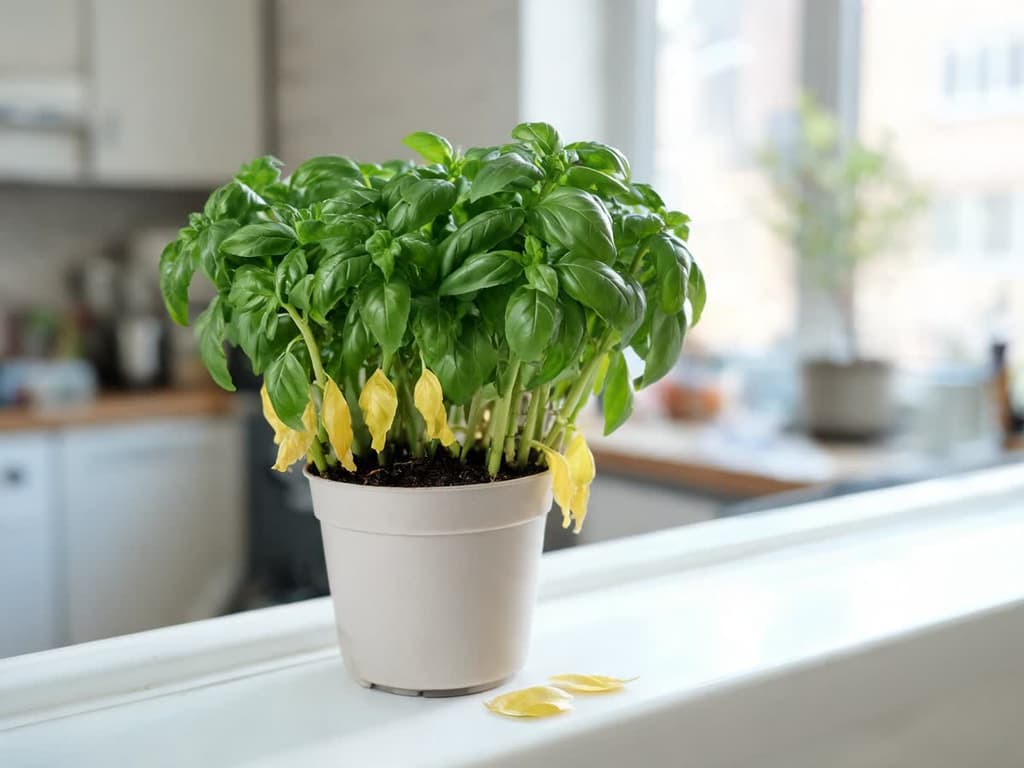
Yellowing leaves on basil most often mean the roots are too wet. In potted plants, Clemson states that yellowing stems most often from overwatering. The other common causes are nitrogen deficiency in a small pot with depleted soil, cold temperatures, low light, and downy mildew. Nitrogen is the fertilizer nutrient the plant uses most to produce leaves. Downy mildew is a disease that can drop all of the plant's leaves in a few days.
Do not toss the pot before two quick checks. First, flip a yellow leaf over and examine its underside. Next, press the soil with your finger and, if it has been wet for days, lift the plant out of the pot with its root ball (the block of soil and roots) to check the root color. These two checks isolate the two causes demanding prompt decisions: downy mildew and root rot.
The leaf comes before the soil for two reasons. Downy mildew spreads to other pots. Furthermore, downy mildew yellowing resembles a fertilizer deficiency, and anyone fertilizing without flipping the leaf wastes time.
The sources for this guide are university extensions in the United States, university outreach services that advise plant growers. They also include the Royal Horticultural Society (RHS) in the United Kingdom. They focus on sweet basil, the common culinary type (Ocimum basilicum):
What you see | How the soil feels | Probable cause | What to do |
|---|---|---|---|
Yellowing in sections bounded by leaf veins (the thin lines of the leaf) and purplish-gray fuzz on the underside | Any | Downy mildew | Harvest healthy leaves and discard the plant |
Yellowing across many leaves, lower and inner parts of the plant, occasionally with wilting | Moist several days after watering | Roots starved of air from overwatering | Stop watering and inspect roots |
Lower leaves yellowing first, evenly light green, stunted growth | Dries out between waterings | Nitrogen deficiency, common in small pots | Apply fertilizer at a low dose or change soil |
Yellowing between veins on new leaves, with veins remaining green | Dries out between waterings | Iron deficiency | Measure soil pH with a test kit and fertilize |
Dark or blackened leaves after a cold night | Any | Cold damage | Bring the pot inside on nights below 10 °C |
Thin, leggy stems, small and pale leaves | Any | Low light | Move to a spot receiving 6 to 8 hours of direct sun |
Sudden wilting and brown streaks on the stem | Any | Fusarium wilt | Discard the plant and soil |
Tiny insects on the underside of yellow leaves | Any | Aphids or whiteflies | Spray water directly onto the undersides |
First, flip the leaf: gray fuzz on the underside means downy mildew
Basil downy mildew starts with yellowing on the upper surface of the leaf, in areas bounded by the veins. It is caused by Peronospora belbahrii, a fungus-like organism that spreads by wind-blown spores (tiny reproductive particles). Cornell explains that the yellowing stops at the major veins because the organism cannot cross them.
The sign that confirms downy mildew is under the leaf. Cornell describes purplish-gray spores that form only on the underside. NC State calls these purplish-brown spores a "sure sign" of the infection. They appear directly underneath the yellow areas on the upper surface, according to Clemson.
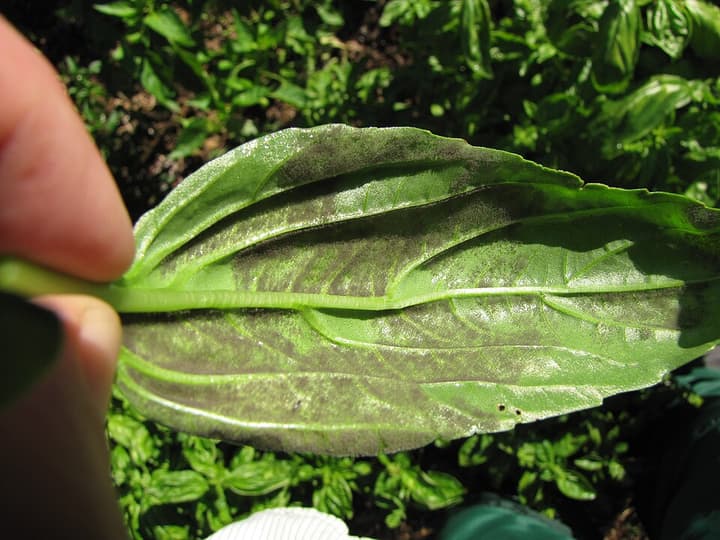
Downy mildew yellowing is easily confused with a nutrient deficiency. NC State, Cornell, the University of Connecticut (UConn), and Clemson all share this warning. For that reason, check the leaf underside before fertilizing. Inspect in early morning: Cornell notes that spores form overnight.
If the leaf is yellow and the underside looks clean, Cornell provides a test. Place the leaf face down on a wet paper towel, inside a sealed plastic bag, in the dark, for a day. If downy mildew is present, the fuzz appears. Sunburn also yellows the leaf, but it does not form fuzz or spots with edges bounded by the veins, according to the same source.
Downy mildew has no cure in a home setting. UConn states that nothing cures an infected plant. NC State notes there is no product sold to home gardeners that controls the disease. Removing only spotted leaves also fails: Cornell reminds us that spores spread through the air.
What to do with downy mildew on basil, in this order:
Harvest unaffected green leaves today. UConn and the University of Maryland note they are safe to eat; UConn suggests using them immediately or making pesto.
Place diseased leaves and the plant in a sealed plastic bag and toss them in the regular trash. UConn advises against putting them in the compost pile.
Move the other basil pots away. For 10 days, flip a leaf in each pot every morning: NC State says symptoms appear up to 10 days after infection. UConn warns that a plant can lose all its leaves in a few days.
Downy mildew favors heat combined with high humidity, particularly warm nights, according to NC State. Cornell points to moving pots indoors as a method to prevent the disease. The University of Maryland advises not crowding pots close together, allowing air to circulate. For your next planting, sources cite resistant varieties such as 'Prospera', 'Rutgers Devotion', and 'Rutgers Obsession'. Cornell cautions that resistance rarely means immunity: they catch the disease less often, but they still can.
Yellow basil in soil that has been wet for days: air-starved roots
When soil stays moist several days after watering and yellowing spreads across numerous leaves, overwatering is the culprit. Waterlogged soil cuts off air to the roots, and suffocated roots rot. The University of Maryland cites overwatering as the number-one reason potted plants fail. Its hallmark sign, according to the university, is wilting or yellowing of the lower and interior leaves.
The roots show whether the problem has already turned into rot. Ask Extension, a question service from US extension offices, explains the difference. Healthy roots are white and firm. Rotten roots are brown or black, soft, and sometimes smell bad. Clemson adds that two soil-borne fungi, Pythium and Rhizoctonia, cause root rot and leave basil yellow and weak.
How to save overwatered basil:
Stop watering immediately, just as Ask Extension recommends.
Hold the plant at the base of the stems, tip the pot, and slide the entire root ball out to inspect the roots.
If the roots are white and firm, return the root ball to the container. Only water again when the top 2.5 cm (1 inch) of soil feels dry to the touch, the benchmark from Ask Extension.
If part of the root system is brown and mushy, trim away that portion using clean shears. Repot in fresh, loose, well-draining soil inside a container with drainage holes.
If virtually the entire root system is dark, mushy, and dead, Clemson notes it is best to discard the plant. First, snip healthy green stem tips and place them in a glass of water to attempt propagation.
Saucers and pot size also trap water. Clemson instructs never to let a basil pot sit in stagnant water in its saucer. Iowa State cautions that an oversized pot remains soggy for too long. The same source notes that clay pots dry out faster than plastic ones.
Thirst also yellows the bottom leaves, and the soil is what separates the two cases. NC State describes the signs of thirst: wilting continues into the next morning, bottom leaves turn yellow or drop, and the soil is dry deeper than 2 inches (5 cm). Dry soil and a wilted plant mean thirst: water until water runs out the drainage hole. Moist soil and wilting only in the afternoon that disappears by the end of the day mean heat stress: do not water. Moist soil and wilting that lasts into the next morning mean roots lacking oxygen: do not water and check the roots. The guide on how often to water basil shows how to get the watering interval right.
Lower leaves yellowing with good soil: lack of nitrogen
If only the lower leaves turn yellow evenly and the plant does not wilt, the likely cause is nitrogen deficiency. The soil, in this case, dries normally between waterings. The University of Georgia (UGA) Extension explains that without enough nitrogen, the plant moves this nutrient from older leaves to newer ones. Because of this, the yellowing starts at the bottom and moves up.
According to Clemson, yellowing and leaf death on lower foliage generally stem from a lack of nitrogen or iron. Root-bound plants filling the entire pot are most susceptible. The same source advises fertilizing regularly and refreshing the soil periodically.
Fertilize sparingly. The University of Illinois recommends liquid fertilizer every 3 to 4 weeks at the label rate, only when growth slows and leaves turn pale green. Iowa State uses half-strength or quarter-strength doses. Utah State fertilizes container plants weekly. This guide follows Illinois and Iowa State, favoring lighter feeding. Illinois warns that overfertilizing reduces leaf aroma and flavor. Apply a half-strength dose every 3 to 4 weeks, only when foliage looks pale green.
Yellowing between the veins, with the veins remaining green, points to another nutrient. Clemson groups iron and nitrogen on the lower leaves, and this guide follows Penn State, which separates the two by position. Penn State separates iron and magnesium by their position on the plant. Iron deficiency appears first on new leaves, and the most common cause is high soil or water pH. pH measures whether the soil is acidic or alkaline. Magnesium deficiency appears first on lower and middle leaves.
Supermarket basil pot yellowing from the bottom up
Supermarket basil pots yellow from the bottom up because they pack many thin seedlings into a small root ball. The RHS describes these pots as packed with thin, crowded seedlings. They tend to catch fungal diseases or flower prematurely. The same RHS states that they can survive if divided and repotted quickly.
Multiple seedlings in a single root ball represent the extreme end of an undersized container: roots consume all available space. Clemson identifies rootbound plants as the most susceptible to lower leaf yellowing. Pouring on more water fails to resolve the cramped root zone and risks suffocating the roots.
To save supermarket basil, gently separate the root ball with your fingers into smaller clumps, each containing a few seedlings and their roots. Plant each clump in a pot with drainage holes at the bottom that is at least 20 cm (8 inches) wide and deep, the measurement from the University of Kentucky. The guide on how to care for basil shows the division step by step and care for the following weeks. Remove the lower leaves that have already turned yellow and watch the new top leaves over the next 2 weeks.
Dark leaves after a cold night
After a cold night, basil leaves turn dark instead of yellowing. UF/IFAS, the University of Florida extension, says that the leaves of many varieties turn black and drop below 4 °C. Clemson and the RHS call for nights above 10 °C to keep basil outdoors. Treat 10 °C as the warning sign and 4 °C as the point of severe damage.
In Brazil, winter runs from June to August, and the greatest risk is in the South and mountain regions. On nights below 10 °C (50 °F), bring the pot indoors. Place the plant near a window, but keep the leaves from touching the cold glass. UF/IFAS notes that blackened leaves drop off: prune these leaves and wait for new growth. The guide to basil winter care shows how to get the plant through the cold season.
Thin stems and pale leaves: light deficiency
When basil stretches, produces small foliage, and loses its rich color, inadequate light is the culprit. Clemson lists low light among the causes of full-plant yellowing. The University of Maryland states that herbs lacking sufficient light grow thin and leggy, yielding smaller leaves with reduced aroma.
Basil needs 6 to 8 hours of direct sun per day, according to the University of Illinois. Indoors, Iowa State says most herbs need about 8 hours of direct light. In Brazil, the window that receives the most sun throughout the year faces north. If no window in the house receives 6 hours of direct sun, use a grow light (a lamp designed for plants). Iowa State recommends placing the light 15–30 cm (6–12 inches) from the leaves.
Sudden wilting or tiny bugs on the leaf: fusarium and pests
Fusarium wilt yellows and wilts basil suddenly and has no treatment. It is caused by the fungus Fusarium oxysporum, which lives in the soil. NC State notes the plant grows normally until 6 to 12 inches (15 to 30 cm) tall, stops growing, and wilts suddenly. The first signs are brown streaks on the stem and sudden leaf drop. The University of Illinois also cites leaf yellowing and uneven growth between the sides of the plant.
Clemson advises pulling and discarding fusarium-infected plants right away. Toss the potting soil as well: NC State warns the fungus can survive 8 to 12 years in soil. The basil fusarium wilt page features photos of these symptoms.
Aphids and whiteflies also yellow leaves when populations surge, according to UC IPM, the University of California pest management program. Aphids are small, soft-bodied, pear-shaped insects that congregate in colonies. Whiteflies are tiny white insects that take flight when you brush the plant. Begin with a strong spray of water directed at the leaf undersides. UC IPM notes this blast knocks off aphids and adult whiteflies. The basil pests page helps identify both pests.
Yellow basil leaves: remove, eat, or discard the pot
Pluck off yellow leaves after pinpointing the underlying cause. Stripping foliage without adjusting watering, lighting, or pot size will not stop subsequent leaves from yellowing. For downy mildew, Cornell reminds us that removing scattered leaves cannot halt the disease. New growth at the top indicates whether the problem is fixed: if fresh leaves emerge green, the plant is recovering.
Eat only firm, green leaves. In the case of downy mildew, UConn and the University of Maryland note that foliage from an infected plant remains safe for human consumption. Yellowed or fuzzy leaves should go into the trash.
Discard the entire pot in three specific situations. The first is purplish-gray fuzz underneath the foliage (downy mildew). The others are brown stem streaking accompanied by sudden wilting (fusarium) and root systems that are almost completely dark and mushy. In other cases, plants can usually be saved once you correct the underlying issue. The yellow leaves on basil page gathers the diseases and pests that trigger this symptom. The general guide to yellow leaves on plants explains how different yellowing patterns appear on other species.
When foliage shows no fuzz, soil conditions seem fine, and no description fits, taking a photo helps. Diagnosis in Bloom (available for iOS) checks leaf photos against known pests and diseases under its Premium plan.
Frequently asked questions about yellow basil leaves
How do you save an overwatered basil plant?
Halt watering and slide the root ball out of the pot to examine the root system. White, firm roots simply need the soil to dry: water again only when the top 2.5 cm (1 inch) dries out. Trim off brown, mushy roots using clean shears and repot in fresh soil within a pot featuring drainage holes, keeping saucers free of standing water.
Are yellow leaves on basil always caused by overwatering?
No. Overwatering is the most frequent culprit in potted plants, according to Clemson, but not the only one. Purplish-gray fuzz under leaves indicates downy mildew. Yellow lower leaves on a non-wilted plant whose soil dries properly between waterings point to nitrogen deficiency. Darkened foliage following nights below 10 °C signals cold injury.
Do coffee grounds help basil with yellow leaves?
There is no evidence that it helps basil. A review by researcher Linda Chalker-Scott, published by the University of Arizona Extension, shows both sides. Coffee grounds contain nitrogen and, in trials, suppressed root fungi such as Fusarium and Pythium. But their pH ranged from 4.6 to 8.4, and in a thick layer they compact and block water and air. No one has measured this on basil: the safest choice is to avoid using them.
Can you eat basil with yellow leaves?
Consume only firm, green leaves. If downy mildew is the culprit, UConn and the University of Maryland confirm leaves from the affected plant remain safe for human consumption. UConn advises harvesting healthy foliage right away. Toss yellow or fuzzy leaves into the trash rather than your compost pile.
Resolving yellow leaves on basil requires the right sequence: check leaf undersides, test soil moisture, inspect roots, and only then consider fertilizer. Remedy the cause and watch new growth at the top over the following two weeks.
Related articles

How to Care for Hibiscus: Sun, Watering, Fertilizer, and Pruning for Flowers
How to care for hibiscus: 6 hours of direct sun, evenly moist soil without waterlogging, half-strength fertilizer in spring and summer, and pruning in early spring. Find out why the flower lasts one day and why buds drop before opening.

Do Ferns Like Sun or Shade? It Depends on the Type
Ferns prefer bright shade: plenty of light, but no direct sun on their fronds. Tuberous sword fern is the exception that handles sun. Here is the ideal light for each type, where to place pots, and how fronds show too much or too little light.

African Violet Yellow Leaves: Causes and What to Do
Yellow leaves on an African violet usually stem from overwatering, and the first place to check is the center of the plant. Losing one lower leaf at a time is normal. Identify whether age, watering, cold water, sunlight, cold drafts, or fertilizer is the culprit based on the yellowing pattern, and see what to do today.