Low light bathroom plants: 10 that survive low light
In a bathroom, light limits your plant, not humidity. Here are 10 low light bathroom plants grouped by window type, what they lose in shade, and why windowless bathrooms kill plants.
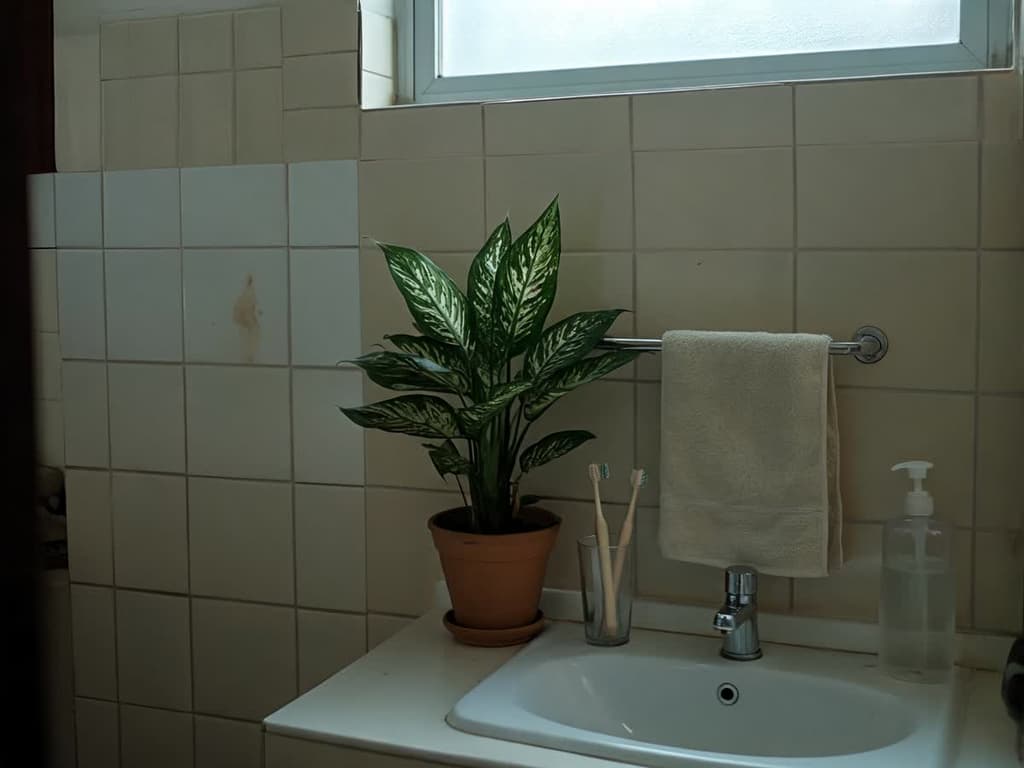
Low light bathroom plants face two environmental conditions at once, and only one is fatal. Apartment bathrooms often have a small transom window, frosted privacy glass, or no window at all. It is simultaneously the most humid room in the house and the darkest.
Almost no shade-tolerant houseplant minds humidity. Light is what determines which species survive there and which give up.
Shower steam creates a twenty-minute humidity spike. A lack of light lasts twenty-four hours a day. Craving high humidity and tolerating dim spaces are two entirely different traits, and very few species possess both. The list below focuses on the second: plants that live with little light and do not mind damp air.
Quick summary:
The University of Georgia Extension publishes a care chart covering 231 houseplants. In it, 30 species require relative air humidity (the percentage of moisture the air holds) of 50% or higher. None of those 30 fall into the low-light category.
In that same chart, 23 species tolerate low light, defined as 25 to 75 foot-candles (the standard light measurement unit used by university extensions; lower numbers mean darker rooms). None of those 23 demand high humidity: all manage with 25% to 49%, and three prefer under 24%.
Penn State Extension addresses placing houseplants in the bathroom and notes the premise is hard to support. As they put it: "one drawback is that bathrooms often do not have the proper light source for a houseplant."
A windowless bathroom cannot sustain a live plant long term. The only reliable workarounds are weekly rotation with a bright room or a grow light running 16 hours a day with 8 hours of darkness.
High air humidity does not water potting soil. In a damp room without direct sun, potting mix dries slowly, so standard plant-tag watering schedules lead to overwatering.
Of the 10 species on this list, 6 are listed as toxic to cats and dogs by the ASPCA. All 6 belong to the arum family (Araceae) and share the same toxic agent: insoluble calcium oxalates, which irritate an animal's mouth and gastrointestinal tract.
Group | Available bathroom light | Plants |
|---|---|---|
1 | Small transom or frosted glass (25 to 75 foot-candles) | Chinese evergreen, parlor palm, arrowhead vine |
2 | Standard window, no direct sun (75 to 200 foot-candles) | bird's nest fern, satin pothos, dumb cane, peace lily, calathea |
3 | Bright bathroom, above 200 foot-candles | flamingo flower, moth orchid |
Shower humidity lasts twenty minutes, darkness lasts all day
Relative humidity measures how much water vapor the air holds compared to its saturation point at a given temperature. It is the metric that makes a bathroom feel tropical.
University of Georgia Extension establishes houseplant humidity brackets. Below 20% is low, 40% to 50% is medium, and above 50% is high. That same publication notes the average home sits between 10% and 20% (University of Georgia Cooperative Extension). Taking a shower spikes this level briefly before it drops back down.
It drops because you deliberately lower it. A closed, damp bathroom grows mildew on the drywall, so standard practice is opening the window or running the exhaust fan right after showering. The airflow that protects your grout strips away the very humidity your plant would absorb.
Penn State Extension features a dedicated section on "putting houseplants in the bathroom" and is blunt about this supposed benefit. The text states the idea "is difficult to support or refute" and hinges entirely on shower frequency. Before deciding, they recommend testing the room with a hygrometer. They add an essential caveat regarding light: "one drawback is that bathrooms often do not have the proper light source for a houseplant" (Penn State Extension).
The article concludes by recommending that you focus on light and moisture, which are the two variables you can actually manage in a bathroom setting.
The math separating humidity lovers from shade plants
Table 3 of the University of Georgia publication details 231 houseplants. For every species, it lists four requirements: light in foot-candles, relative humidity, temperature, and moisture. That allows a direct count of which species demand what conditions.
Only 30 of the 231 species demand humidity of 50% or higher. That is the exclusive group genuinely helped by bathroom vapor. Not one of those 30 appears in the low-light tier. The most shade-tolerant plant among them needs medium to high light, while the majority demand bright light or several hours of direct sun.
Conversely, 23 of the 231 species tolerate 25 to 75 foot-candles, the formal threshold for low light. Not a single one of those 23 requires high humidity. Every one stays healthy between 25% and 49% relative humidity, and three actually prefer drier air.
The two lists share zero species. In a dim bathroom, humidity is never what keeps a plant alive. It is simply an incidental perk for a plant that was already adapted to deep shade.
A foot-candle is the brightness unit used by university horticultural extensions. One foot-candle equals roughly 10.8 lux, the unit displayed by smartphone light meter apps. The 25 to 75 foot-candle low-light range translates to 270 to 810 lux.
Measure your bathroom light with your hand
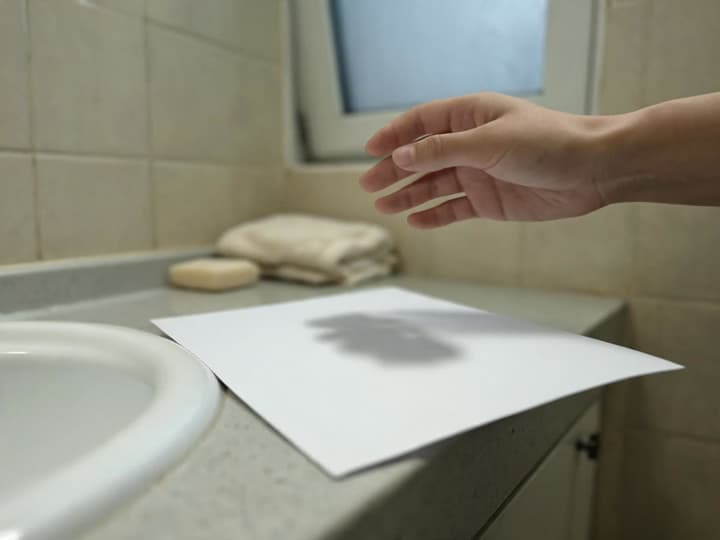
Place a sheet of blank white paper where you plan to set the pot during the brightest part of the day, with electric lights off. Hold your hand roughly 30 cm above the page and examine the shadow.
Low light (25 to 75 foot-candles): The shadow is faint and blurry; individual fingers blend together. This corresponds to small hopper vents or frosted privacy glass.
Medium light (75 to 200 foot-candles): The shadow distinctly resembles a hand, though edges remain soft. This corresponds to an unobstructed window with the pot set 1 to 2 meters away.
High light (above 200 foot-candles): The shadow has crisp, sharp outlines without direct sunbeams hitting the foliage. This corresponds to a large east-facing bathroom window.
If no shadow forms at all, the spot falls below the low-light threshold, and none of the ten plants below will survive there. Head to the windowless bathroom section for practical alternatives.
To put these numbers in context, NC State Extension outlines typical illumination levels for common indoor spaces. An average classroom sits around 20 foot-candles, an office around 50, and a supermarket around 100. That publication classifies any location more than 2.4 m away from a window as low light. Poorly lit corners and north-facing rooms fall into the same bracket (NC State Extension). A bathroom with a tiny hopper window is frequently dimmer than an average office cubicle.
Group 1: small transom or frosted glass
The three plants in this group tolerate 25 to 75 foot-candles. None require shower humidity, which is precisely why they thrive where more delicate tropicals decline.
1. Chinese evergreen (Aglaonema commutatum)
Chinese evergreen belongs here because it is one of the rare species University of Georgia tables place squarely in the low-light bracket. It has no special humidity demands. It tolerates dry winter air and post-shower steam with equal ease.
What it loses in heavy shade is its variegation. Patterns of silver, pink, or cream need fair light to stay pronounced. The Georgia publication observes that "variegated leaf coloration tends to disappear under low light conditions."
The plant stays healthy, but reverting foliage turns solid green. It also ceases blooming, though this is negligible since Aglaonema flowers are modest (NC State Extension).
NC State tested how many months foliage plants retain an attractive appearance across different light levels. Chinese evergreen lasts 12 months at 15 to 20 foot-candles, but jumps to 36 months at 25 to 50 foot-candles. That is the steepest longevity increase in their dataset. Moving it one meter closer to your window can triple its visual lifespan.
Water when the top 2 cm of soil feel completely dry. NC State cautions that roots rot easily in waterlogged mix, advising growers to allow soil drying between waterings.
2. Parlor palm (Chamaedorea elegans)
NC State describes this palm as a plant favoring bright indirect light that "tolerates low light conditions" and low to medium humidity. The profile highlights its popularity for enduring harsh indoor conditions other palms cannot survive, specifically dry air and deep shade (NC State Extension).
The single palm best equipped for a dim bathroom is the one that needs bathroom humidity least. It accepts shower steam gracefully, but it would live just as contentedly in a dry, windowless hallway.
In heavy shade, it sacrifices new growth. Frond emergence halts, leaving the palm at its purchase size for years. Let the topsoil dry out between waterings, and keep the container away from cold outdoor drafts coming through an open window.
3. Arrowhead vine (Syngonium podophyllum)
Arrowhead vine is the sole species in this first tier that actively gains something from added moisture. NC State reports that ideal growing conditions combine warmth with high humidity, noting that direct sun scorches or fades foliage (NC State Extension). Out of these ten selections, it capitalizes most on warm shower vapor.
In shade, it loses its pink or silver patterns, just like the Chinese evergreen, along with its juvenile leaf silhouette. As vines mature, compact clumps stretch into wandering stems, shifting from arrowhead forms into lobed mature leaves. To preserve the tight arrowhead shape, pinch back runners as soon as they elongate.
In NC State longevity trials, arrowhead vine maintained good quality for 12 months at 15 to 20 foot-candles. Higher brackets were not documented for this plant. That is brief compared to the 36 months logged for Chinese evergreen in slightly better light, which is the tradeoff for its tropical nature.
Group 2: standard window, no direct sun
Between 75 and 200 foot-candles, plant options expand. These five thrive in bright ambient light near a window with no harsh direct sun on their foliage, and each appreciates bathroom humidity.
4. Bird's nest fern (Asplenium nidus)
Bird's nest fern is one fern that truly benefits from a bathroom setting. NC State recommends placing it near a north-facing window with bright light or light shade, noting that intense sun yellows fronds and stalls growth. The care sheet mentions that an indoor fern often needs a pebble tray filled with water beneath the pot to supply sufficient ambient moisture (NC State Extension).
In a bathroom used for daily showers, you can skip the pebble tray entirely. This is one instance where bathroom humidity pays for itself.
What it forfeits in insufficient light is frond development. Emerging leaves stay dwarfed and pale, and the center rosette stops producing growth. Keep the potting mix lightly moist, never soggy. Brown, crispy leaf tips point to excessively dry room air rather than underwatering.
5. Satin pothos (Scindapsus pictus)
Satin pothos is a distinct species, not merely a cultivar of common golden pothos. It features matte, heart-shaped, dark green foliage mottled with reflective silver patches. NC State calls for bright indirect light and well-draining moist mix, cautioning that neither cold drafts nor direct sun are tolerated (NC State Extension).
The care sheet distinguishes two watering mistakes: yellow leaves signal excess soil moisture, while curled leaf margins indicate underwatering. In a humid bathroom, overwatering is far more frequent.
Under dim conditions, leaves lose their silver splash and turn uniformly green. Internodes stretch, giving the vines a sparse, bare look.
6. Dumb cane (Dieffenbachia)
Dumb cane thrives on indirect light, warm temperatures, and high humidity, a trio of traits that a windowed bathroom readily provides. NC State instructs growers to water thoroughly, then allow the top 2.5 cm of soil to dry out completely before irrigating again to prevent root decay (NC State Extension).
The entry advises wearing gloves when pruning, as the plant sap causes intense skin irritation. In a compact bathroom where foliage sits within arm's reach, keep this trait in mind. It is also the most moisture-sensitive choice here. Check out the dumb cane watering guide for a step-by-step soil moisture check.
When deprived of adequate light, the creamy white foliage patterns fade. The main stem also weakens, growing leggy and prone to toppling under its own weight.
In NC State durability tables, dumb cane proved remarkably consistent: it logged 12 months of acceptable appearance across every tier from 15 to 75 foot-candles. Pushing it closer to the glass within that low range will not extend its lifespan; diligent watering is what keeps it alive.
7. Peace lily (Spathiphyllum)
Peace lilies can survive in lighting conditions far too weak to ever trigger blooms, and both thresholds have been verified. University of Arkansas Extension notes peace lilies tolerate very low light down to 20 foot-candles, though at those levels they "will probably not bloom" (University of Arkansas Cooperative Extension). Producing white spathes requires 150 to 300 foot-candles.
Twenty foot-candles is dimmer than the floor of standard low-light classifications. A peace lily can linger in a dim bathroom for years without ever throwing a spathe. It sits in Group 2 rather than Group 1 solely due to flowering: it survives by a frosted transom, but blooms by an actual window. Detailed spacing rules by window orientation are covered in the peace lily light guide.
In NC State trials, peace lilies only qualified for visual ratings in the brightest bracket, between 75 and 100 foot-candles. It held up for 12 months there, standing as the only plant on this list with no rating at all in lower brackets.
NC State adds diagnostic tips for brown leaf tips, the single most common peace lily complaint. Primary triggers are excessive direct sun, underwatering, and very low humidity. In a bathroom, low humidity is eliminated, leaving improper watering or light as the culprits.
8. Calathea (Goeppertia makoyana)
Calathea is the least shade-tolerant species on this list, despite its high humidity requirement. NC State notes that for calathea to thrive, it requires temperatures between 18 and 24 °C alongside roughly 60% relative humidity. The profile lists it as intolerant of dry air, soggy mix, and bone-dry soil alike. It also declines rapidly when exposed to cold drafts, direct sun, or deep shade (NC State Extension).
It relishes bathroom moisture while rejecting bathroom gloom. Set beside a bright window, it is the most striking plant here. Tucked beneath a small transom vent, it will be the first to decline.
Its loss in heavy shade is vibrant leaf color: insufficient illumination causes its intricate patterns to wash out. Brown leaf margins are usually caused by tap water fluoride rather than dry air. Switching to filtered or distilled water clears up these blemishes; see the calathea care guide for complete maintenance details.
Group 3: bright bathroom
Above 200 foot-candles, without direct sunbeams touching the leaves. This describes bathrooms with broad, bright windows, where ambient moisture finally turns into an uncompromised asset.
9. Flamingo flower (Anthurium andraeanum)
Flamingo flower needs bright indirect light paired with 60% to 80% humidity according to NC State. That is the highest humidity range among all ten selections. It is the plant that draws the greatest advantage from regular showers, provided your window delivers ample light (NC State Extension).
The university profile notes that leaf spotting emerges when air circulation stalls or foliage stays wet for extended periods. A steamy bathroom left unventilated creates both hazards at once. If your space lacks an exhaust fan, skip anthuriums.
Water when the top 2.5 cm of potting mix dry out. In inadequate light, the red spathes stop forming, which defeats the purpose of keeping one. The foliage remains green, and the flamingo flower care guide covers how to encourage reblooming.
10. Moth orchid (Phalaenopsis)
Moth orchids survive low light but require significantly brighter illumination to initiate flower spikes, placing them squarely in the bright bathroom tier. NC State identifies this genus as a low-light, warm-temperature, high-humidity houseplant. That combination is something none of the 231 entries on Georgia's chart met simultaneously (NC State Extension).
The caveat parallels the peace lily: stiff, dark green leaves indicate light levels are too dim. "The most common reason orchids fail to bloom is insufficient light" (University of Maryland Extension). An orchid kept in a dim room stays green and alive, but bare of blooms.
Its primary indoor risk is trapped moisture. Maryland Extension recommends watering early in the day, letting pots drain freely, and avoiding standing water in saucers. Water lodged in leaf axils or the central crown easily causes crown rot. In a stagnant bathroom, puddles evaporate very slowly; dab standing moisture out with a paper towel.
Watering frequency should be determined by root color, not dates on a calendar. The orchid care guide details how to read healthy root coloration.
5 bathroom plants that low light will kill
These five options love warmth and humidity, which explains why so many gardeners stick them in bathrooms. The humidity is fine, but dim bathroom light ruins them.
Aloe vera (*Aloe vera*): University of Georgia tables place aloe in direct sun alongside low humidity (5% to 24%). A dark bathroom is the polar opposite on both counts. In shade, it etiolates, turns pale, and collapses into mush.
Air plant (*Tillandsia*): Growing without soil, it gathers hydration through leaf scales, meaning bathroom steam helps. The issue is light: Georgia classifies Tillandsia under high light (above 200 foot-candles). Beside a small frosted window, it dehydrates imperceptibly without typical wilting signs.
Monstera (*Monstera deliciosa*): It endures low light only by halting fenestration, losing the split leaves that make it desirable. Clemson University Extension confirms that dim conditions stop leaf perforations from forming. It also quickly outgrows modest bathrooms.
Elephant ear (*Alocasia*): Demands rich humidity alongside bright ambient light. Dim light causes it to drop foliage leaf by leaf, entering dormancy until lighting improves.
Snake plant (*Dracaena trifasciata*): Survives deep shade effortlessly, which lands it on every beginner list. However, Georgia classifies it under low humidity (5% to 24%) with prolonged dry periods between waterings. The snake plant light guide outlines the lighting needed for real growth.
Windowless bathrooms cannot sustain plants
A bathroom with zero natural daylight cannot support living plants indefinitely, regardless of species. Photosynthesis requires light energy, and the ceiling bulb you flip on for hygiene routines runs for mere minutes each day.
The plant will not die during its first week, which often tricks owners. NC State Extension clarifies why: freshly purchased plants arrive with stored carbohydrate reserves from commercial greenhouses. Because of this, "plant decline may take several months" before visible stress appears. Over that period, new leaves emerge tiny, pale, and widely spaced.
The same source categorizes spaces receiving "only artificial light" under low-light care guidelines. A windowless bathroom falls far short of even this threshold because fixtures are switched off most of the day.
Two practical solutions exist.
The first is a plant rotation. Leave the specimen in the bathroom for one week, then shift it into a sunlit room for the next, alternating indefinitely. It works well, though it requires keeping two identical decorative pots if you want uninterrupted greenery, along with the habit of swapping them weekly.
The second is a dedicated grow light. University of Georgia notes that artificial lighting can readily substitute for natural daylight. The publication suggests extending light duration to offset low intensity, recommending 16 hours of daily light followed by 8 hours of darkness for foliage houseplants like the ten profiled here.
Grow bulbs cannot fix poor air circulation, however. An unvented, windowless bathroom traps stagnant dampness, encouraging leaf spot diseases and surface mold.
Bathroom potting soil dries out slowly
Care tags listing weekly watering routines assume dry living room air. In a damp, sunless bathroom, moisture lingers in the soil mix and transpires through foliage far more slowly.
Humid air does not hydrate root systems. Instead, it slows the rate of foliar water loss, meaning your plant draws less moisture from the pot. In practice, you must water less often in a bathroom, not more.
Test soil with your finger rather than relying on a fixed schedule. Push your finger 2 cm deep into the potting mix. If moist soil clings to your skin, wait. If it feels dry and dusty, irrigate thoroughly until water drains from the bottom.
Three non-negotiable container rules:
Drainage holes are mandatory. Potting directly into sealed decorative planters in a humid room guarantees root rot.
Cachepots must not hold standing water. Drain outer cachepots and saucers five minutes after watering. Submerged roots suffocate out of sight.
Never place pots inside the shower stall. Direct shower spray drenches potting soil unpredictably, and hot tap water can scald roots.
Root rot is the universal outcome of these three oversights, progressing beneath the soil line for weeks before leaves show distress.
Soil mold, gnats, and root rot
These three common bathroom plant issues stem from identical conditions: overly wet soil mix for extended periods. They typically appear in sequence, each serving as an early warning for the next.
Tiny black bugs fluttering around the pot are fungus gnats. University of Georgia Extension explains the insect's life cycle: larvae feed in the top 2 to 5 cm of soil, consuming fungi, algae, and organic debris. Adults lay eggs in damp potting mix, completing their life cycle in a few weeks at 18 to 24 °C (University of Georgia Cooperative Extension).
The publication identifies the primary trigger: "excess moisture in the growing medium is the primary reason fungus gnats become a problem in homes and offices." It also notes why aerosol sprays fail: "insecticides are usually ineffective against adults." Spraying merely attacks the non-reproductive phase of the population.
Effective control requires two steps in order. Let the potting mix dry thoroughly between waterings, since larvae cannot survive in dry soil and females will not lay eggs in it. Place yellow sticky traps flush with the pot rim to capture flying adults and break the breeding cycle. See our comprehensive guide on fungus gnats for complete eradication methods.
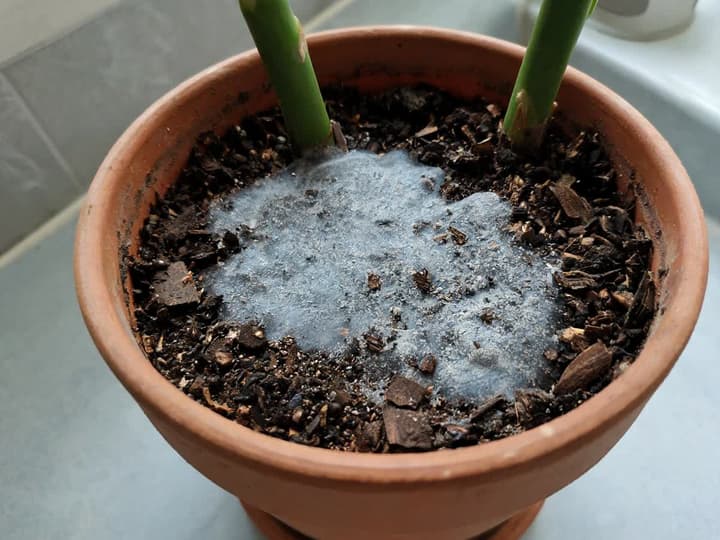
The white or pale green crust coating the potting mix is harmless mold feeding on decomposing bark and peat. While non-parasitic, it serves as a visual warning that the soil is staying damp too long. Scrape away the top layer and withhold water until the surface feels dry to the touch.
Drooping and yellowing leaves: diagnosing the cause
A wilting plant in bone-dry soil looks identical to a wilting plant in waterlogged mix, yet their remedies are complete opposites. Always check soil moisture before reaching for the watering can.
What you see | Soil feel | What it is | Immediate action |
|---|---|---|---|
Lower leaves yellowing, soft limp stems | Moist | Overwatering; early root rot | Stop watering, empty outer pot, let top 3 cm dry out |
Entire plant drooping, soft matte foliage | Moist | Advanced root rot | Unpot, trim mushy brown roots, repot in fresh airy mix |
Wilted foliage that perks up hours after watering | Dry | Underwatering | Soak thoroughly until water drains freely; shorten watering intervals |
Crisp brown leaf margins, center remains firm | Any | Dry air, fertilizer salts, or fluoride | Halve fertilizer strength and switch calatheas to filtered water |
New leaves emerge smaller and paler than older ones | Any | Insufficient light | Shift closer to the window or select a lower-light species |
Healthy root systems are firm, crisp, and pale. Rotted roots turn dark brown, mushy, and slough apart when squeezed. If at least a third of the root mass remains firm, the plant can recover in fresh soil. Our guide on yellow leaves covers other potential causes.
If you received an unlabeled plant as a gift, accurate identification changes everything. Brown tips on a bird's nest fern point to dry air, whereas on a calathea they often stem from tap water minerals. Bloom identifies houseplants from a photo and displays tailored care profiles.
Which of these 10 plants does the ASPCA list as toxic?
Six of the ten appear on the ASPCA Animal Poison Control Center's toxic plant database for dogs and cats. All six belong to the arum family (Araceae) and share the same toxic component: insoluble calcium oxalates. Chewing foliage releases microscopic crystal bundles that trigger oral irritation, mouth swelling, drooling, vomiting, and difficulty swallowing.
Plant | ASPCA toxicity status |
|---|---|
Chinese evergreen | Toxic to dogs, cats, and horses |
Arrowhead vine | Toxic to dogs, cats, and horses |
Satin pothos | Toxic to dogs, cats, and horses |
Dumb cane | Toxic to dogs and cats |
Peace lily | Toxic to dogs and cats |
Flamingo flower | Toxic to dogs, cats, and horses |
Parlor palm | Non-toxic to dogs and cats |
Calathea | Non-toxic to dogs and cats |
Moth orchid | Non-toxic to dogs and cats |
Bird's nest fern | Not cataloged in the ASPCA database |
The absence of an ASPCA entry does not guarantee safety: it simply means the genus has not been formally cataloged. Bathrooms offer an advantage here since closing the door restricts pet access. Keep in mind, however, that cats jump onto sinks and counters where small pots reside.
Frequently asked questions
Which plant is best suited for a bathroom?
Suitability depends entirely on light, not humidity. For small hopper vents or frosted windows, choose Chinese evergreen, parlor palm, or arrowhead vine. If you have an unobstructed window without direct sun, pick bird's nest fern, satin pothos, dumb cane, peace lily, or calathea. For large, bright windows, opt for flamingo flower or moth orchid. Shower humidity does not alter these lighting requirements.
Do houseplants absorb bathroom humidity?
No. Plants do the opposite: they pull water through their roots and release vapor through their leaves, in a process called transpiration. A potted plant adds moisture to the room's air, in small amounts. What removes humidity from a bathroom is an open window or an exhaust fan.
Can any plant live inside a shower stall?
None of the ten houseplants on this list can handle it. Hot water spray soaks the potting soil continuously and heats roots to damaging temperatures. Air plants (Tillandsia) and Spanish moss grow without soil and tolerate getting wet, but they need bright light and must dry out thoroughly between showers.
What plants survive in a bathroom without windows?
None can survive indefinitely. Without natural daylight, a plant exhausts the energy reserves it built up in the commercial greenhouse and halts growth, a decline NC State notes can take several months. Practical alternatives include alternating plants weekly between your bathroom and a sunlit space, or installing a dedicated grow light on a timer running 16 hours on and 8 hours off.
Which houseplant requires almost no daylight?
No plant does without light, but the lowest range runs from 25 to 75 foot-candles, the equivalent of 270 to 810 lux. This range accommodates Chinese evergreen, parlor palm, arrowhead vine, cast-iron plant, dracaena, and other shade species. Below this, no species holds up, and the bathroom light does not count.
How this guide was compiled
Selections were determined by overlapping environmental requirements: candidates had to tolerate the low light levels typical of residential bathrooms while handling warm steam without foliage damage. Light and humidity ranges per species were drawn from the University of Georgia Extension's 231-houseplant reference table (Bulletin B1318).
Individual plant profiles were cross-referenced with NC State Extension's Plant Toolbox. Moth orchid data was expanded via University of Maryland Extension, and peace lily details were supplemented by University of Arkansas Extension. Pet toxicity classifications were verified against the ASPCA Animal Poison Control database. Fungus gnat lifecycles were confirmed using University of Georgia Circular C1250.
Outside the bathroom, these same low-light parameters apply to hallways, dim corners, and bedrooms with small windows. Explore our complete guide to low light houseplants for more shade-tolerant selections.
Related articles
How to Care for a Goldfish Plant: Light, Watering, and Blooms
How to care for a goldfish plant: bright light without strong sun, water when the soil surface dries, and humid air. Learn how to tell a Nematanthus from a Columnea, why it drops leaves, and how to get it to bloom again.
Lavender Leaves Turning Yellow: Where the Yellowing Starts Shows the Cause
Lower leaves turning yellow with moist soil means overwatered roots, the most common cause. Old leaves drying one by one on woody stems is normal. Take the stem and root test, see if your plant can still be saved, and find out what to do today.
How to Propagate Lavender: Where to Cut and Why Cuttings Rot
A lavender cutting comes from a non-flowering branch tip, about 4 inches long, planted in sandy soil that never stays soggy. Learn where to cut, rooting times, seasonality in Brazil, and what to do if the base turns black.