Christmas Cactus Fertilizer: What to Use, How Much to Dilute, and When to Stop
Every fertilization guide for the Christmas cactus tells you to stop in September, and this date is correct for those living in the northern hemisphere, where it blooms in November and December. What almost none of them explain is why. This guide gives you the formula, the dilution in ml per liter, and the right month to stop, with the sources on the table.

The best fertilizer for a Christmas cactus is a balanced liquid formula, like a 10-10-10 or 20-20-20. Dilute it to half the strength recommended on the label and apply it once a month, but only while the plant is actively growing. Getting your plant to bloom isn't about buying a magic bottle, it's about knowing when to stop. The golden rule is to cut off nitrogen about six weeks before the plant starts forming buds.
The University of Florida extension directs you to fertilize from April to September, and the Clemson University extension directs you to stop at the end of summer. Both describe the northern hemisphere, where this plant is sold as a Christmas cactus and blooms in November and December. The fertilization window runs from April to September. In the southern hemisphere, the entire calendar shifts by six months, and in Brazil it blooms in May.
Quick summary:
Formula: Balanced liquid fertilizer (10-10-10 or 20-20-20) during active growth. As bud season approaches, switch to a low-nitrogen, high-phosphorus, and high-potassium formula.
Dilution: Half the label's recommended dose. If the instructions call for 4 ml per liter, use 2 ml instead.
Frequency: Once a month, and always apply it to soil that is already damp.
When to stop: about 6 weeks before the bud window. In the northern hemisphere this falls at the end of August.
Epsom salt: This recommendation comes from Clemson University (HGIC factsheet 1554, revised November 2018), and other university extension sites often republish their text. No peer-reviewed studies have tested magnesium on this specific plant. It is low risk if dosed correctly, but it is not a miracle cure.
If your plant is large, lush, and green but refuses to bloom, the issue isn't a lack of fertilizer. It is nitrogen at the wrong time.
When your Christmas cactus actually needs fertilizer, and why the answer isn't a specific month
A Christmas cactus only needs fertilizer during its vegetative growth phase, which is when it is actively producing new segments. It does not need any nutrients during bud formation, flowering, or the rest period that follows. The cycle has four distinct phases, and only the first one requires heavy feeding. Fertilizing outside this window won't speed up growth and will actively disrupt blooming.
You might notice I haven't mentioned specific months yet. The four most credible academic sources on this topic are all American: the university extensions of Clemson, Minnesota, and Florida, along with the New York Botanical Garden. All four write their guides using Northern Hemisphere months.
Clemson directs you to fertilize "from the time new growth begins in late winter or early spring, and throughout the summer." It directs you to stop in late summer. UF/IFAS gives from April to September.
These dates are correct for those who live in the northern hemisphere, where the plant forms buds in September and blooms in December. Taken to the southern hemisphere without translation, they direct you to fertilize exactly during the months when the plant should be forming buds.
The mechanism does not change by hemisphere. This is a short-day plant. It grows while the nights are short and forms flowers when the nights lengthen and cool, as UF/IFAS describes. In the northern hemisphere this happens in September and October, and the flower opens in November and December.
Long nights and cool temperatures are the two triggers that make the Christmas cactus bloom. The protocol to induce them on purpose is in how to make the Christmas cactus bloom. To fertilize at the right time, count backward from flowering, not forward from January.
The fertilization calendar, phase by phase
The table below translates the cycle into dates. The first date column is for the northern hemisphere, which is yours. The last two bring the calendar for Brazil, where the same plant blooms in the other half of the year, so you can recognize where the numbers come from when you find a guide written there.
Use the date column as a reference and the observable sign column as the decision. A plant on a cold balcony and one in a heated living room do not follow the same clock. But both show the same sign before blooming.
Cycle Phase | What you see on the plant | Northern hemisphere | Southeast and South of Brazil | North and Northeast of Brazil |
|---|---|---|---|---|
Vegetative growth (fertilize) | New, smaller, lighter green segments sprouting at the tips of the branches | April to September | September to February | August to February |
Pre-induction (cut nitrogen) | The newest segments stop growing and begin to harden off | End of August | February | February |
Induction and budding (do not fertilize) | Tiny bumps the size of a grain of rice appear at the tips of the segments | September and October | March and April | March and April, with artificial darkness |
Blooming (do not fertilize) | Open flowers | November and December | April to June | May |
Rest period (do not fertilize) | The last flower has fallen and the plant shows no active growth | December to February | June to August | June and July |
There are two things this table doesn't explicitly say. First, the post-bloom rest period is brief, and the sign that ends it can be easy to miss.
The official end of the rest period is marked by the very first new green segment budding at the tip of a branch. This physical sign, not a date on the calendar, is your green light to start fertilizing for the new season.
This is how the New York Botanical Garden organizes the instruction, in text updated in January 2026. The guidance is to stop feeding when flowering ends and resume when normal watering returns.
The second: near the equator, the induction line only happens if you trigger it. This happens because there the night neither lengthens nor cools.
However, your fertilizing schedule should still follow this table. Adding more fertilizer won't make up for a lack of environmental triggers. The section on nitrogen below explains why.
Which formula to use, and when to switch
These four sources do not agree with each other. All of them are good. But when you read the four side by side, the instructions diverge.
Source | Formula | Strength | Frequency | When to start | When to stop |
|---|---|---|---|---|---|
Clemson HGIC 1554 (rev. Nov 2018) | 20-10-20 or 20-20-20 with micronutrients | Half strength | Monthly | When new growth starts | Late summer, "to encourage bud set in fall" |
University of Minnesota (extension) | Balanced, switching to a low-nitrogen, high-phosphorus, and high-potassium formula when buds form (e.g., 0-15-10) | Half strength | Monthly | June | August for the balanced formula, then continue with the bloom formula |
University of Florida (UF/IFAS) | Not specified | Not specified | Every 1 to 2 months | April | September |
New York Botanical Garden (updated Jan 2026) | Tomato fertilizer, high in phosphorus and potassium | Not specified | Monthly | After the post-bloom rest period | As soon as blooming ends |
Clemson tells you to stop all feeding before buds form. Minnesota tells you to keep feeding during bud development, but with a different formula. The New York Botanical Garden suggests using a bloom-boosting formula year-round, structuring their advice around the plant's growth cycle rather than calendar months.
The key to resolving this conflict lies in a scientific study that none of these four sources actually cite. In 2001, researchers M. I. Spurway and M. B. Thomas published an experiment in the Journal of Plant Nutrition (v. 24, n. 4-5, pp. 767-778).
The study spanned 17 months, tracking Schlumbergera × buckleyi in a controlled greenhouse environment while measuring the effects of nitrogen, phosphorus, potassium, and liming. It remains the only published experimental evidence on the nutritional needs of this plant, directly addressing the points where the university guides disagree. Three main findings stand out:
Nitrogen is essential. Without it, the plants became chlorotic (yellowing leaves due to nutrient deficiency), grew smaller, and produced fewer flowers. Adding nitrogen significantly boosted both vegetative growth and subsequent blooming.
Too much nitrogen delays blooming. High doses of nitrogen actually stunted overall growth and delayed the flowering process.
Phosphorus promotes blooming, while high potassium levels strongly influenced both segment production and the quantity of flowers.
What you need to cut off at the end of the vegetative cycle is excess nitrogen, not all nutrients. This explains why the different guides seem to contradict one another.
Clemson is correct to cut off 20-20-20 before bud formation. The University of Minnesota is also correct to keep feeding with a 0-15-10 formula. Both are achieving the same goal: removing nitrogen while keeping phosphorus and potassium available.
In practice, here is what you should do: use a balanced formula (like 10-10-10 or 20-20-20) during the active growth phase. In the month leading up to the bud window, either stop fertilizing altogether or switch to a bloom formula with low nitrogen and high phosphorus.
Both methods work well. Switching formulas is slightly better for large, mature, well-established plants. Stopping entirely is safer for beginners, as you cannot accidentally overfeed with fertilizer you didn't apply.
How much to dilute, in ml per liter
You will see the phrase "half strength" in almost every gardening guide. While this makes perfect sense on US product labels, you need to translate this advice into concrete measurements for the products you buy.
Half strength simply means using half of the dosage recommended on your product's label. It is not a single, universal number because every fertilizer brand has a different concentration.
Concentrated liquid fertilizers for houseplants typically call for between 3 ml and 5 ml per liter of water. The variation between brands is large. Read your label and divide by two.
For example, if you have a liquid NPK 10-10-10 that calls for 4 ml per liter, you should use 2 ml per liter for your Christmas cactus. If you do not have a syringe, here are two quick reference measurements:
1 level teaspoon is roughly 5 ml.
1 level tablespoon is roughly 15 ml.
Therefore, 2 ml per liter is just under half a teaspoon of fertilizer in a 1-liter bottle of water. Alternatively, you can mix 1 level teaspoon into 2.5 liters of water, which is often easier to measure in a standard watering can.
There is one rule that is even more important than the dilution rate: always water your plant before fertilizing. Applying fertilizer to dry soil will burn the delicate roots. The roots of a Christmas cactus are incredibly vulnerable to this because the plant is an epiphyte. In the wild, it grows nested in tree branches within the Brazilian Atlantic Forest, surviving on rainwater and decomposing organic matter.
The root that evolved for this is thin, shallow, and used to low fertility. Water with clean water, wait half an hour, and only then apply the fertilizer solution. If you want to understand why its pot needs to dry quickly, that is in the right substrate for an epiphyte.
Too much nitrogen: the plant that grows but never blooms
This is the most common issue for attentive plant owners, and it can be highly frustrating because the plant looks incredibly healthy. It is large, lush, and constantly growing new green segments at the tip of every branch.
The color is a beautiful dark green. It doubled in size in two years, but did not produce a single bud in December, nor last December.
This is the classic result of applying nitrogen fertilizer at the wrong phase of the cycle. The Spurway and Thomas study explains the biology: high levels of nitrogen delay and inhibit flowering. The plant is simply doing exactly what your feeding schedule told it to do.
Nitrogen is the fuel for vegetative growth. As long as you keep feeding it, the plant assumes it is still in the "growth season." New segments and flower buds compete for the exact same real estate, which is the very tip of the branches. If you keep feeding nitrogen into March, the plant will grow new leaves where it should have grown flowers.
What to do if this has already happened to your plant:
Stop all nitrogen feeding immediately, regardless of what month it is. Do not give in to the temptation of "just one last dose."
Flush the soil. Thoroughly flush the pot with clean water three times in a row, letting the water drain completely through the bottom holes each time. Empty the saucer after every flush to wash away accumulated salts.
Wait for the next bud cycle and focus on managing light and temperature triggers rather than adding nutrients.
This cannot be corrected in the same season. If your plant spent the entire summer receiving 20-20-20 and arrived in September full of new segments, this year's December is already gone. What you are fixing is next year's December.

A yellow leaf, on the other hand, is not usually a sign of too much nitrogen, but rather the opposite or a watering problem. The same symptom has two opposite causes, and it is worth knowing both, because the fix changes in each case. This is detailed in yellow leaves can be excess or deficiency.
Epsom salt: what it does and what it doesn't do
Using Epsom salt, or magnesium sulfate, is one of the most common questions when it comes to fertilizing these plants, but the advice available online is often poor. Of the various guides on the subject, some give a dosage without citing any source, others call the practice controversial, and some ignore magnesium entirely. Almost none of them explain where the advice originates.
The recommendation is real and comes from a reliable academic institution. Clemson Extension HGIC 1554, originally published in 1999 and updated in 2018, states that "holiday cacti have a higher requirement for magnesium than many other plants."
Clemson advises applying Epsom salt monthly during the active growth phase at a rate of 1 teaspoon per gallon of water. Do not apply this solution during the same week you apply your regular fertilizer.
But it is one source, not three. The University of Georgia Extension (Paul Pugliese, December 2018) provides the same guidance. The NC State Extension in Henderson County (December 2024) features the exact same wording.
While three different university websites publish this advice, the lineage leads straight back to Clemson. This isn't a case of independent confirmation, it is simply republished material.
Furthermore, there are no published trials. No scientific studies have specifically tested magnesium supplementation in Schlumbergera. While Spurway and Thomas measured the effects of nitrogen, phosphorus, potassium, and lime, magnesium was not part of their research.
The recommendation is reasonable, and Clemson is a highly respected source. The suggested dose carries very low risk, but it has not been proven by formal scientific testing on this plant.
There is also a caveat from NC State itself, in an article about Epsom salt in general (Amanda Bratcher, January 2025). Excess magnesium causes toxicity, and the reference dose for pots is low. As the article says, "it is easier to correct a magnesium deficiency than it is to fix a magnesium toxicity." In a small pot, more is not better.
The verdict, with converted measurements: if you want to try it, dissolve 1 teaspoon of Epsom salt in 4 liters of water (approximately 1.3 grams per liter). Apply this once a month during the active growth phase, making sure to use it on a different week than your regular fertilizer. It is perfectly safe.
Just don't expect it to trigger blooms on its own. Flowering in a Christmas cactus is controlled by darkness and temperature, not nutrients. No amount of magnesium will help a plant that spends its nights in a warm, brightly lit living room.
What to buy
Here is what to look for by category, as brand names vary widely by region while the chemical formulas remain the same.
Balanced liquid fertilizer for houseplants (10-10-10, 20-20-20 or close). This is the main one, and it is what you will use from April to September.
Liquid orchid fertilizer. Orchids are also epiphytes, meaning these products are already formulated for root systems that live in loose, low-nutrient, well-aerated potting mixes. They often come in separate "growth" and "bloom" formulas, which makes switching products easy without having to mix different brands.
A low-nitrogen, high-phosphorus bloom formula for the month before bud formation, if you prefer to switch formulas rather than stopping fertilization entirely.
Standard Epsom salt, if you choose to use it. Make sure to buy pure magnesium sulfate without added fragrances or dyes.
Fertilizers labeled "for cacti and succulents" are not the best choice here. These are formulated for desert cacti, which live in mineral-heavy soils and grow incredibly slowly, meaning they contain very little nitrogen. While this works well right before budding, it is not ideal.
It won't provide enough nitrogen during the five months when your plant actively needs to grow new segments. A Christmas cactus might look like a desert cactus, but it does not live like one.
Homemade fertilizers are another common topic. Coffee grounds, banana peels, and rice water are not substitutes for proper fertilizer. None of these have a verified chemical makeup or a controllable dosage.
Coffee grounds pose an extra risk: when spread over the surface of the soil, they form a compacted, crusty layer that traps moisture. This is the last thing the shallow roots of an epiphyte want. If you want to use organic waste, compost it fully first, rather than applying raw scraps directly to your pot.
Before purchasing anything, make sure you know exactly which plant you have. Three very similar holiday cacti are often sold under confusing or swapped names. Each one buds at a different time of year, which completely changes when you need to stop fertilizing.
The Christmas cactus (Schlumbergera truncata, often sold as Thanksgiving cactus) has pointed, tooth-like projections along the edges of its segments. The true Christmas cactus (Schlumbergera × buckleyi) has smooth, rounded, scalloped edges. The Easter cactus (Rhipsalidopsis gaertneri) has almost entirely flat edges and blooms in the spring.
If the leaf shapes aren't clear, which is often the case with young plants, Bloom can identify the exact species from a photo. It also provides detailed care guides and is available for both iPhone and iPad.
The complete guide to the Christmas cactus provides the watering, light, temperature, and humidity numbers that accompany fertilization. It also includes the care calendar for the species throughout the year.
Common fertilizing mistakes that burn roots
Mistake | What happens to the plant | What you should do |
|---|---|---|
Fertilizing when the soil is dry | The fertilizer salts concentrate around the delicate roots, burning the tips | Water with clean water first, wait 30 minutes, then apply fertilizer |
Applying full strength | Excess salt buildup causes the tips of the segments to shrivel, even when the soil is moist | Always dilute to half the recommended label dosage |
Fertilizing during blooming | It serves no purpose and often causes the plant to drop its buds prematurely | Stop fertilizing as soon as you see the very first flower buds form |
Using slow-release granules in shallow pots | These release nutrients for months, including during the bud-induction phase when nitrogen hurts the plant most | Stick to liquid fertilizers, which allow you to control nutrients month by month |
Fertilizing a newly repotted plant | Fresh potting soil already contains nutrients, and adding more can easily overload the roots | Wait at least 6 to 8 weeks after repotting before you start fertilizing |
Ignoring white crust on the soil surface | This is salt buildup from months of fertilizing in a shallow pot, often because water isn't draining out properly | Flush the soil: water thoroughly 3 times with clean water, letting it drain completely and emptying the saucer |
Salt buildup is invisible until it becomes a serious problem. In shallow pots, monthly fertilizing can quickly concentrate salts in a small volume of soil. How you water determines whether these salts stay there. Watering deeply so that water runs out of the drainage holes washes excess salts away. On the other hand, light watering that only dampens the top layer of soil leaves all those salts trapped inside. If you notice a white or yellowish crust on the soil, or a white ring around the rim of your pot, it is time to flush the soil. Make it a habit to do this once a year at the end of the plant's rest period, right before you start fertilizing for the new season.
Frequently Asked Questions
What is the best fertilizer for a Christmas cactus?
A balanced liquid fertilizer, such as a 10-10-10 or 20-20-20, diluted to half strength and applied once a month during the active growing season. Clemson Extension specifically recommends a 20-10-20 or 20-20-20 formula with added micronutrients. Liquid orchid fertilizers also work incredibly well, as they are designed for epiphytic plants.
What does Epsom salt do for a Christmas cactus?
It provides magnesium. Clemson University Extension (HGIC 1554, revised in 2018) notes that holiday cacti have a higher magnesium requirement than most other houseplants. They suggest applying 1 teaspoon per gallon (about 1.3 grams per liter) once a month, during a different week than your regular fertilizer. However, this has not been tested in scientific trials, and magnesium does not trigger blooming.
Are coffee grounds good for a Christmas cactus?
There is no evidence that coffee grounds help, and they pose a real risk to your plant. When spread over the surface, coffee grounds form a dense barrier that traps moisture and cuts off air to the roots, which is highly damaging to epiphytes. If you want to use coffee grounds, compost them first with other organic matter rather than applying them raw to the pot.
How do I make my Christmas cactus bloom?
Adjust dark and temperature, not nutrition. The plant forms buds with long, cool nights, and in the northern hemisphere this happens naturally between September and October. Fertilizer does not induce flowering, and nitrogen at the wrong time gets in the way: the plant produces a new segment where it would produce a flower.
Can I fertilize my Christmas cactus while it has buds?
You should not use a balanced fertilizer once buds have formed. If you are using a low-nitrogen, high-phosphorus bloom formula, recommendations vary. Clemson University advises stopping all feeding once buds appear, while the University of Minnesota suggests continuing with a 0-15-10 formula. If you are unsure, it is safest to stop feeding. The plant already has all the nutrients it needs to open its buds.
In summary
The mistake that costs you the blooms is not choosing the wrong fertilizer. It is fertilizing correctly in the wrong month, following a calendar written for the other hemisphere. If your plant is large, green, and firm, but does not bloom, take fertilizer out of the equation at the end of August. Work on the darkness and temperature in September.
On the other hand, if your plant looks weak, limp, and pale with very little new growth, it is likely hungry. Start your feeding routine as soon as you see the first new green segment sprout at the tips, rather than waiting for a specific date on the calendar.
Related articles
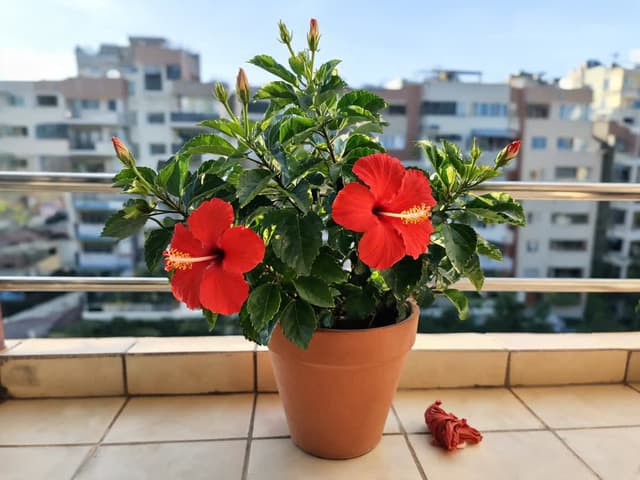
How to Care for Hibiscus: Sun, Watering, Fertilizer, and Pruning for Flowers
How to care for hibiscus: 6 hours of direct sun, evenly moist soil without waterlogging, half-strength fertilizer in spring and summer, and pruning in early spring. Find out why the flower lasts one day and why buds drop before opening.
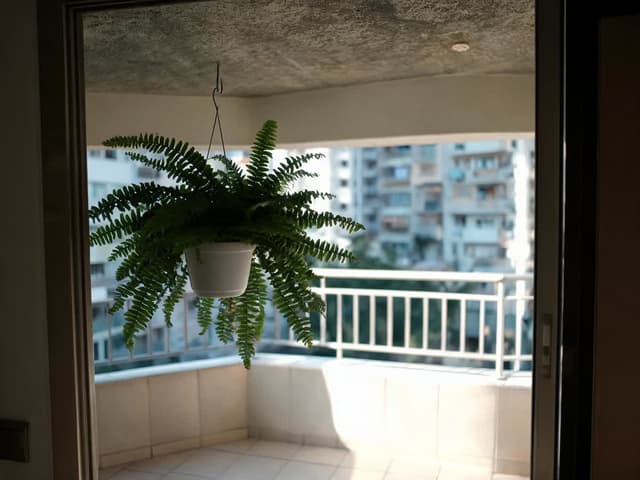
Do Ferns Like Sun or Shade? It Depends on the Type
Ferns prefer bright shade: plenty of light, but no direct sun on their fronds. Tuberous sword fern is the exception that handles sun. Here is the ideal light for each type, where to place pots, and how fronds show too much or too little light.
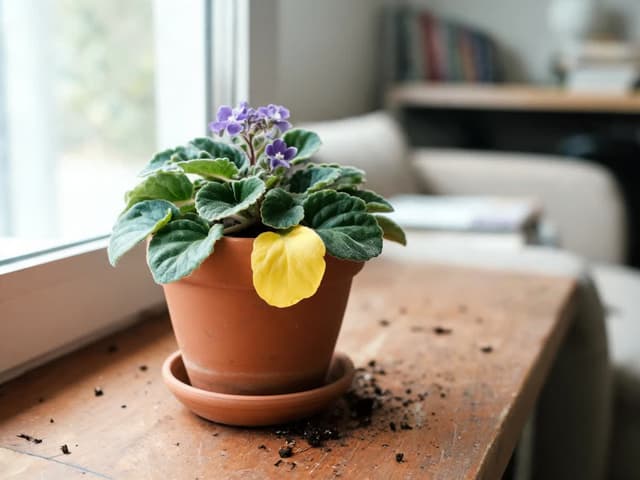
African Violet Yellow Leaves: Causes and What to Do
Yellow leaves on an African violet usually stem from overwatering, and the first place to check is the center of the plant. Losing one lower leaf at a time is normal. Identify whether age, watering, cold water, sunlight, cold drafts, or fertilizer is the culprit based on the yellowing pattern, and see what to do today.