How to Propagate Desert Rose: Seeds or Cuttings
A cutting duplicates the mother plant's flower, but only seeds produce that thick base. Learn where to cut without harming the plant, what a Brazilian trial revealed about letting cuts dry before planting, and the right season in Brazil.
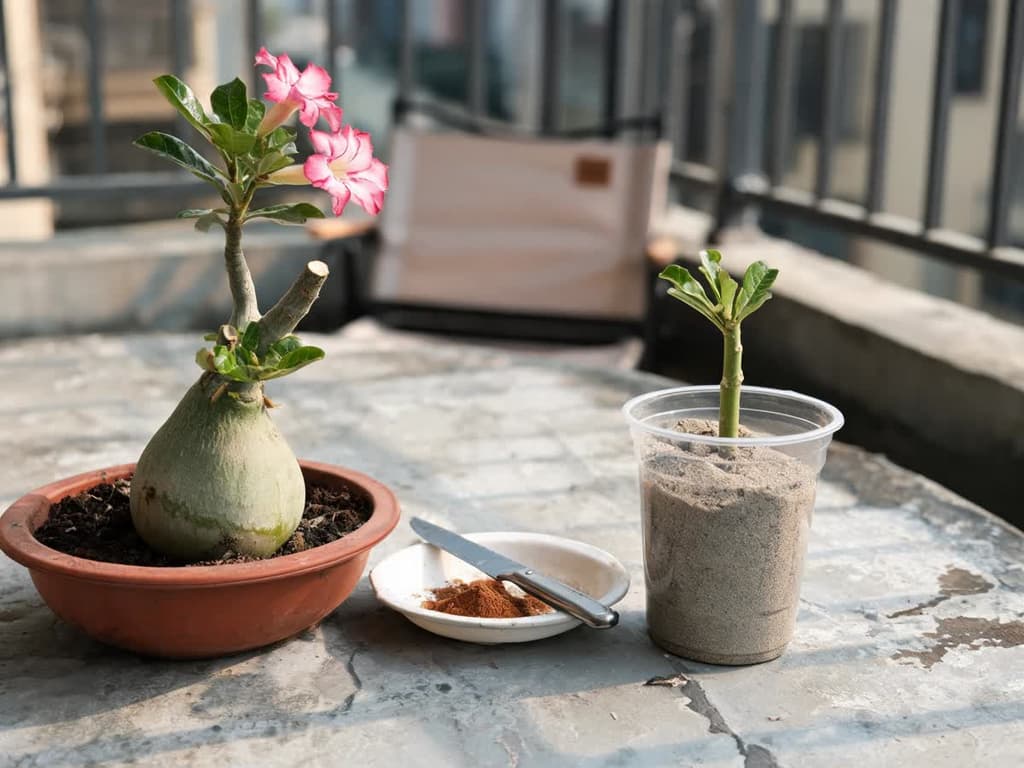
To propagate a desert rose (Adenium obesum), there are three paths, and the difference between them lies in the final outcome. A rooted cutting turns into a plant identical to the mother plant, carrying the exact same flower color. A seed grows into a plant unlike any other, and it is the seed that forms the swollen base that makes a desert rose look like a miniature tree. Grafting (joining two plants into a single individual, the base of one with the branch of another) combines both traits.
Decide this before reaching for your pruning shears, because you cannot undo a cut. If you want a swollen base, sow seeds. If you want to replicate that specific flower, take a cutting.
Quick summary:
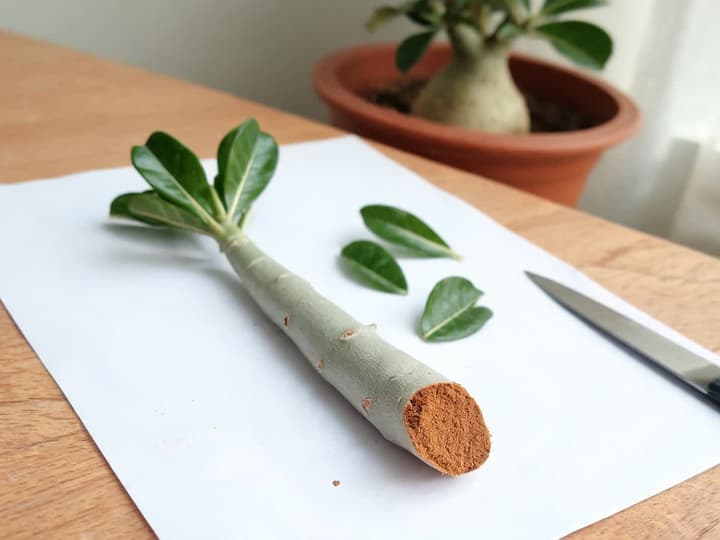
A tip branch, measuring 10 to 20 cm and bearing five leaves, is the proper cutting material, the stem piece that becomes a new plant. A thick branch from the base is not.
Always cut above the swollen base, never directly into it, using a blade sanitized with alcohol.
A Brazilian master's thesis tested letting the cut dry for 0, 3, and 6 days before planting, and cuttings placed in the sand on the same day as the cut came out ahead.
Seeds germinate in 3 to 5 days in a DIY plastic bottle greenhouse.
The milky sap is toxic. Wear gloves when taking cuttings.
The season in Brazil runs from September to March, while the plant is growing.
Seeds or cuttings: only seeds form the swollen base
The fat, smooth base that supports a desert rose's branches is called a caudex. It is a swollen, water-storing stem that forms right from the seedling stage: in a seed-grown plant, this rounded base already appears between the root and the first two leaves within the first few weeks of life.
The branch lacks this base. A cutting is a piece of stem, and it produces thin lateral roots, not the thickened stem at the base. Over the years these roots thicken, and Brazilian growers often expose them during repotting to form what they call a pseudocaudex, a false caudex made of root. The website Jardineiro.net, which teaches cutting propagation for the species, states this plainly: desert roses propagated by cuttings do not form a caudex, and what you get is this false caudex.
No published research includes a trial comparing, side by side, the base of a seed-grown seedling with that of a branch cutting of the same age. Growers' practice and what is visible in the seedling support this claim. The survey by Janúsia Cabral on seedling production of the species, defended at the Federal University of Alagoas in 2023, records that seed propagation is the most widely used method among growers because it is more efficient and cheaper, and it provides the variation in caudex and flower color that interests breeders.
Not every seed-grown desert rose thickens the same way. The az1953 bulletin from the University of Arizona Extension, written by Michael Chamberland in 2021, lists irregular caudex formation specifically among the weak points of Adenium obesum. Sowing seeds greatly increases the chances; it does not guarantee a specific result.
Kalanchoe accepts both paths: cuttings grow from a 5 to 8 cm stem segment, and its leaves also root. With desert rose, leaves will not produce a plant. Only stems and seeds do.
Where to cut the branch without damaging the mother plant
Cut the tip of a branch, above the swollen base, making an angled cut. Never cut into the caudex: it is the plant's storage organ, and any wound there is large, slow to heal, and sits exactly where pot water collects.
The procedure used in Brazilian trials is as follows:
Clean the blade with 70% alcohol before cutting. Utility knife or pruning shears, it does not matter, as long as it cuts in a single stroke.
Clean it again when moving to another plant. Technical Communiqué No. 5 from the Federal Institute of Espírito Santo (IFES) insists on this: that is how you avoid carrying disease from one desert rose to the next.
Make an angled cut, above the swollen base. A beveled cut increases the surface area that will contact the sand.
Choose a tip branch, 10 to 20 cm long. Tip branches root; thick base trunks are not suitable propagation material.
Keep five leaves at the top and remove the rest. This is the standard adopted by stem propagation trials, and too many leaves evaporate water that the cutting cannot yet replace.
Apply powdered cinnamon to the cut left on the mother plant. The same technical bulletin recommends cinnamon on any cut to protect the wound while it heals.
Two things to avoid: do not cut during a cold week, because after pruning the plant can enter dormancy and stop growing. Do not cut during periods of heavy rain either, when rot risk is highest. Both caveats come from that same IFES bulletin.
Do you need to let the cutting dry before planting?
If the cutting is a branch tip, no: the only published trial in Brazil that tested this measured higher survival and more roots in cuttings planted on the same day as the cut than in those that waited 3 or 6 days. The recommendation to let them heal before planting is nursery practice, and the measurement did not confirm it.
Flávia Clemente de Oliveira tested the subject in the master's thesis in Agronomy she defended at the State University of Mato Grosso do Sul in 2021. The experiment ran from June to October of that year in Paranaíba, Mato Grosso do Sul, using 192 cuttings. They were divided into three curing times (planting on the day of the cut, 3 days later, or 6 days later), crossed with four treatments: nothing, powdered cinnamon, rooting hormone (IBA), and both combined. The cuttings were evaluated 119 days later.
Survival rate of cuttings, in percentages:
Curing time | Cinnamon + IBA | Cinnamon | IBA | Untreated |
|---|---|---|---|---|
Planted on the day of the cut | 75.0 | 68.8 | 75.0 | 62.5 |
3-day wait | 43.8 | 43.8 | 25.0 | 68.8 |
6-day wait | 50.0 | 37.5 | 31.3 | 6.3 |
The study concluded that planting on the day of the cut produced more rooting, more growth, and more mass, showing that curing periods were not justified. Cuttings planted immediately also developed more roots per cutting and the longest root in the trial. Cuttings left six days without any treatment survived in only 6.3% of cases. Waiting alone does not protect; it dehydrates.
The trial had a narrow scope. The cuttings were still-tender branch tips taken from seed-grown plants about eight months old and 18 to 22 cm tall. They were cut above the caudex and planted in washed, sterilized coarse sand inside a mesh house providing 30% shade. This is not the thick, woody branch typically produced when pruning a mature specimen.
If you are cutting the tip of a branch, plant it the same day, dusting cinnamon at the base. For thick, woody branches, or for a cut that keeps weeping sap after several minutes, letting it sit in the shade for two or three days remains standard nursery practice. There is no trial data advising against waiting in that specific scenario. What the data disproves is the idea that waiting is universally better.
Cinnamon also performed well in the trial. Combined with rooting hormone, it produced the best rooting and the highest root count. And among cuttings left waiting for six days, cinnamon alone maintained survival at 37.5%, compared to 6.3% for untreated cuttings.
Step-by-step stem propagation
With the cutting in hand, the rest goes quickly:
Washed coarse sand, no soil. This is the substrate used in both Brazilian trials and in the Portuguese-language propagation guide. Potting soil and compost come later during transplanting, not during rooting.
A small container. The trial used pots holding about 240 ml, roughly the size of a coffee cup. An oversized pot retains standing water around the cutting.
Powdered cinnamon at the base, with or without rooting hormone.
Bury about one-third of the stem and press the sand around it so it stands firm.
Keep the sand slightly moist at all times, never waterlogged. This is where most cuttings fail: excess water rots the base, while completely dry sand aborts roots before they emerge.
Bright light without direct sun during the first few weeks.
Rotting is the most common failure, and it has a telltale appearance: the base darkens and softens, while the entire branch wilts from the top down. When this occurs, the cutting will not recover, and the cause is almost always stagnant water in the sand.
Sources differ on the timeline. The Mato Grosso do Sul trial evaluated plants at 119 days; Brazilian guides suggest six months before transplanting. A reliable indicator is not found on a calendar. Give the cutting a gentle tug: if it resists, roots have taken hold. New leaves opening and remaining firm for two weeks serve as the second confirmation sign.
Once the cutting roots, care shifts to standard succulent watering, where the criterion is letting the soil dry out entirely before the next watering. To mix the permanent substrate, the drainage ratios apply to the entire genus. Peperomia propagates through a method desert rose does not support: a single leaf can grow into a whole plant.
Can you save a broken branch?
Yes, following the same procedure as a normal cutting, with one extra initial step. A break leaves a ragged tear with exposed fibers and crushed tissue, which gives fungi an easy entry point. Before anything else, trim the base with a clean, angled cut using a sterilized blade, moving up a few centimeters until you reach firm tissue.
After that, treat it like any ordinary cutting: cinnamon on the base, slightly damp coarse sand, one-third buried, and bright light without direct sunlight.
Two situations are not worth the effort. The first is when the broken fragment is too short, lacking any tip growth. The second is when the break is already darkened and soft, indicating that rot set in before you intervened. In that second scenario, cut above the blackened area and evaluate what remains.
Propagating from seed: germination in 3 to 5 days
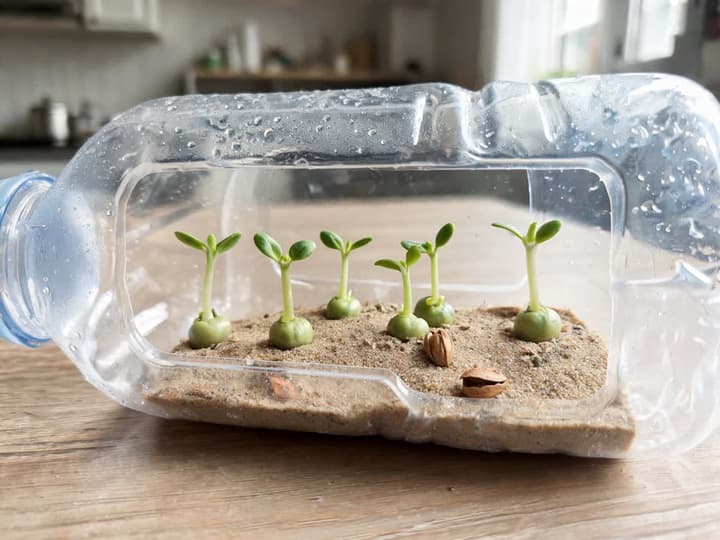
Desert rose seeds are fast. Technical Communication No. 5 from the Federal Institute of Espírito Santo, published in 2020 by the graduate program in agroecology at the Alegre campus, describes an inexpensive homemade greenhouse and provides the timeline: between 3 and 5 days the seeds begin to germinate, and around 10 to 12 days the seedlings can already move to individual small pots.
The greenhouse is a horizontal 2-liter plastic bottle with a window cut into the top. Inside goes a layer of light, well-draining soil, the substrate, moistened with a solution of 1 liter of water and 5 ml of bleach. The seeds lie on the surface, lightly covered, and the bottle is sealed with plastic wrap and left in a bright, warm spot, but out of direct sunlight. Whenever it dries out, moisten it again.
Temperature affects the outcome the most. A study by Marivone Santos and colleagues published in the Multi-Science Journal of the Instituto Federal Goiano tested different ranges: at 25 °C germination reached 85%, with the fastest germination rate in the trial. Moderate, steady heat, therefore, with the bottle out of direct sun.
Your plant probably will not produce seed pods on its own, and that is what makes seeds expensive. The same IFES bulletin notes that, in Brazil, the insects that would handle pollination dislike the bitter taste of the sap, so few flowers get pollinated. To harvest seeds from your own desert rose, you need to pollinate by hand using a toothpick, transferring pollen from the flower of one plant to the flower of another, choosing flowers that have been open for at least three days.
Retailers and growers recommend fresh seeds, which makes sense, but there is no published data on the rate of viability loss for Adenium obesum seeds during months of storage. Buy from sellers who state the harvest date, and sow as soon as the seeds arrive.
The caudex develops within the first year. Flowers take longer; growers report a wait ranging from one to three years, depending on sunlight, warmth, and pot size.
Grafting explains store-bought desert roses
If your desert rose came from a plant fair or store already showing a fat base and double flowers in an unusual color, it is likely grafted: a seed-grown caudex at the bottom, and a branch from a chosen variety on top. This is the way to combine the two advantages that seeds and cuttings cannot deliver on their own. The species profile from the North Carolina State University Extension lists grafting alongside seeds and cuttings as a recommended propagation method.
This detail alters how you prune the plant. Shoots emerging below the graft union belong to the rootstock, the base plant supporting the graft, rather than the variety you purchased, and their flowers will look different. Letting these shoots grow allows them to steal vigor from the scion, gradually returning the specimen to its rootstock variety.
Double flowers with multiple overlapping petals are a recent development in the species. The Arizona Extension bulletin notes that this mutation was only achieved in adeniums in recent years, with much of the breeding work centered in Southeast Asia. That is why striking, heavily petaled plants typically arrive grafted rather than seed-grown.
The sap is toxic: put on gloves before cutting
The desert rose releases a milky white latex when cut, and this latex is toxic. The ASPCA, the American animal protection association, classifies Adenium obesum as toxic to dogs, cats, and horses, and identifies the toxic principle as cardiac glycosides, a group of substances that acts on the heart. The Arizona Extension bulletin explains why the plant has this sap: the desert rose has no thorns, and the toxic sap is its defense.
Caution matters more here than during routine plant care, because propagation is the only time you deliberately wound a desert rose. In practice:
Wear gloves. If sap contacts your skin, wash it off with soap and water.
Do not touch your eyes or mouth while pruning.
Wash your blade and work surface when you finish.
Collect cut trimmings immediately and discard them out of reach of dogs, cats, and young children. A loose cutting on the ground is prime chewing material for a dog.
Crotons demand the same precaution for the exact same reason, and their milky sap also stains and irritates.
The best time to take cuttings in Brazil
September to March, while the plant grows actively. This corresponds to the Brazilian spring and summer, when warm temperatures stimulate bud break and give cuttings enough energy to establish roots.
Winter in Brazil runs from June to August, and this is when the desert rose slows down, needs less water, and can lose its leaves. The IFES bulletin advises against pruning in the cold for this exact reason: after pruning, the plant can enter dormancy and stall its development. Taking cuttings in the middle of winter means asking for roots from a plant that has stopped growing.
If an English-language guide suggests spring is best, check which hemisphere it assumes. Spring in the northern hemisphere spans March to May, while their winter runs from December to February, coinciding with peak summer in Brazil. Calendars in those sources are shifted by six months.
In winter, the plant's pace shifts entirely, and watering drops in tandem with its slowed metabolism.
Frequently asked questions
What is the best month to propagate a desert rose?
Between September and March, throughout the Brazilian spring and summer. During this window the plant is actively growing, and heat triggers bud formation, helping stem cuttings strike root. Avoid June, July, and August: cool weather slows the plant down, and cutting it then can trigger dormancy.
How many days does it take for a desert rose cutting to root?
There is no single timeline. The Brazilian trial tracking apical cuttings evaluated specimens at 119 days, while national plant guides suggest up to six months before transplanting. Instead of tracking days, tug the cutting gently: resistance means roots have formed.
How long do desert rose seeds take to germinate?
Between 3 and 5 days in a DIY plastic bottle greenhouse, according to Technical Bulletin No. 5 from the Instituto Federal do Espírito Santo. By 10 to 12 days, seedlings can be moved to individual pots. The optimal temperature sits around 25 °C.
What is the best substrate for sowing desert rose seeds?
A light, fast-draining substrate kept damp without becoming soggy inside the closed mini-greenhouse. For rooting cuttings, Brazilian trials relied on washed coarse sand free of garden soil. Potting mix and compost come later, after roots have formed and the plant moves to its final pot.
Will a stem cutting ever develop a swollen base?
The swollen base formed by seed-grown plants does not develop on stem cuttings. Over time, growers expose thickened roots during repotting to build a simulated caudex. If you want a truly bulbous base, propagate by seed.
Where to begin
Pick your approach based on your objective:
You want a fat base: sow seeds. Purchase seed stock marked with harvest dates, construct a plastic bottle greenhouse, and look for a visible caudex within the first year.
You want an exact bloom match: take a 10 to 20 cm branch tip with five leaves, cut at an angle above the caudex, coat the base in cinnamon, and insert it into coarse sand that very day.
Someone handed you a fresh cutting today: treat it as a cutting immediately; do not save it for tomorrow.
If you are not certain whether the houseplant you have is a true desert rose or another caudiciform succulent, Bloom identifies the species from a single photo. Propagation methods depend on the specific plant, and a quick scan clears up any doubt before you cut.
A rooted plant requires the same full sun as the mother plant, and that exposure determines whether it blooms. The following guides cover species that thrive outdoors under that level of light.
Related articles
How to Care for a Maidenhair Fern: Light, Water, and Revival Tips
Learn how to care for a maidenhair fern indoors: bright indirect light, consistently moist soil, high humidity, and how to revive it if it dries out completely.
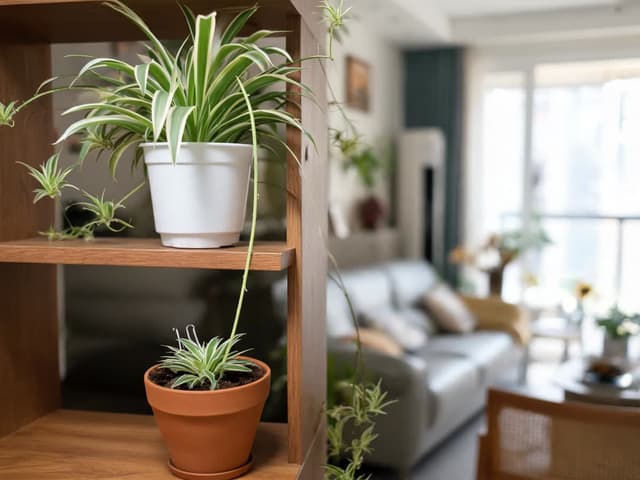
How to Propagate Spider Plants: Root the Pup Before Cutting
The safest spider plant cutting comes from a pup still attached to the mother plant: rest the plantlet on soil in a small pot, wait for roots to establish, and only then cut the stolon. Learn when the pup is ready, whether rooting in water is worth it, how to divide the clump, and why plants fail to produce babies.
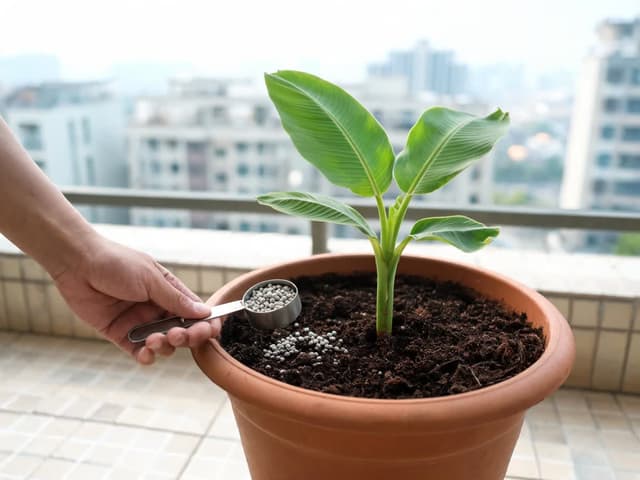
Banana plant fertilizer: fertilizing potted and backyard plants
Banana plant fertilizer needs more potassium than nitrogen, in a 3-1-6 ratio. For a potted plant on a balcony, use the label dose in spring and summer. In the backyard, fertilize every 2 months, adjusting the amount by mat age. Learn the formula, timing in Brazil, and signs of deficiency or excess.