How to Care for Camellias in Pots or the Garden: Light, Acidic Soil, Water, and Cold
How to care for camellias in pots or the garden: partial shade, acidic soil, and watering so the soil never dries out in summer. Learn when to prune and why buds drop.
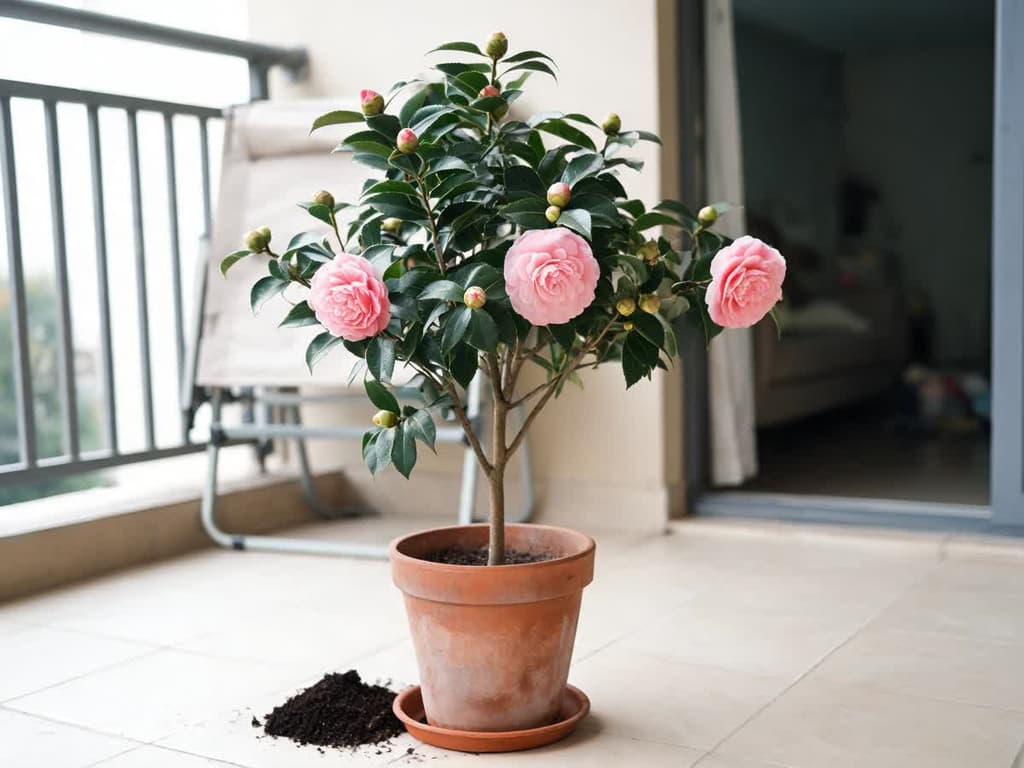
To care for a camellia, place the plant in partial shade, protected from intense afternoon sun and wind. Plant it in loose, acidic soil, and water so the soil stays moist without becoming waterlogged. In summer, do not let the soil dry out: this is when the camellia sets buds for its next bloom. Prune only right after the flowers finish blooming.
If your camellia is dropping its buds, the cause is usually watering, cold, heat, or fertilizer, not a dying plant. The exception is root rot, which also causes bud drop. This year's blooms might be lost, and the underlying cause often occurred months earlier. Do not cut the branches back now, and avoid moving the pot around: first pinpoint the cause using the table in the section on buds.
The figures in this guide come from university extension services in the United States, university programs that publish guidance for plant growers. These include NC State (North Carolina State University), UF/IFAS (University of Florida), and Clemson (South Carolina). They also come from the Royal Horticultural Society (RHS, the British horticultural society) and the international and American camellia societies. These sources are from the Northern Hemisphere. Because of this, the guide refers to seasons and mentions a specific month only when stating "in Brazil."
Quick summary:
Japanese camellias (Camellia japonica) prefer partial shade, with direct sun for only 2 to 6 hours per day, according to NC State.
The ideal soil is acidic, with a pH (a measure of acidity; below 7 is acidic) between 5.5 and 6.5 in most sources. The University of Florida accepts levels down to 5.0.
Winter flower buds form during the preceding summer. Dry soil at that time causes buds to drop months later (RHS, NC State).
Prune right after flowering. Cutting back later removes the buds for the following year (NC State).
Camellias in pots or the garden: care at a glance
The table applies to Japanese camellias. Sasanqua camellias have their own light requirements, explained right below.
Care | What to do | Source |
|---|---|---|
Light | Partial shade; direct sun for 2 to 6 hours per day, without intense afternoon sun | NC State, UF/IFAS |
Soil | Acidic (pH 5.5 to 6.5), loose, and well-draining | NC State, American Camellia Society |
Watering | Soil constantly moist, never waterlogged; never dry in summer | American Camellia Society, RHS |
Water | Rainwater whenever possible; avoid prolonged periods using only lime-heavy tap water | RHS |
Fertilizer | 1 or 2 times per year, in spring; none from mid-summer onward | UF/IFAS, RHS |
Pruning | Right after flowering, lightly and only as needed | NC State, Clemson |
Repotting | Every 2 or 3 years, into a moderately larger pot | American Camellia Society |
Cold | In the ground, tolerates frost; in a pot, the roots suffer more | NC State, International Camellia Society |
Dogs and cats | Classified as non-toxic to dogs, cats, and horses | ASPCA |
Where to put your camellia: light and location
Japanese camellias bloom best in partial shade. NC State defines partial shade as direct sun for only part of the day, from 2 to 6 hours. The University of Florida (UF/IFAS) warns that deep shade is also detrimental: foliage thins out and the plant blooms poorly.
Strong midday and afternoon sun causes the most scorching. The International Camellia Society states that this sun scorches the leaves, fades the flowers, and can dry out the buds. WSU, Washington State extension, links sunburn to full sun and south- or west-facing walls. In Brazil, the equivalent is north- and west-facing walls.
In Brazil, the side of the house that receives the most sun is the north-facing side. For Japanese camellias, prefer an east-facing balcony or window, which receives only morning sun. In frost-prone areas, the International Camellia Society and the RHS recommend avoiding the east: morning sun scorches frozen flowers. The south-facing side works for some varieties, according to the International Camellia Society, provided there is no dense shade from trees or buildings. Avoid the west-facing side, which gets strong afternoon sun, and the north-facing side, which receives sun all day long. Also protect from wind: Clemson states that camellias bloom best away from full sun and drying winds.
Sasanqua camellias (Camellia sasanqua) have smaller leaves, simpler flowers, and bloom earlier, in autumn. They tolerate more sun than Japanese camellias, according to the RHS and the American Camellia Society. If the label says "sasanqua," it can stay in a sunnier spot.
Camellias indoors
Camellias do not do well in warm, enclosed rooms. According to the International Camellia Society, the hot, dry air of heated homes causes leaf drop and can kill the plant. Warm night temperatures also cause buds to drop, according to the University of Connecticut (UConn) Extension.
If you want to keep your camellia indoors, choose the coolest, brightest room, far from heaters and fireplaces. UConn cites a nursery owner who recommends winter night temperatures of at most 15 °C (59 °F). This figure comes from a single nursery; no other source in this guide provides an indoor temperature target. When in doubt, a camellia fares better on a bright, sheltered porch than in the living room.
Did your camellia start dropping leaves right after you turned on the heating, even though the soil is still moist? Hot air is the primary suspect. Move the pot to the coolest, brightest spot in the house. Do not water more to address the leaf drop: when soil is already moist, adding more water only encourages root rot.
Acidic soil for camellias
Camellias require loose, well-draining, acidic soil. NC State recommends a pH below 6.0 and notes that camellias do not tolerate alkaline soil. The American Camellia Society cites 5.5 to 6.5 as the ideal range, while UF/IFAS accepts 5.0 to 6.5. The RHS summarizes it this way: where rhododendrons (relatives of azaleas) grow well, the soil will also suit camellias. The sources diverge on the lower limit. A Spanish study evaluating 4 potted Japanese camellia varieties identified 4.5 to 5.5 as optimal, noting that 2 of them grew worse at higher pH levels. When in doubt, aim close to 5.5, which falls within both guidelines.
In containers, use commercial soil formulated for azaleas and camellias, sold as acid-loving plant mix. The American Camellia Society advises against regular garden soil in pots because it compacts. It also advises against fine peat moss, which either gets waterlogged or dries out excessively. Azaleas need the same acidic soil and low-lime water, so both plants can share the same bag of potting mix.
How to water camellias
Camellias thrive in soil that is consistently moist but never soggy, according to the American Camellia Society. In pots, water when the top layer of soil feels dry to the touch, until water flows out through the drainage hole. No source in this guide specifies a fixed watering frequency for pots: the soil dictates the timing, not a calendar. Never leave standing water in the drainage saucer. In the garden, the RHS recommends digging down about 4 inches (10 cm): if the soil feels dry at that depth, water thoroughly.
Summer watering directly influences blooms the following winter. The RHS explains that letting soil dry out in summer causes buds to drop in winter. UF/IFAS highlights the opposite danger: camellias are sensitive to overwatering, and roots rot if the soil stays excessively wet.
Prioritize rainwater. The RHS warns against watering for extended periods with lime-rich tap water, known as hard water, which reduces soil acidity over time. If only tap water is available, use it anyway. The International Camellia Society states that any water is better than none, because letting the soil dry out causes far more harm.
Fertilizing camellias: when and how much
Camellias need little fertilizer. UF/IFAS notes that one or two applications per year are plenty, using a fertilizer with equal parts nitrogen and potassium and low phosphorus. Nitrogen and potassium are the first and third numbers on the label (NPK); phosphorus is the middle number. The ideal timing is spring, according to the RHS.
Stop fertilizing by mid-summer. The RHS states that feeding too late or too heavily causes bud drop. UF/IFAS explains the other hazard: fertilizing in late summer or fall stimulates tender new growth that the first cold snap will burn.
Sources diverge on acidifying fertilizer for azaleas and camellias. UF/IFAS reserves this fertilizer for established garden camellias and does not recommend it for young or potted plants. The RHS uses ericaceous fertilizer in containers as well. This guide follows UF/IFAS, which is a university extension service. In containers, ericaceous potting mix and soft water keep the soil acidic.
Too much fertilizer shows on the leaves. Clemson says that burned leaf margins and heavy leaf drop usually indicate excess fertilizer. The Connecticut Agricultural Experiment Station adds another sign: a white crust on the rim of the pot or on the soil surface. To flush out the excess, run water through the pot for about 20 minutes.
Why camellia buds drop
Camellia buds drop from too little or too much water, late fertilizer, cold, or heat. Often, the cause happened months before the drop. Common camellias set buds in summer, starting around mid-season, according to the International Camellia Society. In Brazil, summer runs from December to March. The buds grow until blooming, which in Brazil runs from fall to the end of winter, depending on the variety.
Each source lists slightly different triggers. This table compiles the causes cited across them:
Cause | When it happens | Source |
|---|---|---|
The plant set more buds than it can support | Shortly before flowering; some buds drop, not all | Clemson, NC State |
Dry soil during summer | During bud set, months before the actual drop | RHS, Clemson, NC State |
Overwatering or root rot | At any time; accompanied by yellowing leaves | NC State, American Camellia Society |
Fertilizer applied too late or in excess | From mid-summer onward | RHS, International Camellia Society |
Severe cold or frost | In winter, once buds have already formed | RHS, International Camellia Society |
Rapid transition from warm, humid conditions to extreme cold | Right as the weather shifts | International Camellia Society |
Warm nights, low light, indoor environment | When kept indoors | UConn, Connecticut Agricultural Experiment Station |
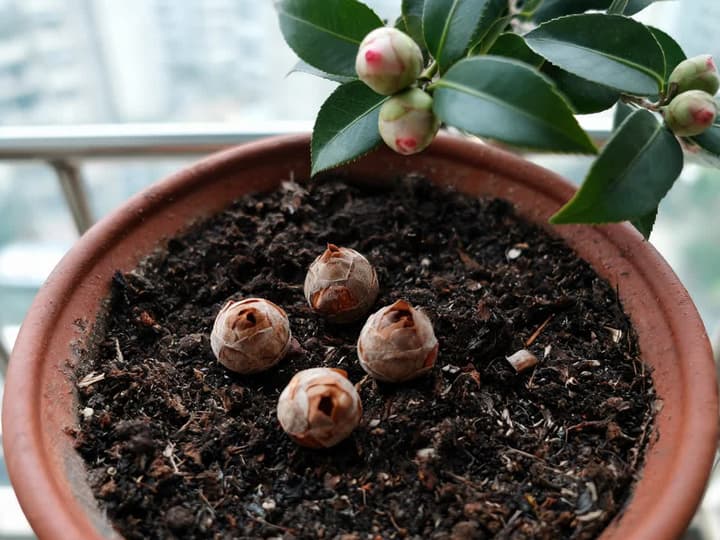
No source in this guide differentiates between sudden drop and gradual drop. First evaluate what changed over the past week: a night of frost, a sudden heat wave, or soil that completely dried out. Next, assess last summer's watering routine, which can also trigger bud drop months later. The Connecticut Agricultural Experiment Station notes that consistent care and even watering (avoiding fluctuations between bone-dry and soggy soil) minimize dropping.
Moving the pot does not appear as an independent cause in any of the university extension sources. What changes when you relocate the plant is light exposure, temperature, and how quickly the soil dries out, all three of which appear in the table. If you already moved your camellia, leave it in its new location, provided the spot is bright, cool, and sheltered from harsh afternoon sun.
Neem oil helps only if pests are present. Use it solely if you spot scale or spider mites on the foliage (refer to the pests section). Avoid cutting back branches to "rescue" the plant: pruning now removes buds waiting to open. The right time to prune is immediately after flowering.
Yellow leaves on camellias
Yellow leaves on camellias trace back to four primary causes, and leaf location helps distinguish them. The RHS notes that camellias shed older foliage periodically, even though they are evergreen. If yellowing is restricted to older leaves near the base and deep inside the canopy during spring or summer, it is natural shedding.
Yellow leaves with green veins indicate chlorosis, an iron and micronutrient deficiency (such as manganese) that leaves foliage looking pale. NC State and the RHS link chlorosis to soil or water that lacks sufficient acidity. NC State recommends treating with chelated iron (a form of iron plants can absorb even in less acidic soils). The RHS cautions that chelates are costly and require annual reapplication. The permanent remedy is acidic soil and rainwater. If your garden soil is alkaline, the RHS advises growing camellias in containers using an acid-loving potting mix.
Uniform yellowing paired with wilting and soggy soil points straight to root issues. Clemson links this condition to root rot. Tiny yellow specks on the leaf surface accompanied by white or brown scales on the undersides indicate scale insects. Each cause leaves its mark on a distinct part of the leaf. The camellia yellow leaves guide features photos of these common culprits.
Can camellias handle cold and frost?
Planted in the ground, Japanese camellia tolerates frost. NC State rates the species for zones 7 to 9 on the United States cold map (USDA). In zone 7a, the coldest of these, the average winter low is between −18 and −15 °C. The RHS rates Japanese camellia as slightly more cold-hardy than sasanqua.
In containers, camellias tolerate less cold than in the ground because the roots lack surrounding soil insulation. The International Camellia Society confirms this and warns that risks increase if the potting soil is waterlogged. None of the sources cited in this guide provides a specific minimum temperature threshold for container-grown camellias.
Ahead of a freezing night, move the pot into a sheltered, unheated space like a garage or enclosed porch. Is your pot too large to move? The RHS and the International Camellia Society suggest wrapping it in multiple layers of bubble wrap, from the ground up to the rim. Mulch the surface soil with dry leaves.
Frost typically damages buds and open flowers first, while mature foliage proves fairly resilient, according to the RHS. Tender new shoots also suffer in hard freezes. This is another reason to avoid late-summer fertilizing.
Pruning camellias: right after blooming
Prune camellias right after they finish blooming. NC State explains why: next year's flowers emerge on growth that forms early in the season, and later pruning sacrifices that upcoming bloom. UF/IFAS confirms that pruning in late summer or fall shears off developing buds.
Camellias require minimal pruning, according to Clemson. Trim dead or broken stems along with leggy shoots that distort the plant's shape. Cut flush back to the originating branch without leaving stubs, as advised by the American Camellia Society. Avoid shearing the whole shrub with hedge trimmers. UF/IFAS notes that shearing creates a dense outer leaf canopy that blocks light from reaching the inner branches.
A hard rejuvenation prune removes one-third to one-half of the plant, according to the American Camellia Society. Severe pruning should also take place immediately after flowering. Expect very few buds, if any, the following year. Normal bud production resumes by the second season, according to the American Camellia Society. The RHS suggests it may take two years or more for the shrub to bloom well again.
Repotting and planting
Container-grown camellias need fresh soil every 2 to 3 years, according to the American Camellia Society. After that duration, the mix degrades, becomes dense, and traps excess moisture. Shift into a larger pot, but avoid overpotting. No source in this guide sets a rigid pot-size limit. The society's example steps up from a 1-gallon (4-liter) pot to a 3-gallon (11-liter) pot after 2 years. The RHS warns that an oversized pot promotes root rot, since unoccupied soil retains moisture for too long.
Always plant shallow. The root ball is the mass of roots and soil from the nursery container. UF/IFAS directs that its top should sit 1 to 2 inches (2.5 to 5 cm) above the surrounding soil level. Camellias do not tolerate deep planting. The International Camellia Society explains that the root flare (where the trunk meets the roots) requires airflow. Many young plants die because this junction ends up buried and rots.
Camellia decline: when it is serious
Root rot is a severe issue for container-grown camellias. The American Camellia Society notes that potted specimens are especially vulnerable to it. Clemson highlights that all Japanese camellia varieties are susceptible, whereas sasanqua varieties show resistance.
The American Camellia Society lists the earliest warning signs: yellowing, stunted, or soft leaves, dieback on twig tips, and buds that stall or drop prematurely. To confirm, slip the plant out of its pot and inspect the roots. Clemson describes diseased roots as reddish-brown to dark brown; healthy roots are white.
If your camellia is losing leaves and lack of water is not the cause, do not fertilize. The International Camellia Society compares fertilizing a sick plant to serving a banquet to someone critically ill. First find the cause through the roots, the soil, and the location.
Camellia pests and diseases
The most damaging camellia pest is tea scale, according to Clemson and UF/IFAS. It forms white and brown scales across the underside of leaves, producing yellow speckles on the upper surface. UF/IFAS recommends insecticidal soaps and horticultural oils over synthetic insecticides, as they spare natural beneficial predators. Apply 2 to 3 treatments, spaced 7 to 10 days apart, thoroughly coating the undersides of the leaves. Learn how to identify and treat scale.
Two-spotted spider mites appear during hot, dry weather with poor ventilation, according to UF/IFAS. They leave foliage with a bronzed appearance and fine webbing or dust on leaf undersides. Treatment steps appear in our spider mite guide.
Blooms that turn brown rapidly may suffer from camellia flower blight, a fungus attacking flowers in cool, damp conditions (WSU). Clemson distinguishes this fungus from frost damage by dark brown veins running through the petals. Sanitation provides the best control: pick off infected blooms and rake up fallen petals from the ground.
Unsure what you are seeing on your foliage? Bloom (available for iOS) identifies plants from a photo and, on the Premium plan, offers issue diagnostics.
How to propagate camellias
The easiest propagation methods for camellias are stem cuttings and air layering, according to UF/IFAS. Air layering encourages roots to form on a stem while it remains attached to the parent plant. A cutting is a severed shoot prepared to generate roots. It is taken from spring growth that has hardened off by mid-summer.
Japanese camellias root slowly. A study from Mississippi State University found that relatively few varieties root readily from cuttings. The Southern California Camellia Society notes that root establishment takes anywhere from several months to a full year. Seeds will not produce an exact clone: the RHS explains that seedlings rarely match the parent plant.
Are camellias toxic to dogs and cats?
The ASPCA, an animal poison control center in the United States, classifies the Japanese camellia (Camellia japonica) as non-toxic to dogs, cats, and horses. The ASPCA page provides only the classification, without a list of symptoms. The classification applies to this species. The Japanese camellia profile on Bloom contains the other plant details.
Frequently asked questions
How many times a year do camellias bloom?
Camellias bloom once per year. Japanese camellias open their flowers between fall and late winter, depending on the cultivar. Individual shrubs remain in bloom for 3 to 4 weeks, according to NC State. Sasanqua camellias bloom earlier, in autumn, and stay in flower for 4 to 6 weeks.
Can camellias stay outdoors in winter?
Yes. Planted in the ground, Japanese camellias tolerate frost. Based on the hardiness zones assigned by NC State, they withstand winter average minimum temperatures between −18 and −15 °C (0 to 5 °F). In containers, roots are more vulnerable to freezing temperatures. On frosty nights, relocate the container to a sheltered, unheated spot or wrap the pot in bubble wrap.
What do camellias dislike?
Camellias dislike alkaline (lime-rich) soil, waterlogged roots, intense afternoon sun, dry winds, and overheated indoor rooms. They also dislike deep planting. The root flare where the trunk joins the roots must sit slightly above ground level, according to UF/IFAS.
When should you cut a camellia back hard?
A severe rejuvenation prune, removing one-third to one-half of the shrub, should take place immediately after flowering, according to the American Camellia Society. Expect few to no buds the following year. The RHS notes that it may take two years or longer before the plant blooms vigorously again.
Related articles

How to Care for Hibiscus: Sun, Watering, Fertilizer, and Pruning for Flowers
How to care for hibiscus: 6 hours of direct sun, evenly moist soil without waterlogging, half-strength fertilizer in spring and summer, and pruning in early spring. Find out why the flower lasts one day and why buds drop before opening.

Do Ferns Like Sun or Shade? It Depends on the Type
Ferns prefer bright shade: plenty of light, but no direct sun on their fronds. Tuberous sword fern is the exception that handles sun. Here is the ideal light for each type, where to place pots, and how fronds show too much or too little light.

African Violet Yellow Leaves: Causes and What to Do
Yellow leaves on an African violet usually stem from overwatering, and the first place to check is the center of the plant. Losing one lower leaf at a time is normal. Identify whether age, watering, cold water, sunlight, cold drafts, or fertilizer is the culprit based on the yellowing pattern, and see what to do today.