Dying String of Pearls: How to Save a Plant with Mushy Beads
String of pearls dying with mushy beads? That means overwatering and rot. Run three tests, cut the firm strands, and save the plant through cuttings step by step.
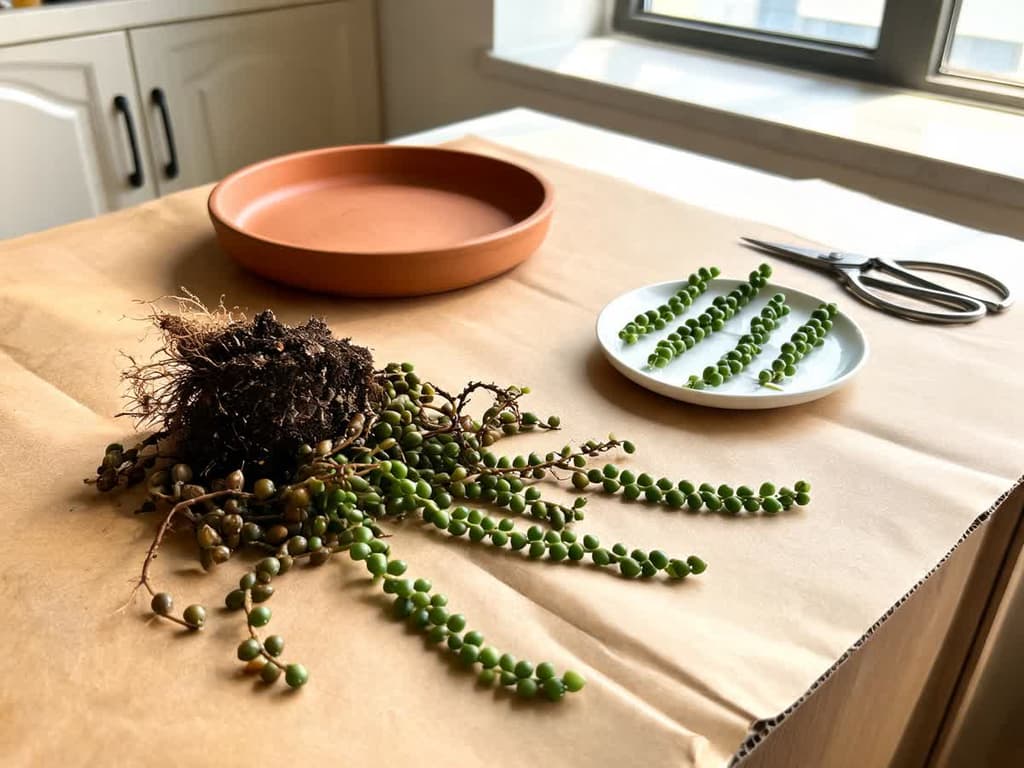
If your string of pearls is dying with mushy beads and the soil is damp, the cause is overwatering. The roots or the base of the strands (the long stems hanging from the pot) have already begun to rot. A mushy bead will not become firm again. What saves the plant are the strands that still have firm, green beads. Cut those strands today and take cuttings, pieces of stem that grow roots in the soil.
The mother plant (the original plant) only stays in the pot if the base of the strands is firm and part of the root system is white. Clemson University Extension recommends discarding the plant when most roots are dark, mushy, and dead. To see which situation applies to you, unpot the plant and run the three tests in this guide before cutting anything.
Can you save a string of pearls with mushy beads?
You can save a string of pearls (Curio rowleyanus, also sold as Senecio rowleyanus) as long as there are strands with firm beads. What changes is how much of the plant remains. The table summarizes the decision based on what you find when you take the plant out of its pot.
What you find | What to do |
|---|---|
Firm, green base of the strands, firm white roots, few mushy beads | Remove the mushy beads, wash the pot, replace the soil, and repot the plant |
Firm base, some mushy, brown roots | Trim off the rotted roots and repot into fresh soil in a clean pot |
Brown or black ring on the stem at soil level | Cut each strand above the ring, take cuttings from the firm section, and discard the darkened base |
Most roots are dark and mushy | Discard the mother plant and take cuttings from the firm strands |
No strands with firm beads | Nothing left to save: discard the plant and the soil |
The fourth row comes from Clemson's criteria for houseplants. NC State Extension, the agricultural extension service of North Carolina State University, makes a similar recommendation for this species. NC State notes that string of pearls tends to decline after a few years. For that reason, it advises renewing the plant from cuttings rather than trying to revive the old plant.
Mushy bead, shriveled bead, or bare pot crown: identifying the issue
Each bead on a string of pearls, the green sphere, is a round leaf filled with water. Touch helps distinguish three different problems. Gently squeeze a bead on each strand before making any decision.
Mushy bead that yields to touch, sometimes yellowish or translucent: overwatering. Waterlogged roots rot, and the rot can also reach the stem base, according to University of Illinois Extension.
Shriveled or pointed bead, but firm to the touch: usually underwatering. University of Wisconsin Extension advises watering when the leaves begin to shrivel. If the soil at the bottom is wet, the cause can be rotted roots, which also make the beads shrivel.
Top of the pot bare of beads, with strand ends covered in beads: low light at the top or a buried crown. The crown is the point where the strands emerge from the soil. Retailers Plantify and Love That Leaf link this sign to light and the crown, without providing measurements.
Each bead has a darker, translucent stripe on one side. This stripe is normal: Wisconsin describes it as an epidermal window, an area of the leaf surface that lets light enter. The sign of trouble is the entire bead turning mushy.
Shriveling is misleading because it appears at both extremes. NC State notes that string of pearls shrivels from both underwatering and overwatering. Iowa State University warns that root rot symptoms are often mistaken for underwatering. Therefore, the university advises checking the roots and soil moisture before watering again. The page on shriveled leaves on string of pearls lists other causes of shriveled beads, such as aphids, mealybugs, and cold.
Three tests before cutting your string of pearls
These three tests reveal whether the problem is limited to the beads, the stem, or the roots. Run all three in order, with the plant out of its pot.
1. Soil at the bottom of the pot. With the plant already unpotted, press the soil at the bottom of the root ball with your finger. Soil at the bottom that still wets your finger without recent watering and with a dry surface points to overwatering.
2. Stem at soil level. Part the strands and inspect the base of each one. Clemson Extension describes stem rot as a ring of brown or black tissue circling the stem. This ring sits at or near the soil line. A strand with this ring is already rotted at the base, and the only usable part is the firm section above the ring.
3. Roots. Remove the soil with your fingers and inspect the roots. According to Iowa State, healthy roots are firm, white, and full of fine feeder roots. Rotted roots are mushy and brown or reddish. Gently pull a dark root. With rot, the outer root sheath slips off easily, leaving only the central core behind, as another Iowa State publication describes.
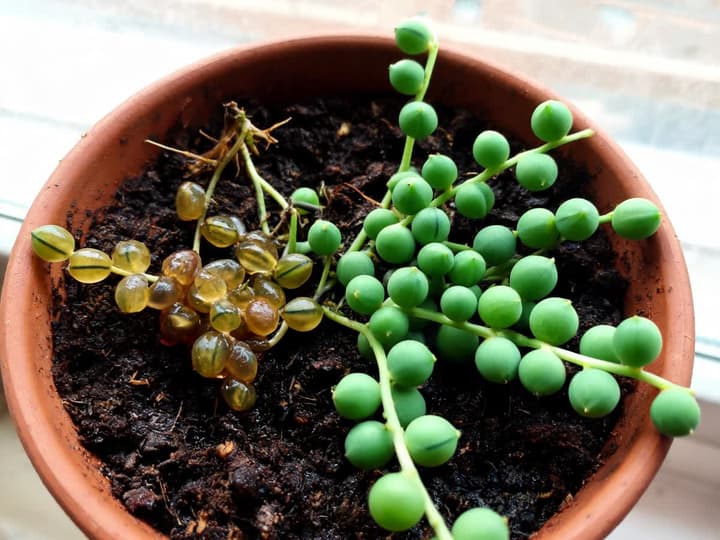
Pythium, Phytophthora, Rhizoctonia, and Fusarium are among the fungi and fungal-like organisms that cause root rot, according to Iowa State. They multiply in wet soil where water drains slowly. Wisconsin notes that root rot from overwatering is the most common cause of death for string of pearls.
Root rot is among the recorded problems for string of pearls:
How to save a string of pearls step by step
Saving a string of pearls with rot means removing everything mushy, separating what is firm, and repotting in dry, fresh soil. Wear gloves, as the plant's sap irritates the skin, according to NC State.
Stop watering starting today, and only water again when the firm beads begin to shrivel.
Remove the plant from the pot and loosen the old soil with your fingers without pulling on the strands.
Sort the strands. Strands with firm beads and green stems go to one side; mushy beads and soft or dark stems go into the trash.
Clean your pruners with 70% alcohol before the first cut and again after every cut into rotted tissue.
Cut away mushy, brown roots until only firm, white roots remain. Clemson recommends trimming rotted roots and repotting when rot affects only some roots.
Discard the old soil. Rot pathogens persist in soil and plant debris, according to Clemson.
Wash the pot before reusing it. Clemson directs scrubbing the pot and rinsing it in a solution of 1 part bleach to 9 parts water.
Repot in dry cactus mix, in a shallow pot with drainage holes, with the crown level with the rim. Wisconsin allows up to 1 part coarse sand, fine gravel, or pumice to 1 part soil.
Place the pot in bright light without direct sun, and do not water while the firm beads stay plump and round.
None of the consulted sources gives a set timeframe for the first watering after repotting a string of pearls. The safest approach is the rule for a healthy plant: water when the firm beads begin to shrivel. Waiting for the bead's signal follows the logic of callusing a cutting. Iowa State advises letting cuts dry for several days before planting.
If the mother plant had more viable strands than will fit in the new pot, take cuttings with what remains. Cuttings safeguard the plant if rot returns to the mother plant.
Rescuing from the tips: taking cuttings from firm string of pearls strands
A cutting is a severed strand section that develops roots in soil, and it is what saves a string of pearls when the base has rotted. Roots form at the nodes, the points on the stem where a bead grew.
Cut 8 to 10 cm pieces from the firm strands, always above any soft or dark section. Wisconsin recommends 8 to 10 cm (3 to 4 inches) and the RHS, the Royal Horticultural Society of the United Kingdom, recommends 10 cm.
Remove 3 to 4 beads from the bottom of each cutting, as Wisconsin recommends.
Let the cut dry for several days on a plate in the shade. Iowa State instructs letting succulent stem cuttings dry for several days until a callus forms, a dry barrier that seals the cut. This leaves the cutting less likely to rot before rooting.
Plant in a shallow pot with fresh cactus mix. Lay the cuttings across the soil or lightly bury the bare portion, covering the lowest nodes.
Keep the soil lightly moist, without wetting the beads, until roots take hold. Wisconsin recommends misting only the soil surface during this phase.
Wait about 1 month for the cutting to root. The RHS states that string of pearls cuttings root in about 1 month.
Sources differ on step 3 for cuttings. The RHS and Wisconsin place cuttings directly into moist soil. Iowa State instructs drying the cut first and includes the genus Senecio among stem-cutting succulents. This guide follows Iowa State for cuttings taken from a rotted plant. The cut is the entry point for fungi, and fungi were already in the pot. No one has compared the two methods side by side on string of pearls.
Put several cuttings in the same shallow pot: each rooted strand becomes a new strand in the pot, and the pot fills up faster. The plant's growing season runs from October to March in Brazil, but none of the sources consulted compare the timing for cuttings. When rescuing the plant, do not wait: today's firm strand may be mushy next week.
The step-by-step propagation guide for healthy plants is in our article on how to care for string of pearls. The same guide explains layering, which roots a strand resting on the soil while still attached to the plant.
When a string of pearls is beyond saving
A string of pearls is beyond saving when no strands have firm beads and green stems. In that case, there is no living tissue to take cuttings from. Rotted tissue cannot recover, and watering less from that point forward will not bring back what has already softened.
Discard the mother plant as well when most roots are dark and mushy, even if healthy strands remain. Clemson recommends discarding the plant in that case. The firm strands can still be used as cuttings.
Discard the soil along with the plant. Clemson notes that fungal spores spread through water splashes and contaminated soil. Do not reuse this soil in another pot.
Hydrogen peroxide, cinnamon, or fungicide on string of pearls
None of the consulted sources report tests of these three products on string of pearls. What saves the plant is removing the rotted tissue and changing the soil. The closest technical recommendation for each one is this:
Hydrogen peroxide: in a study published in HortTechnology in 2021, Goossen and Williams submerged orchid roots in hydrogen peroxide. The immersion lasted 3 minutes, at concentrations of 3%, 6%, and 12%. At 6% and 12%, the root was permanently damaged. At 3%, the damage was small. The authors recommend changing watering and care instead of using the product. The study is on orchids, and there is no measurement in succulents.
Fungicide: Clemson lists fungicides for houseplants. The extension warns that they likely cost more than a replacement plant for most indoor growers. With string of pearls, taking cuttings from firm strands costs less and gives you the plant back.
Cinnamon: none of the consulted technical sources tested cinnamon on succulent cuttings. The step Iowa State recommends for cuttings is letting them dry for several days.
How to keep string of pearls beads from going mushy again
Rot returns when the soil stays wet for too many days. Four adjustments eliminate the risk:
Water by checking the beads, not on a calendar schedule. Water when the beads turn pointed or begin to shrivel, while still firm. The soil at the bottom must be dry. Iowa State recommends watering based on plant need rather than a fixed day. Wisconsin directs letting the soil dry out completely between waterings, while NC State directs never letting it dry out completely. This guide follows the shriveled bead signal used by Wisconsin and the RHS. NC State does not provide a signal for when to water.
Use a shallow terra-cotta pot with drainage holes. Wisconsin explains that terra-cotta allows water to evaporate through its walls. As a result, the soil dries out faster than in plastic.
Water less in winter, from June to August in Brazil. The RHS directs watering very little or barely at all during this time, only if the beads shrivel.
Empty the saucer whenever water drains through, and never mist the beads, as the RHS recommends.
The RHS recommends bright light from an east- or west-facing window. In the summer, the RHS directs protecting the plant from direct midday sun, which scorches the beads. In Brazil, a north-facing window receives this sun. The pot weight test to tell when the soil has dried out is in the guide on how to water succulents.
If you are not sure whether the issue is rot, take a photo of the symptom. With the Premium plan, Bloom (available for iOS) diagnoses plant issues from a photo. The page on string of pearls rot lists other causes of rot in this plant.
Frequently asked questions about dying string of pearls
Will a mushy string of pearls bead become firm again?
No. A bead that has turned mushy from overwatering contains rotted tissue, and that tissue cannot recover. Remove the mushy beads along with any soft stem tissue. A shriveled yet firm bead usually indicates underwatering and rounds out again after watering, provided the soil at the bottom is dry.
Why do people put cinnamon on succulents?
Cinnamon is used on succulent cuts as a home fungicide, but none of the consulted technical sources tested this practice. Iowa State University recommends a different step for cutting ends: letting them dry for several days before planting. This reduces the risk of the cutting rotting.
Can you root string of pearls cuttings in water?
Iowa State University notes that most succulents do not root well in a glass of water. The retailer Love That Leaf reports rooting in water without measurements, and this guide follows extension advice. For cuttings taken from a plant with rot, lightly moist cactus mix is the safest route. The RHS states that string of pearls cuttings root in soil in about 1 month.
When should you water string of pearls after repotting?
Water when the firm beads begin to shrivel. None of the consulted sources specifies an exact number of days for this species after repotting. Repotting into dry soil and waiting for the bead's signal follows the principle of cutting calluses: the cut surface dries before receiving water.
Summary of rescuing string of pearls
Mushy beads and wet soil on a string of pearls point to overwatering and rot. Unpot the plant, inspect the stem at the soil line and the roots, and cut away everything soft. Repot the firm portion into dry cactus mix in a clean pot, and take 3- to 4-inch cuttings from the firm strands. If no firm strands remain, the plant cannot be saved.
Related articles
How to Care for Hibiscus: Sun, Watering, Fertilizer, and Pruning for Flowers
How to care for hibiscus: 6 hours of direct sun, evenly moist soil without waterlogging, half-strength fertilizer in spring and summer, and pruning in early spring. Find out why the flower lasts one day and why buds drop before opening.
Do Ferns Like Sun or Shade? It Depends on the Type
Ferns prefer bright shade: plenty of light, but no direct sun on their fronds. Tuberous sword fern is the exception that handles sun. Here is the ideal light for each type, where to place pots, and how fronds show too much or too little light.
African Violet Yellow Leaves: Causes and What to Do
Yellow leaves on an African violet usually stem from overwatering, and the first place to check is the center of the plant. Losing one lower leaf at a time is normal. Identify whether age, watering, cold water, sunlight, cold drafts, or fertilizer is the culprit based on the yellowing pattern, and see what to do today.