String of Pearls Care: Watering, Light, Pots, and Propagation
How to care for a string of pearls: bright light without midday sun, watering when the pearls lose their round shape, and a shallow terracotta pot. Propagate using 3 to 4 inch stem cuttings.
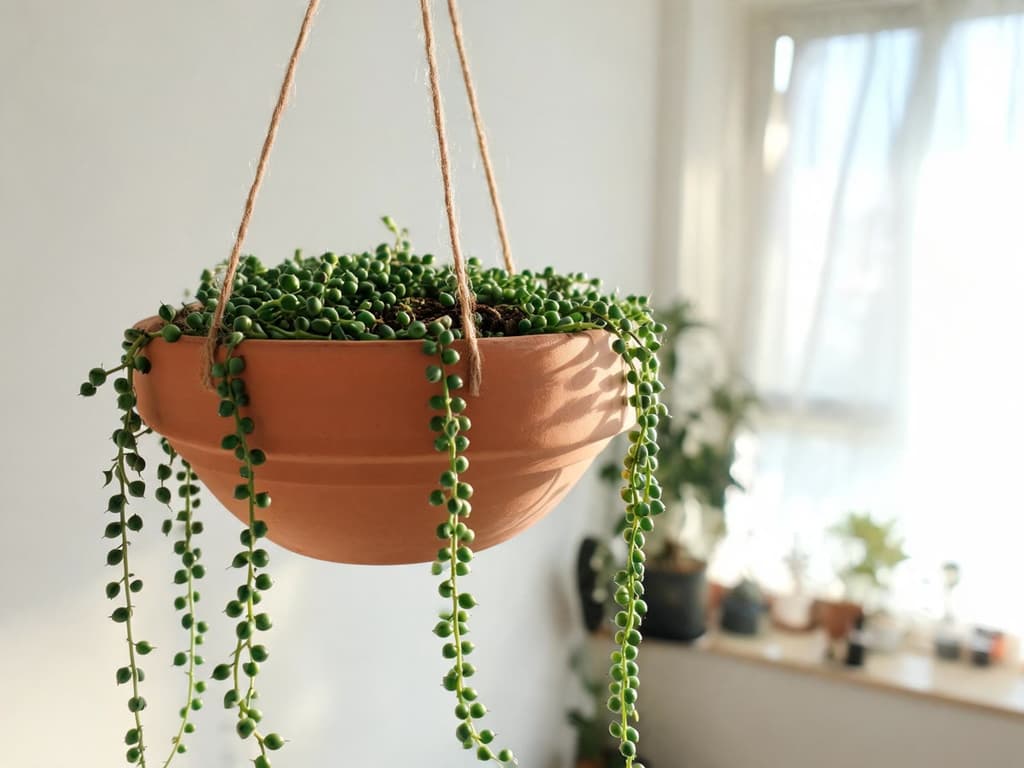
To care for a string of pearls, provide bright light without midday sun. Water when the pearls lose their round shape and become pointed or slightly wrinkled. Plant in cactus mix, inside a shallow terracotta pot with drainage holes, and keep the base of the stems level with the rim. The pearls are water-storing leaves, and their shape signals when to water.
If the top of your plant is soft and brown, stems that remain firm and green can become cuttings. If the pearls are shriveling and dropping, squeeze a pearl before deciding what to do. A firm pearl needs water, while a soft pearl calls for a pause in watering: underwatering and overwatering cause the pearls to shrivel in different ways. And if the base has rotted, cut off the green tips and root them. NC State Extension is the agricultural extension service of North Carolina State University. NC State notes that the plant tends to decline after a few years. It recommends renewing it via cuttings, a cut stem section that roots in moist soil, rather than trying to salvage the old plant.
String of pearls quick reference guide
Care | What to do |
|---|---|
Light | Bright light; morning sun helps; keep out of direct midday sun in summer |
Watering | When pearls become pointed or start wrinkling while still firm; little water, never leaving water in the saucer |
Soil | Cactus mix, or potting soil with coarse sand or perlite (light, white volcanic rock granules) |
Pot | Shallow, terracotta, with a drainage hole; only slightly larger than the current pot |
Temperature | 70 to 80 °F (21 to 27 °C) in warm periods; 50 to 60 °F (10 to 16 °C) in winter; frost kills it |
Fertilizer | Half the package strength, once a month or less, from October to March |
Propagation | Cuttings 8 to 10 cm (3 to 4 in) long; roots in about 1 month |
Pets | Mildly toxic: vomiting, diarrhea, and skin irritation |
Size | Stems 30 to 90 cm (1 to 3 ft) long (NC State) |
String of pearls, bead plant, or rosary vine: the plant's names
String-of-pearls and bead plant are common names for the same succulent, Curio rowleyanus. The name rosary vine also circulates, though it is ambiguous, as shown in the list below. It was described in 1968 as Senecio rowleyanus and moved to the genus Curio in 1999. The World Checklist of Vascular Plants is the plant name database maintained by the Royal Botanic Gardens, Kew, in the United Kingdom. It lists Curio rowleyanus as the accepted name and Senecio rowleyanus as a synonym. Both names continue to circulate in stores.
The plant is native to dry areas of the eastern Cape Province of South Africa, according to the University of Wisconsin Extension. In the wild, it grows along the ground under shrubs and rocks, rooting at every point where the stem touches the soil. These roots that form along the stem are what make cuttings so easy.
Four trailing plants sold under similar names are actually different species:
String of bananas (Curio radicans): long, curved, banana-shaped leaves.
String of dolphins (Curio × peregrinus): curved leaves like string of bananas, but branching out, resembling dolphins.
String of turtles (Peperomia prostrata): a trailing plant unrelated to string of pearls, according to the RHS.
Rosary vine or string of hearts (Ceropegia woodii): heart-shaped leaves. NC State also lists "rosary vine" as a name for string of pearls, so the name "rosary" alone does not identify the plant.
If you received the plant without a label, Bloom (available for iOS) identifies the species from a photo and distinguishes string of pearls from string of bananas and string of dolphins.
Why string of pearls leaves are round beads
Each bead is a whole leaf. The spherical shape exposes little surface area to dry air, so the leaf loses less water, explains the NC State plant profile for Curio rowleyanus. The beads measure 6 to 8 mm in diameter and have a small point.
Look closely, and you will see a darker, translucent stripe on one side of each pearl. This is the epidermal window: a strip of the leaf's epidermis without chlorophyll, letting light penetrate into the interior. The most widely repeated explanation, including by NC State and Wisconsin, is that the window increases the photosynthetic area inside the leaf.
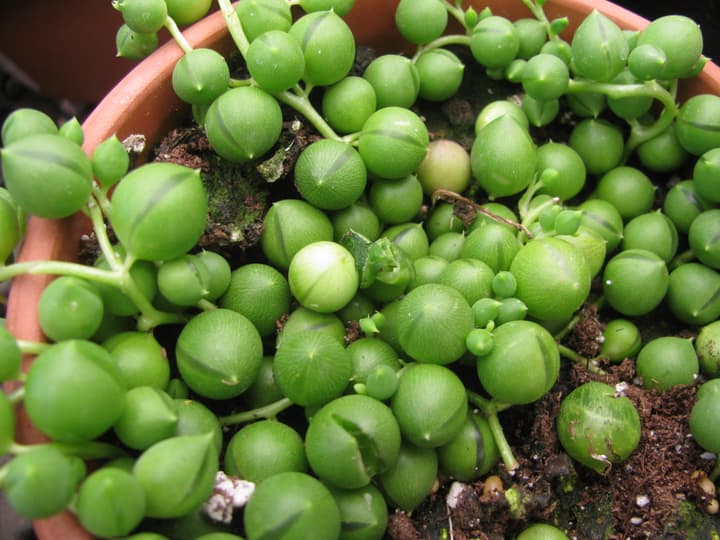
When measured, the expected gain did not appear. In 1999, Egbert and Martin covered the epidermal windows of string of pearls beads with reflective tape and compared them to uncovered beads. They measured CAM, the type of photosynthesis in succulents that absorbs carbon dioxide at night. The windows did not significantly increase CAM, and their function remains an open question. For growers, what NC State notes still holds true: the round shape reduces water loss. Therefore, a round, firm pearl shows that stored water remains.
How to water a string of pearls
Water string of pearls when the pearls lose their round shape and become slightly pointed or begin to wrinkle, but still feel firm to the touch. If the pearl feels soft, do not water: that indicates overwatering. Do not water while the pearls remain round and firm.
The three technical sources consulted (two university extensions and the RHS) disagree on letting the soil dry out. NC State says never to let the soil dry out completely between waterings. Wisconsin says to let it dry out completely. The RHS, the Royal Horticultural Society of the United Kingdom, says to let the soil dry out between waterings. This guide follows the leaf signal. Wisconsin instructs to water when the leaf begins to wrinkle, and the RHS gives the same signal for winter. None of the three sources cite measurements comparing these rules.
Both extremes kill the plant. NC State notes that string of pearls tolerates neither overwatering nor underwatering, and that waterlogged soil rots the roots.
The sources also differ regarding the amount of water to apply. The RHS advises watering sparingly during the growing season and never letting the bottom of the pot sit in water. Love That Leaf, a plant shop in New Zealand, advises soaking the soil until water drains out. This guide follows the RHS, which is the technical source: add water gradually until the soil is evenly moist, and empty the saucer if water drains through.
In winter, from June to August, water only when the pearls begin to wrinkle. The RHS recommends watering sparingly or barely at all during this phase. With cold days and low light, the soil takes much longer to dry.
Do not mist the pearls. The RHS states that these succulents dislike humidity and instructs never to mist. One of the shop guides we consulted (Happy Houseplants, from the United Kingdom) recommends misting and placing a water tray near the plant. This guide follows the RHS, because its recommendation comes from a horticultural society and the other comes from a shop.
General succulent watering methods, including the pot weight test, can be found in our guide on how to water succulents.
Does string of pearls like sun?
String of pearls likes bright light, but direct midday sun will scorch it. The RHS recommends an east- or west-facing window. In summer, move the plant out of direct midday sun, as instructed by the RHS. That sunlight burns the foliage.
In Brazil, a north-facing window receives the strongest midday sun. If the string of pearls sits in one, place a sheer curtain between the plant and the glass in summer. An east-facing window provides morning sun, which is the easiest to get right.
Too little light is also harmful. According to the RHS, insufficient light leads to long, sparse stems with smaller, widely spaced pearls. Retailers Plantify and Love That Leaf describe the signs of light failing to reach the crown, the point where the stems emerge from the soil. The top of the pot becomes bare, while the ends of the trailing stems stay full.
With hanging pots, ensure light reaches the top of the container, not just the trailing vines below. Plantify recommends lowering a hanging pot closer to the window if the top lacks light. In hanging planters, the crown receives less light than the trailing tips, a pattern seen with other hanging plants as well.
Soil, pot, and crown for string of pearls
String of pearls requires fast-draining soil. NC State recommends cactus potting mix or regular potting soil amended with sand or perlite. Wisconsin accepts up to 1 part mineral material (coarse sand, fine gravel, or pumice) to 1 part soil.
Use a shallow terracotta pot. String of pearls has a shallow root system. Because of this, Wisconsin recommends a shallow pot: the plant does not develop an extensive root network. Wisconsin also prefers terracotta over plastic or ceramic containers. Terracotta allows water to evaporate through its porous walls, drying the soil faster. Every pot must have a drainage hole.
Keep the crown level with the rim. The crown is the point where stems emerge from the soil. Two plant shops, Love That Leaf and Wintergreen, advise keeping the crown at the rim level of the pot. When the soil level sits well below the rim, the stems must climb up before trailing downward. Moreover, light cannot reach the crown, and airflow among the stems remains poor. According to Love That Leaf, this dark, stagnant base is where stems begin to rot and the top of the pot goes bald.
To raise the crown without repotting into a different container, carefully lift the plant out. Add cactus soil to the bottom until the crown sits flush with the rim, then set the plant back inside. Do not pile soil on top of the stems: burying the crown traps moisture around the base.
Repot every 1 to 2 years, as Wisconsin notes, or sooner if roots fill the pot. Choose a pot only slightly larger than the previous one, as the RHS recommends. Repot at the beginning of the growing season, in October or November in Brazil. A much larger pot holds more water than the roots can use.
Temperature and winter rest
String of pearls thrives between 70 and 80 °F (21 to 27 °C) during warm periods and prefers a cool winter between 50 and 60 °F (10 to 16 °C), according to NC State. The RHS warns that it dislikes temperatures below 50 °F (10 °C) and cold drafts. The plant tolerates cool temperatures briefly, but frost kills it.
Indoors, keep string of pearls away from air conditioning vents and exterior doors during winter. On a porch or patio, bring the plant inside on nights when frost is forecast.
Fertilizing string of pearls
String of pearls requires little fertilizer. The RHS recommends a general-purpose liquid fertilizer at half the label rate, once a month or less, only during the growing season. In Brazil, this season runs from October to March. From April to September, do not fertilize.
Our guide on succulent care explains how to dilute fertilizer and why excess salts burn roots.
How to propagate string of pearls
Propagate string of pearls with stem cuttings: take an 8 to 10 cm (3 to 4 in) stem section. Strip off a few pearls from the bottom end and place the bare nodes in contact with moist soil. A node is the point on the stem where a pearl was attached, and that is where new roots emerge. The RHS notes that cuttings root in about 1 month.
Starting backups is worthwhile even while the parent plant appears healthy. NC State records that string of pearls tends to decline after a few years and recommends renewing it from cuttings rather than trying to rescue an old plant.
Step-by-step soil propagation:
Disinfect shears with 70% rubbing alcohol and cut a healthy 8 to 10 cm (3 to 4 in) stem with firm, rounded pearls.
Strip 3 or 4 pearls from the bottom of the cutting, as recommended by Wisconsin.
Fill a small, shallow pot with the same cactus mix and moisten the soil.
Lightly press the bare stem portion into the soil, burying the lowest nodes, or lay the stem across the surface.
Pin the stem down with a U-shaped wire clip so the nodes stay in firm contact with the soil.
Place the pot in bright, indirect light and keep the soil lightly moist until roots establish.
To fill in a sparse pot crown, use layering. Layering is propagation done without severing the stem from the parent plant. Lay a long trailing stem across the surface soil of the same pot, still attached to the plant, and pin it down with a clip. The RHS describes this technique, securing the stem to the soil with a bent wire hairpin. Once the stem roots, you can sever its connection to the mother plant or leave it in place.
When watering cuttings, moisten the soil, not the pearls. Until roots form, Wisconsin recommends misting the soil surface rather than watering to avoid saturating a small pot. Mist whenever the surface dries out. Direct the mist onto the soil and only during this phase: mature plants should never be misted.
Single pearls can root, but progress is slower; water propagation relies solely on retail accounts. According to NC State, an individual pearl laid on the soil can form a plantlet, but it develops more slowly and less reliably than a stem cutting. None of the three technical sources consulted (NC State, Wisconsin, and the RHS) describes rooting cuttings in water. Love That Leaf places 10 cm (4 in) cuttings in water, keeping stripped portions submerged and pearl-bearing sections above the waterline, reporting roots in about 3 weeks. Because no technical source corroborates this method, soil cuttings remain the safest approach.
The best time to take cuttings is the growing season, from October to March in Brazil.
Shriveled, soft, or dropping pearls: what each symptom means
Pearls that are pointed or wrinkled, yet firm to the touch, indicate underwatering. Pearls that feel soft to the touch indicate overwatering. NC State notes that string of pearls shrivels from both lack of water and excess water. Sources diverge on the specifics: Wisconsin recommends watering when foliage wrinkles, while the RHS lists wrinkled foliage as an effect of overwatering. Touch differentiates between the two conditions, a practical rule outlined by retailers Love That Leaf and Plantify without comparative measurements.
What you see | Likely cause | What to do |
|---|---|---|
Pearls firm, but pointed, elongated, or with lengthwise grooves from stem to tip | Underwatering | Water the plant |
Pearls soft, translucent, wrinkled in all directions | Overwatering | Stop watering, let soil dry, and inspect the crown |
Pearls dropping at a touch, stem soft and mushy | Overwatering | Follow the stem rot steps detailed below |
Pearls dropping, but stems dry and shriveled | Underwatering or cold drafts | Water only if pearls are pointed or wrinkled; move plant away from drafty airflow |
Top of pot bare while trailing tips remain lush | Insufficient light at the crown or soil set too deep in the pot | Provide more light to the top and raise crown flush with pot rim |
Pearls develop dry, scorched patches on the window-facing side | Sunburn | Move out of direct midday sun |
The article on shriveled string of pearls leaves lists additional causes beyond this table, and our guide on dropping string of pearls leaves covers shedding triggers.
Stem rot at the base of string of pearls: what can be saved
A brown, mushy crown cannot recover, and moving the plant to dry soil will not heal rotted tissue. You can only salvage stems that remain green with firm pearls.
Cut healthy stems above the point where the vine turns brown or mushy, keeping only firm, green tissue on the cutting.
Discard soft, rotting pearls and mushy stems.
Throw away the old soil and wash the pot thoroughly with soap and water.
Plant the cuttings in fresh cactus potting mix in the clean pot, following the propagation steps.
Crown rot, which starts at the base of the stems, is among the problems reported for string of pearls:
Our page on rot in string of pearls distinguishes crown rot from root rot.
String of pearls flowers
String of pearls produces small white flowers just over 1 cm (about 1/2 in) across, featuring red filaments and yellow anthers in the center with a cinnamon scent, according to NC State. The RHS describes the bloom as resembling a small white or cream brush. NC State notes that the plant rarely flowers indoors. Wisconsin adds that a cool, dry winter rest can encourage blooming in summer.
String of pearls pests
The pests most frequently reported on string of pearls are mealybugs and aphids, according to Wisconsin and the RHS. NC State adds whiteflies, fungus gnats, and ants. Mealybugs appear as white, cottony tufts nestled between pearls and around the crown.
Is string of pearls toxic to cats and dogs?
Yes, string of pearls is mildly toxic to cats, dogs, and humans, according to NC State and Wisconsin. NC State classifies the toxicity as low. Leaves and sap contain pyrrolizidine alkaloid, the plant's toxic substance. Eating the leaves can cause vomiting and diarrhea, and the sap can irritate the skin. In a 2021 article on succulents and pets, the ASPCA cites string of pearls and states that ingestion can cause stomach upset, primarily vomiting, and lethargy.
The RHS takes a stronger stance: it labels the plant poisonous and notes that sap can cause severe skin irritation. Because none of the sources quantified severity, treat the plant according to the strictest warning: wear gloves during handling and keep pots out of reach of pets and children.
The ASPCA toxic plant database contains no dedicated entry for string of pearls under either botanical name. The entry for "Pearl Plant" in that database refers to a different succulent, a Haworthia species.
To live safely with string of pearls:
Hang the planter out of reach of cats that jump onto shelves.
Pick up any loose pearls that drop to the floor.
Wear gloves during pruning and propagation, as the sap irritates skin.
If a pet consumes pearls and vomits, call your veterinarian.
Our list of toxic plants for pets outlines risks associated with other common houseplants.
Frequently asked questions about string of pearls
Is string of pearls easy to care for?
String of pearls is easy to maintain when light and watering conditions align, and difficult when either fails. NC State characterizes the plant as very demanding: it does not tolerate excess water, lack of water, or low light. Watering by pearl shape rather than a set calendar schedule helps the most.
How long does a string of pearls live?
A string of pearls typically lasts a few years in the same pot before declining. NC State notes that the plant tends to die back after several years and advises renewing it via stem cuttings. Rooting fresh cuttings from healthy stems before the plant deteriorates ensures you preserve the plant across new pots.
Can you put coffee grounds on a string of pearls?
None of the three technical sources consulted recommends coffee grounds for string of pearls, and no reviewed source provides a tested dosage. The safe method is the RHS recommendation: general liquid fertilizer at half the package rate, applied once a month or less, from October to March.
Can string of pearls live in a bathroom?
A bathroom only works if it has a window supplying bright light, and even then a well-lit living area is superior. The RHS cautions never to mist these succulents because they dislike humidity, and shower steam leaves the crown damp. A room with an east-facing window provides morning sun without lingering humidity.
Summary of string of pearls care
String of pearls requires bright light without direct midday sun and watering when pearls lose their round shape. Plant in cactus mix within a shallow terracotta pot, keeping the crown level with the rim. From June to August, water only if pearls wrinkle. Take 8 to 10 cm (3 to 4 in) stem cuttings to renew the plant before it declines.
Related articles
How to Care for Hibiscus: Sun, Watering, Fertilizer, and Pruning for Flowers
How to care for hibiscus: 6 hours of direct sun, evenly moist soil without waterlogging, half-strength fertilizer in spring and summer, and pruning in early spring. Find out why the flower lasts one day and why buds drop before opening.

Do Ferns Like Sun or Shade? It Depends on the Type
Ferns prefer bright shade: plenty of light, but no direct sun on their fronds. Tuberous sword fern is the exception that handles sun. Here is the ideal light for each type, where to place pots, and how fronds show too much or too little light.

African Violet Yellow Leaves: Causes and What to Do
Yellow leaves on an African violet usually stem from overwatering, and the first place to check is the center of the plant. Losing one lower leaf at a time is normal. Identify whether age, watering, cold water, sunlight, cold drafts, or fertilizer is the culprit based on the yellowing pattern, and see what to do today.