String of Pearls: How Often to Water
There is no fixed schedule for watering string of pearls. Water when the pearls lose their round shape and turn pointed, while remaining firm. See what shifts the timing across summer and winter.
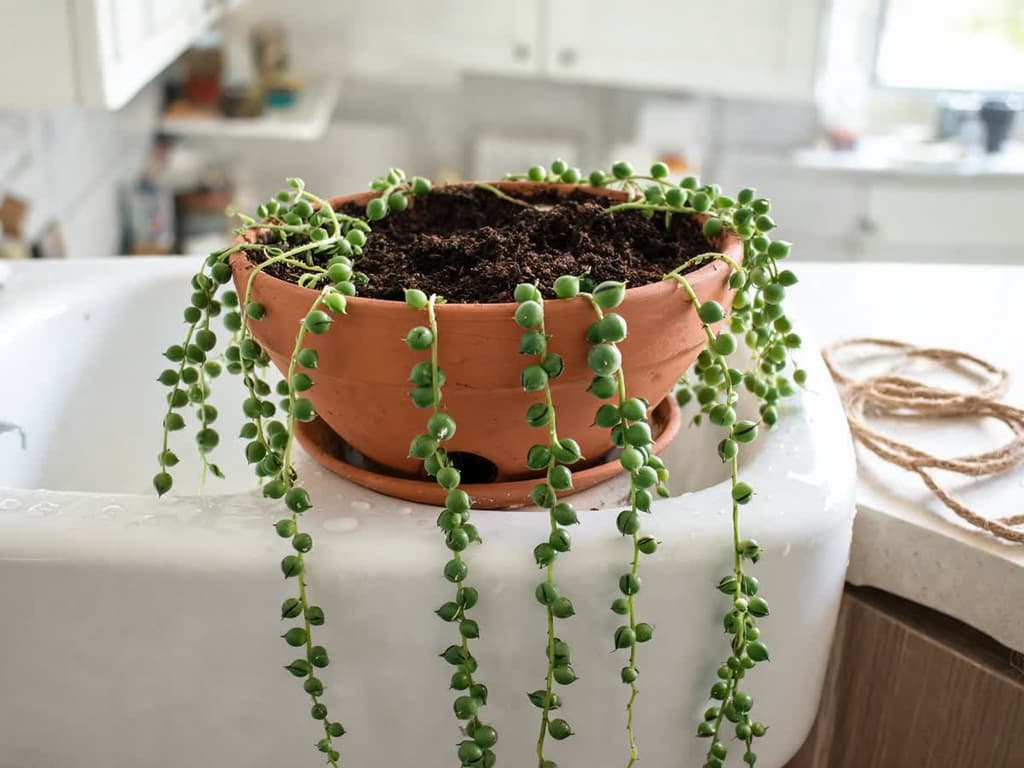
There is no fixed day to water string of pearls. Water when the pearls, the round leaves that store water, lose their round shape and become slightly pointed or puckered, but still firm to the touch. In the warm season, from October to March in Brazil, the pearls ask for water more frequently. From June to August, the plant asks for little to no water.
None of the three technical sources consulted gives a set number of days. These are NC State Extension, University of Wisconsin Extension, and the RHS (Royal Horticultural Society in the United Kingdom). The numbers circulating out there, from 7 to 30 days, come from plant shops and grower reports. They change with the pot, the light, and the warmth of the home. Because of that, the pearls dictate watering, and the calendar is only there to track dates.
How often to water string of pearls
Water string of pearls when the pearls ask for it, and record the date of each watering. The dates show the interval in your home for that time of year. That interval changes when the season turns, and tracking starts over.
The table shows where the most frequently repeated numbers come from:
Source | Warm season | Winter |
|---|---|---|
NC State Extension | No number; never let soil dry out completely | No number |
Wisconsin Extension | No number; more water than in winter | No number; cool and dry rest |
RHS | No number; water sparingly, letting soil dry out between waterings | Little or none; only if the pearl puckers |
Joy Us Garden (grower report) | Every 7 days | Every 14 days |
Plantura (shop) | Every 10 to 14 days | About once a month |
Lively Root (shop) | Every 7 to 14 days | Every 3 to 4 weeks |
The three technical sources also disagree on letting the soil dry out. NC State says never let it dry out completely, Wisconsin says let it dry out completely, and the RHS says let it dry out between waterings. This guide follows the signal from the pearls, which Wisconsin and the RHS use to determine watering.
Joy Us Garden's 7 days come from a warm and very bright home. Nell Foster, author of Joy Us Garden, grows in the Arizona desert. She waters once a week in the summer, with her home at 27 °C. She warns that, in another home, the plant may need water less frequently.
The same page from Lively Root gives three numbers for summer: every 7 to 14 days, every 2 weeks, and once a week. A number of days without the pot, the light, and the temperature does not tell you when to water your plant.
What shortens and what lengthens the watering interval
The interval between waterings for string of pearls depends on how long the soil takes to dry. Each condition in the table shifts that timing in one direction. The last two rows come from the blog of Mars Hydro, a grow-light manufacturer, and from the report by Joy Us Garden, without measurements:
Condition | Effect on interval | Source |
|---|---|---|
Warm season in Brazil (October to March) | Shorter: plant grows and uses more water | RHS, Wisconsin |
Winter in Brazil (June to August) | Much longer: little or no water | RHS, Wisconsin |
Terracotta pot | Shorter: water evaporates through the walls | Wisconsin |
Plastic or glazed ceramic pot | Longer: soil dries slowly | Wisconsin |
Small pot | Shorter: little soil to hold water | Mars Hydro |
Bright light and heat | Shorter: soil dries faster | Mars Hydro, Joy Us Garden |
If you repot the plant or move it to a new spot, go back to watering purely by the pearls' signal. The old schedule stops applying the day you make the switch.
The sign from the pearls: when to water and when to stop
Water when the pearl becomes pointed, elongated, or creased along its length, yet stays firm to a light squeeze. Stop watering when the pearl turns entirely soft or translucent, even if it looks puckered. A firm, shriveled pearl indicates lack of water; a soft pearl indicates excess. The RHS also lists puckered leaves as an effect of overwatering, which is why touch decides.
Wisconsin and the RHS use the shape of the pearl as the watering cue. Wisconsin says to water when leaves begin to pucker. The RHS states that in winter, watering only serves to keep leaves from shriveling. Each pearl is a leaf storing water.
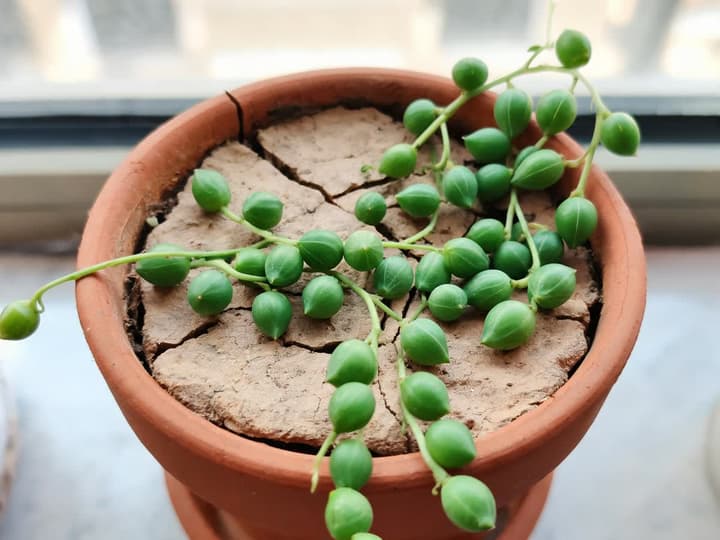
What you see on the pearl | Underwatering | Overwatering |
|---|---|---|
Shape | Pointed, elongated, wrinkled lengthwise | Puckered in all directions |
Touch | Firm | Soft |
Color | Green, with a translucent stripe on one side | Entirely translucent |
Soil | Dry all the way to the bottom | Still moist |
Stem near the soil | Firm | Soft or brown |
A puckered pearl with soil still moist calls for another check. NC State notes that the plant wilts both from too little water and from too much, and that waterlogged soil rots the root system. A puckered pearl in a still-wet pot points to excess water. In that scenario, do not water: slip the plant from its pot and check the roots.
Root rot is the problem overwatering creates in string of pearls:
The translucent stripe on one side of the pearl is normal: it is an epidermal window letting light enter the leaf, and it does not serve as a watering cue. Some store guides claim it closes when water is low, but none of the consulted technical sources describe that signal. Rely on the shape and touch of the pearl.
The page on string of pearls shriveled leaves lists other reasons for shriveled pearls. Crown rot, the base where strands emerge from the soil, along with step-by-step instructions to save green strands, are detailed in the guide on how to care for string of pearls.
How to water string of pearls
Water string of pearls right into the soil by moving the strands aside, without wetting the pearls. The RHS advises avoiding splashes on the foliage, watering sparingly, and discarding leftover runoff from the saucer. Pour water slowly until the soil is evenly moist.
Gently push the strands aside with your hand and pour water slowly around the crown, the base where strands emerge from the soil. Stop once water begins draining from the bottom hole. Let the pot finish dripping before setting it back on its saucer.
Soil that shrank and lets water drain right through
If water drains from the hole right after you pour it in, the soil may have shrunk and pulled away from the sides of the pot. New Mexico State University (NMSU) Extension explains the effect in a 2008 column. Water runs down the gap between the soil and the pot and exits through the hole. The soil in the middle stays dry.
To rehydrate this root ball, NMSU recommends bottom watering:
Set the pot in a basin with shallow water, without letting the pot float.
Wait until the soil surface darkens from moisture.
Lift the pot out of the basin and let it drain until dripping stops.
NMSU notes that this drainage also flushes out excess salts from the potting medium. To keep the soil from shrinking again, water as soon as the pearls ask for it, without waiting for the mix to pull away from the pot walls.
Hanging pots and cachepots
Take the hanging basket off its hook and water it over a sink or tub. This way you can watch water exit the drainage hole without wetting your floor. A cachepot is an outer decorative pot without drainage holes. If your nursery pot sits inside one, empty the cachepot after every watering, just as the RHS advises. Standing water at the bottom leaves the root zone waterlogged.
While the pot sits in the sink, inspect the crown too. A soft or brown stem at the crown signals rot: stop watering until the soil dries.
If the hanging basket came without a label, check the species before following this guide. String of bananas and string of dolphins, with their curved leaves, are different plants. Bloom (available for iOS) identifies the species from a photo.
Watering string of pearls in summer and winter
In the growing season, from October to March in Brazil, water sparingly, letting the soil dry between waterings, as the RHS instructs. The RHS marks this season from April to September, which are the warm months in the United Kingdom. In the heat, the pearls signal for water sooner.
During winter in Brazil, from June to August, water little or not at all. The RHS instructs watering only enough to keep the pearls from shriveling. Wisconsin advises a cool winter rest between 13 and 16 °C (55 and 60 °F) and notes that keeping soil dry during this phase can help encourage summer flowering. With cold days and lower light, soil takes far longer to dry.
Where winters stay warm, the plant continues growing and the pearls signal for water sooner. In that case, the months only serve as a general reference, and the pearls make the call.
Watering cuttings until they root
A cutting, the severed strand taken for propagation, does not yet possess roots to pull moisture from deep in the pot. Until roots establish, Wisconsin recommends misting the soil surface rather than pouring water. Mist whenever the surface dries out. Direct the spray onto the soil, never onto the pearls of an established plant.
The RHS notes that cuttings root in roughly 1 month. From that point on, water by the pearls' signal, just like an adult plant. The step-by-step cutting guide is in the string of pearls care guide.
How long string of pearls can go without water
No one has tested precisely how long string of pearls can survive without water. Retailers like Plantura cite 2 to 3 weeks, without stating which season or what type of container. Before traveling, water only if the pearls are already showing thirst signs, and drain the saucer.
Move the plant out of direct sun while you are away: under lower light, soil dries more slowly. Do not give it extra water to make up for your trip, because waterlogged soil sitting for days rots roots. The pot-weight check, which reveals whether soil has dried at the bottom, is in the guide on how to water succulents.
Frequently asked questions about watering string of pearls
Some pearls look puckered while others are soft. Should I water more or less?
Water less. A soft pearl indicates excess moisture, and when both signs appear together, handle it as overwatering. Let the soil dry out completely and check the crown where strands meet the dirt. If the crown is soft and discolored brown, salvage any remaining firm, green strands by taking stem cuttings.
I water every two weeks and my string of pearls is shriveling. What changed?
Watering every 14 days can be too little during hot spells and too much in the dead of winter. Give the pearls a light pinch before your next watering. If they feel firm and look pointed, shorten the interval; if they feel soft, pause and inspect the root system. If water runs straight out the drainage hole, the soil mix shrank: bottom-water in a basin.
Does misting the pearls replace watering?
No. The RHS states that these succulents dislike moist air and instructs never to mist the plant. Misting merely wets the pearls without reaching the roots. The only misting recommended, by Wisconsin, is on the surface soil for cuttings until roots form.
Is bottom watering better for string of pearls?
Surface watering directly onto the soil works for standard care. Bottom watering is the fix when potting mix dried out too far, shrank, and repels water poured from above. In that case, NMSU recommends setting the pot in a basin until the surface turns dark with moisture. Afterward, pull it out and let it drain completely.
Summary: how to water string of pearls
Water string of pearls when the pearls lose their round form and turn pointed, while staying firm. Do not water if the pearls feel soft. Apply water to the soil without wetting the foliage, and empty runoff from saucers and cachepots. In Brazil, from October to March, the interval shortens; from June to August, water little or not at all.
Related articles

How to Care for Hibiscus: Sun, Watering, Fertilizer, and Pruning for Flowers
How to care for hibiscus: 6 hours of direct sun, evenly moist soil without waterlogging, half-strength fertilizer in spring and summer, and pruning in early spring. Find out why the flower lasts one day and why buds drop before opening.

Do Ferns Like Sun or Shade? It Depends on the Type
Ferns prefer bright shade: plenty of light, but no direct sun on their fronds. Tuberous sword fern is the exception that handles sun. Here is the ideal light for each type, where to place pots, and how fronds show too much or too little light.

African Violet Yellow Leaves: Causes and What to Do
Yellow leaves on an African violet usually stem from overwatering, and the first place to check is the center of the plant. Losing one lower leaf at a time is normal. Identify whether age, watering, cold water, sunlight, cold drafts, or fertilizer is the culprit based on the yellowing pattern, and see what to do today.