Can Fig Trees Handle the Cold? Minimum Temperatures and Winter Care
A leafless fig tree can tolerate about 15 to 20 °F (−7 to −9 °C), but green shoots die just below 32 °F (0 °C). Learn the cold limits for each part of the plant, how to protect in-ground and potted fig trees from frost, and how to tell if yours survived.
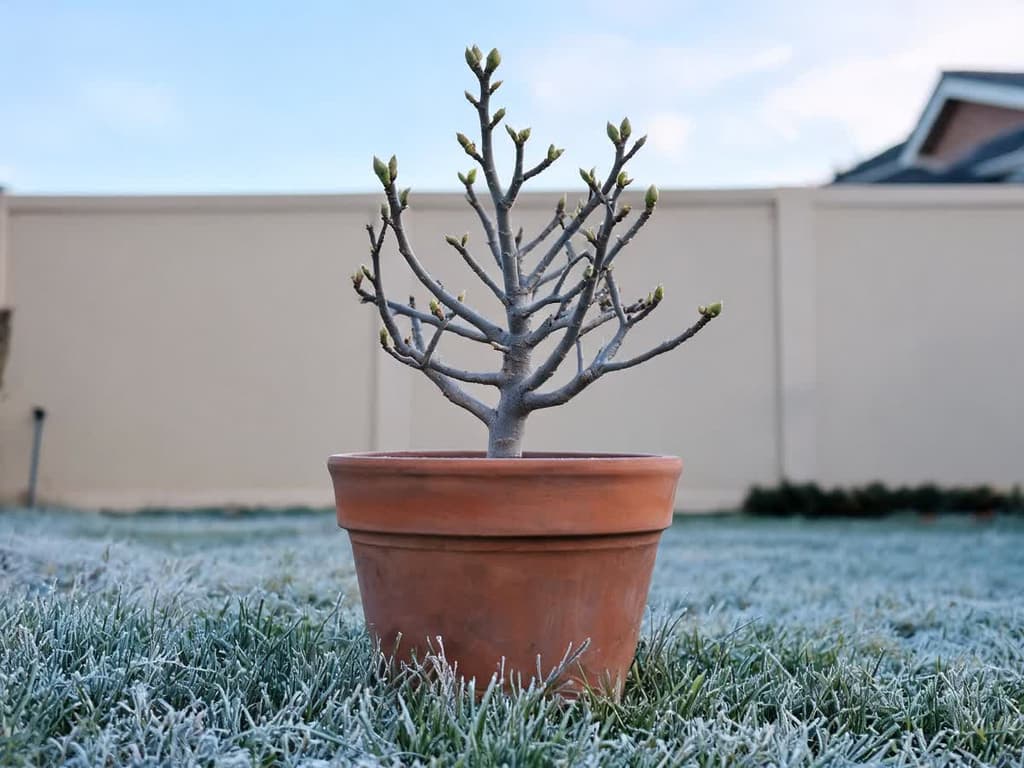
The fig tree (Ficus carica) withstands cold when dormant and leafless: in this state, it tolerates about −7 to −9 °C without serious damage, according to the University of Florida (UF/IFAS). However, green shoots and leaves die just below 0 °C. Because of this, the fig tree tolerates cold differently at each stage of the year.
In Brazil, almost every planted fig tree is the Roxo de Valinhos variety. It is the same variety that European nurseries sell as Brown Turkey, according to Embrapa Clima Temperado. Winter care applies where frost occurs, such as the South and the high-altitude areas of the Southeast.
Quick summary:
A dormant, leafless fig tree tolerates about 15 to 20 °F (−7 to −9 °C). Green shoots die just below 32 °F (0 °C).
In Brazil, the greatest danger is frost in late winter, when the fig tree has already begun to sprout.
On nights below 32 °F (0 °C), move a potted fig tree into an unheated shelter that stays above 32 °F (0 °C), watering once a month.
Frost-damaged fig trees usually sprout back from the base: wait for new growth to appear before pruning.
How cold can a fig tree tolerate?
A fig tree tolerates cold depending on the part of the plant and its current growth stage. Dormant wood (the wood of the branches) is the hardiest part. Buds (where shoots emerge) and green shoots are more sensitive to the cold than the wood.
Minimum temperature | What happens to the fig tree | Source |
|---|---|---|
Just below 32 °F (0 °C) | Green shoots and young leaves die | UF/IFAS (USA) |
25 °F to 27 °F (−3 °C to −4 °C) | Young fig trees suffer severe damage during an early frost, before entering dormancy | UC IPM, University of California (USA) |
25 °F (−4 °C) | After the fig tree leafs out, cold below this causes significant damage | INIAV (Portugal) |
21 °F (−6 °C) | Small overwintering figs that would produce the next crop die on the branch | INIAV (Portugal) |
15 °F to 20 °F (−7 °C to −9 °C) | A dormant, leafless fig tree tolerates this without severe damage | UF/IFAS (USA) |
10 °F (−12 °C) | The entire plant dies, including the base that could sprout back | INIAV (Portugal) |
The INIAV fruit growing manual, from Portugal's agricultural research institute, gives limits of 25 °F (−4 °C), 21 °F (−6 °C), and 10 °F (−12 °C). UC IPM, from the University of California, states that fig trees do well where winter temperatures do not drop below 15 °F (−9 °C). The same source warns that a young fig tree can die in winter between 21 °F and 18 °F (−6 °C and −8 °C).
Different sources give different limits for new shoots: UF/IFAS states that they die just below 32 °F (0 °C), while INIAV notes severe damage below 25 °F (−4 °C). This guide follows UF/IFAS, a university extension service, and protects shoots whenever the forecast calls for 32 °F (0 °C) or lower. This is the safest approach for your plant.
UF/IFAS adds a caveat regarding the 15 to 20 °F (−7 to −9 °C) limit. It applies to fig trees that entered dormancy gradually as cold set in slowly during autumn. The same publication states that below 32 °F (0 °C), dormant buds suffer before the wood does. Because of this, a dormant fig tree may lose some buds even without severe damage to its branches.
Cold-hardiest fig tree varieties
The fig varieties most often cited as cold-hardy are Brown Turkey, Brunswick, Celeste, and Chicago Hardy. The NC State Extension, a gardening service of a US university, lists all four as cold-hardy. UF/IFAS cites Brown Turkey and Celeste as hardier than many other varieties.
Variety changes the extent of the damage, and Clemson University publishes measurements of this. In a test with potted fig trees exposed to 15 °F (−9.4 °C), Verdal Longue suffered no damage. On Violette de Bordeaux, the cold killed branches to the ground. It resprouted from the base: it bore no figs that summer and produced heavily the following year.
Age and location also change the damage. A German nursery specialized in figs, Feigenhof, notes that thick branches tolerate more cold than thin branches. Because of this, young fig trees suffer more in any variety. NC State and Clemson recommend planting near a sunny wall, which radiates heat back at night. In Brazil, this is a north-facing wall.
Do fig trees need cold weather in winter?
The fig tree requires little to no chill. Embrapa Clima Temperado describes the species as having "little to no chill requirement" to break dormancy. This cold is measured in hours: the total accumulated time, in winter, when temperatures drop below a certain threshold. A study on pruning times for Roxo de Valinhos in western Paraná cites roughly 50 chill hours below 45 °F (7.2 °C) for this variety. The study appeared in the Revista Brasileira de Fruticultura in 2009. UF/IFAS reports up to 100 hours below 45 °F (7 °C).
Where winters remain warm, fig trees can keep their leaves year-round, according to INIAV. In the semi-arid São Francisco Valley, Embrapa reports that irrigated fig trees never go dormant. There, plants lose their foliage once irrigation stops and are pruned immediately afterward.
In the South and Southeast of Brazil, winter gives the fig tree a leafless break. The end of this break, when the buds swell, is the time for winter pruning, which prepares the next harvest. The cold itself is not what makes the fig tree produce.
Fig tree losing its leaves in the cold: when is it normal?
A fig tree sheds all its foliage in autumn and winter because it is deciduous, meaning it loses its leaves during the cold season. The leaves turn yellow and drop over a few weeks as the cold arrives. If branch tips remain firm with closed buds, this leaf drop is completely normal.
Leaf drop signals a problem in two situations. Leaves falling during hot weather with dry soil indicate a water deficit: Embrapa explains that drought-yellowed leaves drop even after watering resumes. Leaves turning black and soft overnight indicate frost damage. Other causes of fig tree leaf drop include diseases such as fig rust.
Fig rust causes reddish-brown spots on leaf undersides and makes foliage drop before autumn. UF/IFAS notes that the disease also reduces a fig tree's cold hardiness. Clemson recommends raking up fallen leaves in late autumn because fungal spores (the tiny particles that spread the fungus) overwinter on them.
In-ground fig trees: how to protect them from frost
Protecting an in-ground fig tree begins in late summer. UF/IFAS advises against fertilizing and watering heavily in late summer. Both practices cause the fig tree to put out new growth, and these shoots die just below 32 °F (0 °C). The University of Georgia (UGA) links winter injury to vigor (the plant's strong, rapid growth) and recommends half the fertilizer where the fig tree typically suffers from cold.
In autumn, mulch the soil around the base with dry leaves, straw, or pine bark. Clemson explains that mulch protects roots through repeated freeze-thaw cycles. If cold kills the branches, the plant resprouts from this protected base.
Young fig trees, during their first winters, need more protection in regions with hard frost. Follow the steps from the United Kingdom's Royal Horticultural Society (RHS):
Wait for the fig tree to drop all its leaves.
Wrap the branches with dry straw.
Cover the straw with frost cloth or burlap. Frost cloth is a specialized horticultural fabric sold at garden centers. Avoid plastic, as it does not allow air to circulate.
Remove the protection gradually once the fig tree begins to sprout. Keep the cloth handy to cover the plant on nights when frost is forecast.
In Brazil, the greatest danger is late frost, which hits in late winter and early spring. Embrapa notes that green shoots suffer the most. If the fig tree has already sprouted and frost is forecast, cover the plant in the late afternoon with frost cloth or a thick fabric that reaches the ground, and remove the cover in the morning.
Potted fig trees in winter: placement and watering
Potted fig trees suffer from cold before in-ground trees because only the container wall separates the roots from freezing air. Move your container into shelter whenever the forecast predicts temperatures below 32 °F (0 °C). The RHS recommends an unheated greenhouse, shed, or enclosed porch until the final frost passes.
The New York Botanical Garden (NYBG) recommends an unheated garage that stays above 32 °F (0 °C). Water the fig tree once a month without waterlogging, just to keep the roots from drying out completely. Never leave the pot sitting in a saucer of water in winter, as the RHS warns.
According to German gardening site Die Grüne Welt, shelter can remain dark as long as the fig tree is dormant and leafless. German nursery Eggert outlines the limits of this practice: a fig tree kept in a dark cellar at 50 °F (10 °C) began breaking bud prematurely. Fresh shoots need light. This guide follows that rule: keep it dark only while the plant is leafless and cold; if buds break, move the container to a bright spot.
If you lack indoor shelter, the NYBG suggests sinking the pot into garden soil and protecting the tree as you would an in-ground plant, using straw and fabric. Potted fig trees can also overwinter indoors starting in autumn. In a room kept at 64 °F to 68 °F (18 °C to 20 °C), the tree might not shed its leaves, matching INIAV observations for warm climates. This will not harm the plant, which has minimal chill requirements. A fig tree that has already suffered frost damage follows different rules, detailed in the frost damage section.
Winter pruning of fig trees in Brazil
Prune your fig tree when terminal buds begin to swell, just before they leaf out. In Rio Grande do Sul, this typically occurs in August, according to Embrapa Clima Temperado. Pruning too early triggers tender growth during frost season, which then burns.
If frost burns new growth after pruning, Embrapa recommends pruning again, removing only the cold-damaged parts. Before making this cut, perform the scratch test described in the frost-damaged fig tree section. Wear gloves: NC State and UF/IFAS note that the fig tree's milky sap irritates the skin.
Frost-damaged fig trees: how to tell if yours is alive
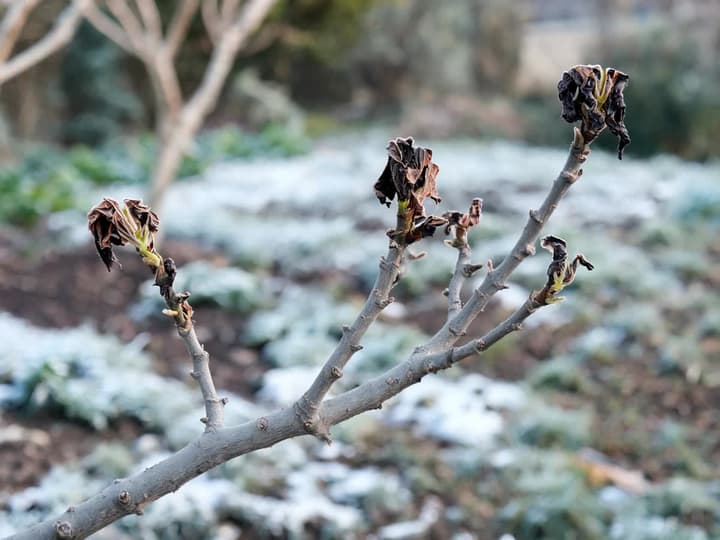
Do not prune a fig tree immediately after a freeze, even if foliage turns black and branch tips shrivel. The University of Georgia notes that Brown Turkey bears figs on new shoots even after severe cold kills branches to the ground. In Clemson's potted fig trial, Violette de Bordeaux also regenerated after dying back completely.
To find out how much of a branch is alive, perform a scratch test:
Lightly scratch the outer bark near the tip using your fingernail.
Examine the layer just beneath the bark. Green tissue means the branch remains alive at that point. Brown or dry tissue indicates dead wood.
Repeat the test farther down toward the base until you reveal green tissue.
Wait for new growth to emerge before pruning. New shoots will show you precisely how far each branch survived. Then, cut away only the dead portions, following Embrapa guidelines for frost-burned fig trees. Never move a frost-damaged fig tree into a heated space: warmth induces premature sprouting, and subsequent frosts will kill those new shoots.
Dry branch tips can stem from issues other than freezing temperatures. Check the causes of dry tips on fig trees before pruning. If you inherited a shrub with large, lobed leaves and need to verify whether it is a fig tree, Bloom (available for iOS) identifies plants from a photo. With a Premium plan, it also diagnoses diseases using leaf photos.
Frequently asked questions
Can all fig trees tolerate the cold?
Every dormant fig tree (Ficus carica) tolerates light frost, but exact limits depend on variety, age, and location. UF/IFAS gives 15 to 20 °F (−7 to −9 °C) for leafless trees, while INIAV notes that plants die below 10 °F (−12 °C). Young trees and tender green shoots suffer damage at much milder temperatures.
Can a potted fig tree spend the winter in a dark garage?
Yes, as long as it remains dormant, leafless, and in a cold spot that stays above 32 °F (0 °C). The NYBG recommends an unheated garage, watering once a month without waterlogging. If the fig tree starts breaking bud in the dark, move the container to a bright spot, as tender growth requires light.
Do newly planted fig trees need extra protection?
Yes. UC IPM notes that young fig trees can suffer severe damage between 25 °F and 27 °F (−3 °C and −4 °C) during an early frost before entering dormancy. Thin branches withstand less cold than thick wood. During their first few winters, mulch the base with straw or dry leaves and protect branches with straw and frost cloth.
A fig tree got hit by frost and its leaves turned black. Should I bring it indoors?
Do not move it into a warm space. Warmth causes the tree to push new growth prematurely, which will burn during the next frost. Leave the plant where it is, or place it in a cold shelter that stays above 32 °F (0 °C). Wait for new shoots to emerge to see how much of the branch survived, and only then prune away the dead wood.
Conclusion
The fig tree withstands cold when dormant and leafless, down to about −7 to −9 °C. Green shoots die just below 0 °C, which makes late winter frost the most dangerous in Brazil. In the ground, protect the base with straw. In pots, use a cold shelter above 0 °C and water once a month. If the fig tree suffers freeze damage, wait for new growth before pruning.
Related articles
How to Care for Hibiscus: Sun, Watering, Fertilizer, and Pruning for Flowers
How to care for hibiscus: 6 hours of direct sun, evenly moist soil without waterlogging, half-strength fertilizer in spring and summer, and pruning in early spring. Find out why the flower lasts one day and why buds drop before opening.
Do Ferns Like Sun or Shade? It Depends on the Type
Ferns prefer bright shade: plenty of light, but no direct sun on their fronds. Tuberous sword fern is the exception that handles sun. Here is the ideal light for each type, where to place pots, and how fronds show too much or too little light.
African Violet Yellow Leaves: Causes and What to Do
Yellow leaves on an African violet usually stem from overwatering, and the first place to check is the center of the plant. Losing one lower leaf at a time is normal. Identify whether age, watering, cold water, sunlight, cold drafts, or fertilizer is the culprit based on the yellowing pattern, and see what to do today.