How Often to Water a Fig Tree in a Pot or in the Ground
How often to water a fig tree without a fixed schedule: in a pot, when the top 2 inches (5 cm) of soil are dry; in the ground, young trees every week and established trees only during dry spells. With liters, months and signs of too much or too little water.
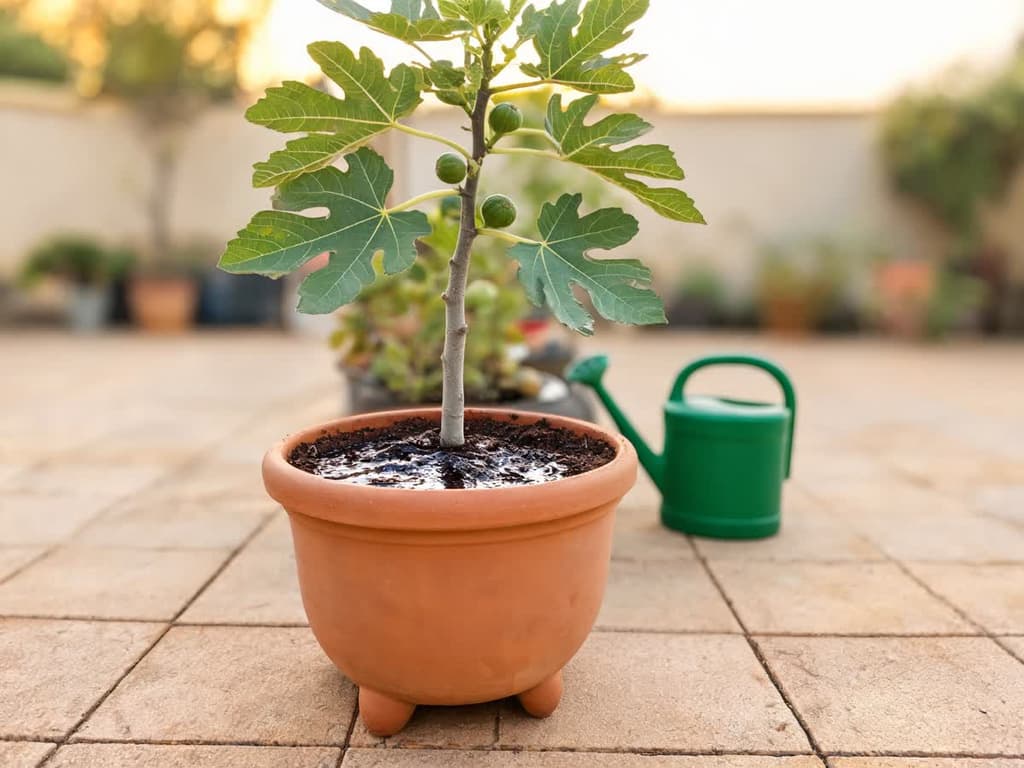
To water a fig tree correctly, use the soil as your guide instead of a fixed schedule. In a pot, water when the top 5 cm (2 inches) of soil dry out, until water drains through the hole. In the ground, a new sapling requires weekly watering in its first year, and a mature tree only needs water during dry spells (weeks without rain). Without leaves in winter, the fig tree barely takes up water.
This guide covers the edible fig tree (Ficus carica), the tree that produces figs, in a large pot or in the backyard. In Brazil, almost every planted fig tree belongs to the Roxo de Valinhos variety, according to EPAMIG Technical Circular 429. Abroad, it is called Brown Turkey. Watering depends on three questions: pot or ground, new sapling or established tree, and what month it is.
Quick summary:
Potted fig tree: water when the top 5 cm (2 inches) of soil dry out, until water drains through the hole. In the heat, check the pot every day.
Sapling planted in the ground: in the first year, water every week with a deep watering, without letting the soil dry out completely.
Established tree in the ground (one past its first year): it survives without watering, but produces more figs with watering during dry spells. Provide up to 25 liters per square meter of the area under the canopy per week, including rainfall.
Water the soil under the entire canopy, not just next to the trunk: fig tree roots are shallow and spread far.
Drought drops leaves and green figs. Too much water while the fig is ripening makes the fruit split.
How much water a fig tree needs in each situation
A potted fig tree needs more water than a fig tree planted in the ground, and a new sapling needs more than an established tree. Without leaves in winter, the fig tree barely uses water.
Situation | When to water | How much | Source |
|---|---|---|---|
Pot, spring, and summer | When the top 5 cm (2 inches) of soil dry out; in the heat, check every day | Until water drains through the hole; empty the saucer | University of Maryland, RHS (Royal Horticultural Society of the United Kingdom) |
Potted, winter, leafless | About once a month | Little water, without waterlogging and without letting the root dry out completely | NYBG |
Sapling in the ground, 1st year | Every week; 3 times a week in sandy soil and intense heat | Deep watering; UF/IFAS uses about 38 liters per watering | Embrapa, UF/IFAS (University of Florida) |
Established tree in the ground | Only during dry spells | Up to 2.5 cm (1 inch) of water per week (25 liters per m² of canopy), including rainfall | Clemson, NYBG (New York Botanical Garden), UF/IFAS |
Ripening figs | Pot: consistent watering; ground: reduce gradually | Without waterlogging and without letting it dry out | UC Davis, RHS |
How to tell if the fig tree needs water
Stick your finger 5 cm deep into the soil. Dry soil at that depth calls for watering. Moist soil calls for waiting, even if the surface looks dry. The University of Maryland recommends letting the soil in a potted fig tree dry out about 5 cm before watering again.
In the ground, count the rain as well. Clemson and the New York Botanical Garden (NYBG) use the same measure: about 2.5 cm (1 inch) of water per week, adding rain and watering together. This measure equals 25 mm of rain, the number that appears in the weather forecast app. A week with 25 mm of rain or more eliminates the need to water an established tree.
For a sapling planted in the ground, do the same test in the soil under the canopy, away from the trunk. Soil that is still moist at 5 cm on the day of the weekly watering calls for waiting one more day.
How to water a potted fig tree
Water the potted fig tree slowly until water comes out through the bottom hole. This wets the soil throughout the entire pot, not just the top layer. When the water stops draining, empty the saucer. The RHS, the UK horticultural society, advises never leaving the pot sitting in a saucer of water, especially in winter.
In the heat, soil in a pot dries out much faster than in the ground. The RHS states that a newly planted fig tree, or one with roots restricted by pot space, dries out easily. For this reason, in hot and dry weather, check the pot every day and keep the soil evenly moist.
A small pot dries out faster and forces you to water more often. If the fig tree asks for water every day in the summer, switch to a larger pot next spring. You can find the right size in the guide on how to care for a fig tree.
How to water a fig tree planted in the ground
The fig tree planted in the ground changes its needs with age. The sapling does not yet have roots to reach water far away, while the established tree already does.
New sapling: weekly watering in the first year
A sapling planted in the ground needs watering in its first year, even with irregular rain. Sources disagree on the amount, and the difference comes from the soil and the climate:
Embrapa Clima Temperado, in Rio Grande do Sul, recommends at least one watering per week during summer dry spells, a rule it gives for fig trees in general;
UF/IFAS, from the University of Florida, recommends about 38 liters per watering, at least 3 times a week, in the first year.
Florida has sandy soil and intense heat, and sandy soil loses water fast. This guide follows the rule that works for both cases: deep watering every week, and more often if the soil dries out down to 5 cm before that.
Established tree: water only during dry spells
An established fig tree in the ground survives without watering, but produces less. UF/IFAS states that after the first year, watering is optional, except during extended droughts. The same source notes that a drought-stressed tree fruits poorly and becomes more susceptible to nematodes (microscopic worms that attack the roots).
In a study on Roxo de Valinhos in Botucatu (SP), August pruning (the fig tree's annual winter pruning) with supplemental watering produced the highest yield. The paper appeared in the journal Bragantia in 2010. The study cites a 1964 paper: where rainfall is irregular, even short dry spells cause leaves to drop and harm production.
For an adult tree, UF/IFAS recommends 76 to 190 liters per tree per week when it does not rain. The calculation of 25 liters per square meter of canopy comes close to this. A canopy with a 2-meter diameter covers about 3 m² and calls for around 80 liters per week without rain.
Opt for one heavy watering a week rather than a little water every day. The West Virginia University Extension explains that deep and less frequent watering in the summer develops deeper roots, which tolerate drought better.
Where to water: under the shade of the canopy, away from the trunk
Water the soil under the entire canopy, out to the outer drip line. The fig tree's root system is fibrous, shallow, and spreads great distances from the trunk, according to Embrapa Clima Temperado. Water poured only near the trunk does not reach most of the roots.
The NYBG recommends a soaker hose around the tree, along the dripline, without touching the base of the trunk. The soaker hose drips water along its entire length. The UC IPM, from the University of California, recommends not wetting the trunk.
Watering a fig tree month by month in Brazil
In the southern hemisphere, the fig tree loses its leaves between April and June and spends the winter, from June to August, without leaves. Sources from the United States and Europe use northern months. The months below apply to Southeastern Brazil, where Roxo de Valinhos loses its leaves in the winter.
September to November (bud break): after the August pruning, the fig tree sprouts and forms figs. In the Southeast, this period is usually dry. Water every week the soil dries out to 5 cm (2 inches).
December to April (summer and harvest): the Roxo de Valinhos harvest runs from December to April, according to the Bragantia study. In the rainy summer, water the established tree only during weeks with less than 25 mm (1 inch) of rain. The sapling and the potted tree follow the 5 cm (2 inches) test.
February and March (late summer): do not push watering and fertilizer. UF/IFAS explains that watering and fertilizer in late summer cause tender shoots to sprout, and frost kills these shoots.
April to June (leaf drop): the leaves turn yellow and fall. Water less, because a fig tree with fewer leaves uses less water.
June to August (winter, without leaves): in a pot, water sparingly, about once a month, as the NYBG recommends for a dormant fig tree. Do not waterlog and do not let the roots dry out completely.
In the South of Brazil, it rains year-round. In the São Francisco Valley, with irrigation, the fig tree does not go through winter dormancy, according to Embrapa. In any region, the 5 cm test matters more than the calendar.
Underwatering drops the leaves and green figs
The fig tree reacts to a lack of water by dropping leaves and figs. The RHS says that an overly dry fig tree can shed leaves and fruit. Clemson notes leaves yellowing and dropping in summer as a sign of drought.
A leaf that turns yellow from drought will drop even after you resume watering. Embrapa Clima Temperado calls this process irreversible: the yellowed leaf drops and the fig tree starts a new flush of growth. Because of this, leaves dropping days after a delayed watering do not call for more water. Check the soil down to 5 cm before watering again.
Yellow leaves on a fig tree can also be rust, lack of fertilizer, or autumn. The guide on yellow leaves on fig trees separates each cause by the location of the yellowing and by the month.
Dry leaves after a heat wave: can you save the fig tree?
A fig tree with dry, brown leaves after a heat wave can be saved if the branches and roots are alive. A scorched leaf does not turn green again. With live branches and roots, the tree puts out new leaves after the heat passes.
Do it in this order:
Water deeply and slowly, soaking the soil under the entire canopy. Then, return to the 5 cm (2 inches) test and do not waterlog the tree every day.
Do not prune or fertilize now. The University of Maryland recommends not pruning a heat-stressed plant. The same source recommends not fertilizing and not spraying anything other than water. The scorched leaves can fall off on their own.
Scratch the bark of a thin branch with your fingernail. Green, moist tissue under the bark indicates a living branch. Brown, dry tissue indicates a dead branch. The test comes from the LSU AgCenter, which recommends starting near the base.
Wait for new leaves. Only after the fig tree sprouts should you cut the branches that remain dry and have no green under the bark.
Embrapa Clima Temperado reports that temperatures of 40 °C during ripening cause figs to ripen prematurely, with altered skin. During weeks of intense heat, check the soil every day.
Too much water when the fig is ripe makes the fruit split
The fig has thin skin and splits easily as it grows. UF/IFAS notes that rain can split figs.
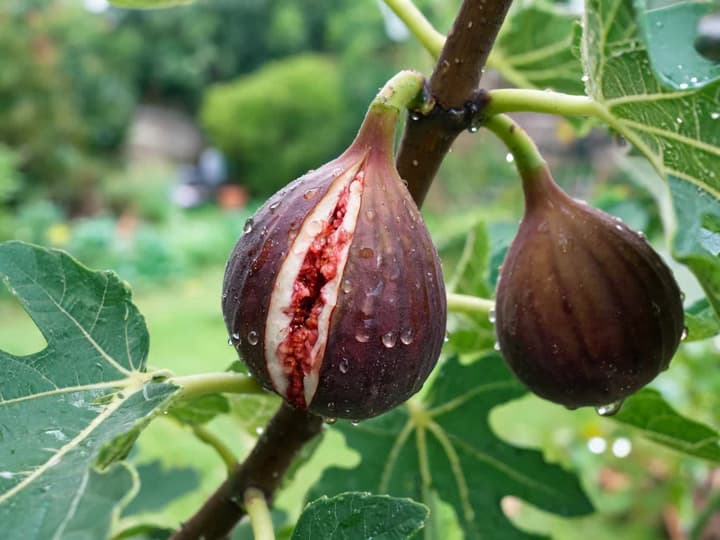
A study from the University of California, Davis, published in 2013, measured this effect on Brown Turkey, the same as Brazil's Roxo de Valinhos. With the figs already formed and growing, watering was reduced to 55% of the water the tree used. Brown Turkey had fewer cracked figs and 50% more marketable figs.
In one of the two harvests, however, Brown Turkey figs turned out 21% smaller with reduced watering. Because of this, in the ground, reduce watering gradually without cutting it off completely. In a pot, keep watering consistent.
Stopping all watering when the fig ripens is only possible for an established tree in the ground. In a pot, the soil dries out on a hot day, and the RHS notes that a dry fig tree drops its fruit. No study has measured the effect of irregular watering on fig trees, with drought followed by heavy water. When in doubt, keep watering consistent, and in the ground, reduce it slightly when the figs begin to soften.
Mulch: less water, with one exception
Mulch is a layer of straw, dry leaves, or tree bark on top of the soil. It retains moisture and reduces watering. In a study with Roxo de Valinhos in Botucatu (SP), a fig tree mulched with sugarcane bagasse used 409 mm of water (409 liters per m²) in 254 days. Without mulch, it used 466 mm. Mulching saved about 12% of the water. The study appeared in Bioscience Journal in 2014.
The RHS recommends a layer of at least 5 cm (2 inches), with a clear circle around the base of the trunk.
The exception is shallow soil. Embrapa Clima Temperado notes that, in shallow soil, mulch makes the fig tree's roots rise to the surface. The tree loses stability and can topple in strong winds. In shallow soil and windy areas, do not use mulch: water using the 5 cm test.
Signs of overwatering and underwatering in the fig tree
Both overwatering and underwatering cause similar symptoms. What tells the two causes apart is the soil at 5 cm (2 inches) deep and leaf texture.
What you see | Soil at 5 cm (2 inches) | Probable cause | What to do |
|---|---|---|---|
Yellow, limp lower leaves, dropping | Wet days after watering | Overwatering | Stop watering until the soil dries out to 5 cm (2 inches). Empty the saucer. |
Wilted leaves in the morning, dry edges | Dry and crumbling | Underwatering | Water until it drains through the hole, or deep across the entire canopy. |
Unripe figs falling off | Drought | Underwatering | Water using the 5 cm (2-inch) test and check every day in the heat. |
Ripe figs splitting | Wet | Too much rain or watering during ripening | Reduce watering a bit and harvest the figs as soon as they soften. |
Leaves falling, soil waterlogged for weeks | Waterlogged | Root rot | Stop watering and check the roots: rotten roots turn dark and soft. |
Wilting leaves are the most confusing sign. Wilting with dry soil means a lack of water; wilting with waterlogged soil means roots without air. The causes of a fig tree with wilting leaves and a fig tree dropping leaves have their own pages.
Waterlogged soil for weeks rots the roots. The rotten root turns dark, soft, and slips its skin off when you pull it:
Not every plant called a fig tree drinks like the edible fig tree. The fiddle-leaf fig (Ficus lyrata) and the weeping fig (Ficus benjamina) are houseplants, and the prickly pear is a cactus. Bloom (available for iOS) identifies the species from a photo. The edible fig tree guide shows the large, hand-shaped leaf that distinguishes it from the others.
Frequently asked questions
Do fig trees like a lot of water?
No. The fig tree likes moist, well-drained soil, not waterlogged soil. Embrapa Clima Temperado advises against planting fig trees in floodplains or in places that become waterlogged. The saying that the fig tree likes its feet in the water has no support in technical sources: waterlogging rots the root.
Can you water a fig tree every day?
Only in a pot, in extreme heat, if the soil dries out to 5 cm (2 inches) from one day to the next. In the ground, daily watering leaves the roots shallow. Choose a deep watering once a week, which wets the soil under the entire canopy and drives the roots deeper.
How to water a fig tree in winter?
Without leaves, between June and August, the fig tree barely uses water. In a pot, water sparingly, about once a month, without waterlogging, as the NYBG recommends. Empty the saucer. In the ground, an established tree does not need watering in winter.
How many liters of water does a fig tree need?
It depends on the size. In the ground, a mature tree needs up to 25 liters per square meter of canopy per week, including rainfall. UF/IFAS recommends 76 to 190 liters per tree per week without rain. In a pot, water until water drains through the hole.
Does watering make the fig larger?
In part. In the University of California, Davis study, reduced watering left Brown Turkey with 21% smaller figs in one of the two seasons, and with fewer split figs. Water without letting the soil dry out while the fig is growing. In the ground, reduce watering slightly when it starts to soften.
Conclusion
To water a fig tree, check the soil before each watering. In a pot, water when the top 5 cm dry out, until water drains through the hole. In the ground, water the sapling every week and the mature tree only during dry spells, always applying water to the soil under the canopy. Reduce watering in the winter and, in the ground, ease up slightly when the figs soften.
The next step is to check the soil today at a depth of 5 cm (2 inches), before the next watering.
Related articles
How to Care for Hibiscus: Sun, Watering, Fertilizer, and Pruning for Flowers
How to care for hibiscus: 6 hours of direct sun, evenly moist soil without waterlogging, half-strength fertilizer in spring and summer, and pruning in early spring. Find out why the flower lasts one day and why buds drop before opening.
Do Ferns Like Sun or Shade? It Depends on the Type
Ferns prefer bright shade: plenty of light, but no direct sun on their fronds. Tuberous sword fern is the exception that handles sun. Here is the ideal light for each type, where to place pots, and how fronds show too much or too little light.
African Violet Yellow Leaves: Causes and What to Do
Yellow leaves on an African violet usually stem from overwatering, and the first place to check is the center of the plant. Losing one lower leaf at a time is normal. Identify whether age, watering, cold water, sunlight, cold drafts, or fertilizer is the culprit based on the yellowing pattern, and see what to do today.