Fig Tree Yellow Leaves: Causes and What to Do
A fig tree with yellow leaves in autumn is going through its normal leaf drop. Outside of that season, check where the yellowing is and inspect the underside of the leaf to distinguish watering, rust, lack of fertilizer, and root problems.
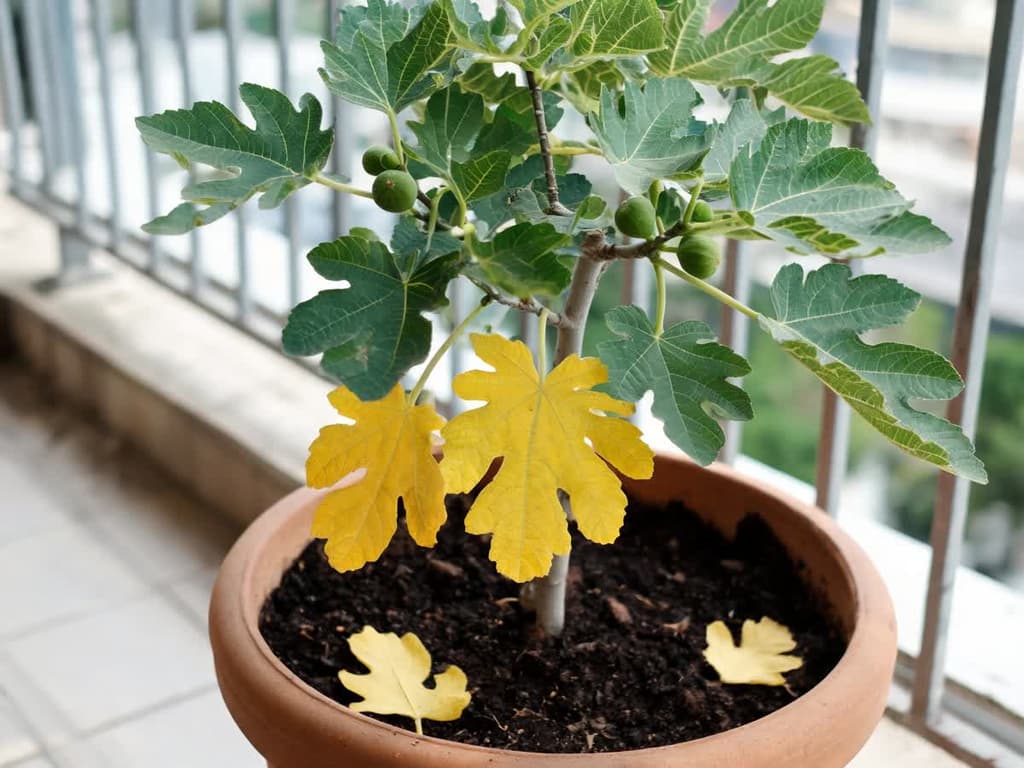
A fig tree with yellow leaves between April and June, in the South and Southeast of Brazil, is almost always normal autumn leaf drop. The fig tree loses all its leaves in winter and sprouts again in spring. Outside of that period, the most common causes are improper watering and rust. Rust is a fungal disease that leaves rust-colored powder on the underside of the leaf.
This guide covers the edible fig tree (Ficus carica), planted in a large pot or in the backyard. In Brazil, almost every fig tree is the Roxo de Valinhos variety (cultivar), according to EPAMIG Technical Circular 429. To save the plant, three questions are enough: where the yellow is, what month it is, and what appears on the underside of the leaf.
Quick summary:
Leaves yellowing evenly and dropping between April and June, with no spots, are just a sign of autumn. Water only when the top 2 inches (5 cm) of soil dry out, do not fertilize, and wait for spring sprouting.
Lower leaves that are yellow and soft, with the soil wet 2 inches (5 cm) deep, point to excess water. Wait for the soil to dry before watering again.
Tiny yellow spots on the upper side and reddish-brown powder on the underside are rust. Collect fallen leaves and stop wetting the foliage when watering.
Old leaves yellowing evenly during the growing season, with watering on point, call for fertilizer. Yellowing that returns every year with the tree barely growing calls for a look at the roots.
Fig tree with yellow leaves: three questions before touching the plant
Answer the three questions in this order before adding more water, fertilizing, or spraying anything.
Where is the yellowing? Only on the lower leaves, across the entire tree, or in spots across the leaf. An evenly yellow lower leaf points to watering or fertilizer. Spotting points to disease.
What month is it? Between April and June, overall yellowing is the start of autumn drop. Between December and March, with heat and rain, rust is the number-one suspect.
What is on the underside of the leaf? Turn a yellow leaf over and run a finger or a white tissue across it. Reddish-brown powder that stains the tissue is rust. A clean underside removes rust from the list.
Then, poke your finger into the pot's soil down to 2 inches (5 cm) deep. Wet soil at that depth, days after the last watering, indicates too much water. Dry, crumbly soil, with wilted leaves, indicates too little water.
What you see | Test | Likely cause | What to do |
|---|---|---|---|
Entire tree yellowing evenly between April and June, no spots | Clean underside | Autumn drop | Water only when 2 inches (5 cm) of soil are dry, do not fertilize, let the leaves drop. |
Lower leaves yellow and soft | Wet soil at 2 inches (5 cm) | Excess water | Wait for 2 inches (5 cm) to dry before watering. Remove the drip saucer. |
Yellow leaves, dry at the edges, wilting in the heat | Dry, crumbly soil at 2 inches (5 cm), wilted leaf | Lack of water | Water until it drains from the hole and check the soil daily in hot weather. |
Tiny yellow spots on top, leaf dropping in summer | Reddish-brown powder on underside | Rust | Collect fallen leaves and water only the soil, in the morning. |
Old leaves evenly yellow, new ones green | Proper watering, clean underside | Nitrogen deficiency | Fertilize if watering is right and the tree has grown little. |
New leaf yellow between green veins | Proper watering, clean underside | Iron deficiency | Measure soil pH with a garden kit before adding more fertilizer. |
Mosaic yellow spots, distorted leaf | Clean underside | Mosaic virus | Do not take cuttings from it. The disease manual recommends pulling up the diseased plant. |
Yellowing and bronzing returning every year, tree barely growing | Root with hard knots | Root-knot nematode (microscopic worm that attacks roots) | There is no cure. Replace pot soil; in the ground, plant the next one elsewhere. |
A leaf that has already turned yellow does not turn green again. The University of Maryland Home and Garden Information Center explains that yellowed leaves do not turn green again. Correcting the cause will not change that leaf. The sign of recovery is new leaves coming in green.
The fiddle-leaf fig (Ficus lyrata) and weeping fig (Ficus benjamina) are also called figs, but they are different species. The diagnosis in this guide applies to the edible fruit fig. If you are not sure which one yours is, Bloom (available for iOS) identifies species from a photo. With Premium, the app also compares the leaf photo against symptoms of pests and diseases. The edible fig plant profile shows the large, hand-shaped leaves that separate the two.
Yellow leaves in autumn: the fig tree sheds its leaves every year
The fig tree is deciduous, meaning a tree that sheds all its leaves in winter. In the South and Southeast of Brazil, yellowing begins between April and June. In winter, from June to August, the tree stays bare. In the Southern Hemisphere, autumn runs from April to June and winter from June to August. In sources from the United States and Europe, the months are different.
In autumn drop, the leaf yellows evenly, with no tiny spots or powder on the underside, and the drop spreads through the entire tree within a few weeks. The fig tree sprouts again in spring.
During this time, do three things. Water only when the top 2 inches (5 cm) of soil dry out; with no leaves, the soil takes more days to dry. Do not fertilize. Let the leaves fall on their own and collect any that remain on the pot's soil.
Winter is also the time to prune the fig tree. A study with Roxo de Valinhos in western Paraná, published in the Revista Brasileira de Fruticultura in 2009, tested pruning from April to September. Pruning from June to August produced the longest harvest period.
Yellow leaf and wet soil: overwatering in potted fig trees
Excess water yellows lower leaves first, making them soft instead of dry. The soil stays damp 2 inches (5 cm) deep days after the last watering. Roots in waterlogged soil run out of air, stop taking up water and nutrients, and leaves yellow even when the soil is soaked.
The University of Maryland recommends letting container soil dry about 2 inches (5 cm) before watering again. The same resource points out a common mistake: keeping the pot on a saucer of standing water. Saucer water seeps back through the drainage hole and saturates the bottom of the pot. Empty the saucer after every watering, or raise the pot on feet.
The risk is higher when the tree has no leaves, between June and August, because it uses almost no water during that stage. A pot with no hole in the bottom is the other classic culprit. If the soil remains wet a week after watering, move the plant to a pot with drainage.
When soil stays waterlogged for weeks, roots can rot. To check, remove the fig tree from its pot and inspect the roots. Healthy roots are pale and firm; rotten roots are dark, mushy, and smell foul. Trim rotten roots with clean shears and repot into fresh soil in a container with a drainage hole.
Yellow leaves with dry edges in heat: underwatering
A potted fig tree dries out much faster than one planted in the ground. The Royal Horticultural Society, in the United Kingdom, recommends checking the soil every day in warm, dry weather. The same page notes that the fig tree drops leaves and fruit when the soil dries out too much.
With a lack of water, leaves wilt during the hottest hours, turn yellow and dry along the edges, and the potting soil crumbles and pulls away from the container walls. Clemson University Extension also lists yellow leaves and leaf drop as a sign of drought.
Water slowly until water drains out through the pot's hole. Water again only when the top 2 inches (5 cm) dry out. In summer, in a small pot placed in full sun, the soil can dry out to that depth every day. Sunburnt and drought-damaged leaves will not recover, but new growth comes in healthy once watering becomes regular.
Tiny yellow spots and powder on the leaf underside: fig rust
Fig rust is a disease caused by the fungus Cerotelium fici: tiny yellow spots on the upper surface of the leaf and reddish-brown powder on the underside. Embrapa Clima Temperado identifies rust as the main disease affecting fig trees in Brazil. It appears with heat and rain and drops the leaves before autumn. Clemson records the disease in late summer, which in Brazil corresponds to February and March.
The publication on rust from the University of Hawaii describes the sequence of symptoms:
First, tiny yellowish spots appear on the upper surface of the leaf.
Soon after, on the underside, directly beneath those spots, reddish-brown pustules develop. A pustule is a raised powdery blister packed with fungal spores.
The upper spots darken, become angular, and merge together.
The leaf yellows and falls prematurely. Fruit on a defoliated tree fails to ripen fully.
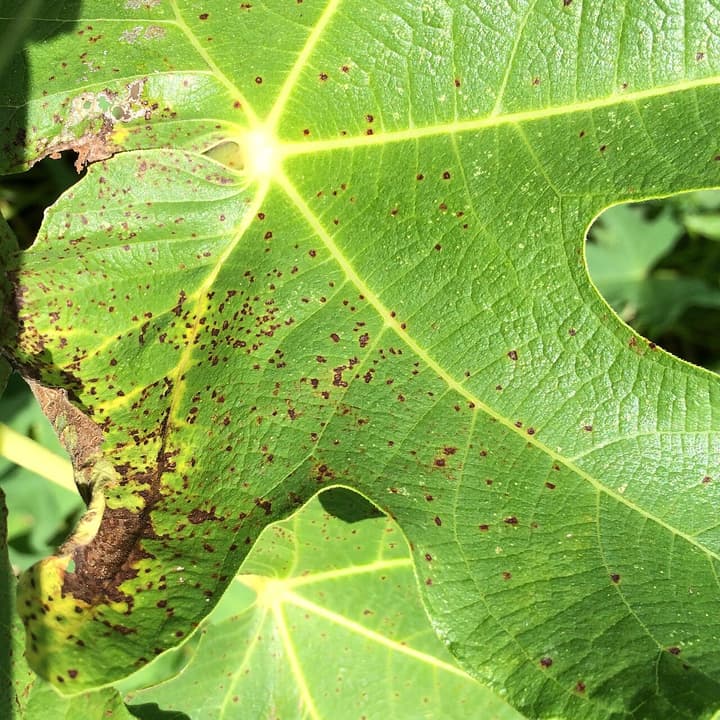
The fungal spore requires at least 14 continuous hours of wet foliage to germinate, according to the University of Hawaii. For that reason, water only the soil, never the leaves, and do so in the morning so the canopy dries out before nightfall.
Rake up and discard fallen leaves, because spores survive on them and reinfect the tree. Prune branches that cross within the center of the canopy so air can circulate and leaves dry faster after rain. Also remove leaves that already display the yellow pinpoints.
Embrapa recommends 1% Bordeaux mixture (copper sulfate with lime) from bud break until fruit ripening. UF/IFAS, from the University of Florida, advises applying the mixture every 2–3 weeks during the growing season. The same source notes that rust reduces the fig tree's cold tolerance and can cause the fruit to ripen prematurely.
Late-summer rust and early-April autumn drop can mix on the same tree. The underside of the leaf tells the two apart. The autumn leaf turns yellow with a clean underside; the leaf with rust has the tiny spots on top and the powder on the underside.
Lower leaves yellowing evenly: nitrogen deficiency
Nitrogen is the nutrient the plant uses most to produce green leaves. When it runs short, the plant pulls nitrogen from old leaves to feed new ones. Because of this, according to the Washington State University nutrient deficiency fact sheet, yellowing starts on the older, lower leaves.
In pots, nitrogen deficiency is common. The University of Maryland explains that nitrogen leaches out of the potting mix along with water running through drainage holes. Frequent watering speeds up this loss. Before fertilizing, verify your watering routine: fertilizer on waterlogged roots will not resolve yellowing.
UF/IFAS recommends fertilizing only when new shoot growth was less than 12 inches (30 cm) in the past season. It suggests a 10-10-10 fertilizer (equal parts nitrogen, phosphorus, and potassium) with micronutrients, three to five times per season. In Brazil, fertilization runs from August, at the end of winter, through the beginning of February. The UF/IFAS rate is for trees in the ground; for pots, follow the rate on the fertilizer label. Excess fertilizer produces too many leaves and few figs.
New leaves yellowing between veins, with the veins staying green, is a different issue. WSU attributes this pattern to iron deficiency, common in high-pH soils that bind iron. In that scenario, more nitrogen fertilizer does not help.
Yellow mosaic spots and deformed leaves: fig mosaic virus
Fig mosaic causes pale green to yellow spots scattered across the leaf, with edges that blend into the green. The Pacific Northwest plant disease handbook describes the rest. Throughout the season, the spots turn into brown or black lesions, and leaves can emerge deformed. Summer heat worsens the symptom.
The cause is a virus, and it has no cure. It is vectored by a tiny mite, Aceria ficus, which overwinters concealed inside the tree's buds. The virus also spreads through cuttings taken from a diseased plant. It likewise spreads through grafting, which joins two plants together. It does not spread through seed.
To avoid spreading the virus, do not take cuttings from a fig tree with mosaic. Buy nursery saplings with spotless leaves and keep the tree well fertilized. The manual also advises pruning the buds in winter to reduce the mite population. The manual recommends uprooting and destroying the diseased plant. Figs from a tree with mosaic can drop before ripening.
Yellow leaves after repotting or moving
None of the reviewed sources measures post-repotting yellowing in fig trees. Growers who repot a fig tree or relocate it commonly observe lower leaves yellowing over the following weeks. If new foliage emerges green at branch tips, the likely cause is disturbed roots, and the plant is adjusting.
During this window, water only when the top 2 inches (5 cm) of soil dry out, and do not fertilize. Fresh potting mix in a larger container takes longer to dry. Watering at your previous pace will waterlog the root system.
Yellowing that recurs every year and a stunted tree: root-knot nematodes
The root-knot nematode is a microscopic worm that lives in the soil and feeds on roots. NC State Extension points to this nematode as the main fig tree disease in sandy soil. The damage is progressive: the tree grows poorly, becomes weak, leaves turn yellow and then copper-colored, and figs come out small and few in number.
To verify, pull back the soil near the base or lift the plant out of its pot. Look for galls, which are hard knots and swellings fused directly to the root tissue. A gall is part of the root and will not rub off, unlike a granule of fertilizer.
There is no cure for an already established plant, according to NC State, and the University of Arkansas notes that an infested tree eventually dies. Proper watering and fertilization sustain the plant for longer. UF/IFAS notes that a drought-stressed tree suffers more from the nematode. The same source states that a layer of mulch or dry leaves over the soil reduces damage.
No source tested potting soil replacement. Changing out all the soil and discarding old mix is the safest approach, but it may not save the plant. In the ground, NC State recommends planting the next fig tree in a spot where figs, tomatoes, or okra have never grown. The alternative is replacing the soil in the planting hole with mix rich in organic matter.
Frequently asked questions
Does a yellow fig tree leaf turn green again?
No. The University of Maryland explains that a leaf that has turned yellow will not return to green. The yellow leaf stays that way until it drops. What confirms the problem is solved is fresh growth emerging green at branch tips over the following weeks.
Should I pull yellow leaves off my fig tree?
It depends on the cause. During autumn drop, let leaves fall naturally and rake up any on the soil. With rust, pick spotted leaves off the tree and gather fallen ones from the ground, because fungal spores overwinter on them. Wear gloves: milky fig sap irritates skin.
Do I need to water my fig tree every day?
Only when the soil calls for it. Water when the top 2 inches (5 cm) of container soil dry out, until water flows out the drainage hole. In summer, in a sunny container, soil can dry to that depth daily. On a bare fig tree between June and August, waterings are spaced much farther apart.
Does Epsom salt fix yellow leaves on a fig tree?
None of the reviewed sources measures the effect of Epsom salts (magnesium sulfate) on fig trees, so do not use it blindly. The horticulture library at the University of Washington features an article by Linda Chalker-Scott from Washington State University. She does not recommend Epsom salts for home gardeners, except when a magnesium deficiency is confirmed.
How do you save a fig tree with yellow leaves?
First determine the cause using the three questions: where is the yellowing, what month is it, and what is on the leaf underside. Then treat only that cause: adjust watering by testing the top 2 inches (5 cm), clear dropped leaves for rust, and fertilize only when watering is balanced. Once the root cause is resolved, the proof of recovery is new growth emerging green.
What to do today for a fig tree with yellow leaves
Check the calendar, flip a yellow leaf over, and push a finger 2 inches (5 cm) into the soil, in that order. Between April and June, with the whole tree yellowing uniformly and leaf undersides clean, it is autumn. Water only when 2 inches (5 cm) of soil are dry and wait it out. If there is reddish-brown powder on the underside, it is rust: rake up leaves and stop wetting the canopy.
If the calendar, leaf underside, and soil do not yield a diagnosis, inspect roots for galls. Next, examine new growth for yellowing between veins. The page on causes of yellow leaves on fig trees gathers the pests that also target the tree. For other houseplants, our guide on yellow leaves on potted plants covers general causes.
Related articles

How to Care for Hibiscus: Sun, Watering, Fertilizer, and Pruning for Flowers
How to care for hibiscus: 6 hours of direct sun, evenly moist soil without waterlogging, half-strength fertilizer in spring and summer, and pruning in early spring. Find out why the flower lasts one day and why buds drop before opening.

Do Ferns Like Sun or Shade? It Depends on the Type
Ferns prefer bright shade: plenty of light, but no direct sun on their fronds. Tuberous sword fern is the exception that handles sun. Here is the ideal light for each type, where to place pots, and how fronds show too much or too little light.

African Violet Yellow Leaves: Causes and What to Do
Yellow leaves on an African violet usually stem from overwatering, and the first place to check is the center of the plant. Losing one lower leaf at a time is normal. Identify whether age, watering, cold water, sunlight, cold drafts, or fertilizer is the culprit based on the yellowing pattern, and see what to do today.