Hibiscus in winter: which ones withstand cold and how to care for each
Hibiscus in winter: rose of Sharon tolerates frost and stays leafless until late spring, while tropical hibiscus needs protection when nights reach 12 °C. Learn how to recognize yours and check if a bare branch is still alive.
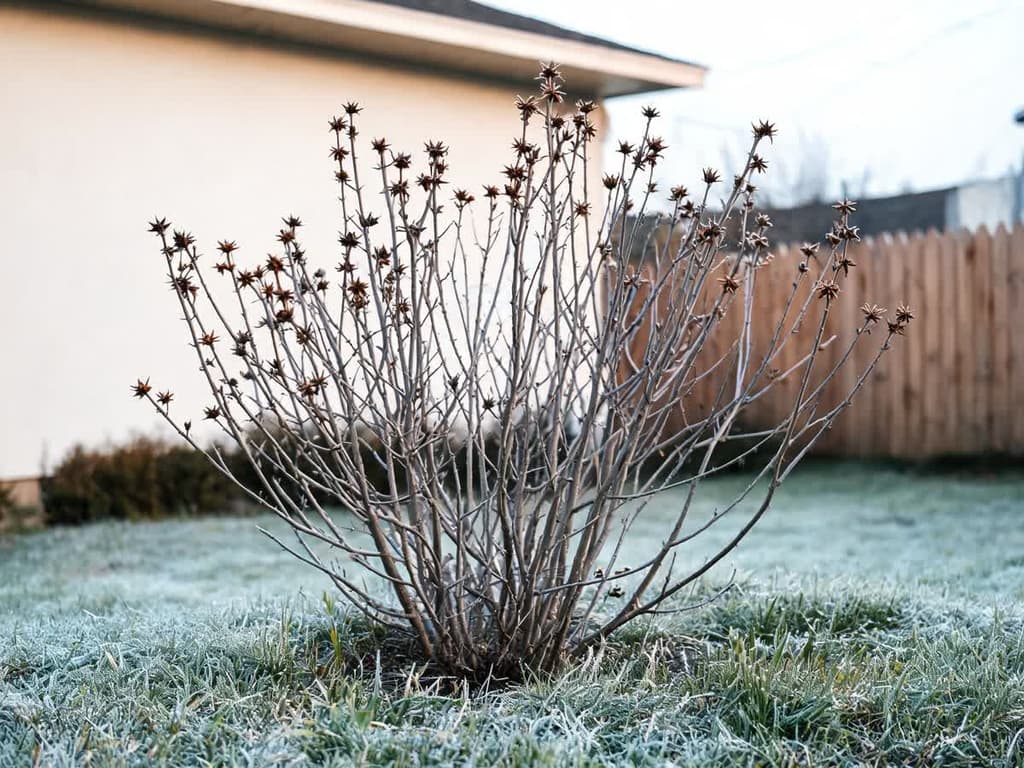
In winter, rose of Sharon (Hibiscus syriacus) tolerates frost and loses all of its leaves, while tropical hibiscus (Hibiscus rosa-sinensis) does not tolerate frost. Tropical hibiscus needs protection when nighttime temperatures reach 12 °C or lower. Staying completely leafless from autumn through late spring is the normal cycle for rose of Sharon. It is one of the last shrubs to leaf out in spring.
To know what to do with hibiscus in winter, first find out which of the two you have. The leaf and what the plant does in the cold tell the species apart. In Brazil, winter runs from June to August, and frost is more common in the South and in the mountains. This guide also covers a third hibiscus, swamp rose mallow (Hibiscus moscheutos), which tolerates severe cold and disappears from the garden in winter.
Which hibiscus is yours: how to tell by the leaf and winter behavior
The quickest way to identify your hibiscus is to look at the leaves and what the plant does in the cold. Tropical hibiscus keeps its leaves all year. Rose of Sharon loses all its leaves in winter. Swamp rose mallow dies back to the ground and returns from the roots.
Tropical hibiscus (H. rosa-sinensis) | Rose of Sharon (H. syriacus) | Swamp rose mallow (H. moscheutos) | |
|---|---|---|---|
Leaf | Glossy green all year | Cut into 3 lobes, medium green, up to 10 cm | Long and oval, with a whitish and hairy underside |
Growth habit | Shrub from 1.2 to 3 m | Shrub or small tree from 2.4 to 3.7 m | Stems from 0.6 to 1.8 m emerging from the ground |
Flower | Up to 15 cm, in red, pink, orange, yellow, or white | From 2.5 to 10 cm, pink, red, lilac, bluish, or white | Up to 20 cm, white, pink, or red, with a dark center |
In winter | Keeps its leaves | Loses all leaves and is left with gray branches | The top dies back to the ground |
Cold tolerance | Does not tolerate frost | From −10 to −15 °C (RHS) | Down to −34 °C (NC State, US Zone 4) |
The measurements come from NC State Extension, the extension service of North Carolina State University. Iowa State and Morton Arboretum provide additional details on the leaves and flowers of rose of Sharon. Iowa State gives 7.5 to 10 cm flowers for this species, and NC State gives 2.5 to 7.5 cm. The table combines both measurements.
The United States zone is a band on the American map that groups regions by the lowest winter temperature. In zone 4, the cold reaches −34 °C.
Rose of Sharon keeps its dry, brown seed capsules on the branch all winter long, according to NC State. In Brazil, rose of Sharon is also sold as hibisco-roxo, a name used in the shrub catalog of the São Paulo City Hall. The plant profile for rose of Sharon gathers photos of the species.
If you cannot tell by the leaves, take a photo of the entire plant and a close-up of a leaf. Bloom (available for iOS) identifies the species from a photo, and the free plan includes 2 identifications per month. Without any leaves, wait for new growth: a bare branch alone is not enough to distinguish the species.
How much cold and frost rose of Sharon can handle
Rose of Sharon tolerates frost. The RHS, the British horticultural society, rates the species as H5, from −10 to −15 °C. This means it tolerates the cold across most of the UK, even in severe winters.
NC State and Iowa State list rose of Sharon down to United States zone 5. In this zone, the lowest temperature of the year reaches −29 °C. Iowa State also gives the limit: −29 °C or lower can injure or kill the shrub. This guide uses the RHS range as the temperature the plant tolerates without damage, because it is the safer of the two.
In Brazil, frost occurs in the South and in the highlands. Embrapa records temperatures of 0 °C or lower in the high-elevation areas of Santa Catarina, mainly in June and July. With forecasted lows above −10 °C, rose of Sharon planted in the ground for more than a year does not need branch protection.
Potted or newly planted rose of Sharon
Rose of Sharon in a pot needs more protection than when planted in the ground, because the root in a pot feels the cold air. Iowa State explains that the root is much less cold-hardy than the branches, and that ground soil protects the root. Penn State Extension recommends protecting the potted plant as if the climate were 2 zones colder.
Do this before the first night of frost, from June to August in southern Brazil:
Cluster pots in a sheltered spot. Penn State directs grouping pots in a cold-protected location, such as up against the wall of the house.
Wrap the container. Clay or ceramic pots left outside can crack. Penn State directs wrapping the pot with bubble wrap or another insulating material.
Water before frost. Penn State directs watering the plant thoroughly before the soil freezes, because dry soil freezes faster than moist soil. Afterward, water again only when the top 2.5 cm dries out.
Cover the soil. Iowa State recommends a 7.5 to 10 cm layer of wood chips or straw over the soil to protect the root. It instructs applying the layer when the topsoil begins to freeze, not before. In Brazil, apply the layer during the week of the first forecasted frost.
For a sapling planted in the ground during the same year, no one has measured how much cold it can withstand. The safest choice is to cover the soil around the base with the same 7.5 to 10 cm layer during its first winter.
Watering rose of Sharon in winter
Without leaves, rose of Sharon uses little water. In a pot, water only when the top 2.5 cm of soil feels dry to the touch, and empty the saucer right after. Planted in the ground, it tolerates all types of soil except extremely waterlogged or extremely dry soils, according to NC State. Water an in-ground plant only if the winter remains rainless and the top 2.5 cm of soil feels dry to the touch.
Pruning rose of Sharon: late winter to early spring
Prune rose of Sharon from late winter to early spring, before it leafs out. NC State and the Morton Arboretum, a botanical garden in Illinois, in the United States, direct pruning in spring in the Northern Hemisphere. The flower grows on stems that develop that year, and NC State says that spring pruning increases flower size. In Brazil, prune at the end of August or in September.
Because the plant leafs out late, perform the scratch test before cutting: scrape the bark and see if the layer underneath is green. That way, you only cut what is genuinely dead. Morton Arboretum also warns that the plant spreads seed if old flowers are not removed. Remove dry seed capsules during pruning if you do not want seedlings popping up around the garden.
Leafless rose of Sharon: is it dead or will it leaf out?
A rose of Sharon without leaves in winter and early spring is not dead because of it: it breaks dormancy late. Morton Arboretum describes the species as one of the last shrubs to leaf out in spring. The RHS notes that leaves appear in late spring.
According to Iowa State, in the US state of Iowa the plant can stay leafless until late May or early June. If it has not leafed out by mid-June, it probably died. In the Southern Hemisphere, the calendar conversion yields late November or early December, with the cutoff in mid-December. No one has measured this timeframe in Brazil, where winter is milder than Iowa's. Wait until mid-December before pulling the plant up.
To tell if a branch is alive, do the scratch test:
Pick a branch and start at a section near the tip.
Gently scrape the bark with your fingernail on a small spot, just until the underlying layer shows.
Look at the layer right beneath the bark. Green and moist means the branch is alive. Brown and dry means that section died.
If it turns out brown, repeat closer to the base of the same branch and on 2 or 3 other branches.
With a green layer, the branch is alive and needs time, according to the Montana State University Extension. A branch that snaps easily, is dry inside, and tests brown died in that section. Cut the dead branch just above the point where the test showed green, toward the tip side, and leave the green section on the plant. If all branches tested brown, test the base of the plant as well and wait until mid-December before pulling it up.
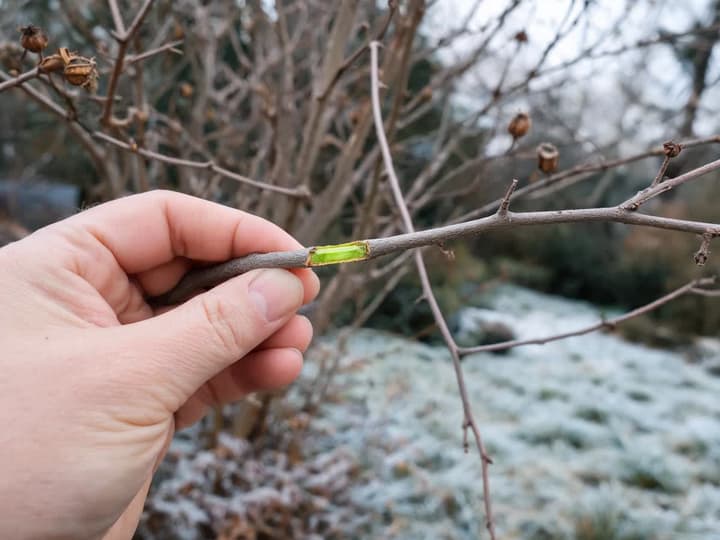
A bare branch in winter is not a sign of improper watering. NC State, Morton Arboretum, and the RHS classify rose of Sharon as deciduous. A deciduous plant is one that drops all its leaves in a season of the year. Perform the scratch test before changing your watering or any other care routine.
Tropical hibiscus in winter: when to protect and when to bring indoors
Tropical hibiscus needs protection when night temperatures reach 12 °C or lower. The RHS directs bringing the plant indoors before temperatures drop below 12 °C. NC State adds that the plant needs shelter from wind and frost.
In Brazil, common hibiscus grows outdoors year-round in warm regions. The risk is in the South and in the mountains, from June to August. The guide on how to care for hibiscus covers sun, watering, fertilizer, and pruning for the rest of the year.
If the pot is going indoors, check the leaves first. Iowa State directs inspecting the plant for insects, especially whiteflies, and washing it with insecticidal soap if there are any. Indoors, the RHS gives 7 to 10 °C as the nighttime minimum. Keep the pot away from heaters, fireplaces, and drafts, as directed by the RHS.
Indoors, tropical hibiscus needs strong direct sun to keep its leaves, according to Iowa State. In Brazil, the window that gets the most sun faces north. Mandevilla is another tropical container plant that spends winter indoors in Southern Brazil.
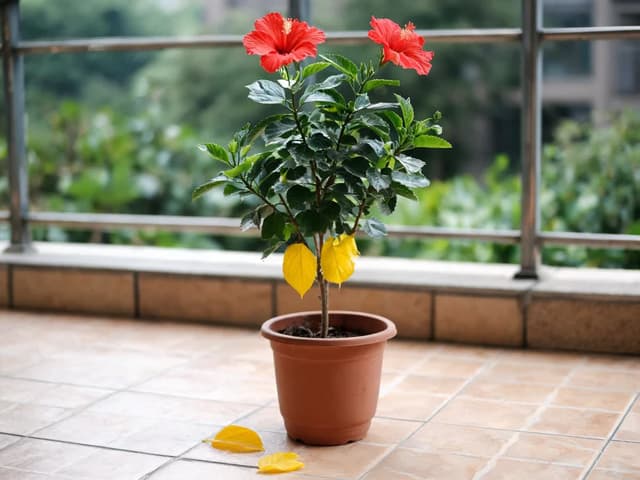
Some yellow leaves and a few dropped buds after moving the pot indoors are expected. NC State notes that moving tropical hibiscus causes the plant to drop leaves and buds. The RHS explains that under low winter light, leaves and buds turn yellow and fall off. According to the RHS, the plant survives in partial rest if you reduce watering.
Before every watering, poke your finger into the soil: water only when the top 2.5 cm is dry. If leaf drop is heavy all at once, the hibiscus leaves falling page breaks down the causes.
Tropical hibiscus caught in frost
Tropical hibiscus that catches frost can freeze to the ground and still come back from the roots. UF/IFAS, the University of Florida Extension, records this in North Florida. It also notes that a mild cold snap yellows and drops the lower leaves. Cold damage on tropical hibiscus shows distinct signs on the leaf:
Do not prune tropical hibiscus right after frost. Wait for the September bud break in Brazil, and cut only the branches that have not sprouted. The scratch test also works for tropical hibiscus.
Swamp rose mallow: disappears in winter and comes back late
Swamp rose mallow (Hibiscus moscheutos) dies back to the ground in winter, and this is normal. Iowa State explains that it dies back to the ground in autumn and returns only in late spring of the following year. It is native to wetlands in the United States. According to NC State, it tolerates down to zone 4 in the country, where the cold reaches −34 °C.
NC State directs cutting the stems almost flush with the ground in autumn, from March to May in Brazil. The same extension suggests leaving 30 to 60 cm of stem standing, because native bees nest in the hollow stems. Both cuts come from NC State, and the 30 to 60 cm one provides nesting for native bees. Choose one of them and keep the root in place.
Iowa State includes hardy hibiscus hybrids, the ones that tolerate severe cold, on a list of plants that are late to emerge. In Iowa, they sometimes do not break ground until June. Its guidance is to wait until mid-June, mark the plant's spot, and avoid planting something else over it. In Brazil, by the same calendar conversion, wait until mid-December.
Frequently asked questions
Is hibiscus hardy, and does it come back every year?
It depends on the species. Rose of Sharon and swamp rose mallow are hardy perennials: they tolerate frost and come back every year. Rose of Sharon drops only its leaves, while swamp rose mallow dies back to the ground. Tropical hibiscus is also a perennial, but it does not tolerate frost: in frost-free climates, it lives outdoors year-round.
Can I leave common hibiscus outdoors in winter in Brazil?
You can, where nighttime temperatures stay above 12 °C. Across most of Brazil, common hibiscus spends winter outdoors. In the South and in the mountains, from June to August, bring the pot indoors when the forecast calls for 12 °C or lower. For plants in the ground, cover the base with straw before frost.
When should I prune hibiscus in winter?
Prune rose of Sharon from late August to September, in Brazil, before budding. Its flowers grow on the current season's growth, according to NC State. For tropical hibiscus that was hit by frost, wait for the September budding and cut only the branches that have not budded. Remove dried swamp hibiscus stems earlier, in autumn.
Is rose of Sharon toxic to dogs and cats?
No. The ASPCA, an American animal protection organization, classifies rose of Sharon as non-toxic to dogs, cats, and horses:
The ASPCA does not have a listing for tropical hibiscus. If your pet ate a tropical hibiscus leaf or flower and shows vomiting or lethargy, call the vet.
Before the first cold snap
Identify your hibiscus by its leaves before June. Tropical hibiscus goes indoors or receives protection whenever night temperatures reach 12 °C or lower. In-ground rose of Sharon stays put; potted specimens move next to a wall, with the pot wrapped in bubble wrap and the soil surface mulched. In spring, run the scratch test before cutting back or digging up any leafless hibiscus.
Azaleas also have species that withstand outdoor cold and species that need a protected pot: check the guide on azaleas in winter.
Related articles
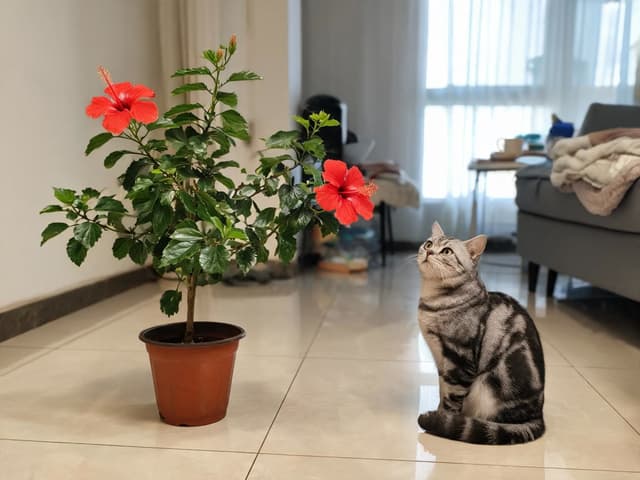
Is Hibiscus Toxic to Dogs and Cats? What Each Source Says by Species
Is hibiscus toxic? The ASPCA classifies rose of Sharon as non-toxic, and CliniTox does the same for tropical hibiscus. See what these records leave out, the risk of potted soil fertilizer, and what to do if your pet ate some.
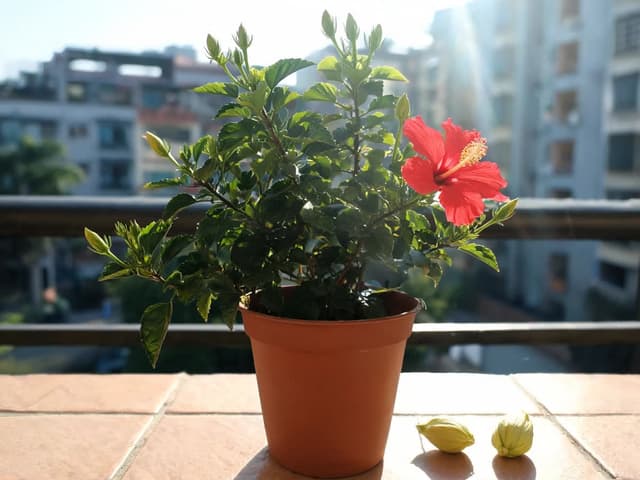
Hibiscus Not Blooming? How to Get Blooms and Stop Bud Drop
How to get hibiscus to bloom: more direct sun, prune only in late winter, and fertilize at half strength. See whether yours fails to set buds or drops them before opening, and what to do.
Hibiscus with Yellow Leaves: Causes and What to Do
Hibiscus with yellow leaves: yellowing is a distress signal, and the plant grows new leaves once the trigger is gone. Identify the cause from the leaf and soil, know which leaves to remove, and see what to do in pots and gardens.