How Much Water a Snake Plant Needs: Where to Pour It and What to Do With the Saucer
Water the snake plant directly on the soil, near the edge of the pot, until water starts coming out of the drainage hole. The center of the leaves stays dry, and the saucer is emptied after 15 minutes. See how much that amounts to for your pot and what to do with cachepots, bottom watering, and overly dry soil.
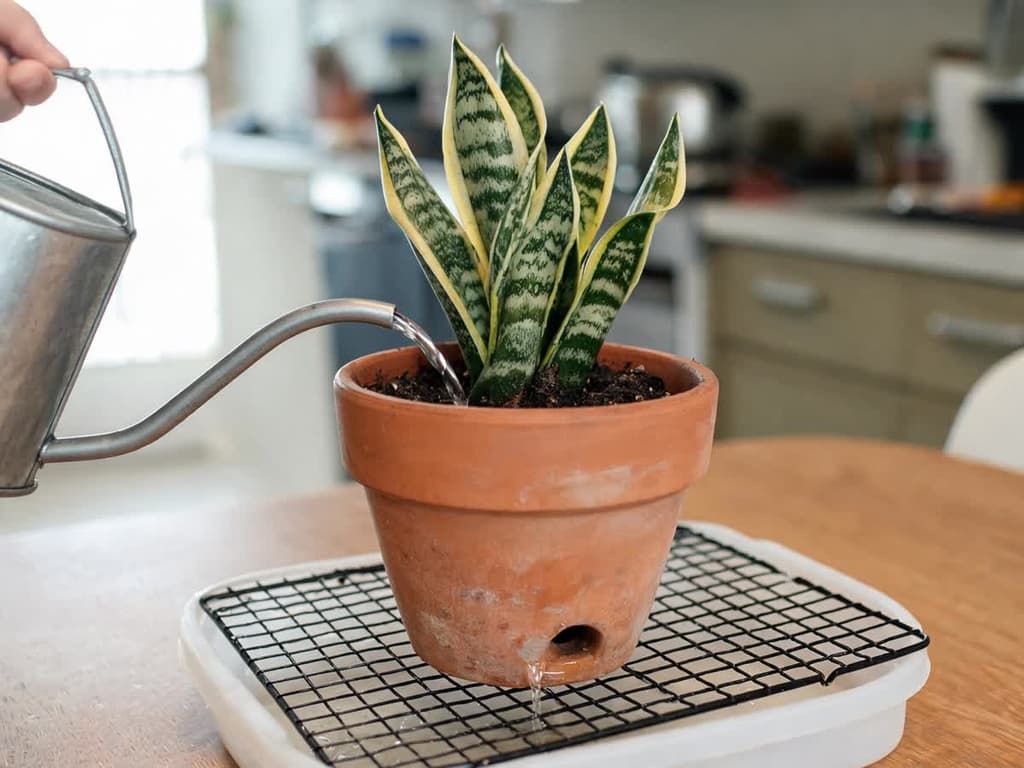
To water a snake plant, slowly pour water over the soil near the pot rim, stopping as soon as it begins draining out the bottom hole. Keep the center of the leaves completely dry. Wait 15 minutes, then dump any leftover water from the saucer. The plant goes by two botanical names, Dracaena trifasciata and Sansevieria trifasciata, both referring to the exact same species.
A lot of snake plants arrive as hand-me-downs or get left behind during a move with soil as hard as a brick. When you take one in, it is hard to know whether to soak it completely or just give it a splash from a cup. The answer is to drench all of the soil once until water flows all the way through. Knowing which day to water comes down to a soil check; this guide focuses on what to do during the watering itself.
Quick summary:
Amount: water until you see moisture coming out the bottom drainage hole, then stop right there. A single cup only moistens the top layer of soil.
Where to pour: directly onto the soil near the rim. Water trapped in the center of the leaves leads to fungal spots on tender new growth.
Saucer: empty it 15 minutes after watering. If the pot is too heavy to lift, set it on pot feet, which keep it slightly elevated above the drip tray.
Bottom watering: useful for reviving bone-dry, compacted soil or caring for dwarf varieties with tight rosettes. For regular care, water from the top.
How much water does a snake plant need at once?
Every time you water a snake plant, it needs enough water to wet the entire soil mass until excess starts draining out the bottom. There is no magic number of cups that works for every container. The exact volume depends entirely on pot size and how thoroughly the potting mix dried out since its last drink.
The University of Wisconsin extension gives the stopping point: water until it begins draining through the drainage holes. The Clemson Cooperative Extension, in factsheet HGIC 1459, explains the reason in two parts. Water passing through the pot carries away excess salt from the soil. And it ensures that the bottom of the pot receives water too.
The University of Missouri Extension, in guide G6510, calls for the same thing: wet the entire soil mass, not just the top 2.5 cm (1 inch). The snake plant is a succulent, and the thick leaf stores water for the weeks between waterings. That is why the rule is the same as in the guide on how to water succulents.
Drenching vs. light sips: the two schools of thought
Not everyone agrees with soaking, and those who disagree write about snake plants. The Arapahoe County extension in Colorado answered a reader through the Ask Extension service. According to the extension, snake plant roots and rhizomes sit in the top 7.5 cm (3 inches) of soil. The rhizome is the stem that runs underground, putting out roots and new leaves.
For this extension, the deep pot only keeps the tall plant from tipping over. Its recommendation is to wet the roots without wetting the soil at the bottom. English grower Tom Knight, from the website OurHouseplants, has watered his snake plant for over 20 years with small amounts of water at a time. The Royal Horticultural Society, the United Kingdom's horticultural society, advises not to overdo it with the watering can.
Nobody has ever run a side-by-side trial comparing both methods on snake plants. This guide follows university extension guidelines, because a thorough flush clears out mineral salts and reaches every root pocket.
The risk pointed out by the low-water side is soil staying wet for too long at the bottom of an oversized pot. The RHS describes the mechanism. A pot much larger than the plant has excess soil, and this soil stays wet after watering, encouraging root rot. For this reason, when repotting a snake plant, the RHS recommends a new pot only slightly larger than the current one. Stability comes from width. The Missouri Botanical Garden notes that a clay pot wider than it is tall is used to keep the snake plant from tipping over.
How to find the right amount for your pot
The Arapahoe extension told the reader that it was impossible to say from afar whether a cup of water was the right measure. You can find your pot's exact amount in a single watering. Next time the potting mix is dry, try this:
Fill a measuring cup or small pitcher with 250 ml (about 1 cup) of water.
Pour slowly onto the soil, circling near the rim of the pot.
When the pitcher is empty, refill it and keep going, keeping track of how many you use.
Stop the moment water begins trickling out the drainage hole.
Write down the total. That is your pot's baseline volume when the mix is dry.
The next time you water dry soil, that exact amount should make water appear at the drainage hole again. If water rushes straight through on the first cup while the soil stays pale and dusty, the mix dried out too much and has turned hydrophobic. The section on rock-hard soil explains how to tackle that.
Where water goes: onto the soil, away from the center of the rosette
Water goes straight onto the soil, and the center of the rosette stays dry. A rosette is the circle of leaves growing from the same point, right at soil level. The Missouri Botanical Garden advises not to pour water into the center of the rosette, and the RHS instructs watering the soil from above, avoiding the center entirely.
The reason lies in the University of Florida snake plant production guide (UF/IFAS, Henley, Chase, and Osborne). Fusarium leaf spot, caused by a fungus, starts on the youngest leaves in the center of the rosette. According to the guide, infection occurs only when this center is wet and fungal spores are present. The spots are irregular, sunken, and reddish-brown, often with a yellow border.
When moisture stays trapped on the foliage, those spots merge together until the infection reaches the meristem. The meristem is the growth tip where fresh leaves emerge. If foliage stays dry, the core can recover and push out several healthy shoots, according to the same guide. That research covered commercial greenhouse operations in Florida with overhead irrigation.
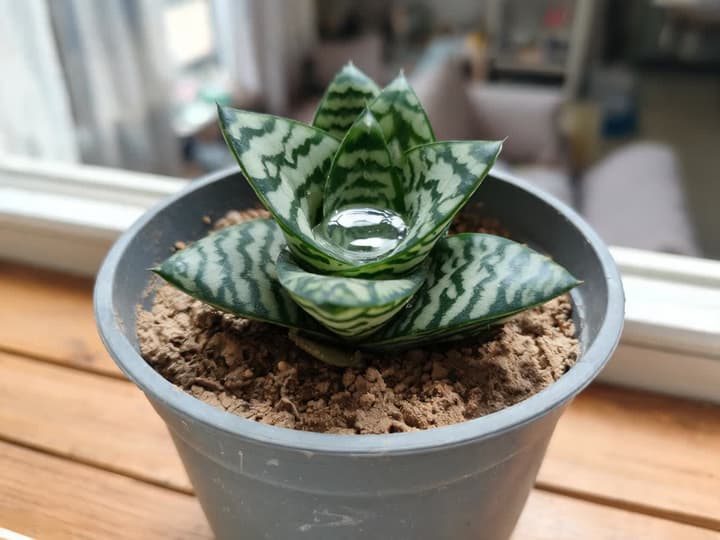
On bird's nest snake plants like the 'Hahnii' cultivar, the short, broad leaves wrap tightly around the center to form a cup. Taller varieties form rosettes too, just more open. In both situations, hold the watering can spout right near the pot rim, aimed directly at the mix.
If water accidentally splashes into the center, tip the pot sideways for a few seconds so it drains out. If splashing happens frequently when you water, do it in the morning: Florida extension researchers recommend early watering so leaves dry fast in daylight. Never mist snake plant leaves. The RHS notes that snake plants prefer low humidity and suggests skipping misting altogether.
Bloom's snake plant leaf spot guide breaks down the types of spots and what to do when they appear:
Step-by-step: how to water a snake plant
Once a soil check tells you it is watering day, follow these six steps:
Confirm the potting mix is dry all the way to the bottom by pushing a wooden skewer deep into the pot. If the stick comes up damp, do not water, not even a little.
Use room-temperature water. Clemson advises keeping it between 17 and 22 °C (62 to 72 °F).
Using a long, narrow-spouted watering can, slowly pour water over the soil near the rim, working around the perimeter.
Stop the moment water begins trickling out the drainage hole.
Wait 15 minutes, then dump out any water sitting in the saucer.
Give the pot a quarter turn before setting it back in place.
Rotating the pot a quarter turn keeps the plant from leaning toward the window, as recommended by the RHS. The narrow spout is suggested by Missouri Extension to keep water off the foliage.
What to do with the saucer under the pot
Dump the water from the saucer 15 minutes after watering. That is the guidance from the New York Botanical Garden for snake plants: water, come back after 15 minutes, and remove the standing water in the saucer. The University of Wisconsin gives 10 to 20 minutes. Missouri Extension and UConn suggest one hour.
This guide follows the 15 minutes from the New York Botanical Garden, because it is the only one of the four guidelines written for the snake plant. Arapahoe Extension, in their reply to a reader on Ask Extension, explains the risk of a full saucer. Water from the saucer can wick up through the soil to the rhizome, and the plant slowly rots.
A large snake plant in a clay pot is too heavy to carry to the sink. For that, the Marion County extension in Oregon offers a solution in their answer about a 'Hahnii' with root rot: rest the pot on pot feet over the saucer. Pot feet are low risers that keep the bottom of the pot above the runoff water. Even so, sponge the water out of the saucer after watering. On an uncovered porch, do the same after every heavy rain.
Cachepots and pots without drainage
A cachepot is a decorative pot, usually without a drainage hole, that holds the actual plant container inside. The University of Minnesota Extension instructs you to remove the plant from the cachepot, water it in the sink, let it drain completely, and only then return it. This applies to snake plants sold in plastic pots set inside decorative containers.
If the snake plant cannot be removed from the cachepot, Colorado State University explains how to double-pot. Place a layer of pebbles at the bottom of the cachepot, and set the clay or plastic pot with drainage holes on top. The Lancaster County Extension at the University of Nebraska explains the purpose of the pebbles: they keep the inner pot elevated above drained water. Missouri Extension reminds you to check occasionally for standing water at the bottom of the cachepot.
Putting pebbles in the bottom of a holeless pot does not fix drainage, because water still has nowhere to escape. Oregon State Extension, in its answer about 'Hahnii', notes that best practices no longer recommend pebbles or shards inside the pot. Drainage comes from the hole, with the pot supported on pot feet.
Bottom watering a snake plant
Bottom watering means leaving the pot in a basin of water so the soil draws the water up through the hole. For snake plants, it is used in two cases. One is rescuing soil that has gotten too dry. The other is the short, tight-rosette snake plant, whose center is hard to avoid with a watering can. For other waterings, water from above.
Missouri Extension describes the advantage: bottom watering wets the entire soil. The sign that it is done is the soil surface becoming moist. NC State adds that it leaves the surface drier, and dry soil on top hinders fungus gnats, which lay eggs in moist soil. Missouri Extension does not give a specific time to leave it in the basin: remove the pot when the soil surface darkens.
The cost of bottom watering is salt. Because water moves up and does not drain out the hole, salt from the water and fertilizer stays in the soil and appears as a white crust on the surface. Colorado State University considers top watering better. For those who bottom water, it recommends top watering from time to time to flush out the salt. The University of Maryland goes further and recommends avoiding bottom watering. This guide sticks with top watering as the default, because it flushes out the salt. Bottom watering is reserved for the two cases where top watering works poorly.
The RHS, in its snake plant profile, directs you to top water while avoiding the center. Bloom's profile on salt buildup in snake plants shows the white crust and burned leaf tip that appear when water never drains through the pot:
When soil dries out so much that water runs down the sides
Potting mix left dry for months shrinks and pulls away from the inside walls of the pot. Colorado State describes the result: water rushes down the gap between the soil and the pot wall, pouring straight through the drainage hole without actually hydrating the root ball. It looks like you watered thoroughly, but the roots remain bone dry.
Clemson explains why this happens to peat-based potting mixes. Once peat moss dries out completely, it turns hydrophobic, repelling water and holding far less moisture than before. This is typical for snake plants neglected in an office corner, inherited from relatives, or left behind during a move.
There are two fixes from reliable sources, and the pot size determines which one to use:
For large, heavy pots: Clemson's double-watering method. Water once, wait half an hour, and water again.
For pots that fit in a sink or bucket: UConn's soaking method. Submerge the entire pot up to its rim in a basin of water, pulling it out once air bubbles stop rising to the surface.
In both cases, let it drain until it stops dripping and empty the saucer. Measure your pot's watering dose during the next cycle, with the soil already watered once.
What kind of water should you use on a snake plant?
Tap water at room temperature (between 17 and 22 °C, as Clemson advises) works fine. Skip icy water right from the fridge as well as hot tap water. Clemson also warns against using water from a home water softener, since softening systems replace calcium with sodium and chloride, which build up in the potting mix.
The snake plant's new name raises a question about fluoride. Cane dracaenas, such as the corn plant, suffer from fluoridated water, and the snake plant is now also called Dracaena. NC State Extension lists the corn plant (Dracaena fragrans) as sensitive to fluoride and salt buildup. In its profile for the snake plant, the same institution does not mention fluoride.
The Pacific Northwest Plant Disease Management Handbook is published by the universities of Washington, Oregon, and Idaho. The handbook's table of fluoride-sensitive plants also lists the corn plant and other cane dracaenas, and not the snake plant. None of the consulted snake plant profiles (NC State, Missouri Botanical Garden, RHS, UF/IFAS, and New York Botanical Garden) call for filtered water, rainwater, or water left out to sit.
Soft leaves after watering: what water volume has to do with it
Soft, floppy leaves paired with damp soil point to overwatering. Clemson notes that snake plants are particularly prone to rot from wet soil, and NC State lists root rot as a primary consequence of excess moisture. If you notice mushy leaves, hold off on watering until the soil dries completely, and make sure the saucer stays dry.
The RHS differentiates between two symptoms. A single tall leaf flopping over usually stems from insufficient light, while an entire plant slumping to the side points toward root rot underneath.
Before heading out on vacation, water your snake plant thoroughly until it drains, empty the tray, and leave it be. Do not double the dose. NC State advises watering snake plants only once every 1 to 2 months during the winter. A two-week trip easily fits inside that window.
A soft base calls for different work, which starts by taking the plant out of the pot and checking the roots. A soft base can also be a disease. Bloom's photo diagnosis (available for iOS on the Premium plan) points out whether the problem stems from watering or another cause. Yellow leaves unrelated to watering have other causes, and the guide to yellow leaves shows how to tell them apart.
Frequently asked questions
How much water should I give my snake plant?
Add water until it begins dripping from the drainage hole at the bottom, then stop immediately. The exact volume in ounces or milliliters depends on your pot size and how dry the mix has become. To find out your container's baseline, water with a 250 ml measuring cup, count how many cups it takes to see runoff, and jot that number down.
Can you bottom water a snake plant?
You can, in two cases: to rescue overly dry soil and for short, dense rosette snake plants. Leave the pot in the basin until the surface of the soil becomes damp. This method does not flush out salts. Therefore, top-water every once in a while until water drains from the hole, as recommended by Colorado State.
Should you get snake plant leaves wet?
Avoid it. Standing water in the center of young leaves fosters Fusarium leaf spot, according to production guidelines from the University of Florida. The RHS warns to never mist snake plants. If water accidentally gets in the center, tip the pot to let it run out. If the leaves tend to get wet during watering, water in the morning.
How long can a snake plant sit in water in the saucer?
Dump the saucer water 15 minutes after watering, as the New York Botanical Garden advises for snake plants. Other extensions accept anywhere from 10 minutes to an hour. Standing water in the saucer for days can travel up through the soil to the rhizome and rot the plant.
At your next watering
Set aside a 250 ml pitcher and a piece of paper. The next day your snake plant's soil is dry, count how many pitchers of water it takes until water comes out the drainage hole. Write down the number and empty the saucer 15 minutes later.
Related articles
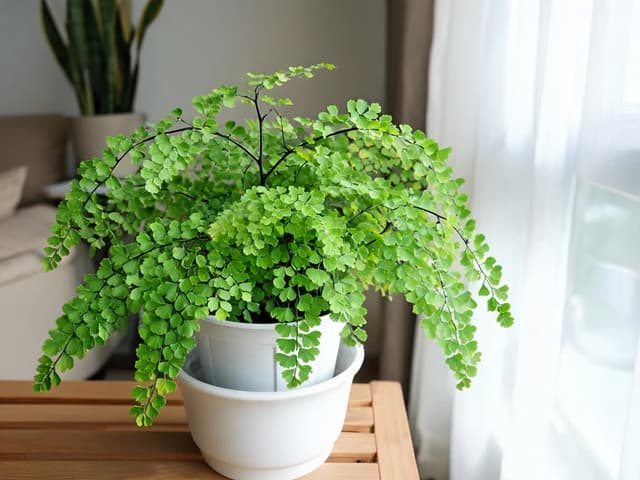
How to Care for a Maidenhair Fern: Light, Water, and Revival Tips
Learn how to care for a maidenhair fern indoors: bright indirect light, consistently moist soil, high humidity, and how to revive it if it dries out completely.
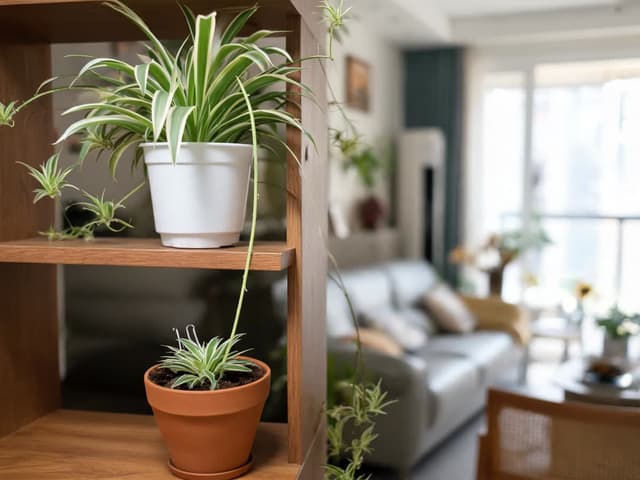
How to Propagate Spider Plants: Root the Pup Before Cutting
The safest spider plant cutting comes from a pup still attached to the mother plant: rest the plantlet on soil in a small pot, wait for roots to establish, and only then cut the stolon. Learn when the pup is ready, whether rooting in water is worth it, how to divide the clump, and why plants fail to produce babies.
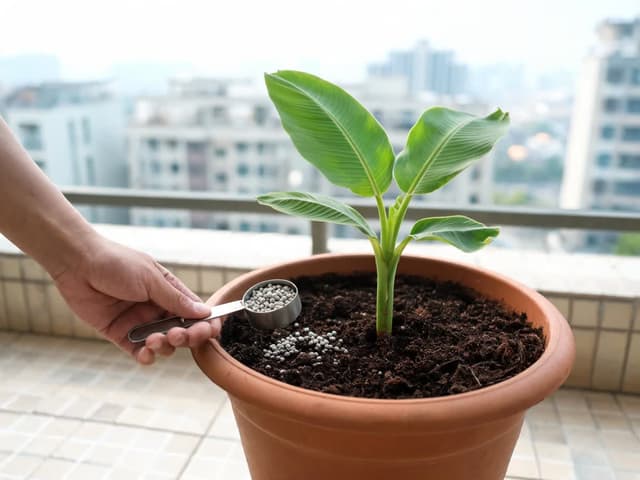
Banana plant fertilizer: fertilizing potted and backyard plants
Banana plant fertilizer needs more potassium than nitrogen, in a 3-1-6 ratio. For a potted plant on a balcony, use the label dose in spring and summer. In the backyard, fertilize every 2 months, adjusting the amount by mat age. Learn the formula, timing in Brazil, and signs of deficiency or excess.