Snake plant soil: what potting mix to use and how to blend it
Snake plant soil needs to drain water fast: ready-made cactus mix, or potting soil with perlite. See how to blend it, when to use sand, and when to repot.
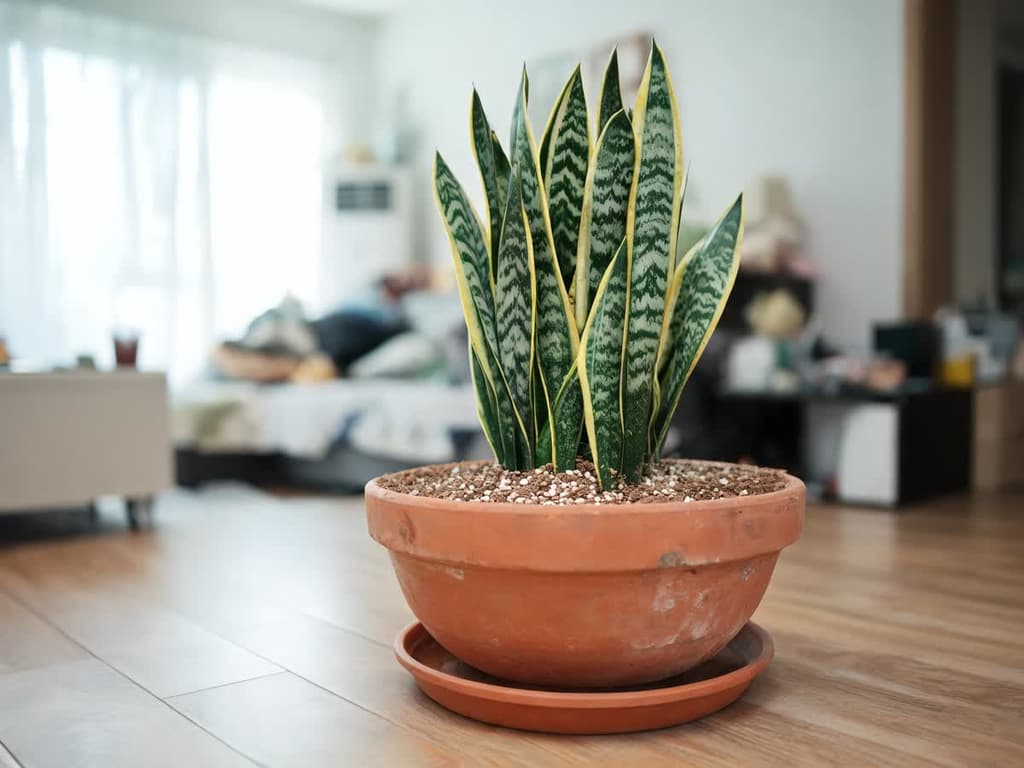
The best soil mix for snake plants is soil that lets water drain quickly through the pot's drainage hole. Substrate is the potting soil. Use ready-made cactus and succulent mix, or standard potting soil mixed with perlite (lightweight white pellets that leave air between the particles), as recommended by the extensions at Penn State and Iowa State. Extension is the service provided by American universities to guide the public.
Snake plants (Dracaena trifasciata, formerly called Sansevieria trifasciata) store water in their thick leaves and rot in waterlogged soil. Iowa State sums it up: overwatering is the fastest way to kill a snake plant.
Quick summary:
Ready-made cactus and succulent mix works straight from the bag. Standard potting soil needs perlite or coarse sand.
The Royal Horticultural Society (RHS) mixes 2 parts soil-based potting medium and 1 part grit. With bagged potting soil, start at 1 part potting soil to 1 part perlite or coarse sand.
Tall snake plants topple over in lightweight pots, especially when the soil is dry. In that case, part of the mix should be coarse sand or fine gravel (small construction gravel), which add weight.
Repot when a warning sign appears or, without signs, about every 5 years.
Is your snake plant in the wrong soil?
Change the soil the same day if the base of the leaves feels mushy, if the soil smells rotten, or if the leaves are flopping over while the soil has stayed damp for days. All three signs point to rotting roots, and this repotting cannot wait for spring. If the only issue is a rootbound plant, wait for spring. Hardened soil does not require repotting: it just needs to absorb water again.
What you see | What it usually means | When to change the soil |
|---|---|---|
Mushy, dark leaf base or a foul smell | Root or base rot | Today, regardless of the month |
Leaves flopping outward, soil damp for days | Roots starved of oxygen, early stage of rot | Today: unpot the plant and inspect the roots |
Soil stays wet at the bottom long after watering, leaves remain firm | Soil holds too much water | In the spring, or sooner if the base softens |
Rock-hard soil, water runs straight down the sides | Peat-based potting mix (dark, fluffy bagged material) dried out and repelling water | No need: rehydrate the soil until it absorbs water again |
White mold layer on the surface, plant is firm | Surface mold, not a plant infection | No need: let the surface dry out |
Bulging or cracked pot | Roots and rhizomes (underground stems) ran out of room | In the spring; if it split open, today |
Leaves flopping outward can stem from another cause. University of Maryland Extension points out that snake plants lean toward the light when kept far from a window. In that case, check the base: if it feels firm, the issue is lighting, not the roots.
To check the roots, slide the plant out of its pot. Healthy roots are firm and pale. Rotted roots are dark brown, mushy, and the outer layer slips off when you pull on it, according to Maryland Extension. The step-by-step guide on how to save a snake plant with a mushy base shows what to trim and how to replant the healthy parts.
Rock-hard soil that does not absorb water
Hard soil that pulls away from the pot wall is almost always peat moss or coconut coir that dried out too much. Iowa State explains that when these two materials dry out, they begin to repel water. Water runs down the gap between the soil and the pot and drains out through the hole without wetting the soil in the center.
You do not need to replace this soil. It needs rehydration, and the guide on how to water a snake plant when water runs down the sides explains the method for rewetting hydrophobic soil. Only change the soil if, after rewetting, it stays soggy at the bottom while the top has already dried out.
White mold and foul odors in the soil
The white, fuzzy layer on the soil surface is almost always a fungus that feeds on dead organic matter. The University of Maryland extension says this growth generally does not harm the plant. It appears when the surface stays damp for many days.
The smell is another indicator. Rotten-smelling soil or soft leaf bases point to root rot, which calls for the "today" row in the table. If the plant stays firm and mold is only on the surface, scrape the mold off and hold off on watering until the soil dries out all the way to the bottom of the pot.
What is the best soil mix for snake plants
The best potting medium for snake plants is commercial cactus and succulent mix, or standard potting soil blended with perlite. Penn State and Iowa State agree on this. The RHS recommends cactus soil or a loam-based mix with grit. NC State notes sandy, well-draining soil on its plant profile.
The common denominator is drainage speed. After watering, excess moisture must drain quickly through the drainage hole, and the pores between particles need to fill with air again. Perlite consists of lightweight white granules sold in bags. It keeps airy pockets open throughout the potting mix.
Standard potting soil on its own retains too much water for a snake plant. University of Maryland Extension specifically advises against mixes labeled "moisture retentive" or "moisture control." These soils stay wet far too long for a plant that stores water in its leaves.
Backyard soil does not work either. The NC State Extension handbook explains that native soil, inside a container, retains too much water, has little pore space for air, and weighs a lot.
Why soggy soil rots snake plants
Roots breathe. They pull oxygen from the air spaces between soil particles. When water floods these pockets for days, roots suffocate and start to die off.
Waterlogged soil also encourages root-rotting fungi. The University of Wisconsin extension lists Pythium, Phytophthora, Rhizoctonia, and Fusarium as the most common root rot fungi. Most of them prefer wet soil. The University of Florida snake plant production guide also describes a soft rot caused by bacteria, Erwinia carotovora.
Snake plants tolerate drought because they store water in their thick leaves. The RHS explains that during cold periods, growth slows down and the plant relies on these stored reserves. At this stage, the plant consumes very little water, and the soil takes longer to dry out.
Snake plants are not desert natives. They originate in Nigeria, in tropical West Africa, according to Colorado State Extension. What they actually tolerate is dry soil between waterings.
How to mix snake plant potting soil at home
Blend potting soil with perlite, coarse sand, or grit, using ratios between 2 parts soil to 1 part mineral material (with actual soil in the base mix, like the RHS recipe) and 1 part soil to 2 parts mineral material. The right ratio depends on your base potting soil. The container drainage test at the end of the steps determines the final blend.
Among sources writing on snake plants, only the RHS provides a specific ratio: 2 parts soil-based potting medium and 1 part grit or fine gravel. The RHS recipe relies on a loam-based mix made with real topsoil, which is heavier and denser. The NC State manual describes bagged potting soil as a blend of peat, pine bark, and perlite, without any actual soil.
For this bagged potting soil, Iowa State uses 1 part organic material to 2 parts mineral material for succulents. No one has measured the ideal ratio for snake plants. With bagged potting soil, start with equal parts, 1 to 1, and go to 1 to 2 if the pot test shows soil that is too wet.
Retail recipes vary widely. Out of nine German plant and soil shop guides, seven list a ratio, with mineral content ranging from 25% to roughly 70%. None cite research. That is why the pot test provides a more reliable answer than any fixed number.
To see what each ingredient contributes to the blend, the guide on how to build cactus soil compares perlite, pumice, sand, and grit one by one.
Step-by-step mix for 1 snake plant pot:
Moisten the potting soil until damp but not dripping wet. Completely dry peat and coconut coir resist water later on.
Measure 1 part potting soil using a cup or scoop.
Add 1 part mineral material: perlite, washed coarse sand, or fine grit. Fine play sand compacts and should not be used.
Mix by hand until the particles are evenly distributed.
Run the container drainage test. Fill a pot with drainage holes and water it slowly. Water should run out through the holes shortly after the soil is thoroughly wetted, without puddling on top.
Check how fast it dries. The RHS advises checking the soil with your finger before every watering. Also insert a wooden skewer to the bottom: if it comes out damp while the surface feels dry to the touch, mix in another 1 part mineral material to reach a 1:2 ratio.
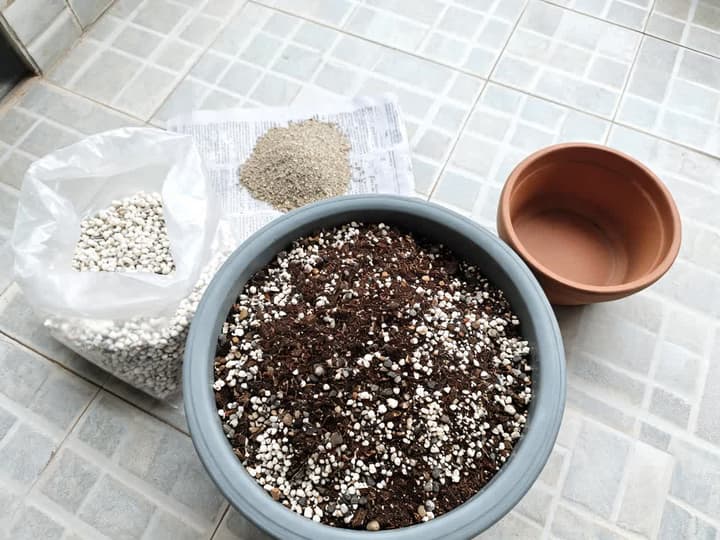
Perlite or coarse sand for tall snake plants
For tall snake plants, use coarse sand or grit as part of the mix, since they add weight. Penn State warns that tall snake plants tip over easily in lightweight pots, particularly when the soil is dry. And snake plants spend much of their time in dry soil between waterings.
Perlite takes care of aeration and adds almost no weight. The NC State manual explains that perlite replaced grit in mixes specifically because it is lighter. The same manual and Iowa State note something different about sand: it provides little aeration inside the pot and serves to add weight for tall plants.
Snake plant type | Mineral material | Why |
|---|---|---|
Compact varieties, like bird's nest snake plant 'Hahnii' | Perlite | Maximizes aeration and keeps the pot light |
Tall varieties with long leaves | Perlite combined with coarse sand or grit | The added weight keeps the plant upright |
Tall plants in lightweight plastic pots | Coarse sand or grit | The container itself adds no stabilizing weight |
NC State calls for coarse builder's sand, never fine play sand.
Perlite has fluoride: the snake plant is now a dracaena
Perlite works fine for snake plants. The updated scientific name raised a concern: snake plants were reclassified into the genus Dracaena, and the NC State manual warns against using perlite on dracaenas. Perlite contains trace amounts of fluoride, and certain dracaenas are sensitive to it.
Sources focusing specifically on snake plants recommend perlite for them, including Penn State and Iowa State. NC State's snake plant profile does not mention fluoride, nor does the University of Florida production guide. Lists of fluoride-sensitive plants highlight cane-forming dracaenas, like corn plants, while omitting snake plants. If you prefer to skip perlite anyway, substitute coarse sand or pumice.
Gravel or expanded clay pebbles at the bottom of the snake plant pot
Never add a layer of gravel, broken pot shards, or expanded clay pebbles to the bottom of the pot. Drainage holes and a porous soil mix are what pull excess water out. A drainage layer at the bottom simply takes up space that roots need.
NC State, Wisconsin, and Oregon extensions advise against the layer. The NC State manual explains why: water stops in the soil right above the stones and only moves down once that soil becomes waterlogged. In a response about a snake plant with root rot, the Oregon extension says that the layer prevents water from draining out.
One study measured the opposite. In 2025, an experiment published in PLOS ONE found less retained water with the layer in most tested combinations. The author himself notes that the experiment was conducted without plants. This guide follows the extension services, which explain why water stops above the stones.
Expanded clay instead of soil: snake plants in hydroculture
Hydroculture is soilless cultivation: the plant grows in expanded clay pebbles, with water and nutrients pooled at the base of the pot. No published studies have tested hydroculture specifically on snake plants. Existing trials were performed on other foliage plants.
In 1994, a study in the journal Acta Horticulturae grew three foliage plants in this system, including a corn plant. All grew well, and expanded clay ranked among the best materials (Cervelli and Farina). The experiment used a controlled fertilizer solution in an ebb-and-flow system.
Without trials on snake plants, a well-draining soil mix remains the safest choice. If you purchased a snake plant already established in hydroculture, keep it in that system and follow the grower's water-level guidelines.
A snake plant's pot matters as much as its soil
Pick a pot with bottom drainage holes that is wider than it is deep. Snake plant roots and rhizomes grow shallow. A rhizome is the thick underground stem that creeps horizontally and sends up new rosettes.
A response from the Arapahoe County Extension, in Colorado, estimates that rhizomes and roots occupy only the top 7.5 cm (3 inches) of the soil. The same response states that a tall pot for a snake plant exists to provide balance, not because the roots grow deep. A wide, heavy clay pot also keeps a tall snake plant upright. The soil at the bottom of a tall pot stays wet without roots to use that water.
Unglazed clay lets more air reach the roots and dries the soil faster, according to Colorado State Extension. The NC State manual recommends a porous pot for those who tend to overwater. Clay also weighs more than plastic, which helps the tall snake plant stay upright.
Rhizomes push against the pot wall. The University of Florida production guide warns that a crowded snake plant can even crack the side of a plastic pot. Penn State warns that crowded roots can also crack a clay pot.
Empty the drip tray after every watering and never let the container sit in standing water. The Arapahoe County advisory warns that water sitting in the saucer wicks back up to the rhizomes and gradually rots the plant.
When to repot a snake plant
Repot your snake plant when visible symptoms appear or, if the plant looks fine, roughly every 5 years. The RHS notes that newly purchased snake plants do well in their original pots for the first few years. Repotting is needed once roots and leaves crowd the pot or distort its shape.
Penn State suggests fresh potting soil roughly every 5 years. The guide's author has owned a snake plant for over 20 years and only repotted it once, after 15 years. While the NC State manual recommends repotting container plants annually, it refers to container plants as a broad group. For snake plants, this guide follows Penn State and RHS recommendations, because snake plants thrive when snug in their pots and grow slowly.
If there is no emergency, repot between September and November, during the Southern Hemisphere spring. That is when snake plants resume active growth after cooler weather. If you notice a mushy base, foul odors, or a split pot, repot immediately, no matter the month.
How to repot without damaging the plant:
Allow the soil to dry out before repotting, unless the situation is urgent. Dry soil slides out of pots far more easily. If the base feels mushy, skip this wait and repot the same day.
Slide the plant from the pot and use your fingers to gently work away loose, old soil.
Inspect the roots. Use clean pruners to cut away any mushy, brown roots.
Add fresh potting mix to the bottom until the plant sits at its previous depth. The pale base of the leaves should sit right at soil level.
Fill around the sides without compacting the mix firmly.
Hold off on watering for a few days if you trimmed any roots. Cut root ends need time to callus before taking up moisture.
Frequently asked questions
Can I use regular potting soil for a snake plant?
Yes, as long as you mix in perlite, coarse sand, or grit. Standard potting soil by itself retains too much water for snake plants, cutting off oxygen to the roots. Start with a 1:1 ratio of soil to mineral material and confirm that water drains freely through the drainage hole. Avoid soils marketed as moisture-retentive.
Can I plant a snake plant in pure cactus soil?
Yes. Ready-to-use cactus and succulent mix is the top recommendation from Penn State, Iowa State, and the RHS for snake plants. Run a drainage test anyway, as recipes vary by brand. If your plant is tall, replace part of the mineral content with coarse sand to add stabilizing weight.
What soil pH do snake plants prefer?
Snake plants grow well at a pH of 4.5 to 8.5, and the ideal range is between 5.5 and 7.5, according to the University of Florida production guide. With such a wide range, you do not need to measure or adjust the soil pH for snake plants at home.
Do snake plants need fertilizer mixed into their soil?
You do not need to add fertilizer to the mix. Penn State suggests fertilizing snake plants once a month during the active growing season using standard houseplant fertilizer diluted to half strength. Soils with built-in fertilizers add nutrients on top of whatever you feed later, so plain, unfertilized potting mix works best.
What to do today
Slide a wooden skewer all the way to the bottom of your snake plant's pot and give the base of the leaves a gentle squeeze. If the base feels soft or the soil smells sour and rotten, pull the plant from its pot and check the roots today. If the base is firm, water again only when the skewer comes out completely dry from the bottom. If the skewer comes up damp while the surface feels dry, your mix retains too much moisture: blend in extra mineral material during your next spring repotting.
Bloom (available for iOS) identifies snake plants from a photo and builds a personalized watering schedule, accessible on the free plan as well.
Sources
Penn State Extension: Snake Plant: A Forgiving, Low-maintenance Houseplant, updated on 09/20/2023 (cactus soil or with perlite, heavy pot for tall snake plants, fresh soil every 5 years, diluted fertilizer).
Iowa State University Extension and Outreach: Caring for Sansevieria, Aaron J. Steil, 01/17/2025 (cactus soil or with perlite), Growing succulents indoors (1 part organic to 2 parts mineral), and Potting media components and handling, Randall Vos, March 2025 (dry peat and coco coir repel water, sand adds weight).
Royal Horticultural Society: How to grow sansevierias (mix of 2 parts soil-based compost to 1 part grit, when to repot, holding back on water in winter, finger test).
NC State Extension: Extension Gardener Handbook, ch. 18, Plants Grown in Containers (perlite, sand, fluoride, layer of gravel, porous pot) and Plant Toolbox: Dracaena trifasciata (sandy soil, good drainage).
University of Maryland Extension: answer on Ask Extension about a leaning snake plant, 04/20/2020 (moisture-retentive soil, heavier clay pot, light), and Algae and fungal growth on soil of indoor plants (white surface mold).
University of Wisconsin Extension: Root rots of houseplants (rot fungi, wet soil, gravel at the bottom).
Oregon, Extension answer on Ask Extension: Sansevieria 'Hahnii' with root rot, 01/18/2022 (drainage layer).
Arapahoe County Extension (Colorado), answer on Ask Extension: snake plant, 05/31/2019 (rhizome and root in the top 3 inches [7.5 cm], tall pot for balance, standing water in the saucer).
Colorado State University Extension, PlantTalk: 1315 Houseplants: Containers (porous clay) and 1337 Snake Plant (native to Nigeria).
UF/IFAS, Henley, Chase, and Osborne: Sansevieria Production Guide, RH-91-30 (pH, rhizomes cracking plastic pots, bacterial soft rot).
Rowe, A. (2025). Effect of drainage layers on water retention of potting media in containers. PLOS ONE 20(2): e0318716.
Cervelli, C.; Farina, E. (1994). Effect of different substrates on growth of ornamentals in hydroculture. Acta Horticulturae 361: 456–463.
All accessed on October 14, 2026.
Related articles

How to Care for Hibiscus: Sun, Watering, Fertilizer, and Pruning for Flowers
How to care for hibiscus: 6 hours of direct sun, evenly moist soil without waterlogging, half-strength fertilizer in spring and summer, and pruning in early spring. Find out why the flower lasts one day and why buds drop before opening.

Do Ferns Like Sun or Shade? It Depends on the Type
Ferns prefer bright shade: plenty of light, but no direct sun on their fronds. Tuberous sword fern is the exception that handles sun. Here is the ideal light for each type, where to place pots, and how fronds show too much or too little light.

African Violet Yellow Leaves: Causes and What to Do
Yellow leaves on an African violet usually stem from overwatering, and the first place to check is the center of the plant. Losing one lower leaf at a time is normal. Identify whether age, watering, cold water, sunlight, cold drafts, or fertilizer is the culprit based on the yellowing pattern, and see what to do today.