How Often to Water an Avocado Tree
There is no fixed schedule for watering an avocado tree. In pots, water when the soil dries halfway down; in the ground, frequency drops as the tree matures. Learn how to tell underwatering from overwatering.
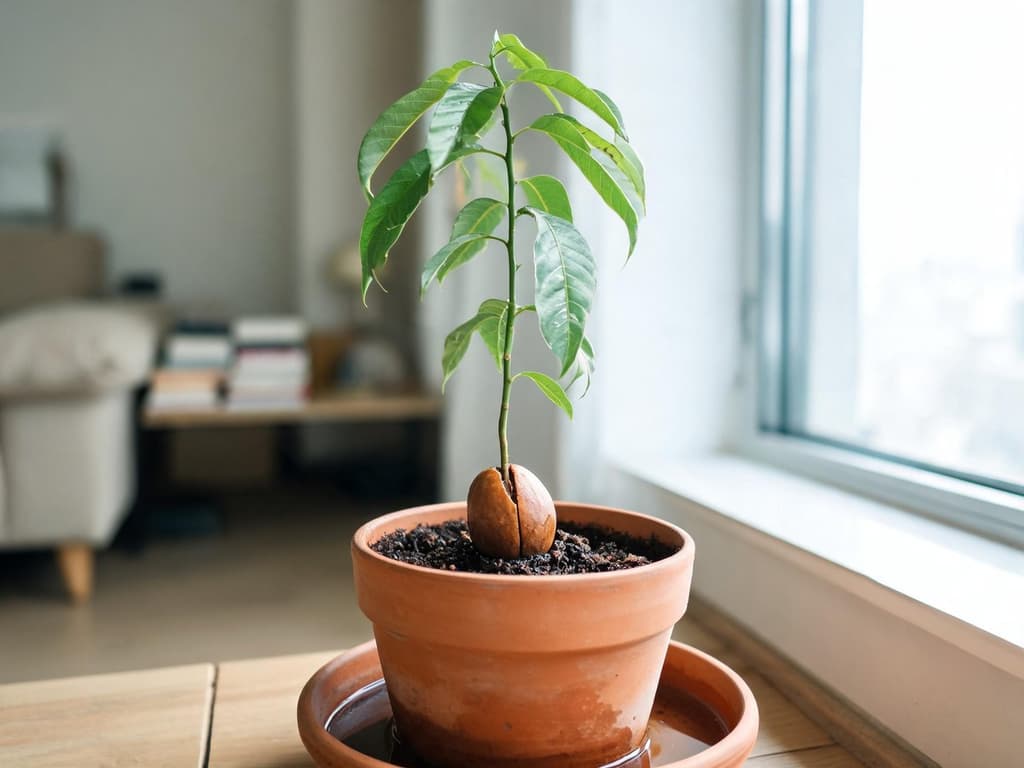
There is no set schedule for watering an avocado tree. In a pot, water when the soil has dried about halfway down the pot. Soak it until water runs out the drainage hole. A newly planted sapling in the ground needs watering 1 to 3 times a week during the first few months. By the end of the first year, frequency drops to about once a week. A tree that has been in the ground for 4 years or more (an established tree) only needs watering during prolonged dry spells.
The biggest risk in watering is waterlogged soil, not dryness. Avocado roots are shallow and require air. In soil that stays wet for too long, they rot. That is why the soil determines when to water, while the calendar is only for keeping notes.
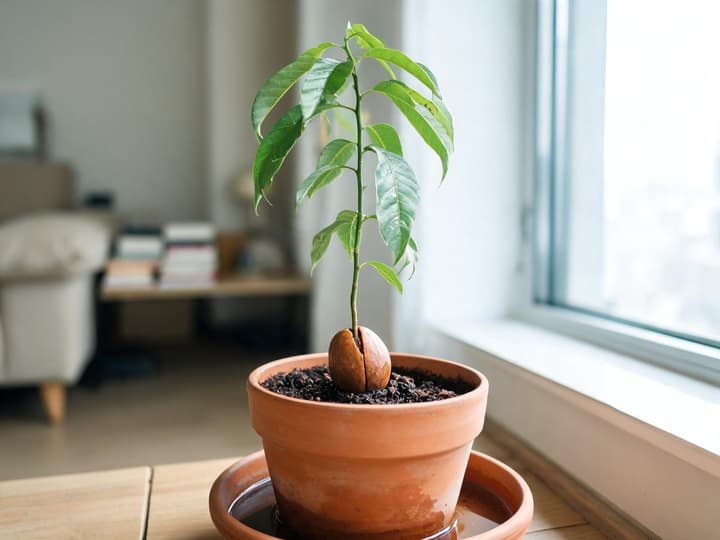
How often to water an avocado tree
How often you should water an avocado tree depends on where it is growing and how old it is. The table summarizes what technical sources advise for each case. The intervals for in-ground trees come from home orchards in California and Florida, where soil and climate differ from yours. Use the soil test to adjust.
Situation | When to water | Source |
|---|---|---|
Pit sprouting in a glass of water | Keep the bottom half of the pit submerged in water at all times | Colorado State University |
Potted avocado tree | When the soil dries halfway down the pot; water until it drains out the hole | University of Illinois Extension (general containers) |
Newly planted in the ground, 1st week | Every other day | UF/IFAS |
Newly planted in the ground, first few months | 1 to 2 times a week (UF/IFAS) or 2 to 3 times a week (UC Riverside), dropping to about once a week by the end of the 1st year | UC Riverside and UF/IFAS |
Young tree in the ground, up to 3 years | Twice a week, only when 5 or more days pass without rain | UF/IFAS |
Established tree in the ground, 4 years or more | Only during extended droughts; stop watering during the rainy season | UF/IFAS |
The "2 to 3 times a week" figure circulates as a general rule. It comes from the University of California, Riverside (UC Riverside) FAQ guide. There, it applies to a newly planted sapling in the ground, which holds about 7.5 liters (2 gallons) of water in the root ball, the block of soil attached to the roots. In a pot, none of the consulted technical sources gives a set number of days.
For an adult tree, the University of Florida (UF/IFAS) writes that the water requirement "has not been determined". Distrust any chart that promises an exact number of gallons per week for your yard.
Why avocado trees suffer in waterlogged soil
Avocado trees have shallow root systems. According to UC Riverside, most feeder roots, which absorb water, stay in the top 15 cm (6 inches) of soil. These roots need good aeration, meaning air pockets between soil particles. Waterlogged soil drives out this air.
Roots without air are exposed to Phytophthora root rot (Phytophthora cinnamomi, a soilborne microorganism that attacks feeder roots). The University of California's pest management program (UC IPM) calls this rot the most serious disease of avocado trees. According to UC IPM, it thrives where there is excess moisture and poor drainage. For UC IPM, watering the right way is the most important practice to prevent the disease. UC IPM also urges you not to water soil that is still wet.
Waterlogging does not need to last a week to cause damage. In a Chilean experiment with potted saplings, repeated 24-hour periods of saturated soil were enough to rot half the roots. The saplings had been intentionally infected with Phytophthora, and the authors caution that the result does not directly apply to the field.
Root rot also turns up in backyard avocado trees watered by automatic irrigation. UF/IFAS cites cases of lawn sprinklers on timers: they water too much and too often, and the tree steadily declines from root rot.
How to know when to water an avocado tree
Before every watering, check soil moisture using one of these three tests. They work for both pots and the ground.
Finger in the soil: insert your finger 2 to 3 cm into the soil. Dry soil at that depth only proves that the top layer has dried out. Before watering, confirm with the weight test that the soil is dry halfway down the pot.
Pot weight: lift the pot right after a thorough watering and remember how heavy it feels. Illinois Extension points out that a pot gets lighter as it dries. Water when the pot feels significantly lighter than it did right after watering, not on a set date.
Soil squeeze: take a handful of soil from root depth and squeeze it in your hand. UC Riverside teaches that if the soil holds the shape of your fingers, it still has enough water. If it crumbles and does not form a ball, water.
Illinois Extension recommends watering the pot when half of the soil's moisture is already gone. In practice, that means soil dried down to roughly halfway down the height of the pot. Colorado State University calls for soil that is consistently evenly moist for indoor avocado trees. This guide follows the half-dry rule, because avocado roots rot in soil that stays wet for too long (UC IPM). Illinois Extension advises checking pots every day in hot weather.
Write down the date of each watering for two or three weeks. The dates show the interval for your home at that time of year, and a plant watering reminder app keeps track of these dates for you. When the season changes, the interval changes and the tracking starts over.
How to water an avocado tree in a pot
In a pot, water slowly until moisture drains out the bottom hole. Watering until it runs through wets all the soil, including the bottom where roots also grow. Giving a small sip every day only moistens the top few centimeters, leaving the base dry.
When water stops draining, discard the water left in the saucer. A pot sitting in a puddle of water keeps the bottom waterlogged for days. UC IPM advises that the soil should not remain waterlogged for long.
The pot needs to have a hole in the bottom. Illinois Extension recommends a pot with more than one hole and potting soil, and never garden soil. It also notes that clay, fabric, or unglazed ceramic pots dry out faster than plastic pots. In a clay pot, check the soil more frequently.
The avocado tree is very sensitive to salt, according to the California Avocado Commission. Salt from water and fertilizer builds up in the potting soil and burns the leaf tips. The water that drains out the hole carries part of this salt away. The commission calls this extra water leaching: watering beyond what is needed to wash the salt out of the soil.
UC IPM recommends watering avocado trees with good-quality water, like drinking water. Water high in salts, chloride, sodium, or boron encourages root infection. None of the sources reviewed addresses chlorine in tap water: treated drinking water is the baseline they provide.
Watering an avocado tree planted in the ground
A sapling newly planted in the ground needs frequent watering because its roots are still confined to the root ball. UF/IFAS recommends watering at planting and every other day for the first week. After that, 1 to 2 times a week for the first few months. UC Riverside suggests 2 to 3 times a week, tapering down to about once a week toward the end of the first year. Both ranges intersect at twice a week. Start with that frequency and adjust using the squeeze test: soil that holds your handprint still has water.
An established tree only needs watering when rains fail. For trees up to 3 years old, UF/IFAS advises watering twice a week during dry periods of 5 days or longer. Once the rainy season starts, reduce or stop watering entirely. For trees 4 years or older, irrigation helps only during extended droughts.
Cover the soil around the tree. UC IPM recommends 10 to 15 cm (4 to 6 inches) of mulch under the canopy: a thick layer of wood chips or tree bark spread over the soil. Leave a few inches clear around the trunk. Mulch holds moisture and reduces salt buildup at the soil surface.
An avocado tree needs well-draining soil, meaning soil that lets water drain through without puddling. In poorly draining soil, UC IPM suggests planting on a mound of soil or in a raised bed. UC Riverside does not recommend putting gravel or any other material at the bottom of the planting hole, because the difference between the layers disrupts water movement.
Overwatering or underwatering: how to tell them apart in an avocado tree
Wilting leaves and brown tips appear with both underwatering and overwatering. What distinguishes the two is the soil. Wilted leaves with dry soil indicate underwatering. Wilted leaves with wet soil point to damaged roots, and adding more water will make things worse.
Sign | Underwatering | Overwatering (root rot) | Salt buildup |
|---|---|---|---|
Soil | Dry all the way down; light pot | Wet for days; heavy pot | Moist or dry |
Leaves | Wilt, dry out, and drop | Small, pale green, or yellowing; wilt even with wet soil | Scorched tips; turn yellow and drop |
Leaf tips | Dry, along with the rest of the leaf | Brown, even with wet soil | Brown, scorched |
Stem and branches | No sign described in the sources | Soft stem in potted plants; twigs die back in the canopy | No sign described in the sources |
Roots | No sign described in the sources | Fine roots black, brittle, or sparse | Stunted growth |
Source | Colorado State University | UC IPM and Colorado State University | California Avocado Commission |
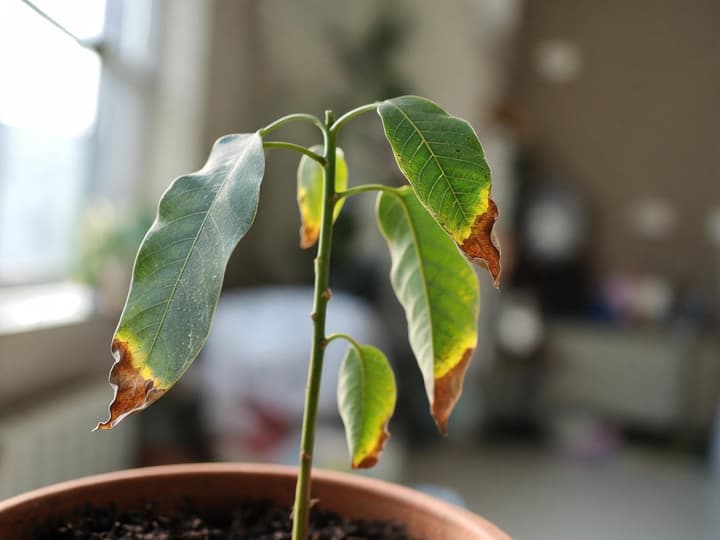
Colorado State University describes an overwatered potted avocado tree as having curling leaves and a soft stem. When underwatered, the plant wilts and the leaves dry up and drop.
To inspect the roots, gently lift the avocado tree from its pot. Healthy roots are light-colored and firm. UC IPM describes diseased roots as black, brittle, and dead. UC Riverside cautions that avocado roots are extremely delicate. Disturb them as little as possible. If the roots look sound, return the plant to its pot. If most of them are black and brittle, withhold water and wait until the soil dries halfway down the pot.
If you do not know what kind of tree is growing in your yard, the soil rule still applies: verify moisture before watering. To identify the species, Bloom (available for iOS) identifies plants from a photo of a leaf.
Coming back from a trip to a wilted avocado tree
Check the soil before watering at all. If it is dry all the way down and the pot feels light, the wilting comes from underwatering. Flooding the pot all at once will not help: potting mix shrinks as it dries, letting water slip down the gap between the soil and the pot wall without soaking the center.
New Mexico State University (NMSU) shares two ways to water soil that has dried out. The first is to pour a little water on the surface, wait for the soil to swell, and then water until it is thoroughly soaked. The second is to place the pot in a basin of water and let the soil draw the water up from the bottom. Do not fill the basin so much that the pot floats. Remove the pot from the basin once the topsoil feels moist and let it drain.
If the soil is wet, do not water. Wilting alongside wet soil points to the roots, and more water will worsen the rot. In that case, wait until the soil dries halfway down the pot before watering again, and check the roots as described in the previous section.
Leaves that have already dried out and turned brown will not turn green again. Leave any leaves that are still green on the plant. The sign of recovery will be fresh shoots forming at the ends of the branches.
What changes the watering interval: heat, rain, and cold
Heat shortens the interval. Illinois Extension advises checking containers every day in hot weather. Clay pots dry out even faster, making daily checks especially important.
Rain extends the interval for trees in the ground. During the rainy season, UF/IFAS advises cutting back or halting irrigation. A potted avocado tree on a covered porch misses out on that rain, so inspect its soil just the same.
In the cold, the plant drinks less and the soil takes longer to dry. In Brazil, winter runs from June to August. During these months, the soil test will show longer intervals. UC Riverside notes that an avocado tree brought indoors suffers from dry indoor heat. In that case, the pot must not dry out completely.
Frequently asked questions about watering avocado trees
My potted avocado tree's leaves are turning yellow and dropping. Should I water more or less?
Check the soil before altering your watering habits. Small, yellowing leaves with soil that has stayed wet for days indicate overwatering and possible root rot: let the soil dry halfway down the pot. Leaves that dry out and drop with dry soil indicate underwatering. Other causes of yellow leaves are covered in the guide on yellow leaves.
Why do avocado leaf tips turn brown?
Brown tips on an avocado tree have three common causes: underwatering, root rot, and salt buildup in the soil. If the roots are pale and firm, salt is the likely suspect. At the next watering, once the soil has dried halfway down the pot, water thoroughly until it flows freely out the hole. That draining water leaches out the salt; afterward, empty the saucer.
Does watering more make an avocado grown from seed bear fruit?
No. NC State Extension warns that an avocado grown as a houseplant does not bear fruit. UC Riverside states that a tree grown from seed takes 5 to 13 years or more to flower. The fruit will also not turn out like the one you planted, because the seed comes from cross-pollination.
Does misting avocado leaves replace watering?
No. Misting only wets the foliage, leaving the root system without water. UC Riverside mentions misting from time to time only as a minor aid for avocado trees kept indoors. Regular watering that prevents the pot from drying out completely still applies.
Summary: how to water an avocado tree
In pots: water when the soil dries halfway down the pot. Soak until water drains out the hole, then empty the saucer.
In the ground: a new sapling needs watering 1 to 3 times a week during the first few months, and about once a week by the end of the first year. An established tree only needs water during prolonged dry periods.
Before watering: test with your finger, check the pot weight, or do the soil squeeze test. If the soil is wet, do not water.
Wilting leaves with wet soil indicate sick roots, not thirst.
Water: use drinking-quality water and let it flow out the drainage hole to wash away salts.
Related articles
How to Care for Hibiscus: Sun, Watering, Fertilizer, and Pruning for Flowers
How to care for hibiscus: 6 hours of direct sun, evenly moist soil without waterlogging, half-strength fertilizer in spring and summer, and pruning in early spring. Find out why the flower lasts one day and why buds drop before opening.
Do Ferns Like Sun or Shade? It Depends on the Type
Ferns prefer bright shade: plenty of light, but no direct sun on their fronds. Tuberous sword fern is the exception that handles sun. Here is the ideal light for each type, where to place pots, and how fronds show too much or too little light.
African Violet Yellow Leaves: Causes and What to Do
Yellow leaves on an African violet usually stem from overwatering, and the first place to check is the center of the plant. Losing one lower leaf at a time is normal. Identify whether age, watering, cold water, sunlight, cold drafts, or fertilizer is the culprit based on the yellowing pattern, and see what to do today.