How Often to Water Chrysanthemums: Pots, Porches, and Gardens
How often to water chrysanthemums depends on where they grow: in pots, water when the topsoil feels dry to the touch until it drains; in gardens, water deeply when the soil dries out. Includes steps to revive a wilted gift mum.
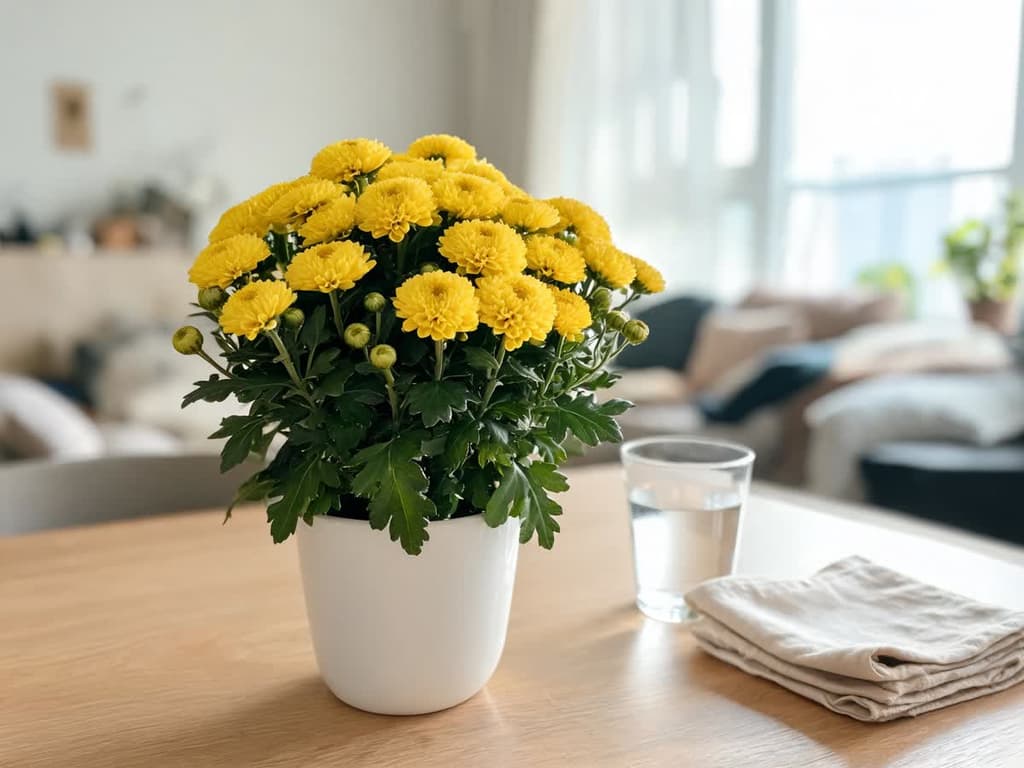
How often to water chrysanthemums (mums) depends on where they grow, not on a set calendar day. In pots, water when the top 1 inch (2 to 3 cm) of soil feels dry to the touch, until water drains out the bottom hole. In sun and heat, pot soil can dry out every day; indoors, in a cool spot, the soil takes longer to dry. In the garden, an established plant needs a deep watering only when the soil dries out.
This guide covers florist mums (Chrysanthemum × morifolium), the double-flowered plant sold in pots year-round in Brazil. The watering rule changes in three situations: a gift pot indoors, a pot on a sunny porch, and a plant in the garden bed.
Quick summary:
Potted mums: check the soil daily and water when the surface feels dry to the touch, until water runs out the pot's drainage hole.
Wilted gift mums with dry soil and a light pot: soak the pot in a basin of water for about 2 hours. After that, return to checking the soil by touch.
Pots inside a cachepot (a decorative pot without drainage holes) or plastic wrap: take the pot out to water and only put it back after it finishes draining.
Garden mums in flowerbeds: soak the soil 5 to 8 inches (13 to 20 cm) deep and water again only when it dries out; avoid quick, frequent waterings.
Always water the soil, never the flowers: blooms that stay wet for 5 to 8 hours encourage gray mold (a fungus that rots flowers).
Potted mums and garden mums need different watering approaches
The mum sold in flower shops and supermarkets is almost always potted, also called a florist mum. It is grown in greenhouses and goes on sale already in bloom. According to Universidade Federal de Viçosa, the mum is one of the most widely grown potted flowers in Brazil. Growers control flowering by day length, which is why it is available for sale year-round.
The garden mum is the hardy type that stays planted in the bed and blooms again every year. Purdue University calls plants with flowers larger than 3 inches (7.5 cm) grown in greenhouses florist mums. The same source states that small-flowered varieties, such as the daisy and pompon types, are usually the hardy garden kinds.
Both are the same species and need the same moisture levels: they like moist soil and cannot stand waterlogged dirt. What differs is the amount of soil holding water. A small pot dries out on a sunny day, while a garden bed with deep roots can hold out for several days.
Before watering, verify the plant is actually a mum
Many people receive a potted plant as a gift without knowing its name. Mums have thin leaves, indented along the margins, with a pungent scent when crushed. If the leaves are thick, smooth, and fleshy, the plant is likely a kalanchoe. That is a succulent that wants the opposite treatment: completely dry soil between waterings.
If you are still in doubt, Bloom (available for iOS) identifies plants from a photo of a leaf and flower. Getting the watering rule right depends on having the right plant name.
Wilted gift mum: what to do right now
A gift mum that wilts on the first or second day is usually thirsty. According to a University of California Master Gardener (a volunteer trained by the university extension program), potted mums often arrive from the store short on water. She recommends starting with a bottom-soak watering for about 2 hours.
Follow these steps if the soil is dry and the pot feels light:
Remove the pot from the cachepot, basket, or decorative plastic wrap.
Place the pot in a basin or bucket containing a few inches of water.
Let it soak for about 2 hours, until the soil surface turns damp and the pot feels heavy.
Lift the pot from the water and let it drain in the sink until it stops dripping before setting it back in its cachepot.
Do not leave the pot forgotten in the basin: roots can rot if kept in waterlogged soil for too long.
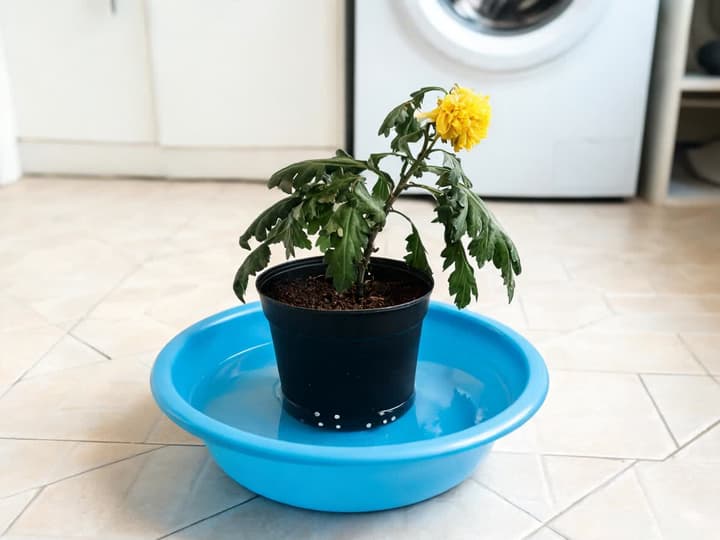
Bottom soaking works because the root ball (the block of soil and roots that comes out of the pot) is often completely root-bound. In a root ball like that, water poured from the top runs down the sides and exits through the hole without wetting the core. 16 Acres Garden Center describes this problem. Soil that dried out too much shrinks and creates the same effect.
If the plant wilted from thirst, its foliage will firm back up after soaking. Flowers that dried to paper will not recover. Snip those blooms off at the base of the stem, keeping closed buds that will open later.
Why potted mums wilt so fast
Potted mums are grown with plenty of water. In a UNESP study conducted at a grower in Paranapanema, São Paulo, Farias and Saad (2005) compared six soil moisture levels. The best commercial quality came from soil kept very moist, among the wettest levels tested.
The same study found that drier soil drastically lowered plant quality for commercial sales. The authors noted, however, that this drier regime might benefit plant shelf life after purchase. Because the research tracked commercial production rather than plants in the home, this guide follows the Iowa State guidance for mums at home: water once the soil surface dries out.
How often to water potted mums
Water potted mums when the soil surface feels dry to the touch, until water begins to drain from the bottom hole. This is the Iowa State University rule for gift mums. Watering frequency depends on the soil, not the calendar.
Use one of these two tests before watering:
The finger test: push your index finger into the soil near the pot rim. If the top 1 inch (2 to 3 cm) feels dry, water.
The lift test: pick up the pot right after a watering and remember how heavy it feels. When it feels distinctly lighter than it did right after watering, the soil has dried out and it is time to water.
The lift test solves situations where dense roots keep you from inserting your finger. 16 Acres Garden Center recommends this exact test for root-bound potted mums.
After watering, discard the water from the saucer as soon as the pot stops draining. Mums like moist soil, but the RHS (Royal Horticultural Society, the horticultural society of the United Kingdom) warns that they do not tolerate waterlogged soil. The same source advises never to let the soil dry out completely.
Cachepots, baskets, and plastic wrap trap standing water
Gift mums almost always arrive nested in a decorative cachepot, basket, or colorful foil wrap. Water draining through the pot's bottom holes gets trapped inside, leaving the roots submerged for days. Iowa State recommends taking the pot out of its sleeve, watering it at the sink, and returning it only after it drains.
If you prefer to keep the plastic sleeve, punch several drainage holes in the bottom. Alternatively, pour off accumulated water after every watering.
Indoor mums versus balcony mums in full sun
Indoors, gift mums last longer in bright, cool locations. Iowa State suggests a spot near a window with bright light but out of direct sun, between 60 and 70 °F (16 and 21 °C). In cool conditions without direct sun, soil dries out much more slowly than on an outdoor balcony.
On a sunny balcony, that same container can dry out in a single day. 16 Acres Garden Center, a US garden retailer, notes that pot-bound plants outdoors can require watering at least once a day. Check the soil daily and water when it dries out.
How to water garden mums planted in beds
In garden beds, apply deep, spaced-out waterings. Purdue University advises soaking the soil 5 to 6 inches deep (13 to 15 cm) while avoiding shallow, frequent waterings. Shallow watering creates shallow roots and encourages fungal issues like powdery mildew (white powder on foliage), Septoria leaf spot, and Verticillium wilt.
The University of Wisconsin bases watering frequency on the plant itself. Soak the soil 6 to 8 inches (15 to 20 cm) deep. Water again when the soil dries out and the leaves begin to wilt slightly. This signal applies to garden beds, where the plant recovers quickly; in a small pot, do not wait for wilting.
A new plant in the garden bed drinks more. The RHS calls for regular watering throughout the growing season for newly planted chrysanthemums, whether in the ground or in pots. Clemson University recommends plenty of water so the transplant does not wilt until the roots establish themselves in the new soil.
A 2 to 3-inch (5 to 8 cm) layer of organic mulch helps soil retain moisture, according to the University of Wisconsin. Use straw, dry leaves, or shredded bark. Leave an open ring of clear space around the base of the stems.
Poorly draining soil kills garden mums
Garden mums tolerate brief drought better than soggy soil. Purdue notes that plants survive short dry spells. The University of Wisconsin warns that mums readily die in winter if planted in wet, poorly drained soil. When planting, steer clear of low garden spots where water collects.
Watering during flowering and after blooms fade
Mums drink more heavily while in bloom. Clemson University notes that plants require ample water during flowering, and insufficient moisture slows or halts growth. Check containers daily during this stage, even indoors.
The chrysanthemum is a short-day plant: it forms buds when the nights grow long. According to the Universidade Federal de Viçosa, the flower begins to form when the day has fewer than 13 hours of light. For this reason, in Brazil, the garden chrysanthemum blooms naturally in autumn, starting in March, when the days grow shorter.
After the flowers finish blooming, continue with the same touch test: dry soil indicates when to water. In cold weather, the RHS recommends raising the pot onto pot feet or bricks to keep the hole clear and prevent the soil from becoming waterlogged.
Water the soil, not the flowers or foliage
Wetting mum flowers encourages gray mold (Botrytis cinerea), a fungus that rots petals and buds. According to the Pacific Northwest plant disease handbook, the fungus requires 5 to 8 continuous hours of a wet surface to infect. Overhead watering can also spread the spores.
The earliest signs appear on older, outer petals as water-soaked brown lesions. A dusty gray-brown fungal fuzz soon blankets the blossom, and affected buds may fail to open. Snip off infected flowers and discard them away from the pot.
To water without wetting the plant, place your watering can spout against the soil beneath the canopy. Universidade Federal de Viçosa recommends irrigation methods in commercial production that keep the foliage dry. Water early in the morning so incidental splashes dry quickly during the day.
Powdery mildew occurs more readily in dry weather, according to the RHS. Purdue links powdery mildew outbreaks to shallow, frequent waterings. The safe path for both diseases is identical: deep watering at soil level, without letting pots dry bone-dry and without wetting blossoms or leaves.
Wilted mum with moist soil: thirsty or overwatered?
A wilted mum sitting in damp soil could either be thirsty or suffering from root rot, two problems requiring opposite treatments. Do not add water before completing these three checks.
Lift the pot. If it feels light even though the soil surface looks moist, the core of the root ball is dry because water ran down the sides. Give it a bottom soaking.
Insert your finger all the way to the bottom along the edge. If the soil is moist only in the top half-inch to inch (1 to 2 cm) and dry underneath, soak the pot.
If the pot feels heavy and the soil is wet all the way to the bottom, check the roots. Carefully remove the plant from the pot. According to the gardening magazine Gardeners' World, healthy roots are white or light tan and firm; rotten roots turn brown or black, soft, and slimy.
Rotten roots cannot take up water, which causes the plant to wilt in saturated soil. If firm roots remain, trim away soft tissue with clean pruners and replace damp dirt with fresh potting mix. Wait until the surface dries before watering again. According to Gardeners' World, if rot has claimed most of the root system, the plant rarely recovers.
Yellow or brown lower leaves alone cannot distinguish between the two problems. The University of Wisconsin cites nitrogen deficiency, drought stress, and crowded plantings as causes of lower foliage yellowing. The lift test and a root check settle the diagnosis.
Signs of overwatering and underwatering in mums
What you see | Underwatering | Overwatering |
|---|---|---|
Pot weight | Light | Heavy |
Soil | Dry, pulling away from pot edges | Saturated to the bottom, foul smell |
Leaves | Wilted and soft, turning dry and crisp | Wilted despite saturated soil |
Roots | Pale and firm | Brown or black, mushy |
Flowers | Dry quickly along petal margins | Petals show water-soaked brown spots (gray mold) |
After watering | Foliage firms back up | Plant stays wilted |
Frequently asked questions
Can you overwater mums?
Yes. Mums like moist soil but cannot stand waterlogging, according to the RHS. The most frequent mistake is letting containers sit in water-filled cachepots or saucers, which suffocates roots and causes rot. Water until moisture drains out the bottom holes, then discard all standing runoff from saucers or cachepots.
Do mums need water every day?
Only if the soil dries out every day. A small container on a sunny balcony may require daily watering. Indoors in a cool spot without direct sunlight, mum soil dries much more slowly. Check the soil daily with your finger or by lifting the pot, watering strictly when dry.
How long do potted mums last?
A potted mum purchased with many tight buds stays in bloom for a month or longer. That estimate comes from the University of California Master Gardener program. Buds open sequentially. Regular watering that prevents the soil from drying out completely, along with pinching off spent blooms, helps the plant sustain flowering.
Can I bottom-water mums using a saucer?
Yes, as an emergency rescue. Submerging the pot in a basin of water for about 2 hours rehydrates a severely dry root ball that repels overhead water. For routine care, water from the top onto the soil until moisture runs out the drainage hole. Keeping a saucer continuously filled with standing water will rot the roots.
Do mums do better in pots or in the ground?
Garden mums do best in the ground, in well-draining soil, where they develop deep roots and need less watering. Florist mums can also go into garden beds after blooming, according to the California Master Gardener program. Purdue says they rarely survive the cold winters there. No one has tested this in Brazil.
Conclusion
Soil conditions dictate how often to water mums. In pots, water when the surface feels dry to the touch until moisture runs out the bottom, taking the pot out of decorative covers first. In gardens, soak deeply and wait for soil to dry. A wilted mum in damp soil calls for a pot weight and root inspection before applying another drop.
If you received a potted plant as a gift without a label, verify its species before following the watering rules in this guide.
Related articles
How to Care for Hibiscus: Sun, Watering, Fertilizer, and Pruning for Flowers
How to care for hibiscus: 6 hours of direct sun, evenly moist soil without waterlogging, half-strength fertilizer in spring and summer, and pruning in early spring. Find out why the flower lasts one day and why buds drop before opening.

Do Ferns Like Sun or Shade? It Depends on the Type
Ferns prefer bright shade: plenty of light, but no direct sun on their fronds. Tuberous sword fern is the exception that handles sun. Here is the ideal light for each type, where to place pots, and how fronds show too much or too little light.

African Violet Yellow Leaves: Causes and What to Do
Yellow leaves on an African violet usually stem from overwatering, and the first place to check is the center of the plant. Losing one lower leaf at a time is normal. Identify whether age, watering, cold water, sunlight, cold drafts, or fertilizer is the culprit based on the yellowing pattern, and see what to do today.