How to Prune Chrysanthemums and Deadhead Spent Blooms
How to prune chrysanthemums: trim spent blooms right above the next leaf or bud, pinch garden mums during active growth, and cut back stems at season's end.
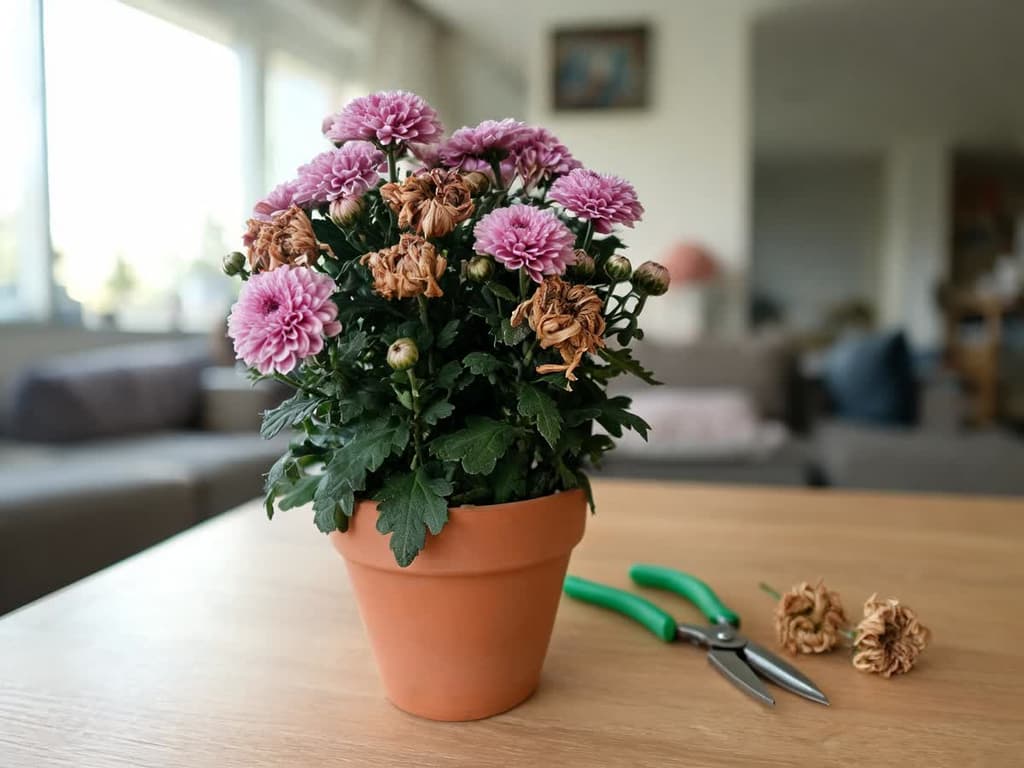
To prune chrysanthemums, start by deadheading spent flowers. Snip the small stem of each faded bloom just above the next leaf or bud on the branch, using clean shears or your fingers. Cut as soon as the flower loses its color and the petals begin to dry up. Trimming off old blooms lets the existing buds on the plant open. Brand-new flower buds only develop once the nights grow long.
The rest of the pruning depends on the variety. Garden mums need pinching (removing the tips of fresh shoots) while actively growing to create bushier branching and more flowers. At the end of their cycle, both potted florist mums and garden mums receive a hard cutback, but at different times. This guide covers potted and garden chrysanthemums (Chrysanthemum × morifolium).
Quick summary:
Spent flowers: cut the short flower stem just above the next leaf or bud as soon as the flower loses its color.
Stems with multiple blooms: remove each dry flower by its stem; once every flower on that stem has faded, cut the main stem back above a leaf.
Pinching (only during the growth stage): once shoots reach 6 inches (15 cm), pinch off about 0.5 inches (1 cm) of the tip above a pair of leaves; pinch 2 to 3 times in total.
Stop pinching about 100 days before flowering. In Brazil, for blooms in mid-April, that means early January.
End of cycle for potted mums (purchased or received in bloom): cut back to 4 to 6 inches (10 to 15 cm) if planting out in a frost-free garden.
End of cycle for garden mums: cut old stems back to 3 to 4 inches (7 to 10 cm) once fresh new growth emerges at the base.
How to deadhead chrysanthemums
Cut the faded chrysanthemum flower at the small stem, just above the next leaf or bud on the branch. This is the general rule from the Royal Horticultural Society (RHS, the British horticultural society) for deadheading. Cut as soon as the flower loses its color and the petals begin to dry up.
Removing spent flowers will not kill your chrysanthemum, even if all the flowers dry up at the same time. The RHS, Ohio State University, and NC State Extension all treat deadheading as routine care for a blooming plant. The only mistake you can make is cutting below the leaf, which removes unopened buds further down the stem.
Step-by-step:
Follow the stem of the dried flower downward until you reach the first leaf or green bud.
Cut the stem just above that leaf or bud using clean pruning shears. You can also snap thin stems with your fingers, as the RHS recommends for soft-stemmed flowers.
If the stem carries a cluster of flowers, remove only the dried ones one by one, leaving the open flowers and buds intact.
Once all the flowers on that stem have finished blooming and dried up, cut the entire stem back just above a lower leaf.
Clean up and discard all trimmed flowers and leaves from the pot and surrounding floor, as chrysanthemums are toxic to dogs and cats.
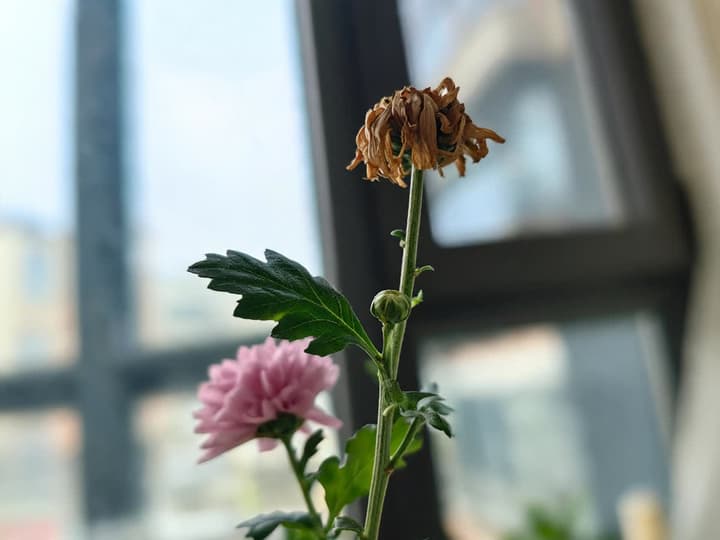
Cut just above the leaf or bud so the entire small stem comes off. If you cut right next to the flower, a bare little stem remains and dries out. If you cut below the leaf, you remove the bud that was still going to open along with it.
Does deadheading spent flowers make chrysanthemums produce new buds?
None of the consulted sources measured whether deadheading makes potted mums form new buds. What cutting does is prolong blooming: Ohio State University notes that blooming lasts longer when faded flowers are removed. NC State Extension recommends deadheading to encourage new flowers on garden mums in the fall. Cut off spent blooms without fear, but do not expect new flowers as long as the nights remain short.
New buds depend on the dark of night, not on pruning. According to Clemson University, chrysanthemums need at least 9 and a half hours of uninterrupted darkness each night to initiate buds. For buds to develop and open, they need 10 and a half hours of darkness or more.
On a potted florist mum, the bloom cycle ends when the buds that came from the store finish opening. The grower makes this potted plant flower in any month by controlling light in the greenhouse, according to the Federal University of Viçosa (UFV). Indoors, without that control, the potted plant will not form new buds until the nights grow long.
A dried flower left on the stem is a target for gray mold (Botrytis cinerea), a fungus that leaves water-soaked spots and a gray powder on the plant. According to Clemson University, the fungus preferably attacks old or damaged plant parts. Gray mold appears more frequently in cold temperatures and high humidity.
Rotten flowers after cold nights: how to save your mum
Flowers that turn brown, soft, and water-soaked right after cold nights are usually gray mold. According to Clemson University, this fungus appears under low temperatures and high humidity: first as a water-soaked spot on the petals, which then turns brown. If there was a frost and the buds turned dark, the cold destroyed the buds, as Iowa State University describes. If there was no frost and a water-soaked spot or gray powder appears, it is gray mold.
What to do:
Trim off every rotting flower and blackened bud just above a healthy leaf.
Remove all clipped plant debris from the container: Clemson University advises clearing away infected material immediately to halt fungal spread.
Move the pot to a frost-free spot.
Water only when the surface of the soil feels dry to the touch. Apply water directly to the soil, avoiding the flowers and foliage, as Clemson University advises.
Next, check the stems and foliage. Firm, green stems and leaves mean the plant is still alive; only the current flush of blooms has finished. In that case, follow the end-of-season cutback instructions for your mum variety below.
Florist mum or garden mum: variety determines pruning
Deadheading spent blooms works identically for both types. However, pinching and end-of-season pruning differ by variety, as do light needs and winter care, which are covered in the guide on how to care for chrysanthemums.
Pruning task | Potted florist mum | Garden mum (hardy mum) |
|---|---|---|
Deadheading | Cut above the next leaf or bud | Cut above the next leaf or bud |
Pinching | Unnecessary while in bloom | 2 to 3 times during the vegetative growth phase |
Stop pinching | Not applicable | Roughly 100 days before expected blooming |
End of cycle | Compost, or cut to 4–6 inches (10–15 cm) and plant outdoors in mild climates | Cut old stems back to 3–4 inches (7–10 cm) once new spring shoots emerge |
Potted florist mums are the varieties sold in full bloom at grocery stores and florists, grown under controlled greenhouse conditions. Garden mums are hardy varieties planted in garden beds that return and flower each autumn. Both belong to the same species. According to Clemson University, the key difference lies in how many weeks of long nights each needs to trigger flowers. Florist mums bloom so late in the year that, if planted outdoors where frosts occur, freezing temperatures usually destroy the flower buds before they can open.
Before pruning, make sure your plant is actually a mum. Florist kalanchoe is often sold blooming in pots right next to chrysanthemums, but it features thick, fleshy succulent foliage. Chrysanthemums have thin leaves with deeply lobed edges that give off a distinct herbal scent when crushed. If you are unsure, Bloom (available for iOS) can identify your plant from a quick photo of its leaves and flowers.
How to pinch chrysanthemums for bushier growth and extra flowers
Pinching means removing the soft tip of each shoot so the plant develops side branches. Every new branch ends in buds, which makes a pinched plant shorter and fuller with more flowers. Virginia Tech identifies pinching, fertilizing, and watering as the main care practices for garden chrysanthemums.
How to pinch:
Wait until shoots reach 6 inches (15 cm) in height.
Remove about 1 cm from the tip of each shoot, just above a pair of leaves. You can do this with your fingers or with the tips of your shears, according to the RHS.
Once the newly formed branches reach 6 inches (15 cm), pinch their tips in the same way.
If the plant grows vigorously, pinch a third time when the next set of branches reaches 6 inches (15 cm).
Sources vary little on the height for the first pinch. Iowa State University and Virginia Tech pinch at 6 inches (15 cm); the RHS waits for 8 inches (20 cm). This guide follows the 6-inch mark because two university extensions agree. Iowa State notes that most varieties benefit from 2 or 3 pinches; Virginia Tech notes that two are usually enough.
A potted florist mum purchased in bloom does not need pinching: pinching would strip away the stems carrying your developing flower buds. If you transplant it into your garden beds after flowering, treat it like a garden mum and pinch during its next active growth cycle.
When to stop pinching chrysanthemums
Stop pinching about 100 days before you want blooms, according to Ohio State University. Pinching too late delays flowering. Virginia Tech warns that where frost occurs, this delay can prevent flowers from opening before the first cold snap. Utah State University states that flowers will not form if you continue pinching past the deadline.
The sources, all from the Northern Hemisphere, give the timeframe in their summer months:
Source | Final pinch (Northern Hemisphere) | Equivalent in Brazil |
|---|---|---|
Iowa State, Utah State | Early July | Early January |
Virginia Tech | Mid-July | Mid-January |
NC State | Late July | Late January |
In Brazil, daylight lasts less than 13 hours in the fall and winter. According to UFV, chrysanthemums begin flowering when the day has fewer than 13 hours of light. Calculate based on when you want blooms: for mid-April flowers, the 100-day rule places the final pinch in early January.
End-of-season cutback: after flowering and before winter
An end-of-season cutback entails cutting down old dried branches after the blooming period ends. This happens either right after flowering or the following spring, depending on mum variety and regional winter temperatures.
Potted florist mum. Iowa State recommends taking the plant to the compost pile after flowering. According to the university, this type rarely survives the winter planted where the ground freezes. A University of California Master Gardener (a volunteer trained by the university extension), in a mild winter region, recommends something else. She instructs cutting the plant back to 4 to 6 inches (10 to 15 cm) and planting it in the garden.
Winter cold determines which path to take. Where frosts occur, follow Iowa State's advice; in mild, frost-free regions, the California method is worth a shot. Iowa State notes that even if a florist mum survives outdoors, early frosts often prevent it from flowering. The university also notes the plant will grow taller in the ground, as potted mums are frequently treated with growth regulators to keep them compact.
To overwinter potted mums where winter frosts occur, the RHS suggests trimming stems back to 8 inches (20 cm) after flowers finish. Store the pot in a cool, frost-free location, keeping the potting mix barely damp.
Garden mums in frost-prone regions. Do not prune stems back in autumn. Iowa State cites research showing that garden mums overwinter significantly better when their old stems remain standing through the winter months. Cut dead stems back to 3 to 4 inches (7 to 10 cm) above the soil in spring once fresh shoots emerge at the crown, as NC State recommends. For bed mulching instructions and container winter care, see our guide on chrysanthemum winter care. Utah State advises cutting stems to the ground as soon as tops die back. This guide sticks with Iowa State because their recommendation is backed by research.
Garden mums in frost-free regions. The spring pruning method works just the same: wait for fresh green shoots to appear at the base, then trim old stems down to 3 to 4 inches (7 to 10 cm).
A California Master Gardener describes another cut for chrysanthemums that bloom there during summer, in July. After this blooming period, she cuts the plant back to about 12 inches (30 cm), fertilizes, and waits for a second bloom in autumn. No one has measured this cut in Brazil, and late pinching can prevent flowering, according to Virginia Tech and Utah State. The safest option for the plant is the spring rule.
Disbudding: only for extra-large blooms
Disbudding means stripping away side flower buds so only a single central bud remains on each branch. The RHS and Virginia Tech describe this technique for growing exhibition or cut-flower mums with huge blooms. The remaining terminal bud absorbs all the plant's resources, yielding a far larger blossom. Utah State points out that disbudding small-flowered spray varieties does not produce giant flowers. On florist mums, disbudding serves no purpose.
Clean tools, gloves, and pet safety
Wash your pruning shears and hands after handling diseased or stunted mums, and disinfect your tools before working on other plants. Chrysanthemum stunt is a disease that stunts plant growth, turning leaves light green or reddish. Utah State warns that stunt viroid easily spreads to healthy plants via pruning knives and hands during pinching. Clemson University advises sterilizing tools immediately after pruning diseased material. If your mums harbor pests, review our guide on chrysanthemum pests before making any cuts.
Wear gloves if you have sensitive skin. According to the NC State Extension, contact with the foliage can cause mild irritation in sensitive individuals.
Chrysanthemums are toxic to dogs, cats, and horses, according to the ASPCA (the American society for the prevention of cruelty to animals). Signs include vomiting, diarrhea, drooling, incoordination, and skin irritation. Pick up trimmed flowers and leaves right away before your pet finds them on the ground.
Frequently asked questions about pruning chrysanthemums
Can you make chrysanthemums bloom again?
Yes, with long nights. Sources differ on the length of the night. Clemson University mentions at least 9 and a half hours of darkness; UFV mentions a day shorter than 13 hours (a night longer than 11 hours). When in doubt, follow the more demanding number: 11 hours of darkness per night, with no lights on. After blooming, cut back old stems: to 4 to 6 inches (10 to 15 cm) for potted chrysanthemums in frost-free climates, or to 3 to 4 inches (7 to 10 cm) in spring for garden mums. Let the plant grow in full sun. Pinch back until about 100 days before flowering. In Brazil, blooms return when the days shorten, in autumn and winter.
Can I cut chrysanthemums down to the ground?
Prune low, but avoid cutting right to ground level. Where frost hits, leave stems alone in autumn: Iowa State explains that garden mums withstand winter freezes better when their old stems remain standing. In spring, as soon as fresh green shoots show at the base, cut dead stems back to 3 to 4 inches (7 to 10 cm) above ground level, as NC State recommends. While Utah State allows cutting down to ground level, this guide follows the consensus between the other two extensions.
How often should you deadhead chrysanthemums?
Inspect plants once a week while in flower. The RHS recommends deadheading perennial border plants weekly or biweekly. For potted indoor mums, trim spent blossoms the moment they begin fading to stop gray mold from taking hold on decaying petals.
Are chrysanthemums perennials?
Chrysanthemums are perennials that live for multiple years. Garden mums bloom reliably every autumn. According to Iowa State, garden varieties require dividing every 2 to 3 years by digging up the clump and separating rooted sections. Florist mums only survive as perennials in frost-free regions. Where the ground freezes, Iowa State and Utah State report that potted florist mums rarely survive their first winter.
Related articles
How to Care for Hibiscus: Sun, Watering, Fertilizer, and Pruning for Flowers
How to care for hibiscus: 6 hours of direct sun, evenly moist soil without waterlogging, half-strength fertilizer in spring and summer, and pruning in early spring. Find out why the flower lasts one day and why buds drop before opening.

Do Ferns Like Sun or Shade? It Depends on the Type
Ferns prefer bright shade: plenty of light, but no direct sun on their fronds. Tuberous sword fern is the exception that handles sun. Here is the ideal light for each type, where to place pots, and how fronds show too much or too little light.

African Violet Yellow Leaves: Causes and What to Do
Yellow leaves on an African violet usually stem from overwatering, and the first place to check is the center of the plant. Losing one lower leaf at a time is normal. Identify whether age, watering, cold water, sunlight, cold drafts, or fertilizer is the culprit based on the yellowing pattern, and see what to do today.