Chrysanthemum Pests: How to Identify and Treat Them
Chrysanthemum pests can be identified by where their signs appear. Tiny black bugs on buds mean aphids, webbing under leaves means mites, and spotted petals mean thrips. Here is how to treat each one and when to discard the pot.
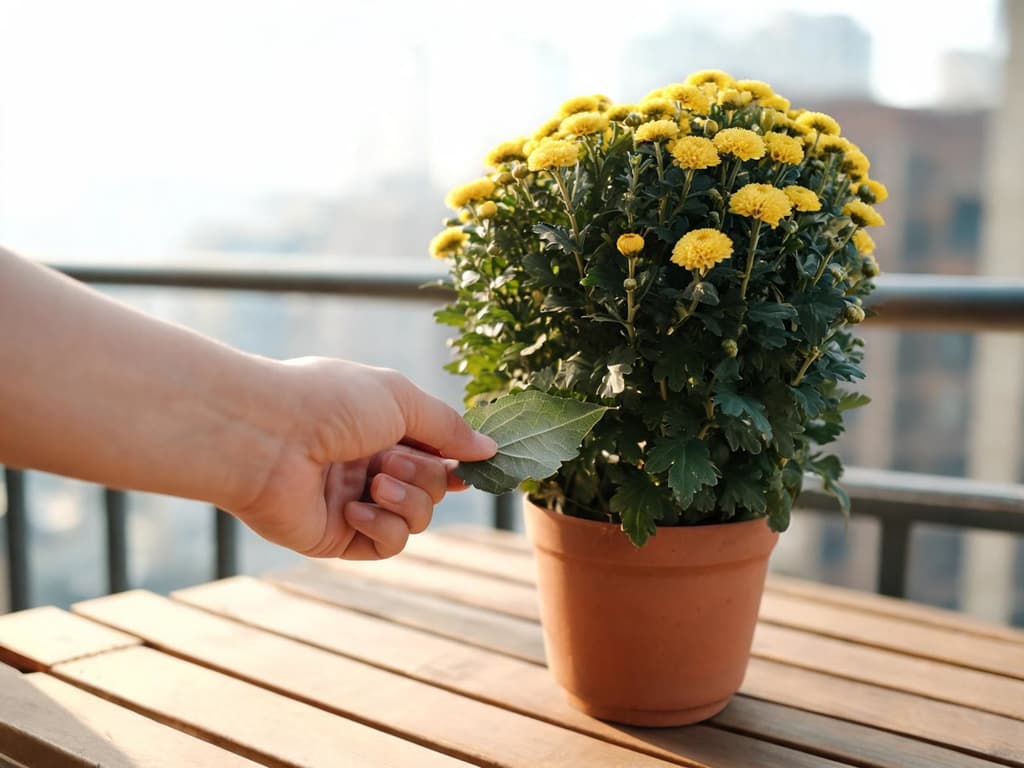
Chrysanthemum pests can be identified by where their signs appear: on the bud, on the underside of the leaf, inside the leaf, or on the flower. Aphids, mites, and thrips appear on every list of chrysanthemum pests from the agricultural extensions consulted. An agricultural extension is a university guidance service. Most are controlled with a stream of water, insecticidal soap, and pruning the affected parts. Three problems can force you to discard the pot: a virus transmitted by thrips, severe outbreaks of white rust, and heavy infestations of two-spotted spider mites.
A cluster of tiny black bugs on the buds does not require cutting down the entire plant. It is almost always aphids, and the first treatment is a strong spray of water every 2 days, at least 3 times. Only the buds that are already dry and brown need to go.
There are two types of chrysanthemums, and their pests differ. Potted chrysanthemums, sold in bloom at florists and supermarkets, suffer more from aphids, mites, thrips, and whiteflies. Garden chrysanthemums, planted in garden beds, also attract caterpillars, slugs, and a microscopic worm that enters through the leaf.
Quick summary:
Clusters of tiny black or green bugs on the bud and new tips: aphids. Rinse with a stream of water every 2 days, at least 3 times.
Leaves with yellow speckles and fine webbing underneath: two-spotted spider mites. Isolate the pot and wash the undersides of the leaves.
Petals with white spots and buds that fail to open: thrips. Cut off infested flowers and check if the leaves show rings, lines, or mosaic spots, which are signs of a virus.
Pale, winding trails inside the leaf: leafminers. Pick off the leaves showing trails.
A cloud of white insects when you touch the plant: whiteflies. Use a yellow sticky trap to monitor the population and wash the leaf undersides.
Holes in the leaves and flowers, along with droppings or slime trails: caterpillars or slugs, found almost exclusively in the garden. Handpick them.
White powder on the upper surface of leaves: powdery mildew, a fungus rather than a pest. Remove infected leaves and space out your pots.
Diagnostic table: where the sign appears and which pest it indicates
Where to look | What you see | Likely pest | Pot or garden | Does it threaten the plant? |
|---|---|---|---|---|
Buds and new growth | Clusters of tiny black, brown, or green bugs; distorted, sticky new leaves | Aphids | Both | Weakens the plant; transmits viruses |
Underside of the leaf | Yellow speckles on top; fine webbing below; dry, brittle leaves | Two-spotted spider mite | Both, worse in hot, dry weather | Yes, in heavy infestations |
Flowers and buds | Petals with white spots; distorted buds that fail to open; silvery leaves with black specks | Thrips | Both | Yes, if carrying viruses |
Inside the leaf | Pale, winding trails with tiny black droppings inside | Leafminer | Both | Rarely |
Underside of the leaf | 1.5 mm white insects that flutter when disturbed; sticky leaves | Whitefly | More common in pots and indoors | Gradually weakens it |
Leaves and flowers | Irregular holes, dark droppings, shiny slime trails | Caterpillars or slugs | Garden | Rarely |
Lower leaves | Brown, wedge-shaped spots bounded by leaf veins, moving upward | Foliar nematode | Garden | Yes |
Powdery mildew (white powder) and white rust (cream-colored pustules underneath) are fungi that resemble pest infestations. They are covered in the diseases section below, along with gray mold and foliar nematodes.
Florist pot or garden: pests change with the location
Potted chrysanthemums are grown to flower in the container and sold already in bloom year-round. The NC State Extension factsheet on chrysanthemum (Chrysanthemum × morifolium) lists aphids, thrips, mites, and lace bugs as occasional problems. The lace bug is an insect that sucks leaf sap.
Indoors and on enclosed porches, still, warm air favors whiteflies and mites. The RHS describes the glasshouse whitefly as a houseplant and greenhouse pest that is active year-round in these environments.
In the garden bed, ground pests come into play. The Clemson Extension describes the foliar nematode in garden chrysanthemums. Slugs and caterpillars attack plants in garden beds, and slugs feed at night.
Aphids: tiny black bugs on buds and new growth
Aphids are the most common cause of tiny black bugs clustered on chrysanthemum buds. The chrysanthemum aphid (Macrosiphoniella sanborni) is dark brown to black, according to Clemson. Other species that attack the plant are green or pink, such as the green peach aphid (Myzus persicae), cited by the Connecticut agricultural station.
Aphids gather on tender new shoots, leaf undersides, buds, and opening blossoms. New foliage emerges distorted or curled, plant growth stops, and a sticky residue appears. A black powder called sooty mold (a fungus that does not attack plant tissue, but covers the leaf surface) develops on this residue. Aphids also transmit plant viruses.
Clemson's treatment protocol for chrysanthemums, in order:
Rinse the plant thoroughly with a strong stream of water, aiming at the undersides of leaves and buds. Repeat every 2 days, at least 3 times.
Protect natural aphid predators like ladybugs: avoid broad-spectrum insecticides that kill these beneficial insects.
If aphids return after 3 washings, apply commercial insecticidal soap or horticultural oil according to label instructions. Spray only the aphid-covered areas to spare ladybugs.
Prune an entire branch only if it has completely dried out. Brown, shriveled buds will not open, and you can pull them off by hand. The rest of the plant recovers once aphids are gone. A stream of water also removes aphids from other indoor plants, as detailed in our guide to aphids on houseplants.
Two-spotted spider mites: pale speckles and fine webbing under leaves
The two-spotted spider mite (Tetranychus urticae) is an arachnid under 1 mm long that feeds on the undersides of leaves. It creates thousands of yellow specks on the upper surface and fine webbing over buds, stems, and leaf undersides. Clemson notes that damage typically begins on lower foliage and populations explode during hot, dry weather.
To verify, inspect the underside of a speckled leaf with a magnifying glass: mites appear as moving dots near the webbing. Leaves with black specks and no webbing might indicate thrips: consult the diagnostic table.
Move the pot away from other plants the same day you detect webbing. Then, follow Clemson's treatment protocol for spider mites on chrysanthemums:
Rinse foliage thoroughly with a strong stream of water, paying close attention to the undersides, at least 3 times.
Trim branches with heavy webbing and desiccated leaves, discarding them in a sealed bag.
Apply insecticidal soap during the early stages of an outbreak, coating the undersides of every leaf.
Neem oil and insecticidal soap fail when the product does not directly contact the mite. Both kill only the mites they hit and leave no residual effect after drying. Eggs also survive, producing a new generation after treatment. Because of this, applications must be repeated and must wet the underside of every leaf.
No precise threshold has been established beyond which a chrysanthemum cannot recover. When webbing encloses shoot tips and most leaves are dry and brittle, discard the potted plant in a sealed trash bag to protect your other plants. Potted chrysanthemums are generally sold in full bloom, and replacing one costs less than losing your plant collection. Two-spotted spider mites, also known as spider mites, infest many indoor plants. For this reason, isolation comes before treatment.
Thrips: discolored flowers and buds that will not open
Thrips are slender insects up to 2 mm long, with fringed wings, that scrape flowers and leaves to feed on sap. On petals, the RHS describes white patches where color has drained away. In heavy attacks, buds fail to open. On leaves, silvered areas appear, dotted with tiny black specks of insect frass.
Thrips are difficult to spot. The RHS recommends shaking the flower or branch over a sheet of white paper and examining the specks that fall, preferably using a magnifying lens. The western flower thrips (Frankliniella occidentalis) is one species listed on chrysanthemums by the RHS.
The greatest risk from thrips is the virus. Chrysanthemum stem necrosis virus was found in São Paulo and Minas Gerais, on chrysanthemum and tomato, according to the EPPO. In a 2000 test, the species Frankliniella schultzei transmitted the virus in 78.1% of cases and F. occidentalis in 65.1%. The onion thrips (Thrips tabaci) did not transmit it.
Clemson includes tomato spotted wilt virus among chrysanthemum viruses, which thrips also transmit. Leaves with rings, lines, or mosaic spots and thin, stunted shoots are signs of a virus. Viruses have no cure. Remove the entire plant and throw it away in a sealed bag so thrips do not spread the virus to other plants.
For thrips without a virus:
Cut off spotted flowers and buds and discard them in a sealed bag.
Indoors, hang a blue sticky trap near the pot. The RHS does not recommend the trap outdoors, because it catches many non-pest insects.
Clemson recommends insecticidal soap and neem oil for thrips: spray the store-bought product directly on the insects, following the rules in the Soap, Neem Oil, and Other Products section.
Spinosad, a bacterial insecticide, controls thrips and leafminers. Clemson warns that it is toxic to bees and should not be applied to flowering plants. Because chrysanthemums infested with thrips are almost always in bloom, do not use spinosad on them.
Leafminers: pale trails winding through foliage
A leafminer is the larval stage of a small fly that burrows inside the leaf tissue. Clemson describes winding light green to brown trails dotted with dark specks of frass inside. Severely infested leaves dry up and drop off. The most frequently cited leafminer species on chrysanthemums is Chromatomyia syngenesiae, whose adult fly is dark-colored and measures 3 mm.
In Brazil, Embrapa studied leafminer attacks on chrysanthemum crops in Ceará, in Research Bulletin 171, from 2018. Leafminers arrive in the home inside plants grown in commercial greenhouses, as reported by the Connecticut agricultural experiment station.
Home treatment is simple: pick off and discard leaves with trails, and clean up any fallen foliage from the soil surface. Leafminers rarely kill a chrysanthemum, and the plant will continue blooming.
Whiteflies: a fluttering white cloud when the plant is disturbed
The whitefly is a 1.5 mm white insect that lives on leaf undersides and takes flight in clouds when the plant is brushed. The RHS lists chrysanthemums among the hosts of the glasshouse whitefly. It secretes the same sticky honeydew as aphids, leading to yellowing foliage and sooty mold.
For home and balcony care:
Hang a yellow sticky trap just above the pot. The RHS notes that traps indicate how many flies are present but do not eradicate the pest.
Quarantine any new plant and check leaf undersides before placing it alongside other plants. According to the RHS, whiteflies enter homes on newly purchased plants.
Wash the undersides of the foliage with a spray of water and prune away heavily yellowed leaves.
Neem oil and insecticidal soap work against whiteflies, according to Clemson, under the same condition as with mites: they must make direct contact with the insect.
Caterpillars and slugs: chewed foliage and blossoms
Holes in leaves and flowers are almost always caterpillars or slugs, and almost exclusively on garden chrysanthemums. Caterpillars leave dark droppings on leaves and petals. Slugs and snails leave a shiny slime trail and feed at night, according to the RHS.
For caterpillars, handpick them in the late afternoon. Bt (Bacillus thuringiensis, a bacterium that only attacks moth and butterfly larvae) works on small caterpillars. Clemson instructs gardeners to apply Bt in the late afternoon or on an overcast day, following the label, because sunlight breaks down the product. Bt does not reach caterpillars that have already entered the stem.
For slugs, the RHS suggests inspecting plants with a flashlight on damp nights and handpicking them. Water in the morning rather than the evening: wet soil at night encourages slug activity.
Chrysanthemum diseases that look like pest damage
Four chrysanthemum conditions resemble pest damage: three are fungal diseases and one is caused by a microscopic worm.
Powdery mildew. It is a white powder on the upper leaf surface and sometimes on the stem. Severely affected leaves turn brown and shrivel, according to the Connecticut agricultural station. Powdery mildew is a fungus that spreads in warm, humid weather and in crowded pots, and watering less does not eliminate it. Place affected leaves into a plastic bag to remove them. Space out the pots so that the leaves of one do not touch those of another, allowing air to circulate. Fungicide is generally not necessary, according to the same source.
White rust. The fungus Puccinia horiana causes sunken yellow spots on the upper surface of the leaf. On the underside, raised cream-colored pustules appear, which later turn white. The RHS notes that the disease spreads through the air and arrived in the United Kingdom on infected cuttings. Cool, humid weather, with foliage wet for hours, favors infection.
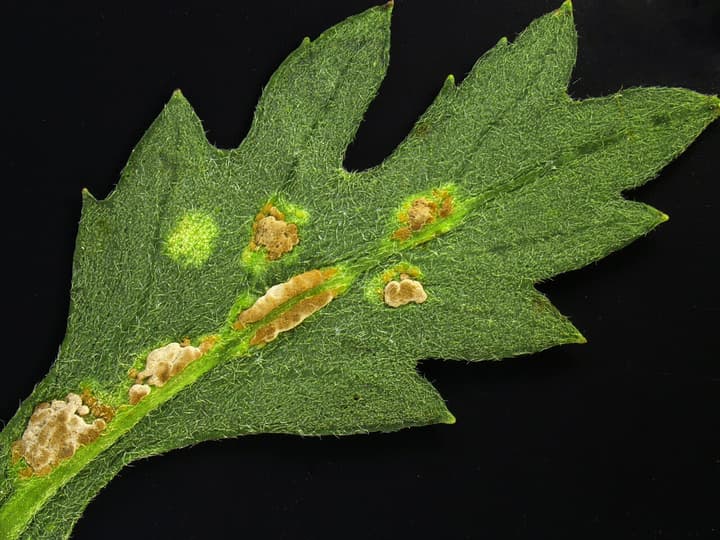
White rust has been a quarantine pest in the United States since 1995, in Canada, and in Mexico, according to the EPPO database. A quarantine pest is one that the government officially controls to prevent it from entering or spreading. In the European Union and the United Kingdom, it is regulated for the sale of cuttings, without being a quarantine pest. In Brazil, the same database records the disease as present.
At home, the RHS advises picking off and discarding pustule-bearing leaves as soon as they appear. If the plant is covered in pustules, the safest choice is discarding the pot. Wind spreads the spores, the microscopic fungal cells, to other chrysanthemums. Water the soil directly without wetting foliage.
Gray mold. Blossoms turn brown, take on a papery texture, and become draped in fuzzy gray mold. The Connecticut station identifies aging flowers as the most susceptible, especially during overcast, humid weather. Deadhead spent blooms promptly and avoid wetting flowers during irrigation.
Foliar nematodes. Brown, wedge-shaped lesions outlined by leaf veins develop on lower leaves and move upward. These microscopic roundworms swim up through rain or irrigation water to infect foliage. Clemson recommends mulching the soil and watering at the base without splashing leaves. Infested leaves should be thrown in the trash along with the top layer of potting soil.
Store-bought chrysanthemums with pests: what to inspect before introducing them
Florist chrysanthemums come from commercial greenhouses, bringing several pests along for the ride. Leafminers and whiteflies frequently arrive this way, and white rust travels on infected cuttings. Before grouping a new pot with other houseplants, check:
the undersides of 5 or 6 leaves from both the top and bottom of the plant for bugs, webs, and pustules;
buds and shoot tips for aphids;
open flowers, shaken over white paper, for thrips;
leaves held up against the light for leafminer trails.
Even without visible symptoms, keep the new pot isolated for several weeks and inspect leaf undersides weekly during this time. The RHS suggests this quarantine window for white rust, which can lurk in foliage before symptoms show, though it does not name a precise number of weeks. The most common potted plant pests and identification tips can be found in our guide to houseplant pests.
Soaps, neem oil, and other products: when they work
Insecticidal soap and neem oil kill on contact: only insects wet by the product die. Clemson lists four rules for them to work without burning the plant:
Thoroughly coat both upper and lower leaf surfaces, as well as stems. Pests hidden inside curled leaves escape.
Reapply at the interval specified on the product label, because these sprays have no residual effect once dry.
Do not apply when temperatures exceed 32 °C (90 °F), in direct full sun, or to drought-stressed plants.
Spray in early morning or late afternoon so the solution dries slowly.
Clemson does not recommend homemade soap, because the chance of burning the leaf is greater than with store-bought products. Colorado State University advises testing the product on a small part of the plant 1 or 2 days before spraying the rest.
Systemic insecticides that the plant absorbs and transports to its leaves, such as imidacloprid, appear in US recommendations for outdoor commercial growers. This guide does not recommend them for indoor potted plants. For aphids and mites in pots, Clemson recommends starting with water rinses and commercial insecticidal soaps.
Do chrysanthemums deter pests?
The chrysanthemum that repels pests is a different species. Pyrethrum, a natural insecticide extracted from flowers, comes from the Dalmatian chrysanthemum (Tanacetum cinerariifolium), according to a 2016 article in the journal Emerging Infectious Diseases. Potted and garden chrysanthemums are attacked by the pests in this guide.
Pyrethrins are a mixture of 6 substances that paralyze the insect's nervous system. The information comes from the NPIC, the pesticide information center at Oregon State University. In sunlight, half of one of them breaks down in 12.9 hours on the soil surface (this measure is called half-life). Pyrethrins are highly toxic to bees and fish. None of the sources in this guide measured whether a planted chrysanthemum protects neighboring plants.
Are chrysanthemums toxic to cats and dogs?
The chrysanthemum is toxic to dogs, cats, and horses, according to the ASPCA. Signs include vomiting, diarrhea, drooling, lack of coordination, and skin irritation. Keep the pot out of reach of dogs and cats, and call the vet if these signs appear.
White powder on leaves and a cat nibbling on foliage are two distinct problems. The powder is powdery mildew and is managed by removing infected leaves. The risk to cats comes from the plant itself, whether a fungus is present or not.
Frequently asked questions
What are the tiny black bugs on my chrysanthemum buds?
They are almost always aphids. The chrysanthemum aphid is dark brown to black and congregates in clusters on buds and tender shoots. Rinse the plant with a strong stream of water every 2 days, at least 3 times, focusing on the buds. If the bugs jump or fly away, consult the chart: they may be thrips or whiteflies.
Do chrysanthemum pests spread to other houseplants?
Yes. Aphids, spider mites, thrips, and whiteflies infest many indoor species. Move an infested chrysanthemum away from other plants the same day you notice the problem. Check the undersides of leaves on neighboring pots for 2 weeks, and wash your hands after handling the infested plant.
Can you use pyrethrin insecticide on chrysanthemums?
Yes, according to label instructions, but pyrethrins kill every insect they coat, including ladybugs that consume aphids. They are highly toxic to bees, so avoid using them on outdoor chrysanthemums in bloom. In direct sunlight, the half-life of one pyrethrin compound on soil surfaces is 12.9 hours, according to the NPIC. For aphids on chrysanthemums, Clemson recommends starting with a stream of water.
Are chrysanthemums pest-resistant?
No. Potted chrysanthemums attract aphids, spider mites, thrips, leafminers, and whiteflies, while garden chrysanthemums also attract caterpillars, slugs, and foliar nematodes. Checking the undersides of leaves weekly catches infestations early. Watering at the base without wetting foliage and spacing pots apart helps minimize fungal problems.
When unsure between two pests, photograph the symptom
Take a clear, close-up photo of an affected leaf underside and a bud in good lighting. Bloom (available for iOS) provides plant disease diagnosis from photos with the Premium plan.
Related articles

How to Care for Hibiscus: Sun, Watering, Fertilizer, and Pruning for Flowers
How to care for hibiscus: 6 hours of direct sun, evenly moist soil without waterlogging, half-strength fertilizer in spring and summer, and pruning in early spring. Find out why the flower lasts one day and why buds drop before opening.

Do Ferns Like Sun or Shade? It Depends on the Type
Ferns prefer bright shade: plenty of light, but no direct sun on their fronds. Tuberous sword fern is the exception that handles sun. Here is the ideal light for each type, where to place pots, and how fronds show too much or too little light.

African Violet Yellow Leaves: Causes and What to Do
Yellow leaves on an African violet usually stem from overwatering, and the first place to check is the center of the plant. Losing one lower leaf at a time is normal. Identify whether age, watering, cold water, sunlight, cold drafts, or fertilizer is the culprit based on the yellowing pattern, and see what to do today.