String of Pearls: How to Make It Bloom and When Flowers Appear
How to make string of pearls bloom: a cool winter between 50 and 61 °F (10 and 16 °C) with light watering and 2 to 3 hours of direct sun daily. See when flowers appear in Brazil and what to do afterward.
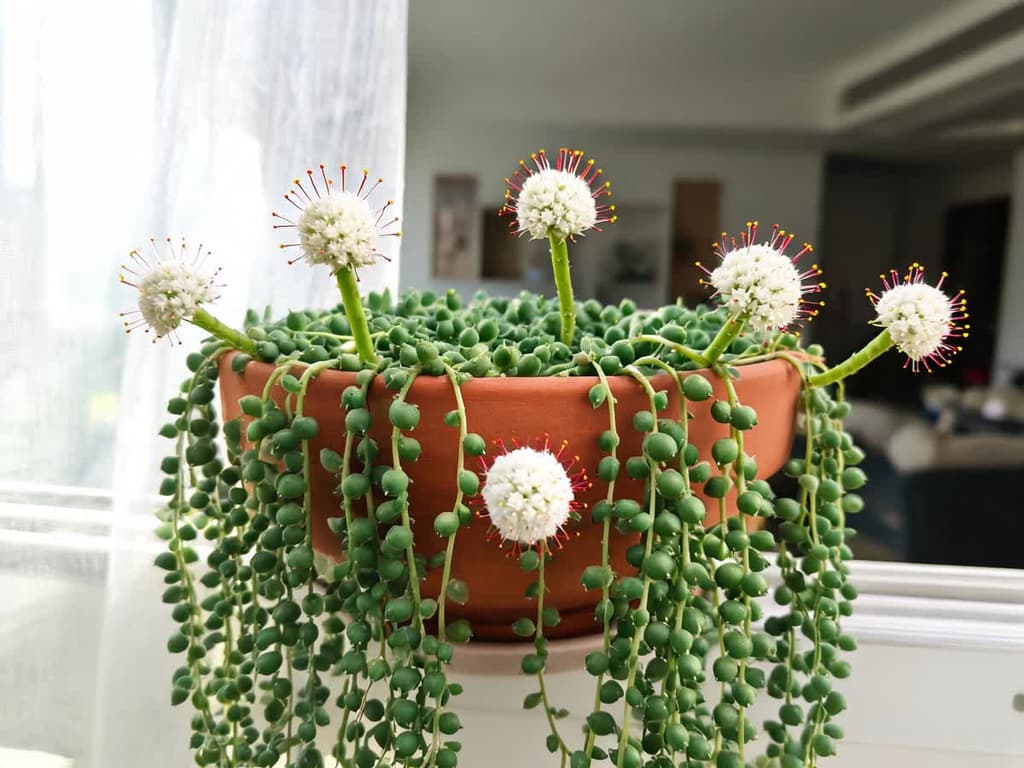
To make string of pearls bloom, give it a cool winter, between 10 and 16 °C (50 and 60 °F), from June to August. During this period, water only when the beads, the plant's round leaves, become wrinkled. For the rest of the year, ensure 2 to 3 hours of direct sun per day, away from the midday summer sun. In Brazil, the flower appears between August and April, with a higher chance in summer. Indoors, flowering is rare, according to NC State Extension, the agricultural extension service of North Carolina State University.
If your string of pearls is already blooming, the flower alone does not indicate that the plant is dying, and you do not need to cut anything. String of pearls is a perennial plant that lives for several years and can bloom again in following years. The flower is a white head about 0.5 in (1.3 cm) wide with colorful filaments, held on a slender stem above the beads. The beads are the plant's water-filled leaves.
Is a flower on string of pearls a sign that the plant is going to die?
No. A flower on string of pearls is not a sign of death. NC State classifies the plant as a perennial, a plant that lives for several years. In South Africa, where it originates, the Random Harvest nursery records flowers from August to April, opening and pausing throughout the season.
The idea of a "death bloom" comes from other succulents. Sempervivum is a succulent that grows in a rosette, with leaves arranged like a rose. The rosette that flowers dies after blooming, according to NC State. None of the sources on string of pearls describe this death after flowering.
A flower also does not prove that the root system is healthy. A string of pearls with soft beads or a brown base can bloom anyway. In that case, treat the rot first, which is roots or stems decaying from excess water. The guide on string of pearls care shows how to save firm green strands as cuttings. A cutting is a piece of strand planted in soil to grow roots.
What the string of pearls flower looks like
The string of pearls flower is white, about 0.5 in (1.3 cm) wide, and smells like cinnamon. This description comes from NC State and the University of Wisconsin Extension. According to LLIFLE, the flower does not have the petals of a daisy. The RHS, the Royal Horticultural Society of the United Kingdom, describes the bloom as a white or cream brush. Each flower sits at the tip of a stem about 1.5 in (4 cm) long.
Slender, colorful filaments emerge from the white center. NC State describes the filaments as red with yellow tips. LLIFLE, an encyclopedia of succulents, describes lilac and violet filaments. The photo below, of an actual plant, shows purple and lilac filaments.
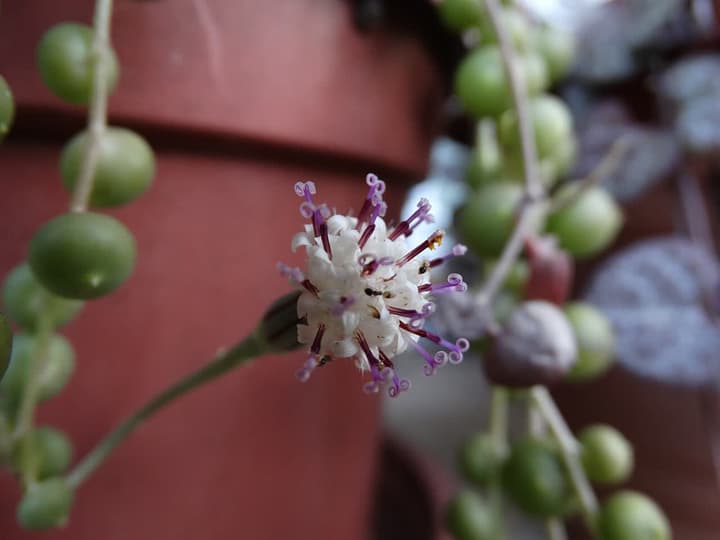
NC State, Wisconsin, LLIFLE, and Random Harvest describe the scent as cinnamon. Wisconsin describes the scent as sweet and spicy, and Random Harvest as faint. Some people also detect cloves: the author of the blog Joy Us Garden describes a blend of cloves (the spice), cinnamon, and carnation (the flower). She notes that the scent is weak when the plant blooms outdoors in cool weather.
The current scientific name for string of pearls is Curio rowleyanus, and it was formerly called Senecio rowleyanus. The string of pearls profile brings together basic facts about the species.
When string of pearls blooms in Brazil
In Brazil, string of pearls blooms between August and April, and does not bloom from May to July. This is the calendar from Random Harvest, a nursery in South Africa, which is in the same hemisphere as Brazil. Northern Hemisphere sources say the plant blooms in summer, which in Brazil corresponds to December to February.
LLIFLE gives a timeframe that starts 1 month later, from spring to fall, which in Brazil runs from September to May. The season runs from late winter to fall, and summer falls in the middle of it. In the coldest months, from June to August, the plant rests, and the first flowers can open as early as August, at the end of dormancy.
Wikipedia states that the bloom lasts about 1 month. The author of Joy Us Garden reports that each flower lasted a few days and that the plant remained in bloom for 2 months outdoors. New flowers opened while old ones dried up. No extension service specifies the duration, so expect 1 to 2 months of flowers on the plant.
Why string of pearls does not bloom
A string of pearls that does not bloom may have spent a warm, watered winter or may be living in low light. NC State records that the plant rarely blooms indoors. Wisconsin links summer blooming to a cool, dry winter. No published study has measured what induces flowering in string of pearls: the recommendations below come from university extensions and plant encyclopedias.
What you see | Probable cause | What to do |
|---|---|---|
Plant is green and lush, but has never flowered | Warm winter with normal watering | Next winter (June to August), keep the plant between 10 and 16 °C (50 and 60 °F) and water only when the beads wrinkle. |
Long, sparse strands with small, widely spaced beads | Low light, according to the RHS | Move the plant to a window with 2 to 3 hours of direct sun daily |
Plant purchased a few months ago, in a small pot | Plant is still young | Wait: the RHS gives 1 to 2 years for the plant to reach mature size, and a young plant can bloom before that |
Plant is many years old, with strands drying out and a sparse base | Old plant | Renew it through cuttings, as NC State recommends |
Soft beads, brown base, or stalled growth | Sick or stressed plant | Treat rot first: save firm green strands as cuttings |
There is no published minimum age for flowering. The author of Joy Us Garden took 4 years to see the first bloom on an indoor plant. In the comments of that same blog, a reader mentions that her plant, in a 5-inch (13 cm) pot, bloomed 4 weeks after purchase.
A string of pearls that grows slowly and fails to bloom may have another cause besides a warm winter. The page on slow growth in string of pearls lists these causes.
The winter rest that helps string of pearls bloom
Winter dormancy is a cool, drier period, from June to August in Brazil. Wisconsin recommends keeping string of pearls between 55 and 60 °F (13 and 16 °C) in winter, with little water, because this can encourage blooming in summer. NC State gives a slightly wider range for winter, 50 to 60 °F (10 to 16 °C).
Do not drop below 50 °F (10 °C) on purpose. The retailer Planet Desert recommends cold temperatures between 35 and 45 °F (2 and 7 °C) to force blooms, citing no source. The retailer Love That Leaf mentions below 50 °F (10 °C), also without a source. The RHS says the opposite: the plant dislikes temperatures below 50 °F (10 °C) and cold drafts. Under the RHS H2 hardiness rating, the plant tolerates minimums between 34 and 41 °F (1 and 5 °C), but it does not survive freezing. This article follows the university extensions, which have stronger verification than shops. Their range also does not drop below the 50 °F (10 °C) floor marked by the RHS.
Water sparingly during dormancy. The RHS directs watering lightly or not at all in winter while preventing the beads from shriveling. Wisconsin advises watering when beads start to wrinkle. This article follows Wisconsin, a university extension: when beads become slightly wrinkled yet still feel firm to the touch, water once. Thirst signs for each type of succulent appear in the guide on how to water succulents.
How to find a cool spot in an apartment:
Use a room without a heater, near a bright window.
Keep the plant away from air conditioning vents and doors leading outside.
Measure nighttime temperatures near the pot with a simple thermometer for one week.
Maintain 2 to 3 hours of direct sun daily, just as throughout the rest of the year. Dormancy only alters temperature and watering.
In September, as days warm up, the plant resumes growth and demands water more frequently. Water whenever the beads lose their round shape while remaining firm to the touch. Where winters stay warm, the plant lacks the cool rest that Wisconsin links to flowering, making blooms less likely.
How much light string of pearls needs to bloom
Direct sun for part of the day can help string of pearls bloom. LLIFLE recommends 2 to 3 hours of direct sun daily year-round and notes that this encourages flowering. NC State classifies the plant as partial shade, with 2 to 6 hours of direct sun daily. This article uses the range from LLIFLE, the only source linking light to blooming.
In Brazil, an east-facing window is the easiest option: it provides morning sun, which is weaker. For most of the year, a north-facing window gets the stronger midday sun. In the summer, place a sheer curtain between the plant and the glass of that window. The RHS advises moving the plant out of direct midday sun in the summer. In the winter, you can remove the curtain.
In a hanging basket, keep the top of the pot level with the window. That way, direct light reaches the top beads, not just the trailing tips. A pot hung high stays shaded by the wall or ceiling. The guide on hanging plants shows how to position hanging pots near a window to illuminate the entire plant.
Does fertilizer help string of pearls bloom?
No one has measured whether fertilizer helps string of pearls bloom. The RHS recommends general-purpose liquid fertilizer at half the package dose, once a month or less, only during the growing season. In Brazil, this season runs from October to March. From April to September, do not fertilize.
LLIFLE recommends low-nitrogen fertilizer for succulents in general. According to the encyclopedia, nitrogen leaves succulents soft and watery. The author of Joy Us Garden advises against bloom booster fertilizers on string of pearls. The author of the guide from Love That Leaf mentions that her plant bloomed only after receiving weak fertilizer every week. The same retailer sells fertilizer. Follow the RHS dosage, the only technical source specifying quantity and frequency.
Flower, seed, or mealybug: how to tell them apart
A white tuft or fuzz ball on string of pearls can be a flower, a seed, or a mealybug, a common pest. Check where the white spot is attached:
What you see | What it is | Source |
|---|---|---|
White head about 0.5 in (1.3 cm) wide with colorful filaments, at the tip of a slender 1.5 in (4 cm) stem above the beads | Flower | NC State |
Tuft of white fluff at the tip of the same stem after the flower dries | Seeds with down that scatter in the wind | NC State and Wisconsin |
Oval bodies 0.1 to 0.2 in (3 to 6 mm) long covered in white wax, resting flat on stems without stalks | Mealybug | Iowa State |
Cottony tufts where beads attach to the stem, without stalks | Mealybug egg sacs | Iowa State |
Iowa State University Extension describes mealybugs as oval insects coated in wax, with the look of white powder. Egg sacs sit in tufts resembling cotton, almost always where leaves attach to stems. The insect excretes honeydew, a sticky sugary liquid that makes beads sticky. Flowers and seeds do not produce honeydew.
Mealybugs appear among the pests recorded for string of pearls:
If the bloom does not match the description above, verify whether the plant is truly a string of pearls. Bloom (available for iOS) identifies plants from a photo. Other trailing succulents, such as string of bananas, are also sold under similar names.
After blooming: prune or leave it?
After flowering, you can trim the dried stalks or leave the plant as it is. No technical source states that cutting spent flowers helps string of pearls bloom again. The author of Joy Us Garden trimmed dried flowers once a week, explaining she did so purely for appearance.
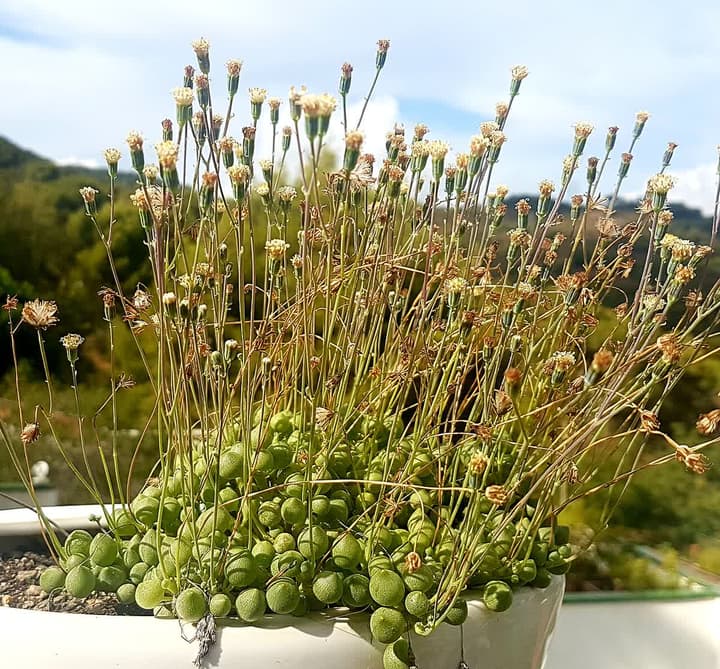
If you prune, cut the entire stalk flush with the bead strand where it emerges, using clean shears. Wear gloves, as sap from string of pearls can irritate skin according to NC State.
If you leave it, the dry bloom turns into a seed head with white down that drifts in the wind. NC State lists seeds as a way to propagate the plant. Stem cuttings, pieces of strand that root in soil, offer the fastest way to get a new plant.
After blooming, continue the regular seasonal routine. Feed with half-strength fertilizer through March and move the plant out of midday sun in summer. In June, start the winter rest again.
Frequently asked questions
Does string of pearls bloom indoors?
Yes, but it is rare according to NC State. Indoors, winters tend to stay warm and light remains weak. Wisconsin links blooming to a cool winter, and LLIFLE links it to direct sun. Keep the plant in a window with 2 to 3 hours of direct sun and, from June to August, in a room between 50 and 61 °F (10 and 16 °C).
Does the string of pearls flower have a scent?
Yes. The string of pearls bloom smells like cinnamon, according to NC State, Wisconsin, LLIFLE, and Random Harvest. Wisconsin describes the scent as sweet and spicy, and Random Harvest as faint. Some people also detect cloves. The scent is weaker when the plant blooms outdoors in the cold, reports the author of the Joy Us Garden blog.
How long does a string of pearls bloom last?
Wikipedia states that a string of pearls flower lasts about 1 month. The author of Joy Us Garden reports that each bloom lasted a few days. While earlier blooms dry, others open on the same strands. On an outdoor plant, the author of Joy Us Garden reports 2 months of flowering. Afterward, dried flowers turn into seed heads with white down.
Do I need to trim string of pearls flowers so the plant does not weaken?
No. No technical source states that flowering weakens string of pearls or that removing spent blooms helps the plant flower again. Trimming spent stems is purely an aesthetic choice. If you trim, use clean shears and wear gloves, as the sap can irritate skin according to NC State.
Summary: string of pearls throughout the year in Brazil
Season | What to do |
|---|---|
June to August | Rest: 50 to 61 °F (10 to 16 °C), water only when beads wrinkle, no fertilizer, bright light |
September | Plant resumes growth: water whenever beads lose their round shape |
October to March | Liquid fertilizer at half strength once a month or less; sheer curtain on north windows in summer |
August to April | Bloom window (starting in August at the end of dormancy), with highest likelihood from December to February |
After flowering | Trim spent stems or leave the seeds; continue normal seasonal care |
A watering schedule helps remind you to scale back watering in June at the start of winter rest:
Related articles

How to Care for Hibiscus: Sun, Watering, Fertilizer, and Pruning for Flowers
How to care for hibiscus: 6 hours of direct sun, evenly moist soil without waterlogging, half-strength fertilizer in spring and summer, and pruning in early spring. Find out why the flower lasts one day and why buds drop before opening.

Do Ferns Like Sun or Shade? It Depends on the Type
Ferns prefer bright shade: plenty of light, but no direct sun on their fronds. Tuberous sword fern is the exception that handles sun. Here is the ideal light for each type, where to place pots, and how fronds show too much or too little light.

African Violet Yellow Leaves: Causes and What to Do
Yellow leaves on an African violet usually stem from overwatering, and the first place to check is the center of the plant. Losing one lower leaf at a time is normal. Identify whether age, watering, cold water, sunlight, cold drafts, or fertilizer is the culprit based on the yellowing pattern, and see what to do today.