How to Propagate Begonias: The Right Method for Every Type
Almost every begonia takes from stem cuttings, but only rex, rhizomatous, and tuberous types form a new plant from a leaf. Learn where to cut without harming the mother plant, how to root in water or soil, and the right method for each type.
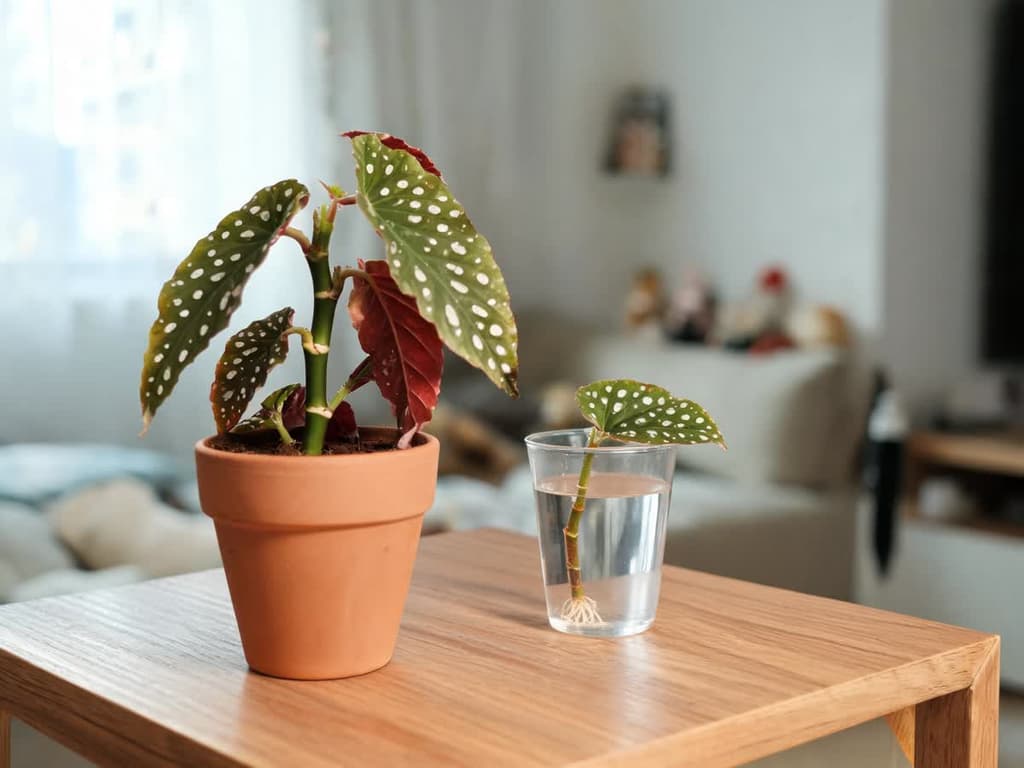
To propagate a begonia, cut a 3- to 4-inch non-flowering stem tip and root it in water or moist soil. Almost every begonia takes this way, according to the American Begonia Society (ABS). A leaf also roots, but it only forms a new plant on rex begonias, other rhizomatous types, and tuberous begonias.
In Brazil, the best time runs from September to December, in spring and early summer. The ABS considers spring the ideal time, but the cutting (the piece of stem cut to make a new plant) can be taken in any month.
Quick summary:
Cut with a clean blade; never tear the stem.
Pick a non-flowering tip: most begonias do not sprout from a node (the point on the stem where a leaf emerges) that has already bloomed.
In water, transfer the cutting to soil when the root reaches 0.5 inches.
Rex leaves root in an enclosed container with bright light and no direct sun.
The propagation method for each type of begonia
Begonia is a genus with hundreds of species, and the method that works depends on your plant's group. Identify the group by its stem and foliage:
Begonia type | How to recognize | Working method |
|---|---|---|
Cane-like (maculata, angel wing) | Upright, stiff stems with thick, bamboo-like nodes | Stem cuttings in water or soil |
Wax begonia | Low-growing plant with shiny, thick leaves, blooming year-round | Non-flowering tip cutting; seed |
Rex and other rhizomatous begonias | Thick stem growing horizontally along the soil (rhizome), large colorful leaves | Whole leaf, leaf wedge, rhizome piece, division |
Tuberous | Large blooms, grows from a potato-like tuber, and goes dormant in winter | Basal tuber shoot, tuber division |
Elatior | Florist begonia packed with blooms | Stem cutting from fresh basal shoot |
Care guides for each group have complete care instructions: polka dot begonia, rex begonia, wax begonia, and tuberous begonia.
If you do not know which begonia you have, a photo in the Bloom app for iPhone identifies the plant. Once you have the name, pick the matching method from the table.
Where to cut the begonia without harming the mother plant
The mother plant survives the cut and often becomes bushier, because the trimmed stem resprouts from the lower nodes. The node is the spot on the stem where the leaf emerges. It holds a bud, and that bud is where new growth begins.
Make two cuts. The first is on the mother plant: measure 3 to 4 inches from the tip of the stem and cut 0.25 to 0.5 inches above the next node, following ABS pruning guidelines. The second is on the severed cutting: trim the base 0.5 inches below the lowest node. According to the ABS, cutting closer to the node can cause the cutting to rot instead of rooting.
Take only a few cuttings at a time. None of the consulted sources specify how many stems a begonia can afford to lose. The ABS advises against cutting all stems down near the base at once, as the plant might not recover. Leave old, healthy stems on the mother plant.
Cutting vs. snapping the begonia stem
Cut it. Use a fresh razor blade, a sharp knife, or clean shears. The ABS recommends a fresh razor blade because it cuts without crushing stem tissue, which would otherwise hinder water uptake. A torn stem ends up ripped with crushed tissue.
The cutting needs a node, and the node must not have bloomed
The cutting needs at least one node to root and sprout. The ABS explains that most begonias will not grow a new shoot from a node that has already bloomed. Exceptions include tuberous, rex, and rhizomatous begonias, which sprout from any rooted tissue.
Pick the tip of a stem with no blooms and no dry scars left behind by fallen flowers. On wax begonias, which flower almost continuously, the ABS advises pruning the plant first and taking cuttings from the resulting fresh growth.
How to propagate begonias from stem cuttings step by step
Stem cuttings are the easiest method and work on almost all begonias (ABS). This applies to cane, wax, and elatior types.
Cut a 7 to 10 cm non-flowering stem tip (ABS), as taught by the RHS, the British horticultural society.
Strip the leaves from the lower nodes. The ABS notes that buried leaves rot.
Fill a small pot with seed-starting mix blended with coarse sand or perlite (light, white mineral granules that keep soil airy).
Bury the cutting deep enough to cover at least one node. The ABS states that the buried bud turns into a new shoot at the base of the plant.
Water and place the pot in bright light, away from direct sun. The RHS roots stem cuttings at 64–70 °F (18–21 °C), using bottom heat under the pot.
Stem cuttings from cane, wax, and other firm-stemmed begonias take root directly in a pot placed in bright light without direct sun, according to the ABS. They do not need a plastic bag.
Propagating begonias in water
Almost every begonia cutting roots in water, according to the ABS. The exception is the leaf section, which needs an enclosed box and clean, fungus-free perlite.
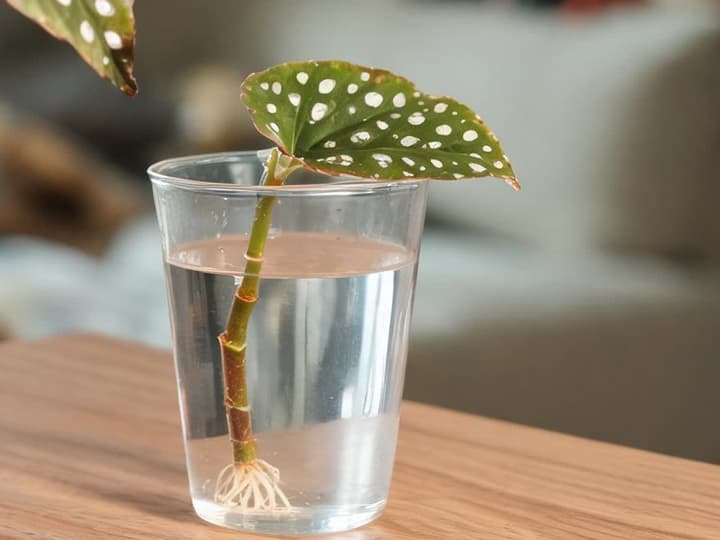
Use a small glass. The ABS explains that cuttings release a substance into the water that encourages root formation, which becomes more concentrated in less water. You can place several cuttings in the same glass.
Transfer the cutting to soil when roots reach 0.5 inches. The ABS states that water-grown roots transition to soil without issue.
How to propagate Begonia maculata (and other cane types)
To propagate Begonia maculata, cut a stem tip with 2 to 4 nodes and root it in water, perlite, or sand. The ABS considers tip cuttings the easiest and most reliable way to multiply cane begonias. Begonia maculata (Begonia maculata), known for its white-spotted foliage, belongs to this group, according to NC State Extension.
Cane begonia seeds do not always produce the same plant. NC State Extension warns that seeds from a hybrid (a plant created by crossing two different begonias) produce plants that differ from the parent plant. A cutting yields an exact copy.
To get many plants from a single stem, use a leaf-bud cutting (which the ABS refers to as a "mallet cutting"). Cut the stem just above and just below a node, keeping the leaf attached to that short stem section. Each leaf-bearing node turns into a new plant, meaning a stem with several nodes yields multiple starts instead of just one or two. Avoid this method on cane begonias that drop foliage easily: the leaf might fall off before the cutting roots (ABS). Treat this cutting like a whole rex leaf: in an enclosed container with bright light and no direct sunlight.
Saving a maculata from a single surviving stem
If you have one live stem left, propagate it. Cut the firm, green section of the stem, staying above any soft or dark patches, and root it in water or soil. A cutting with a single healthy node is enough to root.
Before throwing the pot away, take the plant out and check the roots. Black, soft roots and stems are signs of rot, according to the ABS. Penn State Extension describes shiny black water-soaked lesions on the stem near the soil line, with the plant collapsing. In this case, a cutting taken from the firm section is what saves the plant.
Wax begonia: non-flowering tip cutting
Wax begonias root from tip cuttings or basal shoots, preferably without flowers (ABS). The cutting requires at least two buds buried in the soil. Because wax begonias bloom almost constantly, finding a non-flowering tip can be tricky: prune the plant back and wait for fresh shoots.
NC State Extension also lists seed and leaf cuttings for wax begonias. The ABS says that, outside of rex, rhizomatous, and tuberous types, the leaf roots but almost never produces a new plant. This guide follows the ABS, which describes the leaf method in detail: for wax begonias, use tip cuttings, which both sources recommend.
How to propagate begonias from leaves (rex and rhizomatous types)
A rex begonia leaf propagates in three ways: a whole leaf with its petiole (the stalk connecting the leaf to the stem), leaf wedges with a vein, or a whole leaf with slashed veins. The ABS states that all parts of the leaf root and form a new plant, provided the piece has a main vein. The vein is the thicker, lighter line that runs outward from the petiole across the leaf.
Leaf propagation applies to rex, other rhizomatous varieties, and tuberous begonias. On other begonias, a leaf might root, but it almost never produces a new plant (ABS).
Whole leaf with petiole
Pick a fresh, fully expanded leaf. An imperfect leaf you were planning to remove also works (ABS).
Trim the leaf stalk (petiole) to 0.5 to 1 inch.
If the leaf is large, trim away the outer edges, leaving only the rounded center attached to the stalk. Smaller leaves lose less water.
Insert the petiole into moist perlite or soil, keeping the leaf upright.
Seal the container with its lid and place it in bright light without direct sun.
Hardier varieties will root with their stalk resting in an uncovered glass of water (ABS). Covering a glass of water causes the leaf to rot.
Slashed-vein leaf
Remove the stalk from a fresh, fully grown leaf.
Using a sharp blade, slit the main veins on the underside of the leaf, spacing cuts about 1 inch apart (RHS).
Lay the leaf top-side up so the cuts underneath touch moist sandy soil in a flat tray.
Pin the leaf flat using hairpins or small pebbles so the cuts maintain contact with the soil.
Water lightly and cover the tray with a clear plastic bag or dome.
New plantlets emerge from the slit points. Once each has 2 to 3 leaves, transplant them into 3-inch (7 cm) pots (RHS).
Leaf wedges with a vein
Cut the leaf into 1-inch (2.5 cm) squares, each with a main vein, and pin the squares flat against the soil, as directed by the RHS leaf cuttings guide. The ABS calls these pieces wedges, uses 1- to 1.5-inch (2.5 to 4 cm) pieces, and inserts each one upright into moist perlite. Neither source compares the two positions; both use an enclosed box.
Using leaf wedges is one of the slowest and most finicky begonia propagation methods. The ABS notes that a wedge can take around two months to form roots and new plantlets, requiring an enclosed box and clean perlite. On the other hand, a single leaf yields numerous starts.
The right environment for leaf propagation
Enclosed container: a clear tub with a lid, a seed tray with a humidity dome, or a plastic bag. The ABS explains that an enclosed space preserves humidity and shields the leaf from fungal issues.
Bright light, no direct sun: sunlight hitting an enclosed container creates extreme heat and scorches the leaf (ABS).
Temperatures of 64 to 75 °F (18 to 24 °C): this is the temperature range recommended by the RHS for rex begonias. In cooler conditions, plantlets develop more slowly (RHS).
Air out twice a week: the RHS advises opening the container and removing any decaying foliage to prevent gray mold.
The RHS takes rex leaf cuttings in late spring. In Brazil, this corresponds to November and December.
Rhizome pieces and rhizomatous begonia division
A rhizome is the thick stem that creeps horizontally along the soil in rex and other rhizomatous begonias. The ABS explains that it can be chopped into 2-inch pieces, with each section growing into a new plant. Rhizome cuttings do not need attached leaves.
Lay the piece horizontally across the potting soil, burying it no deeper than halfway. The tip of the rhizome can also be planted upright, with 0.5 to 1 inch of the cut end in the soil (ABS). Rhizomes will root in water, but their succulent nature makes them rot quickly.
To divide the plant, remove the begonia from the pot and separate the rhizome into sections. The RHS divides rhizomatous types in spring (September to November in Brazil) and requires each section to have at least one shoot.
Tuberous and elatior begonias: basal shoots and tuber division
Tuberous begonias propagate through basal shoots arising from the tuber and by dividing the tuber itself. The tuber is the fleshy underground structure from which the plant returns each year.
A basal shoot is the easiest cutting for tuberous begonias, according to the ABS. When the tuber produces more shoots than you want, gently detach one (sometimes it already comes with roots) or cut it at 3 inches (7.5 cm), just below a node, as UF/IFAS, the University of Florida Extension, does. Root it in sand, away from direct sun, between 59 and 64 °F (15 and 18 °C). Under these conditions, roots appear in about 5 weeks.
To divide the tuber, cut it into pieces with at least one shoot each (UF/IFAS). Let the pieces dry for a few days and plant each one 0.5 inch (1.3 cm) deep in sand. UF/IFAS applies a fungicide to the cut to prevent rot.
Elatior begonias are also referred to as semi-tuberous begonias. The RHS notes that they are typically started fresh each year from cuttings. Following flowering, the RHS rests the plant for about 6 weeks at 45 °F (7 °C) with light watering, never allowing the soil to dry out completely. Afterwards, cut the stems down to 6 inches from the base. Once new growth reaches 2 to 3 inches, take cuttings flush with the base and root them at 64 to 72 °F (18 to 22 °C) in bright, indirect light.
Propagating begonias from seed
Begonia seeds are fine as dust and sit directly on the soil surface. The RHS directs sowing fibrous-rooted begonias, such as wax begonias, on seed-starting compost between 70 and 77 °F (21 and 25 °C). Cover them with no more than a dusting of fine sand. NC State warns against covering wax begonia seeds with soil.
The RHS sows in late winter, which corresponds to August and September in Brazil. When the seedling puts out its first true leaf (the one that comes after the first two small leaves), move it to a 3-inch (7.5 cm) pot (RHS). Hybrid seed does not come true to the parent plant (NC State).
Why begonia cuttings rot or fail to take
Begonia cuttings fail or rot for four main reasons:
Waterlogged soil: the RHS cautions that cuttings rot if the substrate stays overly wet. Water again only when the surface starts to dry out.
Covering the wrong cuttings: stem cuttings do not require enclosed covers, and leaves placed in a covered glass of water will rot (ABS).
Cutting too close to the node: the ABS instructs leaving 0.5 inches of stem below the node.
Cuttings from previously flowered nodes: these may root, but they fail to produce new branches (ABS).
Cold temperatures slow leaf cuttings down. The RHS notes that plantlets grow slower in cold rooms and recommends holding leaf cuttings around 68 °F (20 °C).
Are begonias toxic? Precautions when handling rhizomes and tubers
Begonias are toxic to dogs and cats, according to the ASPCA, the American animal protection society. Signs include vomiting and salivation. The most toxic part is underground: the rhizome and tuber you handle when propagating. Keep leftover pieces away from animals.
Other common plants are also toxic to animals. The list of the most common ones can be found in toxic plants for pets.
Frequently asked questions
Can you propagate begonias from stem cuttings?
Yes. Almost all begonias take from stem cuttings, according to the American Begonia Society. Cut a 3- to 4-inch non-flowering stem tip, 0.5 inches below a node. Strip the bottom leaves and root in water or moist soil in bright light without direct sunlight.
How long do begonia cuttings take to root?
It depends on the method. Stem cuttings of tuberous begonias take around 5 weeks at 59 to 64 °F (15 to 18 °C), according to UF/IFAS. Rex leaf wedges can take around two months to form roots and plantlets (ABS). In water, you can watch root growth: pot them up once roots hit 0.5 inches.
Do you need rooting hormone for begonia cuttings?
It is not necessary: begonias root in water and soil without added hormones. The American Begonia Society mentions rooting powder and ground cinnamon applied to cut ends as options to ward off fungi. Wear gloves when using commercial rooting hormones.
How do you propagate a begonia from a leaf?
Leaves only yield new plantlets on rex, other rhizomatous varieties, and tuberous begonias. Insert the leaf stalk of a fresh leaf into moist perlite, or slash the underside of main veins and pin the leaf flat on the soil. Keep in an enclosed container with bright indirect light between 64 and 75 °F (18 and 24 °C).
Next step
To start today, cut a non-flowering stem tip, remove the lower leaves, and place it in a small glass of water in a bright spot. If your begonia is a rex, use a fresh leaf with its stem attached. Peperomia also forms new plants from leaves: see how to propagate peperomia. Pilea multiplies through offsets that sprout from the soil: see how to propagate pilea. Kalanchoe roots from both stem and leaf cuttings: see how to propagate kalanchoe.
Sources
American Begonia Society. Vegetative propagation.
American Begonia Society. Cane-like begonias: like bamboo with flowers.
American Begonia Society. Semperflorens begonias: most are sturdy and easy.
Penn State Extension. Begonia diseases.
American Begonia Society. Growing tuberous begonias.
Royal Horticultural Society (RHS). Begonias as houseplants.
Royal Horticultural Society (RHS). Leaf cuttings.
UF/IFAS Extension. Begonia tuberhybrida, hybrid tuberous begonia.
UF/IFAS Gardening Solutions. Begonias.
NC State Extension. Begonia, cane types and Begonia, wax types.
Related articles
How to Care for a Maidenhair Fern: Light, Water, and Revival Tips
Learn how to care for a maidenhair fern indoors: bright indirect light, consistently moist soil, high humidity, and how to revive it if it dries out completely.
How to Propagate Spider Plants: Root the Pup Before Cutting
The safest spider plant cutting comes from a pup still attached to the mother plant: rest the plantlet on soil in a small pot, wait for roots to establish, and only then cut the stolon. Learn when the pup is ready, whether rooting in water is worth it, how to divide the clump, and why plants fail to produce babies.
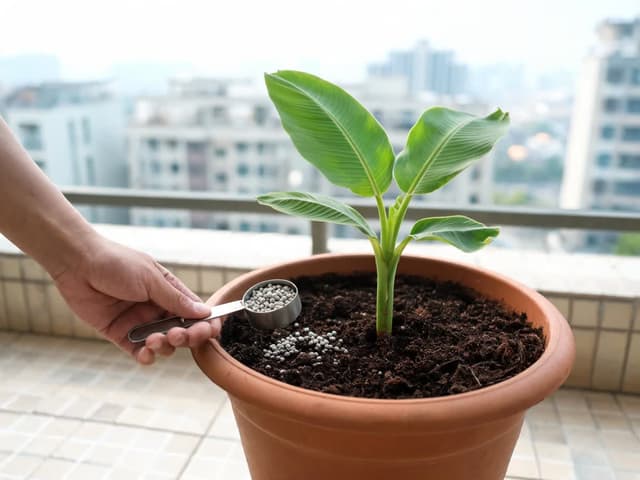
Banana plant fertilizer: fertilizing potted and backyard plants
Banana plant fertilizer needs more potassium than nitrogen, in a 3-1-6 ratio. For a potted plant on a balcony, use the label dose in spring and summer. In the backyard, fertilize every 2 months, adjusting the amount by mat age. Learn the formula, timing in Brazil, and signs of deficiency or excess.