How to Propagate Lilies: 5 Methods and Time to Bloom
How to propagate lilies: by bulb division, scales, stem bulblets, tiger lily bulbils, or seed. See the step-by-step guide for scales and how long each method takes to bloom.
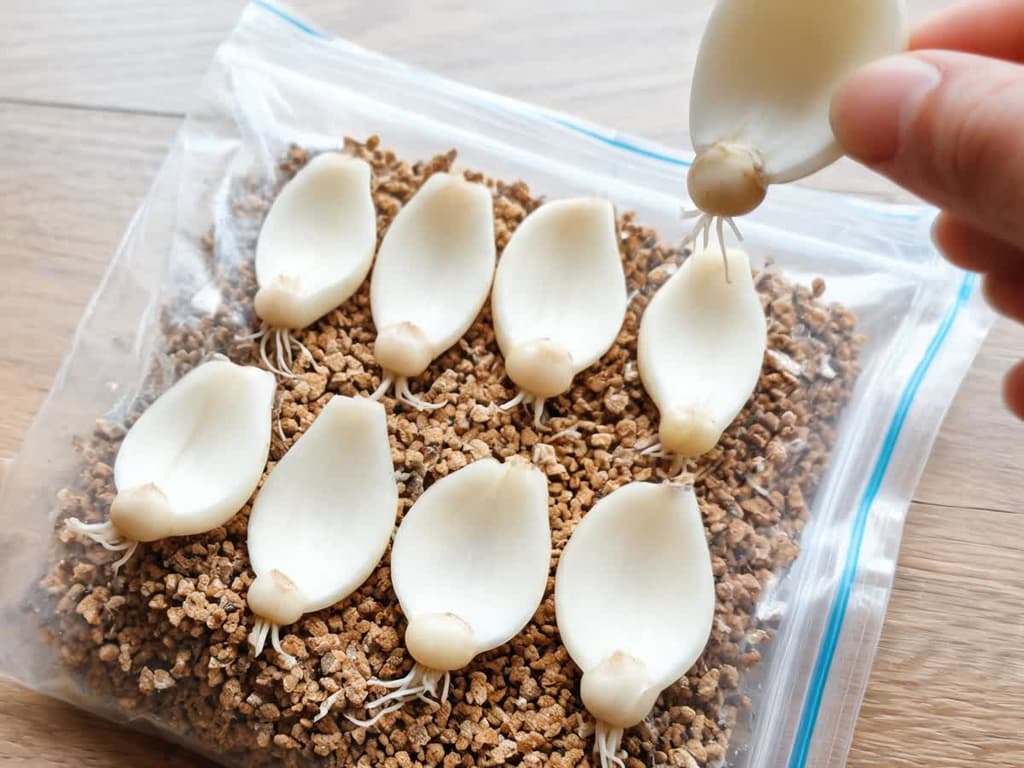
To propagate lilies, you work with the bulb, the white and fleshy part that stays underground. The lily (Lilium) propagates in 5 ways: bulb division, bulb scales, stem bulblets, leaf bulbils, and seed. Division is the fastest way: according to Iowa State University (Iowa State), a separated large bulb blooms the following summer. Scales yield more plants, from 3 to 5 per scale, and take 2 to 3 years to produce their first flower.
This guide applies to bulb lilies: Asiatic lilies, Oriental lilies, Easter lilies (Lilium longiflorum), and tiger lilies (Lilium lancifolium). The data comes from university extensions and the Royal Horticultural Society (RHS), the United Kingdom's gardening charity. Peace lilies, calla lilies, and daylilies are also called lilies, but they propagate differently. The first section shows how to identify each one.
Quick summary:
Bulb division: separate the clump in early fall. Large bulbs bloom the following summer; small bulbs take 2 to 3 years.
Scales: each scale removed from the bulb produces 3 to 5 bulblets in about 2 months, in a bag with moist vermiculite.
Tiger lily bulbils: the black beads where the leaf meets the stem are ready-to-plant offsets.
Seed: plants grown from hybrid lily seed usually differ from the parent plant.
Cats: the entire lily is toxic to cats, including the bulb and scales stored in the refrigerator.
Which lily you have: four plants with the same name
Four different plants are commonly called lilies, and each propagates in a different way. The first step is figuring out which one is in your pot. These characteristics separate the four:
Plant | How to recognize | How it propagates |
|---|---|---|
Bulb lily (Lilium): Asiatic, Oriental, Easter lily, tiger lily | Tall stem with leaves arranged from bottom to top; large 6-petaled flower; white bulb made of loose scales | From the bulb: division, scales, bulblets, bulbils, or seed (this guide) |
Peace lily (Spathiphyllum) | Broad leaves emerging directly from the soil; white leaf-like flower surrounding a spadix | Clump division |
Calla lily (Zantedeschia aethiopica) | Arrowhead-shaped leaf; white funnel-shaped spathe with a yellow spadix in the middle | Division of the rhizome, the thick stem growing horizontally underground |
Daylily (Hemerocallis) | Long, narrow leaves growing in a fan from the base; each flower lasts 1 day | Clump division |
The peace lily propagates by clump division. The step-by-step instructions, along with the right time of year, are in the guide on how to propagate peace lilies. For calla lilies, North Carolina State University Extension (NC State) recommends division. The time is early spring or late summer.
The orange flower that pops up on its own in the yard is usually one of two plants: daylily or tiger lily. NC State notes that the daylily is not a true lily and that it multiplies by division, in fall or spring. The tiger lily has leaves along the entire stem and black bulbils where each leaf meets the stem. If you do not know which plant you have, the Bloom app identifies the species from a photo.
The 5 ways to propagate lilies and time to bloom
A propagated lily always grows from a new bulb. A small bulb needs a few years with foliage to reach flowering size.
Method | When to do it | How many new plants | Time to 1st flower | Source |
|---|---|---|---|---|
Bulb division | Early fall, after the plant finishes blooming | The bulbs already present in the clump | Large bulb: following summer. Small bulb: 2 to 3 years | Iowa State |
Bulb scales | After flowering, late summer to early fall | 3 to 5 bulblets per scale | 2 to 3 years | Univ. of Florida (UF/IFAS) and Univ. of Wisconsin |
Stem bulblets | Late summer or early fall | Those that form underground every year | 2 to 4 years | Iowa State |
Leaf bulbils | Right after flowering, before they drop | One at each leaf on tiger lilies | Iowa State advises planting them like stem bulblets | NC State and Iowa State |
Seed | When the seed pod begins to split open | One plant per seed | None of the sources provides the number of years | Iowa State and RHS |
Ready-to-plant commercial bulbs also take years to reach flowering size. The University of Wisconsin notes that commercial Easter lily bulbs spend 3 to 4 years in the field before going into pots.
Bulb division: the fastest way
Division separates the bulbs that the lily has already formed together in the same planting hole. The North American Lily Society notes that Asiatic lilies produce 2 to 4 new bulbs each year. Over time, the clump develops multiple attached bulbs, and each one can become an individual plant.
Divide in early fall, after blooming has finished: March and April in the Southern Hemisphere, September and October in the Northern Hemisphere. The step-by-step process comes from Iowa State:
Dig carefully around the clump and lift the entire root ball without cutting into the bulbs.
Separate the bulbs using your hands.
Cut the stem just above each bulb.
Replant the same day. Lily bulbs lack the dry, protective papery skin found on onions, and the University of Wisconsin advises replanting as soon as possible.
Bury each bulb at a depth equal to 3 times its diameter. A 2-inch bulb goes 6 inches deep.
Bulb size determines how long you wait. Large bulbs bloom the following summer; small bulbs can take 2 to 3 years, according to Iowa State.
How to propagate lilies from bulb scales
A lily bulb consists of scales, thick white segments layered like artichoke leaves. Each detached scale forms bulblets at its base where it joined the bulb. It is the most productive method: the University of Florida (UF/IFAS) notes 3 to 5 bulblets per scale. This is how commercial Easter lilies are produced.
You will need a zip-top plastic bag, bulb fungicide or hydrogen peroxide, and vermiculite. Vermiculite, a lightweight mineral sold at garden centers, holds moisture without becoming waterlogged. Follow these steps:
Lift the bulb from the soil after flowering, from late summer to early fall, which is the RHS timing. Use only firm, unblemished bulbs.
Remove 4 to 8 outer scales, the amount recommended by the North American Lily Society. Snap each one off as close to the base of the bulb as possible, as advised by the RHS. Replant the mother bulb the same day.
Protect the scales against fungus. Iowa State recommends dusting the scales with fungicide or dipping them in hydrogen peroxide. Apply fungicide according to the label rate.
Place the scales in the bag with moist vermiculite. The vermiculite has the right moisture level when you squeeze a handful and no water drips out.
Store the bag in the dark, around 70 °F (21 °C), for 6 weeks. This is the RHS timeframe. UF/IFAS mentions bulblets forming within 2 months.
Move the bag to the refrigerator crisper drawer for 6 to 12 weeks. Never use the freezer.
Plant each bulblet when it reaches pea size. By this point, the parent scale has shriveled. Iowa State recommends planting about 1 inch deep in a small pot.
Sources differ on the chilling period in step 6. The RHS calls for cold only for certain species, such as the martagon lily. The North American Lily Society states that scale bulblets require 6 to 12 weeks in the refrigerator before sending up their first leaf. Neither measured what happens to Asiatic lilies without chilling. This guide includes refrigeration because it satisfies both recommendations simultaneously.
From scale to first bloom, count on 2 to 3 years. That is the timeline from the University of Wisconsin for scales and bulblets. The North American Lily Society mentions about 2 years; UF/IFAS says only "several years." This guide follows the University of Wisconsin, the only extension service with an exact figure for both scales and bulblets. The University of Wisconsin notes that the Oriental lily 'Stargazer' roots easily from scales, unlike many other Oriental lilies.
Stem bulblets: offsets that form underground
Several lilies develop bulblets along the buried portion of the stem, right above the main bulb. The North American Lily Society notes that these form every year on varieties that produce them. Each bulblet is an offset ready to be detached.
In late summer or early fall, gently brush away the soil around the stem until you see the bulblets. This is the timing recommended by the RHS Lily Group. Detach each one carefully, keeping any roots already attached. Plant them about 1 inch deep, each in its own pot. Iowa State reports 2 to 4 years until the first flower.
A piece of lily stem does not root like a regular cutting. Iowa State explains that on the buried stem segment, bulblets form instead of roots and shoots. This contrasts with kalanchoe, where a branch tip produces roots in 2 to 3 weeks.
Tiger lily bulbils: the black beads on the stem
Tiger lilies form bulbils, small black beads located where each leaf meets the stem. Each bulbil is a miniature bulb ready to become a plant. NC State notes one bulbil per leaf and mentions that they drop to the ground and grow on their own. NC State considers this the easiest way to propagate this lily.
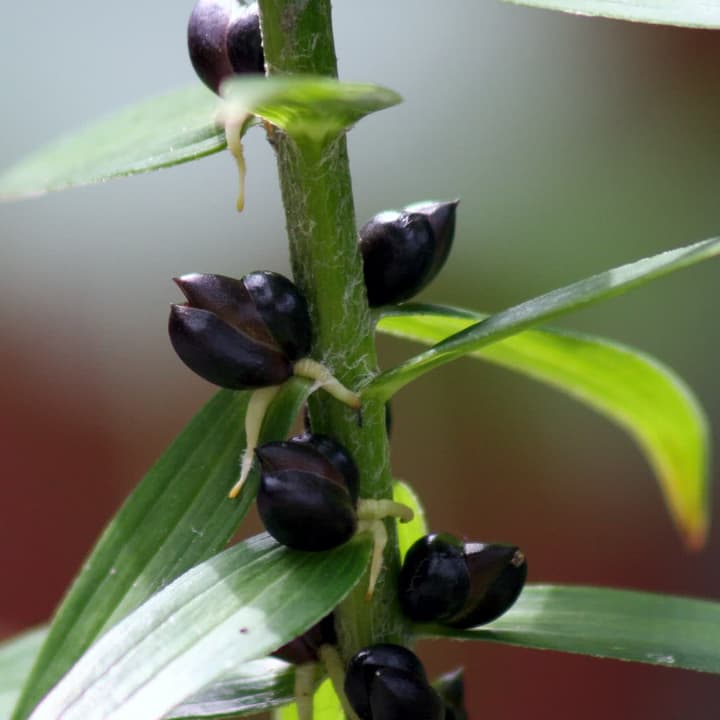
Harvest bulbils right after flowering, just before they drop. Iowa State notes that they form in late spring and drop shortly after blooming. The RHS Lily Group suggests gathering them when they reach small pea size. Plant them just like stem bulblets, about 1 inch deep.
Outside Asia, tiger lilies are typically sterile, producing neither fruit nor seed, according to NC State. That makes bulbils the only way to propagate them aside from the bulb. Other lilies also form bulbils, such as Lilium sargentiae and certain forms of Lilium bulbiferum. Asiatic lily hybrids do not produce bulbils, according to NC State.
Propagating lilies from seed: the slowest method
Lily seed forms inside a capsule that develops after flowering. Iowa State recommends harvesting when the pod begins to split open and sowing the flat seeds right away. Some species send up a leaf and a bulblet within a few weeks. Others form only an underground bulblet and produce their first leaf after winter.
Plants grown from hybrid lily seed usually differ from the parent plant, according to the RHS. Asiatic and Oriental lilies sold in flower shops are hybrids, according to NC State. Flower color and shape in the seedling can vary. None of the consulted sources indicates how many years a seed-grown lily takes to flower. To produce an exact copy of the lily you already have, use division, scales, or bulblets.
Potted flowering lilies: how to propagate them
Lilies sold in pots for Mother's Day and Easter were grown in cold-controlled greenhouses to bloom out of season. You can propagate them, but the bulb must finish its cycle first. Keep the foliage green until it dries out naturally. University of Illinois Extension explains that the leaves provide energy to the bulb after flowering.
Once the stem is dry, remove the bulb from the pot. If baby bulbs are already attached, separate them as you would for division. If it is a single bulb, use scales. The timeline works out to 6 weeks in warm temperatures plus 6 to 12 weeks in the refrigerator. That means 3 to 4 months before planting the bulblets.
The replanted mother bulb can also take time to bloom again. The University of Wisconsin warns that a forced greenhouse lily may not bloom the following year. Afterwards, it returns to blooming in its natural season. In a study from Universidade Federal de Santa Maria (UFSM), the Easter lily bulb only flowered after 6 or 8 weeks at 4 °C or 10 °C. The guide on how to care for lilies explains how to give the bulb this cold period in the refrigerator.
Why lily scales rot in the bag
Fungus is common inside the scale bag, according to Iowa State. Open the bag every 2 weeks and inspect each scale. Here are the symptoms described by the Connecticut Agricultural Experiment Station (CT CAES) and the Pacific Northwest Plant Disease Management Handbook (PNW Handbook):
Soft scale with water-soaked spots that darken and a sour odor: soft rot, caused by Rhizopus fungus. Discard the scale.
Dry, crumbling scale coated with blue-green powder: blue mold, caused by Penicillium fungus. Discard the scale.
Chocolate-brown rot spreading up from the base of the scale: Fusarium rot, caused by Fusarium fungus. The PNW Handbook instructs destroying diseased material and propagating only from healthy scales.
Lily fusarium remains in the soil for at least 3 years, according to the RHS. Do not reuse soil from a pot where a bulb rotted to grow your new starts.
Lilies are toxic to cats, including the bulb
The entire lily plant is toxic to cats, according to the FDA, the health agency of the United States. A small piece of a leaf or petal can cause fatal kidney failure in less than 3 days. The FDA cites the stem, leaves, flowers, pollen, and vase water. The bulb and scales are part of the same plant.
In a home with a cat, store the bag of scales inside a closed refrigerator and plant the bulblets in a spot the cat cannot reach. Daylilies are also on the FDA's list of plants that are highly toxic to cats. If the cat bit any part of the plant, call the veterinarian immediately without waiting for symptoms.
Frequently asked questions
Can you propagate lilies in water?
None of the consulted extension services teaches lily bulb propagation in water. The method they describe relies on a bag with moist vermiculite, where the scale stays damp without being submerged. People mentioning lily propagation in water are usually referring to peace lilies, which are entirely different plants.
Can you propagate lilies from stem cuttings?
Not the way you do with other plants. According to Iowa State, a buried section of lily stem develops bulblets instead of roots and shoots. You can separate and plant these bulblets just like stem bulblets. With peperomia, a single leaf can produce a new plant; with lilies, none of the consulted sources teaches propagation from leaves.
How long does a propagated lily take to bloom?
It depends on the method. A large bulb separated through division blooms the following summer, according to Iowa State. Scales take 2 to 3 years, according to the University of Wisconsin. Stem bulblets take 2 to 4 years. For seed, none of the consulted sources provides a specific number of years.
When is the best time to propagate lilies?
After flowering, from late summer to early fall. Iowa State recommends early fall to divide clumps: March and April in the Southern Hemisphere, September and October in the Northern Hemisphere. The RHS harvests scales from late summer to early fall. Tiger lily bulbils are collected right after blooming, before they fall off.
How do lilies reproduce?
Lilies reproduce by bulbs and by seeds. Underground, the bulb produces offset bulbs and stem bulblets; each scale removed from the bulb also forms bulblets. Some species, like tiger lilies, form bulbils along the stem above ground. Seed comes from the capsule that develops after blooming.
Summary: which method to choose
For the earliest flowers, divide clumps in early fall and replant large bulbs at a depth of 3 times their diameter. To get many plants from a single bulb, use scales. Keep them 6 weeks in the dark around 70 °F (21 °C), followed by 6 to 12 weeks in the refrigerator. If your lily has black beads along the stem, those beads are already ready-to-grow offsets.
If you are not yet sure whether your plant is a true bulb lily, a photo in the Bloom app identifies the species. Bloom is only for iPhone (iOS).
Related articles

How to Care for a Maidenhair Fern: Light, Water, and Revival Tips
Learn how to care for a maidenhair fern indoors: bright indirect light, consistently moist soil, high humidity, and how to revive it if it dries out completely.
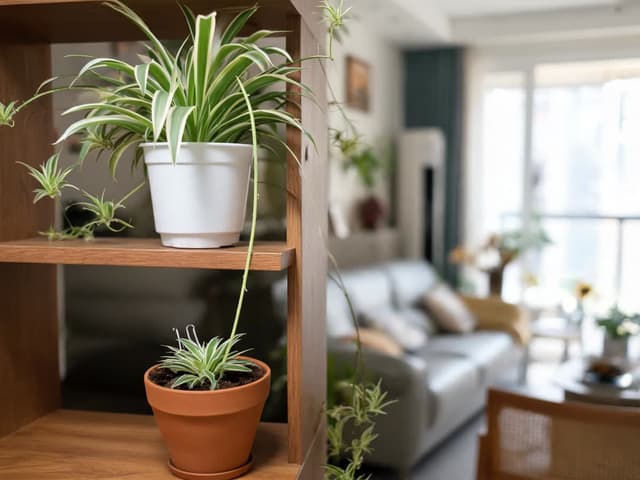
How to Propagate Spider Plants: Root the Pup Before Cutting
The safest spider plant cutting comes from a pup still attached to the mother plant: rest the plantlet on soil in a small pot, wait for roots to establish, and only then cut the stolon. Learn when the pup is ready, whether rooting in water is worth it, how to divide the clump, and why plants fail to produce babies.
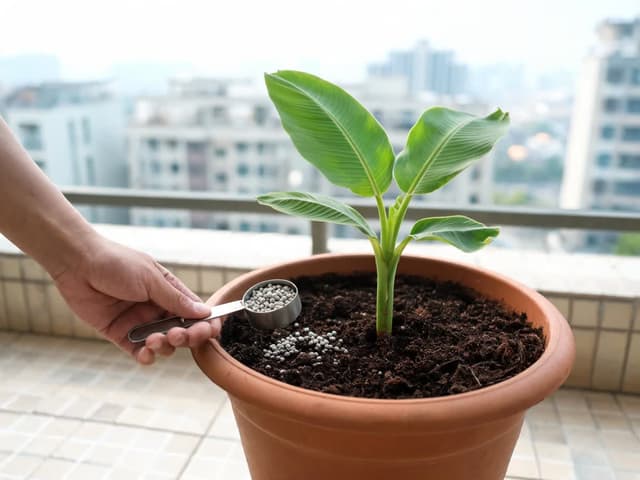
Banana plant fertilizer: fertilizing potted and backyard plants
Banana plant fertilizer needs more potassium than nitrogen, in a 3-1-6 ratio. For a potted plant on a balcony, use the label dose in spring and summer. In the backyard, fertilize every 2 months, adjusting the amount by mat age. Learn the formula, timing in Brazil, and signs of deficiency or excess.