How to fertilize a yucca: when, how much, and which fertilizer to use
To fertilize a yucca, use small amounts and only when it is putting out new leaves. Learn the right timing in Brazil, how light dictates frequency, the right NPK, and what yellow leaves mean.
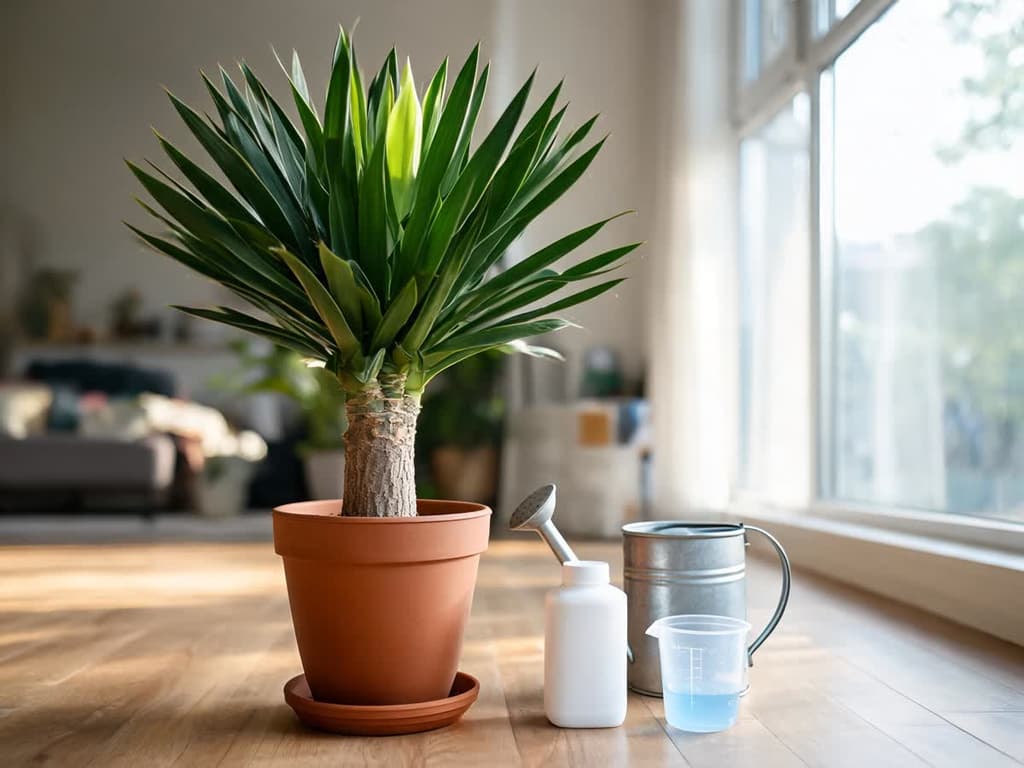
To fertilize a potted yucca, use little fertilizer and only when it pushes out new leaves, generally from September to March in Brazil. A liquid foliage fertilizer, at the label dose, every 15 days to 2 months, is what the sources indicate. The more light the plant receives, the more fertilizer it uses.
Yellow leaves at the bottom of a yucca almost never mean a lack of fertilizer. Before fertilizing, check whether the plant is actively growing and whether the trunk is firm.
Quick summary:
Fertilize only when new leaves are emerging at the top. A dormant, sick, or soft-trunked plant gets no fertilizer.
The frequency ranges from every 15 days to every 2 months. The 15-day interval comes from the RHS, the British gardening society; the 2-month interval comes from the University of Nebraska Extension. A yucca near a sunny window that is pushing out new leaves can handle the shorter interval; a yucca farther from a window should stay on the longer one.
Use a foliage fertilizer with NPK (the three numbers on the label: nitrogen, phosphorus, and potassium). UF/IFAS recommends a 3-1-2 ratio, such as 18-6-12, and notes that a 1-1-1 ratio, such as 10-10-10, produces equal growth. Avoid superphosphate, a phosphorus fertilizer: its fluoride is toxic to yucca.
After repotting, wait at least 2 weeks before fertilizing.
A white crust on the soil and brown leaf tips can indicate too much fertilizer (brown tips also stem from underwatering or fluoride). If excess is the issue, the fix is flushing the pot with water, not fertilizing again.
Yellow leaves on a yucca: does fertilizer help?
In most cases, no. The Royal Horticultural Society (RHS) states in its yucca growing guide that some yellowing of lower leaves is normal. On a healthy plant, older leaves dry up over time, while the top continues to produce new leaves.
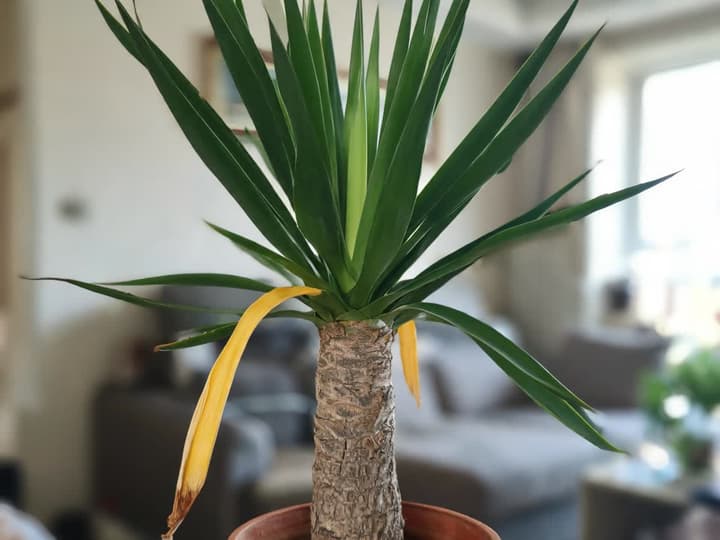
According to the same source, when lower leaves turn yellow suddenly and become soft, overwatering is the cause. In that case, water less and let the soil dry almost completely. Do not fertilize.
Squeeze the trunk from the base upward before doing anything else. A soft, dark, or foul-smelling trunk indicates root rot, and a sick plant cannot take up fertilizer. The fertilizer salts will only harm what remains of the roots.
A genuine lack of fertilizer shows up on new leaves, not old ones. In research on indoor plants, the University of Florida (UF/IFAS) found that a plant under high light with low fertilizer grows pale and weak. Here is what a true deficiency looks like: the yucca sits near a sunny window, produces pale, thin new leaves, and has gone more than 2 months without fertilizer.
Light determines how much fertilizer a yucca uses
The UF/IFAS research report RH-91-7, by Conover, Poole, and Henley, shows that light sets the pace of fertilizer use. In low light, the plant grows slowly and uses very little fertilizer.
The threshold provided in the report is 75 foot-candles (a US unit of light), about 800 lux (the unit used on light meters). Below that level, the peat (decomposed moss common in bagged potting mixes) and bark in the potting mix are enough. As they decompose, they already release sufficient nitrogen for most foliage plants. In that scenario, any fertilizer you add remains unused in the soil.
The report describes the most common mistake: mixing a single fertilizer solution for plants sitting in different light levels. Those kept in a darker corner suffer toxicity from salts accumulating in the potting mix. Those in strong light grow pale and weak because they receive too little fertilizer.
A yucca needs a lot of light. The UF/IFAS yucca production guide, by Poole, Chase, and Osborne, calls for at least 150 foot-candles indoors. That equals about 1,600 lux. The RHS calls for sun year-round and recommends the sunniest window in the house during the winter. In Brazil, that is the north-facing window.
A yucca in the back of a room stops growing due to lack of light, and fertilizer cannot make up for that deficit. Without a light meter, use the plant itself as your test: during the growing season, a new leaf emerging at the top indicates sufficient light to use fertilizer.
When to fertilize a yucca in Brazil
Fertilize the yucca in spring and summer, which in Brazil run from September to March. The RHS instructs to fertilize from April to September, which is the growing season in the United Kingdom. In the Southern Hemisphere, the seasons are reversed.
The most reliable indicator is the plant itself. Start fertilizing when a new leaf appears in the center of the cluster, and stop when new leaves stop emerging. In a very bright window, a yucca can keep growing through the winter.
Near a very bright window, a yucca can keep putting out new leaves in winter. Nebraska Extension advises fertilizing this plant as an actively growing plant. In Brazil, the brightest windows face north and west. An idle plant receives no fertilizer, because fertilizer salts accumulate in the soil.
Cold temperatures also reduce the required dose. According to UF/IFAS report RH-91-7, tropical foliage plants grow very slowly when the potting mix drops below 18 °C. In that situation, the recommendation is to cut fertilizer by at least half until warm temperatures return. In winter, the RHS advises watering yucca sparingly and keeping it in the sunniest window in the home. These practices are detailed in the guide on yucca winter care.
How often to fertilize a yucca
Two institutions provide different schedules. Nebraska Extension instructs you to follow the label rate; the RHS does not state a dosage:
Source | Frequency during the growing season | Dosage |
|---|---|---|
RHS, yucca guide | balanced liquid fertilizer every 15 days | not stated |
Nebraska Extension, indoor plants in general | water-soluble fertilizer every 2 months | label rate |
Frequency without dosage cannot be compared. Fertilizing every 15 days with a diluted product can deliver the same total amount as fertilizing every 2 months at full strength. UF/IFAS research provides the criterion for choosing between the two: the light level your yucca receives.
Start with the Nebraska Extension schedule, every 2 months: it comes from a university and leaves less salt in the soil. Shift to the RHS schedule, every 15 days, only when the yucca sits next to a sunny window and pushes out new leaves continuously. The RHS does not specify a dosage and no one has measured one: on that schedule, the safest approach for the plant is using half the label rate. The RHS writes for yuccas kept in full sun year-round.
Under either schedule, moisten the soil before fertilizing and never exceed the label rate for indoor plants. Slow-release fertilizer (granules or spikes that release nutrients gradually) follows the schedule on the package. UF/IFAS notes that it releases faster in heat and slower in cool conditions, so space reapplications farther apart in a chilly room.
Which fertilizer to use on a yucca
Use a foliage fertilizer with nitrogen equal to or higher than phosphorus and potassium. The three numbers on the label are the NPK: the percentages of nitrogen (N), phosphorus (P), and potassium (K), in that order.
UF/IFAS tested indoor plants over long periods. They grow equally well with two ratios among the three label numbers. In a 3-1-2 ratio, for example, there are 3 parts nitrogen to 1 part phosphorus and 2 parts potassium:
1-1-1 ratio, such as 14-14-14 or 20-20-20 (10-10-10 shares the same ratio);
3-1-2 ratio, such as 9-3-6 or 18-6-12.
The university recommends the 3-1-2 ratio because it leaves less salt behind in the potting mix. Lower salt accumulation helps the plant adapt to indoor conditions. On Brazilian labels, the three NPK numbers appear together, like 10-10-10. The guide on plant fertilizer explains how to compare two fertilizers on the shelf.
Do not use superphosphate on a yucca. The same UF/IFAS report notes that superphosphate contains 1% to 2% fluoride. The report includes yucca among the plants where this fluoride causes severe toxicity, along with dracaena and spider plant. In its yucca production guide, UF/IFAS cites fluoride as a possible cause of dead leaf tips and margins.
If you inherited the plant and are not sure whether it is a yucca, Bloom (available for iOS) identifies the species from a photo. Dracaena, which looks similar to yucca, is also on the list of fluoride-sensitive plants.
The yucca is also not a palm tree, despite being called "Yucca-Palme" (yucca palm) in German. NC State Extension classifies it in the asparagus family (Asparagaceae) under the name Yucca gigantea, formerly called Yucca elephantipes. The garden palm fertilizer formula, with more potassium than nitrogen and with magnesium, was made for a different plant.
Newly purchased or recently repotted yucca: when to fertilize
After repotting a yucca, wait at least 2 weeks before fertilizing. Montana State University Extension gives this timeframe for the roots to recover. The mix that prevents waterlogging and the step-by-step repotting instructions are in the guide on yucca potting soil.
Some bagged potting soils already include slow-release fertilizer. Nebraska Extension advises reading the packaging. If it states that the mix feeds plants for up to 6 months, do not fertilize before that time has passed.
For a newly purchased yucca, no one has measured how long to wait. One option that UF/IFAS gives nurseries is slow-release fertilizer every 3 months. Because of this, the plant may arrive with fertilizer already in the soil. The safest option is to wait 3 months and only fertilize if the yucca is putting out new leaves in your home.
Signs of overfertilizing a yucca and how to flush the pot
Too much fertilizer leaves salts in the soil, and salts pull water away from roots. Nebraska Extension explains that in saline potting soil, a plant struggles more and more to draw up moisture, even when the mix is damp. The same source lists the warning signs:
slower growth;
brown leaf tips;
dead root tips;
wilting foliage;
a yellowish to white crust across the soil surface;
a hard white ring on the rim of a clay pot or around the drainage hole.
Nebraska Extension itself cautions that these symptoms also stem from other causes. For brown tips on yucca, the UF/IFAS production guide lists three: fluoride, underwatering, and excess soil salts. High salt levels also weaken roots and leave the plant more susceptible to root rot, according to Nebraska.
If you applied too much fertilizer, flush the pot. Here is the procedure from Nebraska Extension:
Scrape off any white crust, removing no more than 6 mm (1/4 in) of soil.
Take the pot to a sink, laundry tub, or shower stall where water drains freely from the drainage hole.
Pour water slowly over the potting mix until it flows out the bottom hole, and repeat until you have used twice the pot's volume in water. For a 5-liter pot, use 10 liters.
Let all the water drain through, and water again only when the soil dries down to your normal watering point.
If you used fertilizer spikes or granules, remove any remnants from the potting mix before flushing. Resume fertilizing only when the yucca produces new leaves, using the 2-month interval. Nebraska Extension recommends repeating this flush every 4 to 6 months as routine maintenance, even without signs of excess. Salt crust is easily mistaken for mold, and our guide on plant fertilizer shows how to tell the two apart.
Frequently asked questions
Can coffee grounds fertilize a yucca?
Not directly in the pot. The New York Botanical Garden (NYBG) library does not recommend raw coffee grounds on indoor plants. The fine particles compact the potting mix, deprive roots of oxygen, encourage fungus, and build up salts. Grounds also attract fruit flies, particularly in enclosed compost bins. They work much better in an outdoor compost pile.
Can I fertilize a yucca in winter?
Only if it keeps putting out new leaves. The RHS advises against fertilizing yucca in winter when growth stops, alongside watering sparingly. Near a very bright window, a yucca may continue growing, and Nebraska Extension treats an actively growing indoor plant as one in active growth. That makes new foliage the true signal rather than the calendar month: the RHS specifies timing for the UK climate. When the potting mix drops below 18 °C, cut fertilizer by at least half (UF/IFAS).
Do fertilizer spikes work for yucca?
Yes, as long as you follow the schedule and dosage on the package. Spikes are a slow-release fertilizer, and UF/IFAS notes that this type of fertilizer releases faster in warm conditions. If your yucca turns yellow after inserting spikes, pull out any leftovers and flush the pot with twice its volume in water.
Where to start
Check the top of your yucca. If new leaves are emerging and the trunk feels firm, apply a liquid foliage fertilizer at the label rate. Water the potting mix first, and repeat every 2 months. If new growth comes in pale and thin next to a sunny window, tighten the interval to every 15 days using half the label rate.
Related articles

How to Care for Hibiscus: Sun, Watering, Fertilizer, and Pruning for Flowers
How to care for hibiscus: 6 hours of direct sun, evenly moist soil without waterlogging, half-strength fertilizer in spring and summer, and pruning in early spring. Find out why the flower lasts one day and why buds drop before opening.

Do Ferns Like Sun or Shade? It Depends on the Type
Ferns prefer bright shade: plenty of light, but no direct sun on their fronds. Tuberous sword fern is the exception that handles sun. Here is the ideal light for each type, where to place pots, and how fronds show too much or too little light.

African Violet Yellow Leaves: Causes and What to Do
Yellow leaves on an African violet usually stem from overwatering, and the first place to check is the center of the plant. Losing one lower leaf at a time is normal. Identify whether age, watering, cold water, sunlight, cold drafts, or fertilizer is the culprit based on the yellowing pattern, and see what to do today.