Amaryllis with Yellow Leaves: Causes and What to Do
An amaryllis with yellow leaves months after blooming, with a firm bulb, is entering dormancy. Learn how to squeeze the bulb, when to cut the leaves, and what red spots and streaks mean.
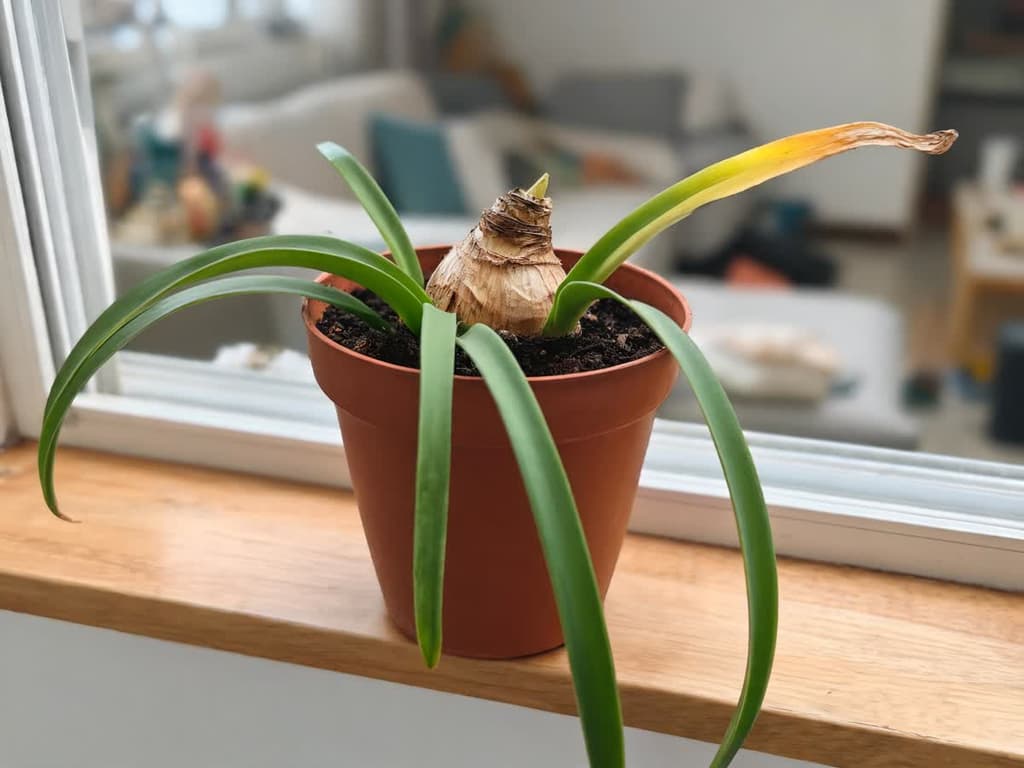
An amaryllis with yellow leaves months after blooming, with a bulb that feels firm to the touch, is entering dormancy. In this case, nothing is wrong: the bulb has already stored its reserves and is letting the leaves dry out. Yellowing becomes a problem when it appears right after flowering, when the bulb is soft, or when the leaf has red spots or streaks.
This guide covers the potted amaryllis (Hippeastrum), the large bulb sold in bloom or to force into bloom, described in the amaryllis care sheet. To pinpoint the cause, run two tests in this order: check how much time has passed since flowering, and squeeze the bulb with your fingers.
If you do not know whether the bulb you received is really an amaryllis, Bloom (available for iOS) identifies the plant from a photo. On the Premium plan, the app also compares the photo of the leaf with symptoms of pests and diseases.
Quick summary:
Leaves gradually turning yellow, from February to May in Brazil, with a firm bulb: it is dormancy. Stop fertilizing, reduce watering, and wait.
In Brazil, yellow leaves before February do not mean dormancy. Check the soil, the light, and the bulb.
Soft, sunken, or dark bulb: this is rot. The bulb goes in the trash, but firm offsets can be saved.
Red spots with well-defined margins and a leaf twisted at the spot: this is red blotch, a fungus.
Light yellow streaks or a mosaic pattern of light green and dark green: it is a virus, with no cure.
Cut the leaf only when it is brown or dry. Foliage with green still feeds the bulb.
Should I cut the yellow leaves off the amaryllis or wait?
Wait. Do not cut any leaf that still has green on it, even if the tip is turning yellow. The University of Maryland Extension (UMD) instructs to cut the flower stalk and keep the leaves. The leaves produce the energy the bulb uses to bloom again.
Also, do not throw the bulb away before squeezing it. On a firm bulb without spots, yellow, drooping leaves come from watering, light, or dormancy. Watering and light can be corrected, and dormancy just requires waiting. A soft, sunken bulb or one with dark areas is lost, according to Iowa State.
Amaryllis with yellow leaves at the end of the cycle: the bulb entering dormancy
Dormancy (or rest) is the phase when the bulb stops growing and sheds its leaves. It stays inactive for 8 to 10 weeks before blooming again. The leaves turn yellow slowly, one or two at a time, starting from the tip. The bulb stays firm and dry on the outside. No spots, streaks, or mold appear.
In nature, the leaves dry up in the Northern Hemisphere's fall, according to the University of Wisconsin Extension. In potted plants, the leaves die back in mid- to late summer, also in the north. Iowa State University Extension instructs inducing dormancy in late September in the north. The Royal Horticultural Society (RHS), a UK gardening charity, advises the same. In Brazil, the equivalent period is late summer and fall, from February to May, months after spring flowering (September to November).
When you see this slow yellowing, stop fertilizing and reduce watering. Iowa State stops water entirely and moves the pot to a cool, dimly lit place. There it stays at 50 to 55 °F (10 to 13 °C) for at least 8 to 10 weeks. New Mexico State University (NMSU) allows a little water, with long intervals, to keep the roots alive, provided the bulb does not shrivel. Both are extensions, and neither compares the two methods. The safer option is NMSU's: little water, spaced far apart, squeezing the bulb once a week to see if it shrivels. Without a place between 50 and 55 °F (10 and 13 °C), use the coolest and darkest room in the house.
Dormancy is not mandatory for every bulb. Wisconsin says the commercial bulb blooms even when kept green year-round. For this extension, the 8-to-10-week dormancy serves to choose the bloom time. Iowa State says the bulb needs 8 to 10 weeks of cold to flower. It offers a path without losing the foliage: keep the plant green in a bright, cool place at 10 to 13 °C (50 to 55 °F) until mid-winter in the north (July, in Brazil). To merely keep the plant alive, green foliage year-round is safe. To choose the bloom time, follow Iowa State. If your amaryllis does not turn yellow, that is also normal.
The time between flowering and yellowing varies from one bulb to another. In lilies with yellow leaves, normal yellowing begins just a few weeks after the flower fades. In amaryllis, the foliage stays green for months after blooming.
A yellow leaf right after flowering is not dormancy
After the flower fades, the amaryllis leaves still have months of work ahead. Iowa State directs keeping the plant in a sunny window and continuing to water and fertilize through July, in the Northern Hemisphere. In Brazil, this corresponds to January. During this period, the leaves manufacture the sugar that the bulb stores for the next flower.
Because of this, yellowing leaves in the first weeks after blooming call for another explanation. The most common are waterlogged soil, low light, and bulb rot. In Brazil, yellowing that appears in December or January is not yet dormancy, even on a plant that bloomed in September. Dormancy comes from February to May.
How to squeeze the amaryllis bulb to check for rot
Squeezing the bulb separates normal yellowing from rot-induced yellowing. Hold the bulb with your thumb and index finger, first at the neck (the narrow part where the leaves emerge) and then along the sides. Squeeze firmly, without bruising the tunic.
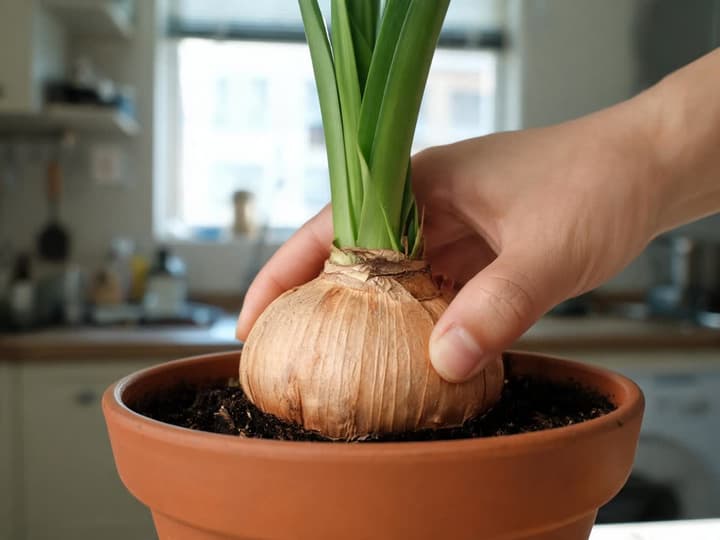
Firm bulb: the bulb does not yield to squeezing and springs back into place. The outer skin can be dry and flaking off, like an onion, and that is normal. The roots may even have died during dormancy: for NMSU, this is not a problem as long as the bulb remains firm.
Wrinkled and light bulb, but hard: it is thirsty. NMSU warns not to let the bulb shrivel during dormancy. Resume watering gradually: provide a small amount of water and squeeze the bulb again the following week.
Soft, sunken, or dark-spotted bulb: Iowa State describes these soft, sunken, or dark areas as a sign of disease. It instructs discarding the bulb with rot.
When squeezing leaves doubt, remove the bulb from the pot and examine the base: look for soft, sunken, or dark areas. Rot usually comes from soil kept too wet or from a damaged bulb. The information comes from a North Carolina State University (NC State) factsheet, reproduced by the Siebenthaler nursery. The same factsheet directs discarding the diseased bulb and replacing the potting soil.
None of the consulted extensions teaches how to save a soft bulb by cutting away the rotted part. The safest option is to salvage the offsets, the smaller bulbs attached to the base. Iowa State does not address rotted bulbs, but, when dividing the bulb, it directs separating the smaller ones and keeping only those that are firm. Apply the same criterion. Each firm offset goes into its own pot with fresh soil.
When to cut the yellow leaves off the amaryllis
Cut the leaf when it is brown or dry, never before. At that point, it has already transported its reserves to the bulb. Two extensions and the RHS give similar guidelines, with varying details:
NC State directs letting the leaves die back naturally and removing them when they turn brown.
Iowa State cuts the foliage when the leaves turn brown.
The RHS leaves the plant dormant in a cool spot for 8 to 10 weeks. After that, it cuts the old leaves 4 inches (10 cm) from the neck of the bulb.
Use clean pruners and cut 4 inches (10 cm) above the neck, as the RHS does, without wounding the bulb. Wipe the blades with rubbing alcohol before moving to another plant, because dirty tools spread viruses from one bulb to another. A leaf that has yellowed only at the tip stays on the plant: the green part continues working.
Red spots or streaks on the leaf: red blotch
Red blotch (also called leaf scorch) is a disease caused by the fungus Stagonospora curtisii. The University of Florida (UF/IFAS) describes red spots on the leaves and flower stalk that grow, elongate, and sink. At the affected point, the leaf or stalk becomes crooked or bent.
Not all red coloration indicates disease. The same UF/IFAS publication notes that any mechanical injury on amaryllis produces red pigment. A red scratch, speck, or irregular mark can merely be a bruise. Red blotch exhibits well-defined edges and outlines.
The fungus is likely already in the bulb, according to the Connecticut Agricultural Experiment Station. Because of this, the leaf can already emerge spotted. Wisconsin notes that the disease rarely kills the plant. What to do, according to these sources:
Water the soil, never over the leaves and the neck of the bulb.
Leave one-third to one-half of the bulb above the soil. The leaflet reproduced by Siebenthaler says this keeps the tip of the bulb dry and reduces red blotch.
Give the pot light and ventilation, as the Connecticut Agricultural Experiment Station recommends.
Discard a heavily attacked bulb that has large dark red blotches or rotting sections.
For a lightly infected bulb, UF/IFAS mentions a hot water bath. Take the bulb out of the soil and strip off the spotted scales (the layers of the bulb, like those of an onion) and excess soil. Soak the bulb for 30 minutes in water between 104 and 114 °F (40 and 46 °C). Use a kitchen thermometer to keep the water within this range for the entire soak.
Pale yellow streaks and mosaic patterns: viruses
Mosaic virus leaves an irregular pattern of light green and dark green on the leaf. The plant disease handbook for the Pacific Northwest is affiliated with Oregon State University. It points to hippeastrum mosaic virus as one of the main amaryllis viruses. It spreads from plant to plant through aphids.
Connecticut describes mottled leaves, with white or pale yellow specks that often turn red, along with foliage death. The factsheet reproduced by Siebenthaler mentions light yellow streaks as well as smaller blooms and reduced growth each year. There is no cure. Connecticut notes that an infected plant rarely recovers, and that symptoms improve and worsen depending on the season.
The Oregon handbook instructs destroying the diseased plant or bulb, and Connecticut directs disposing of symptomatic plants. To protect other plants, discarding is the safest choice. If you wish to keep it, isolate the amaryllis, sanitize pruners before and after using them on it, and discard the bulb when it loses vigor. Connecticut cautions that aphid insecticides are not enough to prevent transmission.
Pests at the leaf base: mealybugs, thrips, and bulb mites
Amaryllis has few pests, and nearly all hide where the foliage meets the bulb. Gently pull apart the base of the leaves and inspect with a flashlight.
Mealybugs: cottony white clusters between the leaves. NC State and Wisconsin report this pest on amaryllis. The guide to mealybugs on plants shows how to remove the insects and treat.
Thrips: insects about 1/16 of an inch (1.6 mm) long, black when adult and yellowish when young. Connecticut explains that they rupture the leaf surface to feed on plant sap.
Bulb mites: a pest that attacks the bulb itself. The RHS lists this mite among the causes of an amaryllis failing to flower. The consulted sources do not link this pest to yellow leaves.
Overwatering, insufficient light, and unseasonal fertilizing
Limp, yellow leaves accompanied by soil that has stayed wet for days point to overwatering. Waterlogged roots stop functioning, and the bulb can quickly rot afterward. If the leaves are yellow and soft, insert your finger 1 inch (3 cm) into the soil. If the mix feels moist at that depth, withhold water until it dries out.
During active growth with green leaves, water when the soil surface feels nearly dry, as advised by Iowa State. The RHS advises against letting the soil dry out completely and warns not to let water sit in the saucer. Water until liquid runs out of the pot's drainage holes, and empty the saucer right away. During dormancy, supply little to no water.
Underwatered soil also turns the leaves yellow. Gardener's Path describes dry brown edges, wilted leaves, and a shriveled bulb. In this case, the soil is dry all the way to the bottom. Water until liquid runs out of the drainage hole, and water again when the surface feels nearly dry.
UMD says that thin, flopping leaves indicate insufficient light. Gardener's Path, a gardening website, adds that too little light for a long time turns the leaf yellow. NMSU calls for 4 to 6 hours of bright light per day, not necessarily direct sun. The factsheet reproduced by Siebenthaler calls for at least 4 hours of direct sun and points to a south-facing window in the Northern Hemisphere. In Brazil, the sunniest window is the north-facing one.
Iowa State fertilizes every 2 to 4 weeks, with fertilizer diluted in water, while the leaves are green. UMD also fertilizes after blooming, until the start of dormancy. The factsheet reproduced by Siebenthaler warns that fertilizing a leafless bulb can kill the roots. A dormant bulb receives no fertilizer.
Waxed amaryllis with yellow leaves
The waxed amaryllis is a bulb sold covered in a colored coating, without soil and without water. Iowa State explains that this bulb was meant to bloom only once and then be thrown away. It blooms using the reserves it already has and shrinks, because it has no way to replenish the spent reserves.
Weak leaves on a waxed bulb after flowering are expected, since the bulb depleted its reserves. To attempt to salvage it, peel off the wax carefully to avoid snapping emerging roots. Next, inspect the bulb for sunken, mushy, or dark areas, and discard it if you discover any. If it feels firm, pot it in soil with the upper half exposed. Iowa State cautions that this does not always succeed: the bulb is sometimes too spent to recover.
What yellowing amaryllis leaves indicate, sign by sign
What you see | Probable cause | What to do |
|---|---|---|
Slow yellowing from tip to base, months post-bloom, firm bulb | Dormancy | Stop fertilizing, reduce watering, remove leaf once fully dry |
Yellow before February (in Brazil), wet soil | Overwatering | Water only when surface is nearly dry, empty drip saucer |
Yellow, mushy leaf, soft or sunken bulb | Bulb rot | Discard bulb, save any firm bulblets |
Defined red blotch, distorted or bent leaf | Red blotch (fungus) | Water soil directly, keep neck dry, discard severely infected bulbs |
Pale yellow streaks or light and dark green mosaic | Virus | Isolate plant, sanitize shears, manage aphids |
Thin, flopping, pale yellow leaf, set back from window | Low light | From 4 to 6 hours of bright light; in Brazil, a north-facing window |
Dry brown margins, soil dry throughout depth | Underwatering | Drench until water flows from drainage hole |
Waxed bulb weak after blooming | Depleted reserves | Peel off wax and pot up, or discard |
For other houseplants exhibiting the same issue, the guide to yellow leaves on potted plants covers the universal causes.
Frequently asked questions
Why do amaryllis leaves turn brown?
A leaf turning brown after turning yellow at the end of the growth cycle is simply foliage drying out in dormancy, which you can cut away. Dry, brown leaf margins with soil parched down to the base point to underwatering. Well-defined reddish-brown blotches with the blade twisting at the injury indicate red blotch. Inspect the soil and bulb to distinguish among these three scenarios.
How often should you water an amaryllis?
There is no fixed schedule, because watering needs shift with the bulb's growth stage. When leaves are green, water when the soil surface is almost dry, applying enough until it drains from the bottom hole. During dormancy, Iowa State cuts off water entirely. NMSU permits a little water at extended intervals, provided the bulb does not shrivel. The safest method is NMSU's approach, checking the bulb by squeezing once a week.
Is amaryllis toxic to cats and dogs?
Yes. The American Society for the Prevention of Cruelty to Animals (ASPCA) classifies the amaryllis as toxic to dogs, cats, and horses, due to lycorine and other substances. Signs include vomiting, diarrhea, abdominal pain, hypersalivation, lack of appetite, and tremors. NC State notes that the bulb is the most poisonous part. Keep the pot out of reach of pets and consult a veterinarian if your animal chews on the plant.
Why does an amaryllis produce leaves but no flowers?
The RHS notes three causes: letting the bulb dry off too early, placing the plant in heavy shade, and underwatering during the preceding growing season. Bulb mites and diseases can also prevent flowering. Iowa State adds that the bulb may lack adequate stored reserves. In that case, nurture the leaves for one more season.
What to do today with your yellowing amaryllis
Calculate how much time has passed since flowering and squeeze the bulb. Months after the blooms fade, with gradual yellowing and a firm bulb, the plant is entering dormancy: stop fertilizing, cut back on watering, and trim each leaf only when it has dried out completely.
If the yellowing started early, test the soil 1 inch down and evaluate window light before altering anything else. If the bulb feels soft, salvage any firm bulblets and toss the rest. If the foliage shows sharp red blotches or streaks, water strictly at the soil level for blotches, and quarantine the plant if you spot streaks.
Related articles

How to Care for Hibiscus: Sun, Watering, Fertilizer, and Pruning for Flowers
How to care for hibiscus: 6 hours of direct sun, evenly moist soil without waterlogging, half-strength fertilizer in spring and summer, and pruning in early spring. Find out why the flower lasts one day and why buds drop before opening.

Do Ferns Like Sun or Shade? It Depends on the Type
Ferns prefer bright shade: plenty of light, but no direct sun on their fronds. Tuberous sword fern is the exception that handles sun. Here is the ideal light for each type, where to place pots, and how fronds show too much or too little light.

African Violet Yellow Leaves: Causes and What to Do
Yellow leaves on an African violet usually stem from overwatering, and the first place to check is the center of the plant. Losing one lower leaf at a time is normal. Identify whether age, watering, cold water, sunlight, cold drafts, or fertilizer is the culprit based on the yellowing pattern, and see what to do today.