Basil Leaves with Brown Spots: Causes and What to Do
Brown or black spots on basil: how to tell apart cold, bacterial leaf spot, downy mildew, sun, and fertilizer salt. See when to discard the plant and when the leaf can still go on your plate.
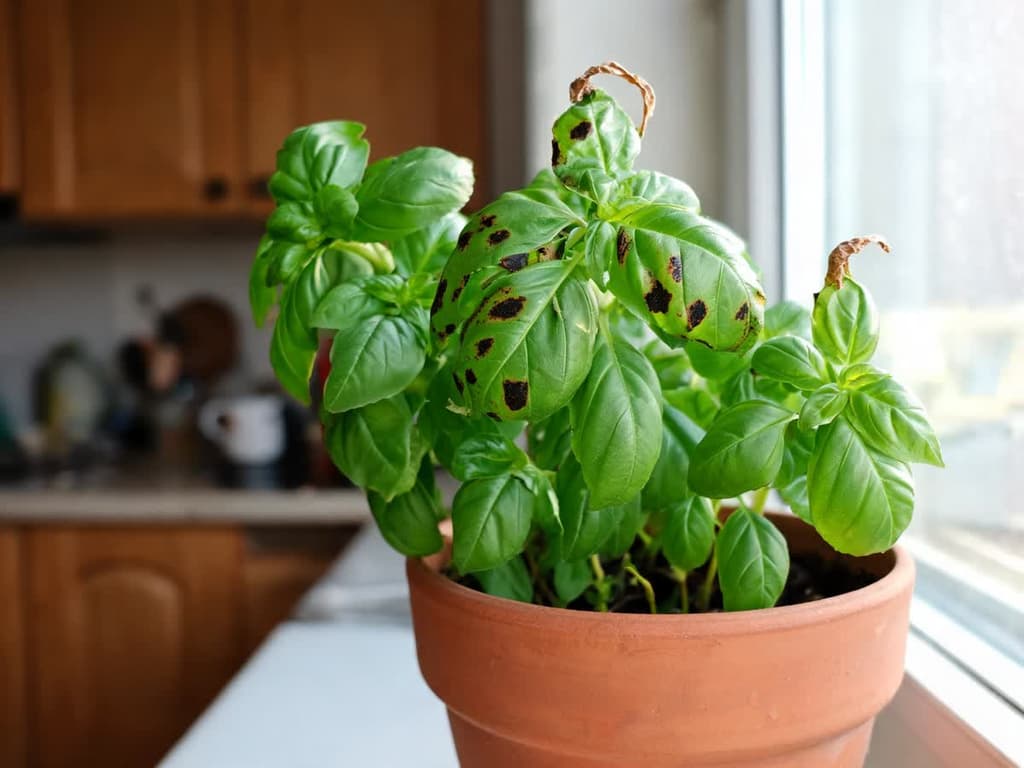
Brown spots on basil leaves stem from different causes, and the shape of the spot shows which one it is. Dark leaves after a chilly night indicate cold injury. Dark, water-soaked flecks point to bacterial leaf spot. Yellowing between the veins with gray fuzz on the underside means downy mildew. Dry tips and edges come from irregular watering or the salt that fertilizer leaves behind in container soil.
In most cases, simply removing the spotted leaves and correcting the cause is enough. Only two signs call for discarding the entire plant: purplish-gray fuzz on the underside of the leaf, and brown streaks on the stem accompanied by sudden wilting.
The instructions in this guide come from university extension services in the United States, university programs that advise plant growers. The primary ones are the University of Florida (UF/IFAS), the University of Illinois, Clemson, NC State, the University of Maryland, and the University of Connecticut (UConn). The basil guide covers the species (Ocimum basilicum) and its diseases.
Quick summary:
Dark leaves after cold weather or the refrigerator: cold injury. The University of Illinois records blackened leaves at 10 °C.
Dark, water-soaked flecks trapped between the veins: bacterial leaf spot. Remove the leaves and water only the soil.
Yellowing that darkens, with gray fuzz on the underside: downy mildew. Discard the plant in a sealed bag.
Dry, light-colored spots only on the top leaves: heat and strong sun.
Dry tips and edges, white crust on the soil: fertilizer salt. Water until it drains freely from the bottom hole to flush the pot's soil.
Leaves with mild spotting can go on the plate: even leaves with downy mildew are safe to eat, according to the University of Maryland and UConn.
Basil with brown spots: save it or throw it away
Removing spotted leaves resolves most cases of basil with brown spots. Cold, sun, fertilizer salt, and bacterial leaf spot damage leaves, and the plant sprouts new leaves if the cause stops. The plant only goes into the trash for two diseases that spread through the entire plant.
The first is basil downy mildew. UF/IFAS advises removing and destroying any infected plant right away, and the University of Maryland (UMD) says to pull it up, bag it, and throw it away. NC State states that no product sold to home gardeners controls the disease.
The second is fusarium wilt, caused by the fungus Fusarium oxysporum. According to NC State, it begins with brown streaks on the stem, drooping branch tips, and sudden leaf drop. Dark stem streaks can also appear with bacterial leaf spot. What points to fusarium is the combination of streaks, curled branch tips, and sudden defoliation. Clemson advises removing and discarding plants with fusarium immediately. The fusarium wilt page on basil illustrates the symptom.
Store-bought potted basil falls ill more easily. The RHS, the British horticultural society, explains that these pots contain many thin, overcrowded seedlings that tend to catch fungal diseases. The RHS also notes that these seedlings can survive if divided and repotted promptly. The guide on how to care for basil shows how to divide the root ball (the mass of soil and intertwined roots).
How to find the cause of spots on basil in 2 minutes
Four quick checks distinguish the causes of brown spots on basil. Run through all four in this order, with the plant in daylight:
Flip over 3 spotted leaves. Gray or purplish fuzz on the underside indicates downy mildew. Moving specks or fine webbing indicate spider mites.
Examine the shape of the spot against the light. A dark, water-soaked spot with angular borders bounded by veins is bacterial. A circular spot with a pale center or a small hole points to leaf spot fungi (fungi that create spots on foliage). A dry, pale spot thin as paper points to sun or heat.
Look at where the brown color sits. Confined purely to tips and margins points to irregular watering or salt. Only on upper leaves points to sun. Leaves affected all over the plant at once point to cold.
Recall what changed in the last 3 days. A chilly night, time in the fridge, a dish soap spray, or a week of rain shifts the diagnosis.
When the spots do not match any description, a photo helps. The diagnosis feature in Bloom (available for iOS) matches photos of leaves against known diseases and pests on the Premium plan.
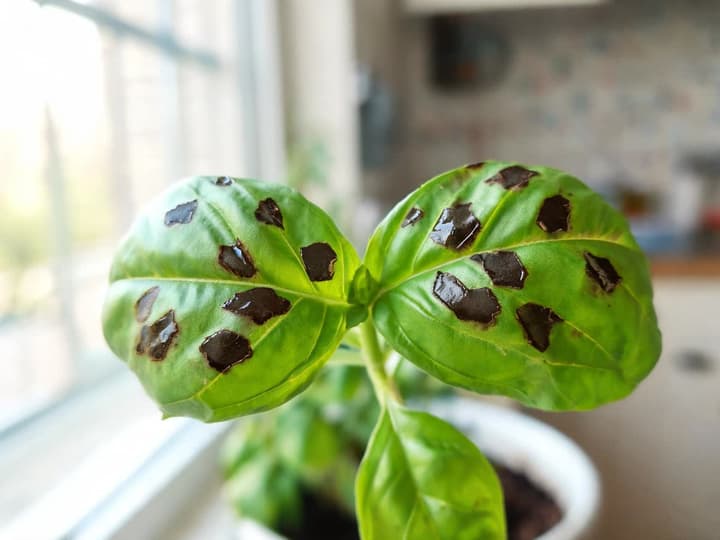
Black spots on basil after cold exposure or refrigeration
Black spots appearing across multiple leaves simultaneously after a cold night stem from cold damage. Basil suffers in temperatures well above freezing. The University of Illinois states that cold air and chilled soil can turn leaves dark at 10 °C. According to UF/IFAS, below 4 °C the leaves of many varieties turn black and drop.
Harvested leaves also darken in cold conditions. A 2023 review in Frontiers in Plant Science notes injury in leaves stored below 12 °C. Below 10 °C, the damage is severe or complete. For this reason, the University of Illinois warns that storing basil in the refrigerator discolors the foliage. The same source advises keeping harvested stems in a glass of water at room temperature.
According to UF/IFAS, leaves darkened by the cold drop. Cut off black leaves. On nights below 10 °C, keep the pot indoors, away from cold window glass. The guide on winter basil care shows where to place the pot during cold months.
Bacterial leaf spot on basil: dark, water-soaked flecks
Bacterial leaf spot of basil is caused by the bacterium Pseudomonas cichorii. According to the UF/IFAS basil disease guide, the spots are dark and look water-soaked. They can have straight edges, bounded by small veins, or an irregular shape. Cornell's Plant Disease Diagnostic Clinic describes brown and black spots on leaves and dark streaks on the stem.
The bacteria thrive on wet foliage. UF/IFAS explains that they spread through splashing water and on hands that handle diseased leaves. Penn State PlantVillage, a Pennsylvania State University initiative, notes that high humidity and overhead watering spread the disease. The same source states that there is no treatment once the spotting appears.
To manage the disease, eliminate the bacterial source and keep the leaves dry:
Snip off all spotted leaves and toss them in the trash, along with any fallen foliage on the soil.
Water only the soil in the morning, keeping the foliage dry.
Space pots apart so air circulates freely.
Wash your hands and pruners after handling an infected plant.
Clemson adds that you should never save seeds from plants infected with bacterial leaf spot, as the pathogen carries over in seed.
Overwatering or bacterial leaf spot on basil?
Overwatering and bacterial leaf spot can both leave you with spotted leaves, but the first problem starts at the roots while the second attacks the foliage. The quickest check is feeling the soil and inspecting the entire plant. According to Clemson, root rot leaves basil yellowed and stunted. Stems die back from the tips, and roots turn brown.
What you see | Overwatering (root rot) | Bacterial leaf spot |
|---|---|---|
Soil | Soggy for days | Can be dry or moist |
Leaves | Yellowing, plant looks weak | Isolated dark flecks on green leaves |
Stems | Die back from the tips | May show dark streaks |
Roots | Brown; outer root layer slides off when pulled | Not the origin of the problem |
What to do | Allow soil to dry before watering again | Remove spotted leaves and water soil directly |
Both issues can occur together, since overhead overwatering drenches the foliage and the soil at the same time. If roots look brown and mushy, treatment starts with watering practices. The guide on how often to water basil shows how to gauge needs by soil moisture rather than a calendar schedule.
Yellowing between veins turning brown: basil downy mildew
Basil downy mildew is caused by the organism Peronospora belbahrii. UConn describes the early stage as yellowing bounded by veins on the upper leaf surface. The tissue subsequently dies. UF/IFAS notes that under high humidity, this yellow area turns dark brown quickly.
The definitive sign of downy mildew appears on the lower leaf surface. A gray fuzz develops there, described by Clemson as purplish-gray and by NC State as purplish-brown. Cornell warns that this growth can resemble dirt clinging to the leaf. UF/IFAS cautions that the initial yellowing is easily mistaken for nutrient deficiency. Check the undersides of the leaves before fertilizing.
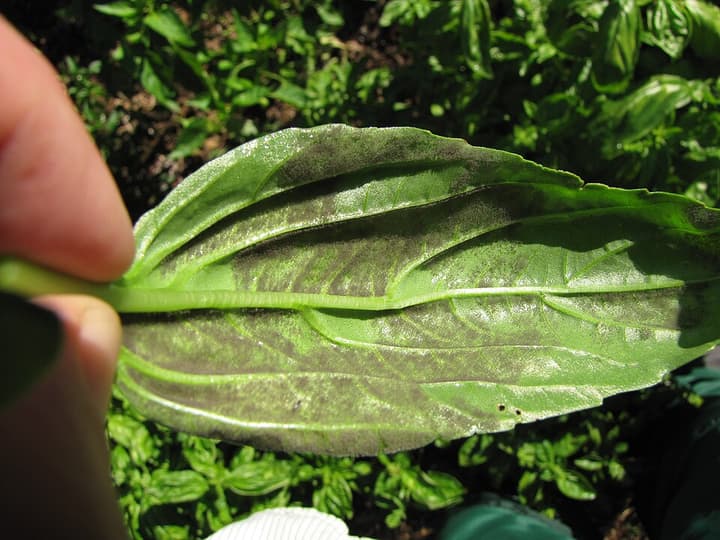
NC State notes that downy mildew favors warm, humid weather, especially warm nights. The basil downy mildew page shows photos of the symptom. If fuzz appears, do this:
Seal the entire plant in a bag and discard it in the trash, as directed by UMD.
Never add infected leaves to compost, warns UConn.
Before disposal, harvest any asymptomatic leaves and consume them promptly, as UConn suggests.
If downy mildew returns every year, switch cultivars. UF/IFAS notes that purple basils, Thai basil, and lemon basil show lower susceptibility to the disease.
Spots with pale centers or holes: leaf spot fungi
Circular dark spots with paler centers indicate fungal, rather than bacterial, infection. Penn State PlantVillage describes Cercospora leaf spot on basil in this manner. UF/IFAS cites another fungal genus, Colletotrichum, which causes dark brown to black spots. The centers of these lesions can drop out, leaving shot-holes in the leaf.
Clemson records three leaf spot fungi on basil and advises the same management for all of them. Always water at the base of the plant, keep foliage dry, and remove infected leaves at the first sign. For mild cases, Clemson notes that potassium bicarbonate fungicide can be applied once a week.
Dry, pale spots on upper basil leaves: heat and sun
Dry, straw-colored patches occurring solely on the most exposed leaves typically point to heat. Ask Extension is the public question-and-answer service of the US cooperative extension system. In one published answer, a University of Minnesota extension volunteer identified browning limited to top foliage and attributed it to heat. The guidance was to prune those leaves and keep watering consistent without overdoing it.
There is a widespread idea that water droplets on leaves act like magnifying lenses, burning foliage under the sun. A 2010 study published in New Phytologist tested water drops in direct sun on smooth, hairless leaves. The droplets did not cause burns. The study did not test basil directly, so the guidance to water at the soil line remains essential due to disease risks rather than sun scald.
Brown spots after spraying dish soap
A brown spot that appears right after a homemade spray is usually a burn from the product. Iowa State states that dish soap is much more likely to damage the plant than insecticidal soap. UF/IFAS notes that any soap, even insecticidal soap, can burn leaves. If the leaf edge darkens or the plant wilts a few hours after spraying, rinse the plant with clean water. That is the guidance from the LSU AgCenter, of Louisiana State University. Do not repeat the application.
Brown, dry tips and margins on basil: irregular watering and fertilizer salt
Crisp brown tips and edges without lesions across the leaf center point to root issues rather than disease. The University of Maryland states that excess fertilizer or soluble salts show up as brown, burned leaf margins. Washington State University adds that salt builds up in leaf tissue, killing tips and margins.
According to Washington State University, the telltale sign on the container is a white or brownish crust. It forms on the soil surface or around the inner rim of the pot. The same source notes that container plants are especially prone to this injury. To leach excess salts, water slowly until moisture runs out the drainage hole and empty the saucer promptly. Washington State University warns that this leaching technique works only for liquid or quick-release fertilizers.
Irregular watering also dries out leaf tips. A UMD specialist on Ask Extension connected brown leaf tips to moisture fluctuations in the root zone combined with high heat. The basil dry tips page covers this symptom. Trim away just the dried portion of the leaf using clean shears.
Specks and crusts on basil leaves: spider mites, thrips, or scale
Pale or brown stippling scattered like dust across leaves generally indicates pests rather than disease spots. Clemson explains that two-spotted spider mites feed on the leaf undersides. They puncture plant cells, producing speckled stippling on the upper surface. Fine webbing eventually appears, and a 10x hand lens or smartphone zoom reveals the mites.
Shiny black dots amidst the stippling can be droppings from thrips, which are insects about 1 mm long, nearly invisible without a hand lens. An Ask Extension answer regarding tomatoes describes these black dots as thrips feces. Raised dark marks resembling a crust can be armored scale insects. UC IPM, the University of California's pest management program, describes these scales as immobile insects that look like round or oval bumps. Some excrete a sticky liquid on which a black mold called sooty mold grows.
Run your finger over the mark: a raised bump points to scale, and a disease spot stays smooth on the leaf. The basil pest page shows the most common ones.
Can you eat basil with brown spots?
Yes, in most cases. The University of Maryland states that consuming leaves from downy mildew-infected plants is safe because the pathogen does not harm humans. UConn confirms this stance. An Ask Extension specialist from UMD evaluated yellowed, spotted leaves of undetermined cause and confirmed they remain edible if thoroughly washed.
Discard leaves that are mushy, foul-smelling, or covered in mold other than downy mildew fuzz. None of our cited sources address that scenario, making disposal the safest choice. Leaves blackened by cold or scorched by sun are not diseased. By the UMD specialist's criteria, they are safe to eat once washed well, though they usually look unappealing in sauces.
Frequently asked questions
Does fungicide fix brown spots on basil?
In most situations, no. NC State notes that no retail fungicide available to home gardeners effectively controls downy mildew. Penn State PlantVillage notes that bacterial leaf spot cannot be cured once symptoms emerge. For mild cases of leaf spot fungi, Clemson notes that potassium bicarbonate can be used. Against cold, sun scorch, and salt accumulation, fungicides offer zero benefit.
Should I cut off basil leaves with brown spots?
Yes, whenever dealing with bacterial leaf spot, fungal leaf spots, cold, or sun scorch. With bacterial leaf spot, infected foliage spreads the bacteria through water droplets, according to UF/IFAS. Cut flush to the stem with clean pruners and throw the trimmings in the trash. For downy mildew, UMD guidance advises discarding the whole plant.
Yellow basil leaf with brown spots: what is the cause?
Flip the leaf over to inspect the underside. Purplish-gray fuzz there confirms downy mildew. If clean, check soil moisture: potting mix that has stayed wet for days combined with yellowing lower leaves points to overwatering. Normal soil moisture paired with pale leaves in an old pot can signal fertilizer deficiency, as explained by a UMD specialist on Ask Extension.
Summary of basil spot diagnosis
Three checks distinguish most causes: inspecting the underside of the leaf, checking the shape of the spots, and seeing where the browning sits. Fuzz on the underside or dark stem streaks coupled with sudden wilting require discarding the entire plant. In other scenarios, snip off damaged leaves, water only the soil, and remedy cold, sun, or salt stress. Fresh green leaves emerging at branch tips show that the underlying issue is resolved.
Related articles

How to Care for Hibiscus: Sun, Watering, Fertilizer, and Pruning for Flowers
How to care for hibiscus: 6 hours of direct sun, evenly moist soil without waterlogging, half-strength fertilizer in spring and summer, and pruning in early spring. Find out why the flower lasts one day and why buds drop before opening.

Do Ferns Like Sun or Shade? It Depends on the Type
Ferns prefer bright shade: plenty of light, but no direct sun on their fronds. Tuberous sword fern is the exception that handles sun. Here is the ideal light for each type, where to place pots, and how fronds show too much or too little light.

African Violet Yellow Leaves: Causes and What to Do
Yellow leaves on an African violet usually stem from overwatering, and the first place to check is the center of the plant. Losing one lower leaf at a time is normal. Identify whether age, watering, cold water, sunlight, cold drafts, or fertilizer is the culprit based on the yellowing pattern, and see what to do today.