How to Care for Basil: Light, Watering, Pruning, Flowers, and Black Spots
How to care for potted basil: how much sun it needs, how to water without rotting roots, where to cut for bushy growth, what to do with flowers, and how to tell three black spots apart.
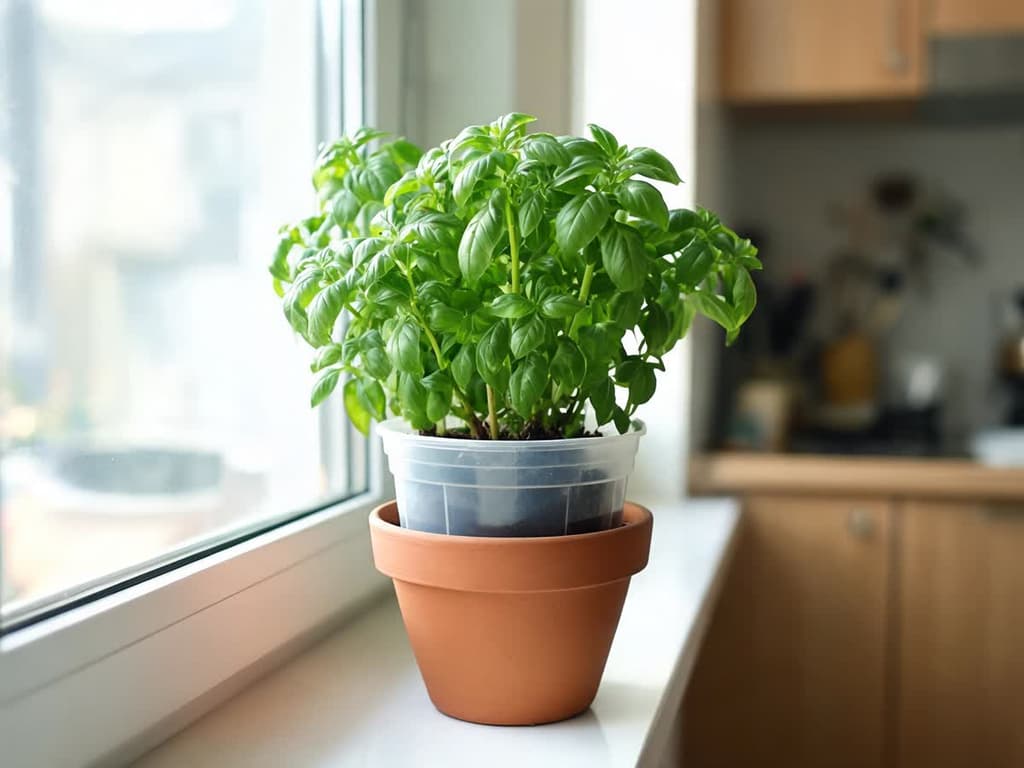
To care for basil, give it 6 to 8 hours of direct sunlight a day. Water when the top layer of soil dries out. Cut branch tips just above a pair of leaves and remove flowers as soon as they appear. Keep the plant indoors on nights below 10 °C. Basil is a warm-weather annual that lives for one season. Proper care extends its leafy stage, and cuttings rooted in water renew the plant.
Is your basil wilting, developing black tips, or stretching out with yellowing lower leaves? The cause usually comes down to one of four factors. The first is watering, which can be too much or too little. The second is cold nights. The third is low light, which stretches the stems. The fourth is the supermarket pot, which packs many seedlings competing for the same handful of soil. The sections below show how to identify each case.
The numbers in this guide come from United States university extensions, which are university services that advise plant growers. The main ones are from the University of Illinois, Clemson, the University of Florida (UF/IFAS), and the University of Kentucky. They also come from the Royal Horticultural Society (RHS, the British horticultural society) and other American universities, such as Iowa State, NC State, and Colorado State. Embrapa, the Brazilian public agricultural research company, completes the list. The foreign sources come from the Northern Hemisphere, which is why window direction and the cold season appear already adjusted for Brazil. The basil plant profile covers the species (Ocimum basilicum) and its diseases.
Quick summary:
Light: 6 to 8 hours of direct sunlight a day; in intense heat, some afternoon shade.
Watering: water when the top layer of soil dries out, preferably in the morning, directly onto the soil without wetting the leaves.
Pot: at least 20 cm wide and deep, with a drainage hole.
Cold: suffers below 10 °C; below 4 °C the leaves turn black and drop.
Harvesting: cut just above a pair of leaves, taking no more than 1/3 of the plant at a time.
Flowers: pinch off buds as soon as they appear so the plant keeps producing leaves.
Care | What to do |
|---|---|
Light | 6 to 8 hours of direct sunlight; indoors, the sunniest window (in Brazil, the north-facing one) |
Watering | When the top layer of soil dries out; never leave standing water in the saucer |
Soil and pot | Loose, rich soil that drains well; pot 20 cm or larger, with a hole |
Temperature | Nights above 10 °C; leaf damage at 10 °C and blackened leaves below 4 °C |
Fertilizer | Liquid fertilizer every 3 to 4 weeks, only if growth is weak and leaves turn pale |
Harvesting | Cut above a pair of leaves, up to 1/3 of the plant at a time |
Life cycle | Annual: flowers, sets seed, and declines; renew with cuttings rooted in water |
Dogs and cats | Non-toxic to dogs and cats, according to the ASPCA (American animal protection organization) |
How long a basil plant lives
Basil lives for one warm season and then weakens and dies. Embrapa classifies the species as an "annual herb." The RHS explains that it is treated as an annual because it needs a lot of heat and light. The plant grows, flowers, sets seed, and stops producing new leaves.
Flowers indicate that the cycle is coming to an end. According to the University of Illinois, when basil blooms and sets seed, production stops and the leaves turn bitter. The stem also turns woody, meaning hard as wood. UF/IFAS adds that letting the plant flower and go to seed shortens the harvest season.
That is why caring for basil means delaying flowers and renewing the plant. Pinching off flower buds and harvesting stem tips every week keeps the plant in its leafy stage longer. When the base begins to turn woody and blooms non-stop, take a cutting. A cutting is a piece of branch that grows roots in water, restarting the cycle with a new plant.
The cycle changes with the region's climate. In an experiment by Embrapa in the Federal District, between February and August, only one of the plants flowered. Cultivation continued for 135 days, with regrowth after cuts. In Londrina (PR), a study in the journal Científica measured leaf production across seasons. In fall and winter, it fell below half the production of spring and summer.
Supermarket basil pot: why it wilts and how to save it
The pot of basil sold in supermarkets contains many thin seedlings planted together in a small root ball (the mass of soil containing the roots). The RHS describes this pot as meant for a quick harvest: crowded seedlings tend to catch fungal diseases or flower prematurely. The same RHS notes that they can survive if you divide and repot them promptly.
To save supermarket basil, divide it within the first few days:
Remove the entire root ball from the plastic pot, holding the plants at the base of their stems.
Gently separate the root ball with your fingers into smaller clumps, each containing a few seedlings and their roots.
Plant each clump into its own pot that is at least 20 cm wide and deep, set at the same depth it was growing before.
Water thoroughly until moisture runs out the drainage hole, then place the pot in the sunniest spot in the house.
If you plant several clumps in one large pot, leave at least 10 cm between them, as the RHS recommends. Crowded basil flowers sooner and cuts the harvest short, according to the same source.
Tall, weak stems with yellowing lower leaves stem from improper watering (too much or too little) or insufficient light. The University of Illinois states that both underwatering and overwatering cause weak, leggy growth. Iowa State points to light as the most limiting factor for indoor herbs. Divide the root ball into clumps and move the plant to your brightest window. Then, cut back the tops of the stretched stems, as covered in the pruning section.
Light, watering, and soil for basil
How much light basil needs
Basil needs 6 to 8 hours of direct sun a day, according to the University of Illinois. Clemson says that, with 6 hours, it still grows reasonably well. Therefore, treat 6 hours as the minimum and 6 to 8 hours as ideal. In intense heat, UF/IFAS recommends some afternoon shade to protect the plant.
Indoors, light is the most common limitation. Iowa State states that most herbs need about 8 hours of direct light a day when grown indoors. In Brazil, north-facing windows receive the most sun throughout the year. If no window in your home receives enough direct sun, Iowa State recommends a grow light (a lamp designed for plants).
How to water basil without waterlogging
Water basil when the top layer of soil feels dry to the touch. Check the soil with your finger before every watering. The University of Illinois suggests watering at least once a week, and more frequently in hot weather. No source gives a fixed schedule for pots, so the soil itself dictates when to water. The university notes that container soil dries faster than garden beds.
Water only the soil and keep the leaves dry. The RHS recommends watering in the morning, because basil does not tolerate wet roots overnight. Clemson notes that wet foliage is more prone to diseases and advises never to leave the pot sitting in standing water in its saucer.
The plant wilts from both underwatering and overwatering, and the soil tells the two apart. Dry soil and a wilted plant mean thirst: water until it runs out the drainage hole. Soil that has been wet for days and a wilted plant are signs of root rot. Ask Extension, the inquiry service of US extensions, explains that healthy roots are white and firm. Brown, soft roots are rotted roots, and the basil wilted leaves page covers the other causes.
Watering basil is different from watering rosemary, another common potted kitchen herb. Basil requires soil with consistent moisture, provided that water drains well, according to Clemson. Therefore, water as soon as the top layer dries out, without waiting for the whole pot to dry. Drought also makes the plant flower earlier, according to the RHS. In contrast, rosemary requires the soil to dry out between waterings.
Soil, pot, and fertilizer
Use a pot at least 20 cm wide and deep, with a drainage hole at the bottom. The RHS and the University of Kentucky give the same measurement. Fill it with loose soil rich in organic matter (decomposed plant matter, such as compost or humus) that drains well. Clemson and Embrapa describe this type of soil for the species. Iowa State warns that a pot that is too large keeps the soil wet for too long, but does not provide a maximum size. When in doubt, stay close to 20 cm.
Fertilize lightly. The University of Illinois recommends liquid fertilizer every 3 to 4 weeks at the label rate. Iowa State suggests using half-strength or quarter-strength. When in doubt, start with the lower dose. Apply fertilizer only if growth stalls and leaves turn pale green. Illinois warns that excessive fertilizer weakens the foliage's aroma and flavor, and Clemson notes that it diminishes flavor.
How to prune and harvest basil
To prune basil, cut the stem just above a pair of leaves. Two new branches will grow from that point, one on each side, producing a bushier plant. The University of Illinois states that new growth emerges at the cut site in about a week.
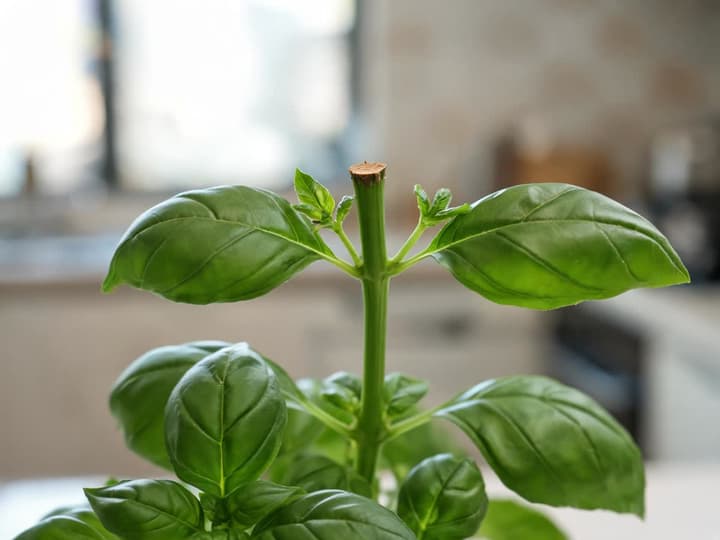
Step-by-step harvesting without weakening the plant:
Pick a stem with several leaf pairs and locate the point where two leaves branch off opposite each other.
Cut the stem with clean shears just above that pair of leaves.
Take no more than 1/3 of the plant at once, as recommended by the University of Kentucky. That leaves at least 2/3 of the plant behind, which exceeds the half that Illinois advises keeping.
After a large harvest, wait several weeks before cutting again, according to Kentucky.
Try to prune on a dry day. Clemson explains that cuts take 48 hours to seal, making them an entry point for gray mold during damp weather.
Harvest a small amount every week, even if you do not need the leaves right away. Sources vary on the exact amount: Colorado State trims half of each new shoot weekly, while WVU takes only 5 to 8 cm off the tip. This guide follows the 1/3 rule from Kentucky, respecting the minimum set by Illinois. According to the West Virginia University (WVU) Extension, trimming branch tips about once a week promotes branching and prevents flowering. Removing branch tips stimulates branching; plucking only large lower leaves leaves the tips untouched.
Basil flowers: pinch off or leave alone
Pinch off flower buds as soon as they appear if you grow basil for its leaves. The RHS notes that early removal of flower stalks delays blooming and preserves leaf quality for as long as possible. The University of Illinois instructs growers to keep removing flowers throughout the entire season.
Allowing blooms has its uses. The RHS suggests letting flowers develop at the end of the season, as blooms supply nectar for bees. The same source notes that the flowers are edible and carry a milder flavor than the foliage. UF/IFAS points out that leaving blooms helps anyone looking to collect seed. If you grow multiple plants, the RHS suggests letting one flower early while continuing to harvest the tips of the others.
Basil in cold weather
Basil suffers from cold temperatures well above freezing. The University of Illinois notes that cold air and chilled soil stall growth and can turn leaves dark at 10 °C. UF/IFAS reports that the leaves of many varieties turn black and drop below 4 °C. Treat 10 °C as your warning sign and 4 °C as the point of severe injury. Embrapa Semiárido summarizes that the species tolerates neither low temperatures nor frost.
In Brazil, winter runs from June to August, and the greatest risk is in the South and in the mountains. To move the plant outdoors, wait for nights above 10 °C, as the RHS and Clemson recommend. UF/IFAS is more cautious and calls for nights above 13 °C. If your region cools down quickly at night, wait for 13 °C, which is the safer option. On nights below 10 °C, keep the pot indoors, near your sunniest window and away from cold glass.
Cold also ruins harvested leaves. The University of Illinois warns that basil stored in the refrigerator turns black. Keep harvested stems out of the fridge at room temperature.
Black spots on basil: cold, bacteria, or downy mildew
Black spots on basil stem from three common causes, and each requires a different response. Cold darkens multiple leaves simultaneously after a chilly night. Bacterial leaf spot produces dark, water-soaked flecks. Downy mildew begins with yellow patches between the leaf veins (the thin lines on the leaf) before turning dark.
Sign | Cold | Bacterial leaf spot | Downy mildew |
|---|---|---|---|
When it appears | After a night below 10 °C | After wetting the leaves or during humid days | During warm, humid nights |
How it starts | Leaves turn dark entirely or across large patches | Dark, water-soaked specks, sometimes bounded by veins | Yellowing between veins on the upper leaf surface |
Underside of leaf | Normal | No fuzz | Purplish-gray fuzz |
Stem | Normal | May show dark streaks | Normal |
What to do | Protect from cold; affected leaves turn dark and drop | Remove diseased leaves and water only the soil | Remove and discard the entire plant |
Bacterial leaf spot is caused by the bacterium Pseudomonas cichorii. According to the UF/IFAS disease guide, it spreads with splashing water. It also passes through the hands of anyone who handles a diseased leaf and then touches another plant. Remove spotted leaves, water only the soil, and space the pots apart. The bacterial leaf spot on basil page shows photos of the symptom.
Basil downy mildew is caused by the organism Peronospora belbahrii, which forms downy growth on the underside of the leaf. UF/IFAS warns that early yellowing is easy to confuse with nutrient deficiency. Therefore, turn the leaf over before fertilizing. NC State states that no product sold to home gardeners controls the disease. UF/IFAS advises removing and destroying infected plants promptly.
Sources differ regarding downy mildew-resistant varieties. UF/IFAS notes that all sweet basil varieties, the common culinary types, remain highly susceptible. Purple varieties, Thai basil, and lemon basil contract the disease less frequently. Clemson and NC State list resistant sweet basil varieties such as 'Prospera', 'Rutgers Devotion', and 'Rutgers Obsession'. Because two sources mention these varieties, this guide points to one of them or purple basil. If downy mildew returns every year, look for one of these varieties or plant purple basil.
There is one more disease that kills the plant and does not start with spots. Fusarium wilt is caused by the fungus Fusarium oxysporum. According to Clemson, the plant grows normally up to 15 to 30 cm, stops growing, and suddenly wilts. NC State describes brown streaks on the stem and states that the fungus can persist for 8 to 12 years in the soil. Discard the plant and the potting soil; the Fusarium wilt page provides the details.
Yellow leaves, pests, and leaf-burning dish soap
Yellow leaves on basil call for two checks before applying any treatment. First, flip the leaf over: gray fuzz underneath points to downy mildew. Then, touch the soil: soil that has been waterlogged for days points to root rot, which Clemson links to yellow foliage. The sweet basil yellow leaves page lists the other causes.
The most common pests of basil are aphids and slugs, according to Clemson and the RHS. Little white bugs on the leaf can be three different pests, and UC IPM, the University of California's pest program, helps tell them apart:
Whiteflies: tiny white insects that take flight when you brush the plant; immature stages stay motionless on the undersides of leaves.
Mealybugs: oval insects covered in white wax that cluster without flying along the joints where leaves meet the stem.
Aphids: pear-shaped soft bodies bearing two tiny rear tubes that no other insect has.
Start with a strong stream of water, which knocks off aphids as well as adult whiteflies, according to UC IPM. If that is not enough, Clemson recommends insecticidal soap, a commercially prepared product, applied in the late afternoon and hitting the undersides of the leaves. The sweet basil pests page and the whiteflies page show the photos.
Dish soap is not insecticidal soap. Iowa State states that dish soap is much more likely to burn the plant. UConn, the University of Connecticut, explains why: dish soap is formulated to remove grease and dissolves the wax layer protecting the leaf. Colorado State does not recommend any household cleaning product as a pesticide. The University of Georgia, the University of Nebraska-Lincoln, and UC ANR accept a homemade mixture, but only at a low dose and with a prior test. Because the sources are divided, this guide recommends ready-to-use insecticidal soap, which is the safer option.
If you sprayed dish soap and the leaves burned, rinse the entire plant with clean water, as advised by the LSU AgCenter at Louisiana State University. Do not repeat the application: Colorado State says that leaf damage accumulates with each new exposure. The sources do not say whether a burned leaf returns to normal. Cut off the dry leaves and watch the branch tips in the following weeks: new green leaves show that the plant remains alive.
Any soap, including insecticidal soap, can burn foliage, according to UF/IFAS. Before treating the entire plant, test the spray on a few leaves and wait 24 hours, as UConn and NC State advise. Never apply to a wilting plant, in intense sun, or on days above 32 °C.
When a spot or insect matches no description, a photo helps. Diagnosis in Bloom (available for iOS) matches photos of leaves against known diseases and pests on the Premium plan.
How to propagate basil in water
Cut the top 10 cm of a branch without flowers, just below a pair of leaves. Place this cutting in a glass of water. WVU Extension uses this measurement, and the RHS says that basil cuttings root quickly. Step by step:
Select a branch without flower buds and cut the top 10 cm just below a pair of leaves.
Strip off the lower leaves so no foliage sits submerged in water.
Set the cutting in a glass of water in a bright, warm location.
Once roots form, plant the cutting into a pot with potting mix and water until moisture flows through the drainage hole.
Extension sources do not state the exact number of days until roots show up. The RHS simply states that cuttings root quickly. Embrapa produces basil seedlings from cuttings in soil trays. It uses 15 cm cuttings and transplants the rooted plants 20 days after rooting.
Take cuttings before the plant blooms completely, while non-flowering shoots are still available. Each rooted cutting becomes a new plant, resetting the life cycle back to its leafy stage.
Frequently asked questions about how to care for basil
Does basil need to be watered every day?
There is no set schedule. Water when the top layer of soil feels dry to the touch, and never let water sit in the saucer. The University of Illinois references watering at least once a week as a baseline, and more often in high heat. A small pot in intense sun dries faster and may need more frequent watering.
How long does potted basil last?
Potted basil lasts for one warm season. Once it flowers and sets seeds, the plant becomes woody and stops producing new leaves, according to the University of Illinois. Removing flowers and pinching tips weekly lengthens the leafy phase. Water-rooted cuttings replace the old plant.
Is basil safe for dogs and cats?
The ASPCA classifies basil (Ocimum basilicum) as non-toxic to dogs and non-toxic to cats. The ASPCA is the American animal protection organization that runs an animal poison control center. The ASPCA entry includes no classification for horses.
Can you keep basil alive in winter?
It is possible, if you keep the plant indoors on nights below 10 °C. Place the pot on the sunniest windowsill (in Brazil, the north-facing one) and away from cold glass. The plant grows less in the cold: in Londrina (PR), leaf production in autumn and winter fell below half of spring and summer production.
Related articles

How to Care for Hibiscus: Sun, Watering, Fertilizer, and Pruning for Flowers
How to care for hibiscus: 6 hours of direct sun, evenly moist soil without waterlogging, half-strength fertilizer in spring and summer, and pruning in early spring. Find out why the flower lasts one day and why buds drop before opening.

Do Ferns Like Sun or Shade? It Depends on the Type
Ferns prefer bright shade: plenty of light, but no direct sun on their fronds. Tuberous sword fern is the exception that handles sun. Here is the ideal light for each type, where to place pots, and how fronds show too much or too little light.

African Violet Yellow Leaves: Causes and What to Do
Yellow leaves on an African violet usually stem from overwatering, and the first place to check is the center of the plant. Losing one lower leaf at a time is normal. Identify whether age, watering, cold water, sunlight, cold drafts, or fertilizer is the culprit based on the yellowing pattern, and see what to do today.