Basil Bugs: How to Identify Them by the Damage and Treat Without Losing Your Harvest
Holes in leaves, pale stippling, sticky leaves, or tiny gnats in the pot: each type of damage points to a specific basil pest. Here is how to confirm which one it is, how to remove it with water and handpicking, and when the leaves are still safe to eat.
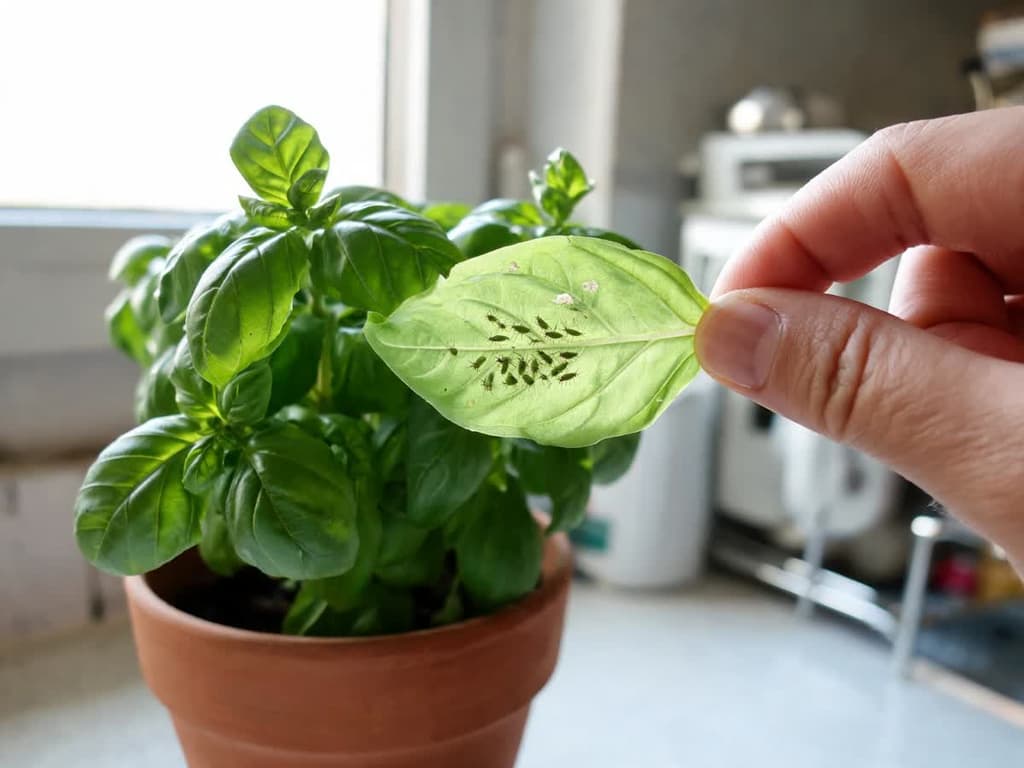
The most common basil bugs are aphids, whiteflies, spider mites, thrips, caterpillars, slugs, and snails. Almost all of them come off with a stream of water, handpicking, and cutting off the affected tip. Basil is an edible herb. For that reason, use only spray registered for vegetables and follow the safety interval on the label (the days between application and harvest). Do not use systemic insecticide, the kind the plant absorbs and takes into the leaf. A plant with aphids almost always recovers: according to UC IPM, most established plants tolerate aphids and overcome the damage.
The first step is to look at the type of damage. Pests that chew the leaves leave holes. Pests that suck the sap leave light specks, curled leaves, or sticky leaves. Basil (Ocimum basilicum) is a warm-season annual herb. The University of California pest list for basil (UC IPM) includes aphids, armyworms, flea beetles, nematodes, slugs, snails, and whiteflies. Nematodes are microscopic roundworms that attack the roots and leave no marks on the leaves, so they are excluded from this guide.
Quick summary:
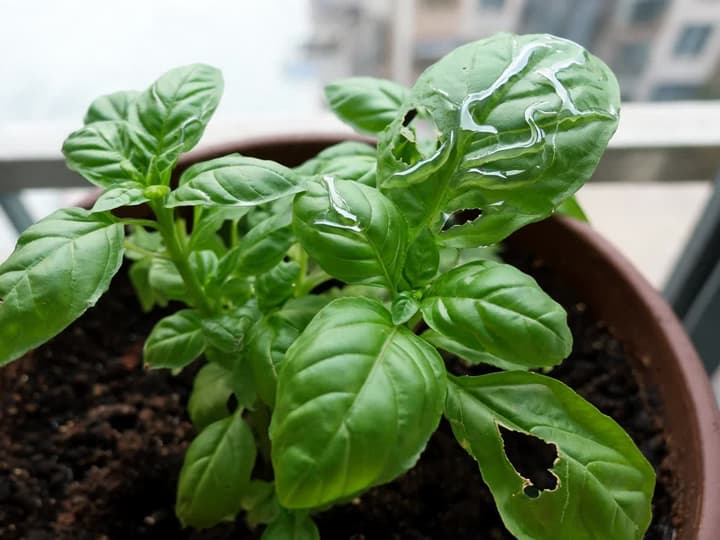
Irregular holes with a shiny trail: slugs or snails, which feed at night.
Holes with green or black droppings on the leaf: caterpillars.
Pale stippling and fine webbing on the underside: spider mites.
Sticky leaves and tiny bugs on new growth: aphids. A white cloud when you touch the pot: whiteflies.
Tiny gnats flying around the indoor pot: fungus gnats, which live in damp soil.
Can you eat it? Leaves chewed by caterpillars or beetles, yes, after washing. Leaves with slug trails go into the trash, as a precaution.
How to identify basil pests by the type of damage
The table below matches the damage you see to the most likely pest and the way to confirm it. Check twice: once during the day, turning the leaves over, and again after dark, with a flashlight. The University of Maine Extension recommends looking at both times. Damage from different pests often looks the same, so confirmation means finding the pest feeding.
What you see | Most likely pest | How to confirm |
|---|---|---|
Irregular holes with smooth edges, missing new leaves | Slug or snail | Silvery, shiny trail on leaves or pot; pests appear at night |
Large, irregular holes, fecal droppings | Caterpillar | Green caterpillar on leaf undersides or shoots, sometimes grouped together |
Small, round holes scattered across the leaf | Flea beetle | Tiny, dark, shiny beetle that jumps when touched |
Leaves reduced to skeletons with only veins remaining | Japanese beetle or feeding caterpillars | Metallic green beetle during the day, or clusters of caterpillars |
Pale stippling, bronze leaves, fine webbing | Spider mite | Tap the leaf over white paper: walking specks |
Silvery patches with tiny black spots | Thrips | Tap the leaf over white paper: slender, elongated insects |
Sticky leaf, curled shoot, ants climbing | Aphid | Green or black colonies on shoots and leaf undersides |
Black specks moving on the underside, sticky leaf | Black aphid | Specks move when touched; thrips droppings remain still |
Stationary white flecks near the colony | Aphid cast skins | Dry cast skins rub off with a finger and have no legs |
White cloud when disturbed, leaves yellowing | Whitefly | Flat, oval, stationary nymphs on the leaf underside |
Small black gnats around the pot indoors | Fungus gnat | Pale larvae in moist soil; leaves remain intact |
Holes in leaves: what is chewing on basil
Holes in leaves usually come from chewing pests. The shape of the hole and the time it appears distinguish the suspects.
Slugs and snails: night feeding and shiny trails
Slugs and snails make irregular holes with smooth edges in leaves. According to the UC IPM, they hide during the day, come out at night and on cloudy days, and leave a silvery mucus trail. Basil is on the UC IPM list of plants they severely damage because they prefer soft leaves and young seedlings.
What to do about slugs and snails:
Handpick slugs and snails at night with a flashlight, and in the early morning. Destroy what you collect.
Rest a board on 1-inch (2.5 cm) risers near the pot and scrape away whatever hides underneath daily.
Clear away other hiding spots next to the pot: stones, fallen leaves, and empty pots. Keep the trap board, because you check it every day.
Elevate the pot to a higher surface, as suggested by the University of Maine Extension.
Use iron phosphate bait only if other steps are not enough, and follow the label. UC IPM considers this bait safer around dogs, children, and wildlife.
Soil that is always wet at the surface attracts slugs and snails, according to cultural tips for growing basil from UC IPM. Basil requires regular watering, but a constantly wet surface attracts slugs and snails. Water when the topsoil dries out, without waiting for the plant to wilt.
In Brazil, the giant African snail (Achatina fulica) also eats garden crops and can transmit angiostrongyliasis, an infection caused by a parasitic worm it carries. The Ministry of Health Technical Note No. 30/2022 links Brazilian cases to snail mucus on poorly washed leafy greens. The note advises hand-collecting with gloves and crushing the snails and their eggs. Afterwards, bury them with quicklime in a trench 80 cm to 1.5 m deep, far from water wells. Without quicklime, the note indicates soaking the crushed snails for at least 24 hours in a solution of 3 parts water to 1 part bleach.
Caterpillars: large holes and droppings on leaves
Caterpillars eat a lot and stay hidden on the underside of leaves and on shoots, so check there. Armyworms feed in groups and, on larger plants, skeletonize leaves down to the veins, according to the UC IPM. Droppings appearing as small green or black pellets on lower leaves show where they are.
Handpick the caterpillars. UC IPM cites Bacillus thuringiensis (Bt, a bacterium used against caterpillars) for young caterpillars, and only when there are many on a small seedling. Use only products registered for vegetables and follow the pre-harvest interval on the label.
Beetles: tiny round holes or skeletonized leaves
The flea beetle is a tiny, dark, shiny beetle that jumps when you touch it. It makes small, round holes in the leaf. UC IPM notes that damage is rarely serious past the seedling stage. Cover the seedling with a lightweight fabric until it has 6 leaves: UC IPM notes that older plants suffer less.
The Japanese beetle is metallic green and skeletonizes leaves, leaving only the veins. It is a pest in the United States and parts of Europe. The University of Maryland Extension recommends handpicking the beetles or shaking the leaf over a bucket of soapy water. The same extension advises against baited traps because they attract more beetles.
Stippled, curled, or sticky leaves: sap-sucking pests
Aphids, whiteflies, spider mites, and thrips do not leave holes in leaves. They pierce the surface and suck out internal plant juices, causing damage that looks like stippling, curled leaves, or sticky residue. All four live mainly on the undersides of leaves, so flip leaves over when inspecting.
Aphids on basil: curled shoots and sticky leaves
The aphid is a small, soft-bodied insect that is green, black, yellow, brown, or reddish. It lives in clusters on new growth and on the undersides of leaves. The stationary white specks near the colony may be cast skins: aphids shed their skin about 4 times before reaching adulthood. According to UC IPM, aphids excrete honeydew, a sugary, sticky liquid. Honeydew attracts ants and sooty mold, a black fungus that grows on it. Ants climbing up the basil stem are a clue of aphids or another insect that excretes honeydew, such as whiteflies.
Aphids return after treatment because they reproduce quickly. UC IPM notes that a single female can produce up to 12 offspring per day without mating. A spray or jet of water only removes the aphids it hits, so repeat until you find no more on new shoots.
What to do about aphids:
Direct a strong spray of water at shoots and leaf undersides, holding the pot firmly. Repeat at every inspection as long as aphids remain.
Snip off the shoot tip holding the colony if the infestation is limited to a few shoots.
Check the plant at least twice a week during periods of rapid growth, as recommended by UC IPM.
Apply nitrogen fertilizer only as needed: UC IPM notes that excess nitrogen favors aphid reproduction.
Ladybugs and their larvae eat aphids, and broad-spectrum insecticide kills both along with the pest. The guide to aphids on plants explains the insect's life cycle and what to do when it returns.
Whiteflies: a white cloud when you touch the pot
The adult whitefly is a tiny white insect that flies up in a cloud when you disturb the plant. The damage comes from the nymph (the young stage), which is oval, flat, and motionless on the underside of the leaf. According to the UC IPM, the leaf yellows, dries out, and can drop, and honeydew leaves the leaf sticky. Aphids also leave the leaf sticky, but they do not fly up in a cloud when you disturb the pot.
What to do about whiteflies:
Direct a strong stream of water at adults and leaf undersides, and repeat whenever the cloud reappears.
Pick off the most heavily infested lower leaves early in the infestation.
Hang a yellow sticky trap near the pot to monitor the pest. UC IPM uses one trap per medium-sized plant, and with high populations, it also helps reduce numbers.
Whiteflies multiply quickly in warm weather and become difficult to control once numbers are high. For that reason, take action the day you see the first cloud. UC IPM lists tomatoes and peppers among plants attacked by whiteflies, so inspect any vegetables near your basil.
Spider mites: pale stippling and webbing on leaf undersides
The twospotted spider mite, also called a spider mite, is not an insect: it is related to spiders and measures less than 1.3 mm (1/20 inch). You see the damage first: light-colored speckling on the leaf, which later turns bronze or yellow. When mite numbers are high, fine webbing appears on the undersides and between leaves, according to UC IPM. To confirm, tap the leaf over a sheet of white paper and look for moving dots.
Spider mites like heat, dust, and water-stressed plants. UC IPM recommends watering enough so the plant does not experience drought stress. As long as there are mites, spray water on the undersides of the leaves at least once a day. In hot weather, spider mites complete a generation in less than 1 week, according to UC IPM. The article on spider mites shows the mite life cycle and how it spreads between pots.
Thrips: silvery patches with tiny black spots
Thrips are slender, elongated insects, less than 1.3 mm long. They scrape the leaf and suck out the fluid inside, leaving the leaf with silvery or stippled spots. Shiny black specks appear alongside the spots, which are their feces, according to UC IPM.
To confirm, tap the leaf or flower over a sheet of white paper. UC IPM points to blue or yellow sticky traps for monitoring flying thrips. UC IPM also advises avoiding excess water and excess nitrogen fertilizer, which increase thrips populations.
Gnats flying around indoor basil pots
A small black fly hovering around the pot, with the leaves intact, is usually a fungus gnat. Its larva lives in the moist soil of the pot and feeds on fungus and organic matter. According to the UC IPM, the adult fly does not damage the plant or bite, but heavy larval populations can chew the roots of seedlings and small plants.
Whiteflies are white and emerge from leaves. Fungus gnats are dark and emerge from the soil. To check for larvae, place a raw potato slice on the soil for a few days and inspect its underside: UC IPM uses this test. Let the soil surface dry out between waterings and keep pots draining freely without standing water in the saucer: this reduces fungus gnats.
Supermarket basil arrives with many seedlings crowded into a single root ball. The Royal Horticultural Society (RHS) notes that these seedlings are thin and often get sick from fungi. Fungus gnats also appear on other indoor houseplants. The guide to indoor plant pests shows how to tell them apart from other pests.
Basil spots that resemble pests but are diseases
A spot that spreads without any pests nearby is usually a disease, and the treatment is different. Basil downy mildew is a disease caused by a fungus-like organism. It starts with yellow leaves in areas bordered by the veins. On the underside of these areas, a purplish-gray velvety powder appears, according to Cornell University.
The same Cornell page shows that black thrips frass can be confused with downy mildew. The difference is the texture: the thrips speck is smooth and shiny, while downy mildew looks dusty and velvety. A dark spot, without any bugs, can be bacterial leaf spot on basil, another disease.
If uncertainty remains, photograph both the front and underside of the leaf in good light. In Bloom (available for iOS), photo diagnosis (a Premium feature) compares symptoms against known basil diseases.
What to do against basil pests, from gentlest to last resort
Always start with the mildest step and only move on to the next one if the pest persists. For culinary herbs, the University of Maryland Extension advises against spraying herbs with insecticide. UC IPM, Colorado State, and Maine Extension accept insecticidal soap against aphids and mites. This guide takes the safer route, because the leaf goes into food: steps 1 to 3 first, and registered soap only in step 4.
Handpicking. Slugs, snails, and caterpillars come off by hand. For beetles, shake the foliage over a cup of soapy water, which only serves to drown them: do not spray this soapy water onto the plant.
Water spray. Blast shoots and leaf undersides with a strong jet of water against aphids, whiteflies, and spider mites. Repeat as long as you find pests.
Pruning damaged tips. Cut just above a pair of healthy leaves, and the aphid colony comes off with the tip. The RHS recommends pinching out basil growing tips to encourage branching.
Registered insecticidal soap. Use the product sold for vegetables, not dish soap, and follow the label.
Steps 1 through 3 put no chemicals on the plant, so they work well in beds where children play and in pots sitting in the kitchen. If you need slug bait, iron phosphate bait is what UC IPM considers safer around children and dogs.
Insecticidal soap only kills the insect it wets and leaves no effect after drying. According to the Colorado State University Extension, it does not reach aphids hidden inside curled leaves. Because the effect ends once the soap dries, you may need to repeat the application every 4 to 7 days. The same extension advises testing the product on a few leaves 1 or 2 days before treating the entire plant.
UC IPM adds another precaution for soap and oil: do not apply to drought-stressed plants or when temperatures exceed 32 °C (90 °F). Neem oil and other plant-based oils work the same way, by contact. Use only registered products that have a pre-harvest interval on the label.
What not to use on basil:
Dish soap. Colorado State University notes that dish detergent can damage foliage. Homemade concoctions also lack efficacy testing and established pre-harvest intervals.
Systemic insecticides. Systemic products enter the plant's vascular sap stream and remain inside the leaves you plan to eat. UC IPM points out that they are far more toxic and harm bees and beneficial insects.
Broad-spectrum insecticides (which kill many kinds of insects), such as carbaryl. UC IPM notes that they kill natural enemies and can even accelerate spider mite reproduction.
Can you eat basil that had pests?
Yes, in most cases, with proper washing. Leaves chewed by caterpillars or beetles can be rinsed under running water and eaten. Leaves with aphids can also be eaten once the colony is removed. Leaves with slug or snail slime trails go straight into the trash as a precaution: none of the consulted sources quantify the safety risks on these leaves, and the CDC and the Ministry of Health advise thoroughly washing fresh produce. Foliage coated in honeydew and sooty mold, marked by disease spots, or extensively chewed should also be discarded.
Caution with slugs and snails is a health matter. The US Centers for Disease Control and Prevention (CDC) recommends thoroughly washing vegetables that will be eaten raw. The reason is the rat lungworm, which slugs and snails transmit. The technical note from the Ministry of Health links Brazilian cases to the mucus of the giant African snail on poorly washed vegetables.
After water sprays, handpicking, or pruning tips, harvesting can happen the same day. After applying a pesticide product, the product label defines when you can harvest under its pre-harvest interval. Wash all leaves before eating, even after observing the waiting period.
Homemade concoctions have no labels and no verified pre-harvest intervals. Without safety data, the safest choice when eating the harvest is to skip homemade recipes on basil.
Why basil gets pests
Certain growing conditions invite basil pests. Three crop up repeatedly across UC IPM sources:
High-nitrogen fertilization: promotes aphid reproduction and drives up thrips populations.
Drought stress, heat, and dust: favor spider mites. Plants lacking sufficient water suffer more damage from attacks.
Consistently soggy soil: attracts slugs, snails, and fungus gnats, while increasing the risk of root rot.
Watering when the top inch of soil feels dry, without waiting for the plant to wilt, reduces the third cause and prevents the drought stress that favors spider mites. The guide on how often to water basil shows how to do the finger test and what changes the interval between waterings.
Before placing a new plant with the others, turn the leaves over and check for pests. The UC IPM recommends checking every new seedling before planting, because of aphids and whiteflies. For the rest of the routine, like sunlight, watering, and harvesting, see the guide on how to care for basil.
Frequently asked questions about basil pests
Do coffee grounds repel slugs from basil?
There is no measurement with coffee grounds in the consulted sources. The 2002 study by the US Agricultural Research Service (USDA-ARS) tested caffeine dissolved in water, not grounds: a 1 to 2% solution killed slugs and snails. The researcher himself said at the time that it was too early to recommend coffee in home vegetable gardens. Handpick the slugs and use a board as a trap.
What makes tiny holes in basil leaves?
Tiny, round holes are usually from flea beetles, small dark beetles that jump when disturbed. Small, irregular holes can come from young caterpillars or small slugs. Check for pests during the day and after dark. A shiny trail confirms slugs, while dark fecal specks confirm caterpillars.
Do basil pests spread to other plants?
Aphids, whiteflies, spider mites, and thrips attack many plants and spread from one pot to the next. Keep the infested basil separate from other pots until the pest is gone, and check the undersides of the leaves on neighboring plants. Mealybugs do not appear on UC IPM's list of basil pests, but mealybugs are common on other potted plants in the home.
Can I use basil that had aphids in a sauce?
Yes, after washing. Knock off the colony with a water spray, trim heavily infested growing tips, and rinse the leaves under running water. Discard any leaves blackened with sooty mold or severely curled. If you sprayed any product, wait through the label's pre-harvest interval before harvesting.
Start by checking the underside of the leaf
Turn over basil leaves whenever you harvest, checking shoots, undersides, and the soil surface. Pests caught early can be cleared with plain water and handpicking, without needing sprays. If damage does not match any entry in the table, photograph the foliage and compare it against common basil diseases before treating.
Related articles

How to Care for Hibiscus: Sun, Watering, Fertilizer, and Pruning for Flowers
How to care for hibiscus: 6 hours of direct sun, evenly moist soil without waterlogging, half-strength fertilizer in spring and summer, and pruning in early spring. Find out why the flower lasts one day and why buds drop before opening.

Do Ferns Like Sun or Shade? It Depends on the Type
Ferns prefer bright shade: plenty of light, but no direct sun on their fronds. Tuberous sword fern is the exception that handles sun. Here is the ideal light for each type, where to place pots, and how fronds show too much or too little light.

African Violet Yellow Leaves: Causes and What to Do
Yellow leaves on an African violet usually stem from overwatering, and the first place to check is the center of the plant. Losing one lower leaf at a time is normal. Identify whether age, watering, cold water, sunlight, cold drafts, or fertilizer is the culprit based on the yellowing pattern, and see what to do today.