How to Care for Mums in Pots or Gardens: Water, Light, Blooms, and Cold
How to care for mums in pots or gardens: water when the soil dries, deadhead spent blooms, keep the plant in a bright, cool spot, and learn which of the two types survives frost.
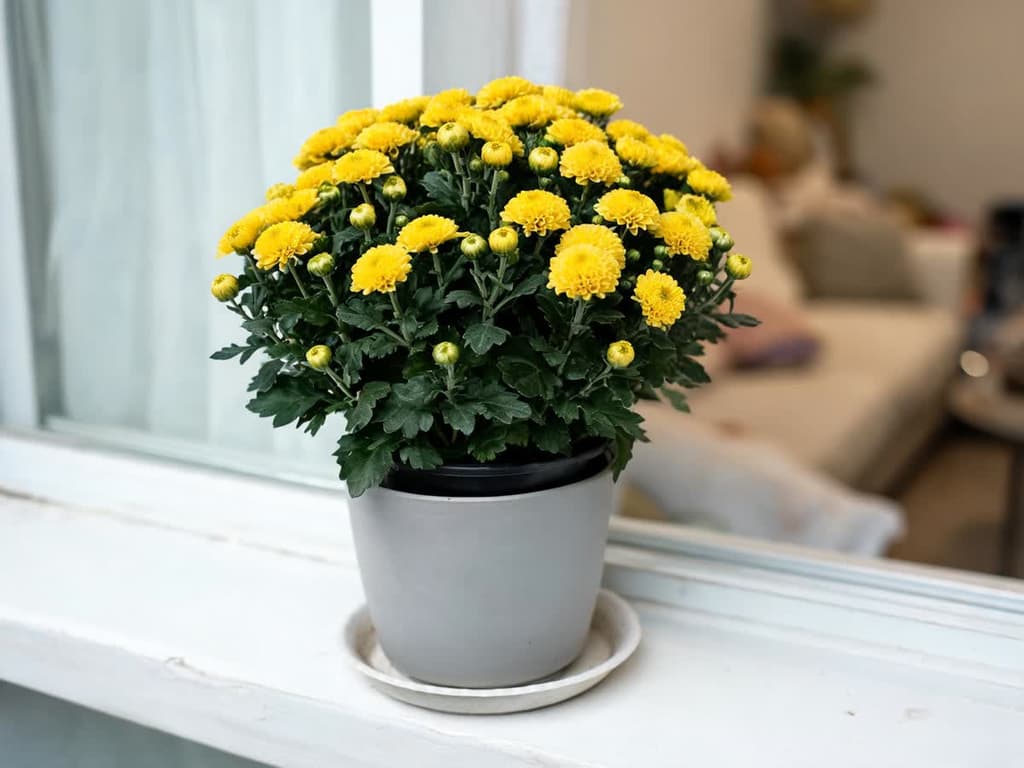
To care for a potted mum, keep the plant in a bright, cool spot away from direct sun. Water when the soil surface feels dry to the touch, until water drains from the bottom of the pot. Cut off spent blooms with scissors and protect the plant from frost. First, identify which mum you have. Florist potted mums usually last through a single blooming period, while hardy garden mums come back to flower year after year.
The figures in this guide come from seven university extensions in the United States and the Federal University of Viçosa (UFV). The extensions are from Iowa State, Clemson, Utah State, Ohio State, Virginia Tech, NC State, and the University of California. An extension is a university service that advises plant growers. The foreign sources are from the Northern Hemisphere. Because of this, the guide refers to seasons and only cites a month when it specifies "in Brazil."
Quick summary:
Planted where the ground freezes in winter, most florist potted mums die, according to Iowa State and Utah State.
Indoors, flowering mums do best near a bright window without direct sunlight, between 16 and 21 °C (Iowa State).
Mums form flower buds when they get at least 9 and a half hours of uninterrupted darkness each night, according to Clemson.
Buds that have already turned brown and soft will not open, according to Utah State; green buds on the same plant can still bloom.
Which Mum You Have: Florist Potted Mums vs. Hardy Garden Mums
Florist potted mums and hardy garden mums belong to the same species (Chrysanthemum × morifolium), bred for different purposes. Florist mums are grown in greenhouses to bloom at any time of year and typically last for a single display. Garden mums were selected to bloom in garden beds and return every year.
The difference lies in how many weeks of long nights each type requires to bloom. According to Clemson, hardy mums open their flowers about 7 to 8 weeks after long nights begin. Greenhouse florist mums take longer: in Clemson's example, a 10-week variety planted in the garden would freeze before opening.
Utah State explains why florist mums do not return in the cold. They produce few stolons, the underground shoots that renew the crown (the cluster of stems growing from the same root system). They can also suffer from the ground freezing and thawing, or bloom so late that frost kills the flowers.
Florist potted mum | Hardy garden mum | |
|---|---|---|
How you usually buy it | In bloom, in a plastic pot inside a cachepot (a decorative outer pot that conceals the plastic pot), from a florist or supermarket | As a nursery starter or large pot from a garden center, meant for planting in garden beds |
Sales season | Year-round; in Brazil, production occurs in every month (UFV) | Late summer and fall, or spring |
Winter with frozen ground | In most cases, it does not survive (Iowa State, Utah State) | Tolerates at least −5 °C in the ground (RHS) and returns in spring if planted early (Iowa State) |
After flowering | Discard it, or cut it back and try planting it in the garden in mild climates | Leave it in the bed and divide every 2 to 3 years |
If you received or bought your plant already in bloom, in a thin plastic pot inside a cachepot, it is most likely a florist mum. Watering and deadheading routines apply to both types. Light, overwintering, pruning, and transplanting rules vary by type, and each section specifies which mum it covers.
Potted Mum Care at a Glance
Care task | What to do | Source |
|---|---|---|
Light | Near a bright window, out of direct sun, while in bloom | Iowa State |
Temperature | Between 16 and 21 °C indoors | Iowa State |
Watering | When the soil surface feels dry to the touch, until water drains through the holes; do not let water sit in the cachepot | Iowa State, Ohio State |
Spent blooms | Cut with clean scissors as soon as the flower fades | NC State, Ohio State |
Fertilizer | None of the consulted extension services recommend fertilizing a pot already in bloom | UC, Iowa State |
Frost | Bring florist pots indoors before the first frost | Iowa State |
Pets | Toxic to dogs, cats, and horses | ASPCA |
How Much Light Do Mums Need?
Flowering potted mums last longer near a window with plenty of bright light but no direct sun, according to Iowa State. The same source recommends an indoor temperature range of 16 to 21 °C. The University of California advises the opposite, suggesting a sunny window spot.
This guide follows Iowa State because it couples lighting with temperature. Direct afternoon sun can easily heat the pot above this ideal range. If your only bright window receives direct sun, set the pot back from the glass where the rays do not strike it directly.
In the garden, the rules change. Hardy mums need at least 6 hours of direct sun daily, according to Iowa State and Ohio State. NC State recommends shielding plants from afternoon sun in hot regions. In warm climates, choose a bed with morning sun and afternoon shade. Mums will grow in shade, but their stems stretch and flop over, according to NC State.
How to Water Potted Mums
Check the soil every day with your finger. If the surface feels dry to the touch, water until moisture drains from the bottom holes; if it feels damp, do not water, according to Ohio State. NC State offers two additional tests: soil that is dry down to your second knuckle, and a pot that feels light when lifted. If these checks disagree, rely on the surface dryness test recommended by Iowa State and Ohio State.
Remove the plastic nursery pot from the cachepot to water it over the sink, returning it only after water stops draining, according to Iowa State. Standing water in the bottom of a cachepot keeps the root system waterlogged. Always empty saucers after watering as well.
Plants often arrive dry from the store. According to the University of California, mums are frequently underwatered in retail settings. UC recommends soaking the pot in a bucket of water for about 2 hours right after purchase, then letting it drain thoroughly. Afterward, rely on the finger test and do not let the soil stay soggy.
Underwatering and overwatering produce distinct symptoms, according to Clemson. Underwatered plants develop woody stems and stunted growth. Overwatered plants develop yellow leaves that subsequently turn dark and fall off.
Why Mum Buds Dry Out
Synthesizing the sources, five main causes dry out mum buds: dry soil inside the root ball, gray mold (Botrytis fungus), frost, artificial light at night, and aphids or spider mites. Buds that turn brown and soft will never open (Utah State). Green buds remaining on the same plant can still bloom.
If only a portion of the buds dried out, the plant can still bloom from the green ones. Cut away the brown buds, check the causes below, and watch for the green buds to open. If all the buds dried out, the current bloom cycle is lost: resolve the underlying issue and consult the section on getting mums to rebloom.
What you see | Probable cause | What to do |
|---|---|---|
Dried buds, wilted leaves, lightweight pot | Soil dried out severely; mums are frequently underwatered in retail stores (UC) | Soak the pot in a bucket of water for a few hours (UC) and always water until it runs through the drainage holes |
Brown, soft buds, sometimes with water-soaked spots on the petals | Gray mold, which appears in cool, humid conditions (Clemson) | Cut off the bud and water the soil without wetting the flowers (Clemson) |
Darkened buds following a frosty night on the porch | Freezing temperatures killed the buds before opening (Iowa State) | Trim off the damaged buds and bring the pot indoors |
Buds that neither grow nor open, situated near a light or street lamp at night | Light interrupts the long dark periods needed for blooms (Iowa State, Clemson) | Move the pot to a spot that stays completely dark all night |
Curled, sticky young leaves, insects visible on the buds | Aphids or spider mites (Clemson) | See the pest management section below |
Gray mold attacks mum petals and buds during periods of cool, humid weather, according to Clemson. It begins as water-soaked spots on the petals that eventually turn brown.
How to Deadhead and When to Prune Mums
Snip off spent blooms with clean scissors, cutting just beneath the dry flower head as soon as the color fades. According to Ohio State, deadheading spent flowers prolongs the blooming period. NC State also advises removing spent heads to encourage new blooms. Taking off the dead blooms exposes the developing green buds.
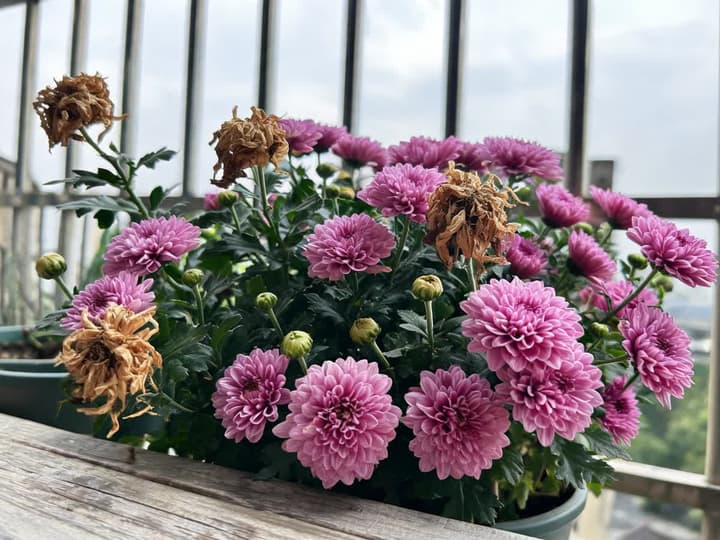
Pinching for shape is a separate task intended for hardy garden mums. When young shoots reach 15 cm in height, pinch off the top of each stem, taking about 1 cm (Virginia Tech). Repeat this once new growth reaches 15 cm again, as directed by Iowa State. According to Iowa State, most varieties benefit from 2 to 3 pinchings like this. The plant stays shorter and grows bushier.
Stop pinching about 100 days before you want the plant to bloom, according to Ohio State. Virginia Tech explains why: pruning too late delays flowering, which may prevent buds from opening before the first frost.
How to Get Mums to Bloom Again
Mums develop flower buds as nights lengthen. According to Clemson, the plant requires at least 9 and a half hours of uninterrupted darkness each night to set buds. To develop and open those buds, it needs over 10 and a half hours. For this reason, Clemson notes that mums should really be called "long-night plants."
UFV describes the requirement from the daylight side, using a different number. Mums initiate flower buds when the day length drops below 13 hours of light. Across most of Brazil, this occurs in autumn and winter. Near the equator, day length stays around 12 hours year-round, constantly below 13.
Artificial light at night disrupts this biological trigger. A photograph from Iowa State shows mums without flowers on the side facing a street lamp, while the shielded side of the same plant bloomed. In research cited by UFV, a 100 W incandescent bulb mounted 2 m high prevented blooming within a radius of up to 1.60 m.
Commercial growers force florist mums to bloom year-round by controlling the night period. They turn on lights when they want vegetative leaf growth and cover crops with light-blocking material when they want blooms, according to UFV. None of the consulted sources provides a home recipe of hours and weeks to duplicate this process on a windowsill.
After blooming finishes, cut the stems back to 10 to 15 cm above the soil. Let the plant grow in a sunny spot far from artificial night light. Hardy garden mums bloom again as days shorten in autumn. Florist mums bloom later, and in areas with early frosts, they rarely flower outdoors, according to Iowa State.
Fertilizing Mums: When It Makes a Difference
Fertilizer serves plants that are actively growing stems and setting buds. The University of California advises fertilizing before flower buds form. None of the extension services consulted recommends feeding a potted mum that was purchased in bloom. Without that guidance, the safest choice is to avoid fertilizing potted mums while they are in flower.
For hardy garden mums, Iowa State recommends slow-release fertilizer that feeds the plant gradually. Spread it around the base as new shoots emerge in spring. Overfertilizing causes leggy, weak stems, according to the same source. Virginia Tech favors frequent light feeding over occasional heavy doses. Both institutions agree on the essential rule: never exceed package instructions.
Where winters are severe, Iowa State advises against fertilizing in summer. Late feeding stimulates tender new growth that cannot harden off before cold weather arrives.
Can Mums Tolerate Frost?
Hardy garden mums tolerate at least −5 °C in garden beds, according to the Royal Horticultural Society (RHS). To withstand that cold, the plant must be in the ground long enough to establish its root system. Most florist potted mums do not survive the winter when planted where the soil freezes, according to Iowa State and Utah State. None of the consulted sources provides a minimum survival temperature for florist potted mums.
Without this data point, the safest approach is bringing florist pots indoors before the first frost. Iowa State explains the problem: planted outside, they bloom late, and frost usually destroys the buds before they open. In containers, even hardy garden mums are vulnerable to freezing, according to the RHS. The RHS instructs bringing pots inside once flowering ends. Store them in a bright, frost-free location that stays above 4 °C at night.
Potted Mums on the Porch in Fall
Keep potted mums outdoors on the porch as long as frost is not in the forecast. When freezing temperatures are predicted, deadhead dried flowers and move the pot inside. Set it near a bright window away from heating vents, within the 16 to 21 °C range recommended by Iowa State. An unlit spot at night will not harm open blooms, since mums require dark nights. During the day, the plant still needs bright light. A well-tended potted mum will stay in bloom for a month or more, according to the University of California.
Hardy Mums in Garden Beds
Do not cut back dead stems in autumn. Iowa State reports that research shows hardy mums survive winter better when the old stems remain standing until spring. Utah State and Ohio State allow fall cutbacks; this guide follows Iowa State because of its citation of research.
Where the ground freezes, apply a mulch of straw or pine needles over the plant after the soil has frozen solid (Iowa State). The mulch layer should measure at least 5 cm deep, according to the RHS. Mulching keeps the soil consistently frozen, stopping the freeze-thaw cycles that push root crowns out of the ground. Remove the mulch in early spring. Avoid tree leaves: they pack down tightly and can smother the crown.
Plant early. Utah State permits planting up to 6 weeks before winter. Iowa State notes that mums planted in late summer or early fall rarely survive the winter. This guide follows Iowa State: plant in spring. In spring, cut the old growth back to 7 to 10 cm above the ground, according to NC State.
After Flowering: Garden Planting vs. Discarding
Sources disagree about transplanting florist potted mums into the garden, and climate explains the difference. Iowa State and Utah State explain that, in most cases, florist mums do not survive their first winter outdoors, recommending that growers compost them. The University of California, in a mild-winter climate, advises pruning the plant back to 10 to 15 cm and planting it in the garden.
Where the ground freezes, treat the florist mum as a single-season plant. Where winters are mild, such as in Brazil outside the South and the mountain regions, plant it in a sunny garden bed after blooming. The florist mum may have received a growth regulator, a product that keeps the plant short. Because of this, it tends to grow taller in the ground than in the pot, according to the University of California.
Established hardy garden mums require division every 2 to 3 years, according to Iowa State. In early spring as new shoots emerge, lift the entire clump from the soil. Discard the woody center, slice the outer clump into sections with several shoots and healthy roots, and replant right away.
Pests and Diseases on Mums
Clemson and NC State list these primary mum pests: aphids, two-spotted spider mites, leafminers (Clemson), and thrips (NC State). Notable diseases include powdery mildew, rust, and wilt, with Clemson adding gray mold to the list.
Aphids cause new growth to curl or twist. They secrete honeydew, a sticky, sugary liquid that coats foliage and can support dark mold growth. Clemson suggests washing aphids away with a strong stream of water, repeating every 2 days for at least 3 treatments. Other houseplants may harbor the same aphids, and the water rinse method works for them too.
The two-spotted spider mite creates pale yellow stippling across the foliage and fine webbing on flower buds and leaf undersides. Populations increase rapidly in hot, dry weather, according to Clemson. Rinse the plant with a strong water spray. Insecticidal soap works best when applied during the early stages of an infestation.
Leafminers create winding, light green to brown trails inside leaf tissue; prune and dispose of damaged leaves immediately, according to Clemson. Powdery mildew shows up as white or gray powdery patches across the leaves; space pots apart to ensure good air circulation. White rust causes yellow spots on the upper leaf surface and raised blisters that turn white underneath; strip off infected leaves as soon as you spot them.
For all foliage diseases, water the soil without wetting the foliage, according to Clemson. If you are unsure what pest or disease is affecting your plant, take a close-up photo of the leaf. Bloom (available for iOS) identifies plants from photos and provides image-based disease diagnosis on its Premium plan.
Are Mums Toxic to Dogs and Cats?
Yes. The ASPCA, the animal poison control organization in the United States, lists mums as toxic to dogs, cats, and horses. Symptoms include vomiting, diarrhea, hypersalivation, incoordination, and skin irritation. NC State rates the plant's toxicity as low severity, noting that handling the foliage can also cause contact dermatitis in people.
Keep the container out of reach of pets and consult a veterinarian if an animal chews the plant. This guide to other toxic plants for pets helps evaluate the rest of your home.
Frequently Asked Questions About Mums
How long do potted mums last?
A well-cared-for potted mum stays in flower for a month or more, according to the University of California. To achieve this, choose plants with plenty of tight buds. Hardy garden mums grow for many years in landscape beds. Iowa State suggests dividing clumps every 2 to 3 years to maintain vigor.
Are mums annuals?
No. Mums are perennials that live for multiple years, according to Clemson. Florist potted mums are typically handled as temporary seasonal plants. They fail to survive winters with frozen ground in most situations, according to Iowa State. In mild-winter areas, they can persist outdoors in garden soil.
Can I plant potted mums in the garden?
Yes, where winters are mild. After flowers fade, prune the plant back to 10 to 15 cm and plant it in a sunny garden bed, according to the University of California. Where the ground freezes in winter, most do not survive, according to Iowa State and Utah State. In cold regions, planting hardy garden mums gives far more reliable results.
Do mums bloom again?
Hardy garden mums bloom annually as nights grow long. Florist mums do not always flower again: where early autumn frosts occur, they usually fail to bloom outdoors, according to Iowa State. Mums need at least 9 and a half hours of continuous darkness to initiate buds, according to Clemson. Prune stems back after flowering, maintain the plant in sun away from night lights, and wait for autumn.
Can mums stay outside?
Yes, in bright spots protected from night lighting. Hardy garden mums overwinter directly in landscape beds. Florist potted mums must come inside before the first frost, since freezing weather destroys buds before they open, according to Iowa State.
Before Buying Your Next Mum
Select a pot filled with tightly closed buds and just a few open flowers. The buds will open in your home and provide a longer display, according to the University of California. Make sure the potting mix is not bone dry, and inspect leaf undersides for webbing or insects. If you are shopping for your garden, choose a hardy variety and plant in spring.
Related articles

How to Care for Hibiscus: Sun, Watering, Fertilizer, and Pruning for Flowers
How to care for hibiscus: 6 hours of direct sun, evenly moist soil without waterlogging, half-strength fertilizer in spring and summer, and pruning in early spring. Find out why the flower lasts one day and why buds drop before opening.

Do Ferns Like Sun or Shade? It Depends on the Type
Ferns prefer bright shade: plenty of light, but no direct sun on their fronds. Tuberous sword fern is the exception that handles sun. Here is the ideal light for each type, where to place pots, and how fronds show too much or too little light.

African Violet Yellow Leaves: Causes and What to Do
Yellow leaves on an African violet usually stem from overwatering, and the first place to check is the center of the plant. Losing one lower leaf at a time is normal. Identify whether age, watering, cold water, sunlight, cold drafts, or fertilizer is the culprit based on the yellowing pattern, and see what to do today.