Fertilizer for Jaboticaba: What to Use, How Much, and When to Fertilize
There is no official fertilization table for jaboticaba. See the only published dose we found, the right season in Brazil, how to fertilize in pots, and what to do if you overfertilized.
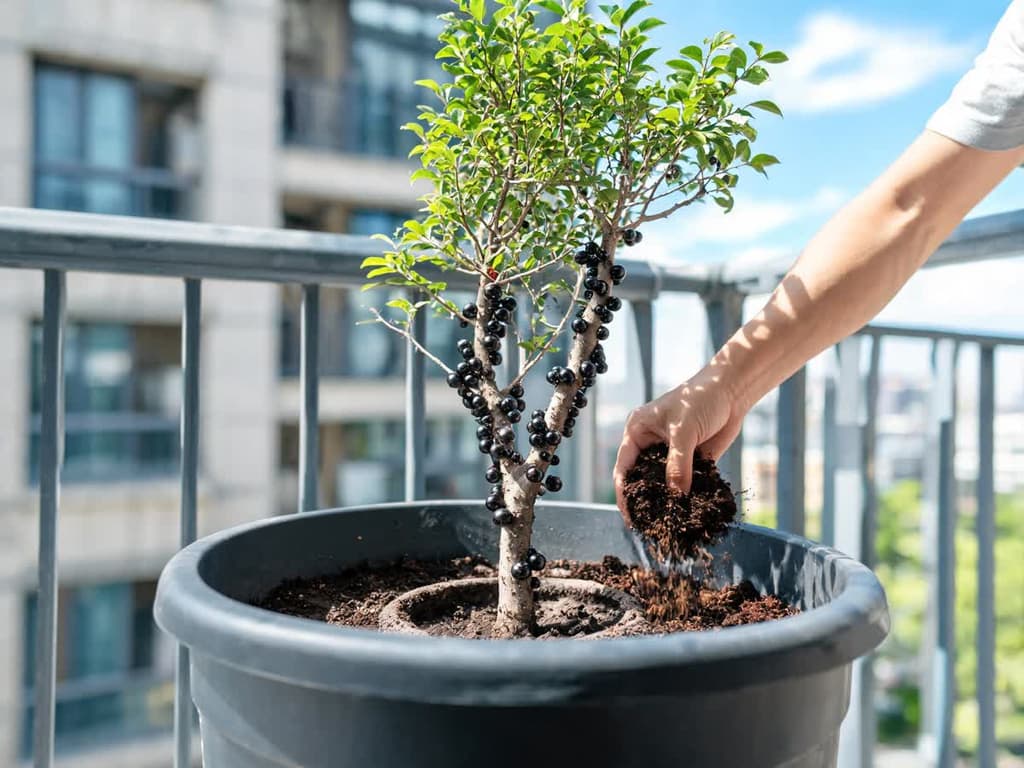
The best fertilizer for jaboticaba is well-rotted manure, paired with a small dose of NPK split into applications during the rainy season. For a mature tree planted in the ground, we found only one published dose: 30 to 50 kg of manure and 250 g of NPK per year. Spread the fertilizer on the strip of soil beneath the canopy, well away from the trunk.
This dose was adapted from other fruit trees, and there is no official fertilization table for jaboticaba. The formulas and frequencies in this guide come from two sources: Donadio's book and University of Florida publications. Well-rotted manure is manure that has fully decomposed, turning dark and odorless. NPK is a synthetic fertilizer containing nitrogen (N), phosphorus (P), and potassium (K).
Quick summary:
Mature tree in the ground: 30 to 50 kg of well-rotted manure and 250 g of NPK per year (Donadio, 2000). Split the dose into parts during the rainy season.
Sapling: the University of Florida recommends fertilizing monthly in the 1st year, every 2 months in the 2nd year, and every 3 months in the 3rd year. Apply this while the sapling is actively growing and the soil is moist.
Formula: balanced NPK with magnesium for saplings, shifting to higher potassium starting in the 3rd year.
Jaboticaba burns easily from excess nitrogen: leaf tips and margins turn brown and dry. Treat your tree as sensitive to soil salts.
In containers, choose organic fertilizer or slow-release fertilizer, which releases nutrients gradually.
No study shows that fertilizer causes jaboticaba to bloom. Flowering follows a cool, dry period once water returns.
Is there an official fertilizer recommendation for jaboticaba?
There is no official fertilizer recommendation for jaboticaba (Plinia cauliflora). Agronomist Luiz Carlos Donadio wrote a technical book about jaboticaba (Native Fruit Series, Funep, 2000). According to him, all fertilization recommendations for the species are adapted from other crops. The University of Florida says the same in a recent guide. It suggests following the dosage for mango or other tropical fruit trees in the guava family.
A master's thesis from the Federal University of São João del-Rei (2015) points out another gap. No published study describes how to collect jaboticaba leaves for nutritional tissue analysis.
Because no official recommendation exists, no product marketed as "jaboticaba fertilizer" has an official dosage standard to follow. Read the formula on the label (the three NPK numbers) and compare it to the formulas in the sections below.
When to fertilize jaboticaba in Brazil
Fertilize jaboticaba during the rainy season, splitting the annual dose into separate applications. This is Donadio's (2000) recommendation for Brazil, matching the period when the tree actively grows.
A study on 18- and 32-year-old jaboticaba trees in Hidrolândia, Goiás, measured the tree's annual cycle (Semensato and colleagues, Iheringia, 2020). Starting in May, with the cold and drought, the leaves began to fall, and by June the trees were nearly leafless. The reproductive period, from flowering to harvest, lasted from September to October in the irrigated trees.
A resting jaboticaba, nearly leafless during the dry winter, grows very little. No study has evaluated the effect of fertilizer during this phase, and fertilizer only works in moist soil, according to Washington State University. For that reason, wait for new bud break and the return of rains.
The Florida guide says the opposite: fertilize 3 times a year and stop from June to September, which is their rainy season. The reason is to prevent heavy rain from leaching the fertilizer into the groundwater. In Brazil, follow Donadio: the Goiás study shows the tree with leaves during the rains and leafless during the cold and dry period. Fertilize during this growth phase, from the beginning of the rains until the onset of the cold and dry season.
How much fertilizer to use on in-ground jaboticaba
The dose depends on the tree's age. This table gathers the published numbers, along with the source for each:
Stage | What to use | Amount and frequency | Source |
|---|---|---|---|
Sapling planting | Well-rotted manure mixed into planting hole soil (60 cm × 60 cm) | 200 g per planting hole, once | Donadio (2000) |
Sapling, 1st year | Balanced NPK with magnesium | Monthly, at the label rate, while the sapling grows in moist soil | University of Florida (HS39) |
Sapling, 2nd year | Balanced NPK with magnesium | Every 2 months, at the label rate, while the sapling grows in moist soil | University of Florida (HS39) |
Sapling, 3rd year | NPK with higher potassium | Every 3 months, at the label rate, while the sapling grows in moist soil | University of Florida (HS39) |
From the 4th year onward | NPK with higher potassium | Once per year, at the label rate | University of Florida (HS39) |
Mature tree | Well-rotted manure + NPK | 30 to 50 kg of manure and 250 g of NPK per year, split across rainy season applications | Donadio (2000) |
The seedling schedule comes from the University of Florida extension (HS39, revised in 2005). It does not provide grams, only the frequency. Use the dose that the fertilizer label indicates for the size of the plant and never increase the amount. During the dry winter dormancy, skip those months: no study has measured fertilizer during this phase.
The mature dose applies to large, bearing trees planted in the ground. No source specifies the exact size threshold at which a tree qualifies as mature. Donadio does not prescribe an NPK formula or specify how many parts to divide the 250 g into.
Divided into 3 applications, as in the Florida guide, each feeding takes roughly 80 g of NPK and 10 to 17 kg of well-rotted manure. For the formula, use the 3rd-year blend: 8-2-10 with 5% magnesium. For an in-ground mature tree, this guide follows Donadio's rainy-season split. That is the recommendation developed for Brazil, whereas the single annual application originates from Florida.
Which NPK to use on jaboticaba
The three NPK numbers indicate the percentage of nitrogen (N), phosphorus (P), and potassium (K) in the fertilizer. A 10-10-10 contains 10% of each element.
For saplings, the University of Florida suggests a balanced formula with magnesium, following a 1-1-1-½ ratio. The four numbers represent nitrogen, phosphorus, potassium, and magnesium. An example is 10-10-10 with 5% magnesium. From the 3rd year onward, shift to a ratio with higher potassium and lower phosphorus, such as 8-2-10 with 5% magnesium. A recent guide from the same university reports good results using a slow-release 4-3-4 with 5% calcium, magnesium, and sulfur. This formulation works for young and mature plants alike, eliminating the need to change formulas as the tree ages.
Exercise the greatest caution with nitrogen. According to the University of Florida, jaboticaba is prone to nitrogen burn, though it tolerates higher doses of phosphorus and potassium well. Excess nitrogen also leaves the tree more vulnerable to aphids, scale insects, and whiteflies, according to the same guide. On figs, another common container fruit tree, excess fertilizer drives excessive leafy growth at the expense of fruit production.
A greenhouse study measured what the sapling accumulates up to 450 days of age (Souza and colleagues, Revista Brasileira de Fruticultura, 2018). The 'Paulista' jaboticaba sapling accumulated 706 mg of nitrogen, 541 mg of potassium, and 488 mg of calcium. Iron and manganese were the micronutrients it accumulated the most. These numbers show what the plant needs most, but they are not a fertilizer dose.
Organic fertilizer for jaboticaba: manure and compost
Jaboticaba responds exceptionally well to organic fertilization, according to Gomes, cited by Donadio (2000). Well-rotted manure forms the cornerstone of Donadio's mature tree dose. The University of Florida also favors organic fertilizer to prevent salt buildup in the soil.
Use only well-rotted manure or fully decomposed compost, as specified in Donadio's dose. Fresh manure has not broken down and should not be used in these quantities.
Organic fertilizer releases nutrients slowly. It serves as the base for the year, while NPK is applied alongside it, 250 g per year for a mature tree, divided across the rainy season.
How to apply fertilizer under the canopy dripline
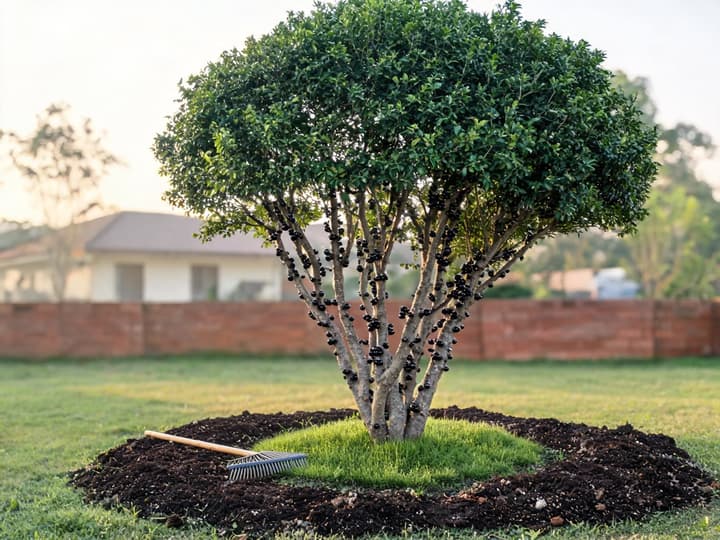
The canopy dripline is the ground area beneath the branches, reaching out to the tips of the outer limbs. Donadio recommends incorporating the fertilizer into the topsoil within this zone. In the photo below, the ring of fertilizer sits directly under the outer edge of the branches.
To fertilize in-ground jaboticaba:
If the soil beneath the canopy is dry, water it thoroughly before fertilizing. Washington State University advises never fertilizing a plant stressed by drought or heat.
Scatter the fertilizer in a wide ring under the branch tips, keeping it completely off the trunk. No source defines an exact clearance distance: keep the area around the base of the trunk clear, as shown in the photo.
Gently work the fertilizer into the top layer of soil with a hand trowel, taking care not to dig deeply. Jaboticaba has shallow roots, according to the University of Florida.
Water immediately afterward until the topsoil layer where you incorporated the fertilizer is thoroughly moist.
When using granular fertilizer, brush off any granules that land on the trunk or wet foliage. Fertilizer granules on wet leaves cause localized leaf burn, according to Washington State University.
How to fertilize jaboticaba in pots
Fertilize potted jaboticaba according to the age schedule: monthly in the 1st year, every 2 months in the 2nd, and every 3 months in the 3rd. Apply the lowest dosage listed on the label for containers. After the 3rd year, the University of Florida recommends fertilizing once per year.
Container plants are especially vulnerable to fertilizer burn, according to Washington State University. Residual salts remain trapped within the container's soil. Spread the fertilizer across the soil surface near the pot rim, away from the trunk, as shown in the opening photo. Scratch it only into the very top layer.
The fine feeder roots of jaboticaba occupy the top few inches of container soil, according to a recent University of Florida guide. This is why potting soil must never dry out completely, and fertilizer must never contact dry soil. Water both before and after applying fertilizer.
Choose well-rotted manure, worm castings, or slow-release fertilizer, which release nutrients gradually. No source gives an exact quantity of manure or worm castings for pots. Start with the lowest rate recommended on the package label and only reapply when the schedule calls for it. Liquid fertilizer works as well, provided you dilute it strictly according to label instructions.
Jaboticaba can live in pots for many years due to its slow growth rate. It tolerates rootbound conditions, which can even trigger earlier flowering in some varieties, according to the University of Florida. Move the tree to a larger pot as it expands, adjusting to the label dosage for the new container volume.
A white or brown crust on the soil surface or pot rim indicates accumulated fertilizer salts. Stop fertilizing immediately and flush the soil as described in the overfertilization section below.
pH, iron, and magnesium: when yellow leaves are not a fertilizer deficiency
The jaboticaba tree prefers acidic soil, with a pH between 5 and 6, according to the University of Florida. Soil pH measures acidity: below 7 is acidic, above 7 is alkaline. In a UTFPR trial with jabuticabeira-açu in Paraná, seedlings grew more at pH 5.5 than at 6.5 and 7.5 (Kreczkiuski and colleagues, 2020).
The same study notes that liming is not always appropriate for native fruit trees, as jaboticaba is adapted to acidic soils. Liming is the application of agricultural lime to raise soil pH and lower acidity. Only lime your soil if a laboratory soil test explicitly calls for it.
New leaves turning yellow with dark green veins is the classic sign of iron deficiency. Iron chlorosis appears most frequently in high-pH soils, where iron is present but cannot be absorbed by the root system. The University of Florida recommends applying chelated iron to the soil or as a foliar spray at the label rate. Chelated iron is a specialized form of iron that plants can absorb even in alkaline conditions.
When applied as a spray, chelated iron requires precise dilution to avoid foliage burn; follow the guidelines outlined in foliar feeding.
With magnesium deficiency, yellowing starts on older foliage, also between the veins. The University of Florida's jaboticaba formulas include supplemental magnesium.
Yellow leaves can also stem from overwatering or root rot, issues that fertilizer cannot resolve. For other potential causes and how to distinguish them, consult our guide on yellow leaves on jaboticaba.
Overfertilization: how to save your jaboticaba
Too much fertilizer causes salt buildup in the soil, damaging root tissue and impairing water absorption. According to extension specialists at the University of Maryland and Washington State University, warning signs include:
brown, dry leaf tips and edges;
a wilting plant despite moist soil;
lower foliage dropping while new shoots shrivel;
a white crust forming on the soil surface or container rim.
A frequent cause is quick-release fertilizer applied during hot weather or without post-application watering, according to Washington State University. Quick-release fertilizers dissolve rapidly in moisture. To rescue an overfertilized jaboticaba:
Remove any visible fertilizer granules remaining on the soil surface.
For container trees, pour clean water through the pot until it flows freely from the drainage holes, let it drain, and repeat. The University of Maryland recommends flushing with a volume of water at least equal to the pot's total volume. A 30-liter container requires at least 30 liters of water, administered over consecutive flushes.
Empty the saucer underneath the pot. Leaving drainage water in the saucer allows the roots to reabsorb the flushed salts.
If flushing that volume through the pot is impractical, replace the potting medium entirely with fresh soil, as the University of Maryland recommends for smaller pots.
For trees in the ground, run water over the canopy zone slowly in several sessions, letting it soak in without pooling. No source has quantified an exact flush volume for in-ground trees.
Withhold all fertilizer until the tree initiates healthy new foliage growth.
Flushing effectively removes quick-release and liquid fertilizers, according to Washington State University. It does little for slow-release formulations, which continue discharging nutrients into the root zone. In that situation, scrape away and discard the top soil layer containing the granules.
Crisp leaf tips and edges on an otherwise turgid plant in normal soil point to salt damage, identical to the pattern observed in container avocado trees.
Soaking the soil once and leaving the pot sitting in standing water does not leach salts away: water must percolate down through the profile and escape out the bottom.
Leaf drop does not necessarily mean the tree is dead. After drought stress, jaboticaba trees with intact green cambium under the bark stand a strong chance of recovery, according to the University of Florida. No studies have quantified this survival rate specifically for fertilizer burn, so wait for bud break before discarding the plant.
Does fertilizer make jaboticaba produce fruit?
No studies show that fertilizer makes a jaboticaba bloom. The University of Florida links heavier blooms to cold, frost-free, dry seasons. In the Goiás study, flowering followed three months of cold, dry rest once watering resumed. That study was purely observational, lacked a control group, and does not prove that water triggers flowering.
The flower induction trial we found tested chemicals and irrigation, not fertilizer. In that study with hybrid jaboticaba, paclobutrazol brought flowering forward and increased production (Kosera Neto and colleagues, Pesquisa Agropecuária Tropical, 2018). Paclobutrazol is a plant growth regulator, a product that alters the plant's growth rate.
The age at which a jaboticaba first fruits depends heavily on propagation method. Seed-grown jaboticabas take 8 to 10 years before bearing fruit, according to the University of Florida. Grafted or air-layered saplings (rooted while still attached to the parent limb) can produce within a few years. No scientific evidence shows that fertilizer accelerates this timeline, and overapplying nutrients risks burning young trees.
DIY homemade fertilizer for jaboticaba
We found no technical research validating homemade fertilizer recipes for jaboticaba. Popular homemade mixtures often combine earthworm castings and bone meal, though recommendations conflict regarding application frequency. An article from the TudoGostoso portal suggests applying every 3 months, whereas a publication by Abrafrutas instructs repeating every 30 days. Neither source cites supporting data: adhere to the research-backed schedules detailed above from Donadio and the University of Florida.
Earthworm castings and mature compost constitute true organic matter and should be handled like well-rotted manure. Crushed eggshells consist of calcium carbonate, the exact compound found in agricultural lime. Eggshells tend to increase soil pH, contrary to the jaboticaba's preference for acidic conditions. Coffee grounds and kitchen scraps belong in a compost bin first, rather than piled raw around the tree trunk.
Frequently Asked Questions
What is the best fertilizer for jaboticaba?
Well-rotted manure forms the foundation, as jaboticaba responds enthusiastically to organic inputs, according to Gomes, cited by Donadio (2000). Supplement this with a light dose of NPK during the rainy season: balanced with magnesium for young saplings, and higher in potassium starting in year three. No single commercial brand has an official formulation to follow, since no official standard exists.
Is urea good for jaboticaba?
Urea is a pure nitrogen fertilizer, and jaboticaba is especially prone to nitrogen fertilizer burn, according to the University of Florida. We found no published research evaluating urea applications on jaboticaba. Opt instead for well-rotted manure or a complete NPK blend, which balance nitrogen with phosphorus, potassium, and, in the case of manure, organic soil conditioners.
What is the best month to fertilize jaboticaba?
In Brazil, fertilize during the rainy season when the tree is flushing, splitting the annual dose into multiple applications (Donadio, 2000). In the study conducted in Goiás, this spans from November, after flowering, to April, before the cold and drought set in. Do not fertilize a dormant tree that has dropped most of its leaves during the dry winter.
Can I put coffee grounds on jaboticaba?
We found no scientific studies on applying coffee grounds directly to jaboticaba. The safest method to use coffee grounds is processing them through a compost pile with other kitchen scraps until fully broken down into finished compost. Once cured, apply the compost under the dripline as an organic soil amendment.
In summary
Fertilize jaboticaba with well-rotted manure and NPK (250 g annually for a mature in-ground specimen), split into separate applications across the rainy season. Distribute fertilizer beneath the canopy while soil is moist. For container specimens, use the lowest label rate and water both prior to and following application. If leaves show interveinal yellowing, investigate soil pH and iron availability rather than adding general fertilizer. If foliage displays fertilizer burn, leach excess salts before resuming applications.
Has your jaboticaba turned yellow or dropped leaves, and you don't know whether it's fertilizer, watering, or disease? Bloom (available for iOS) identifies the problem from a photo of the leaf.
Related articles

How to Care for Hibiscus: Sun, Watering, Fertilizer, and Pruning for Flowers
How to care for hibiscus: 6 hours of direct sun, evenly moist soil without waterlogging, half-strength fertilizer in spring and summer, and pruning in early spring. Find out why the flower lasts one day and why buds drop before opening.

Do Ferns Like Sun or Shade? It Depends on the Type
Ferns prefer bright shade: plenty of light, but no direct sun on their fronds. Tuberous sword fern is the exception that handles sun. Here is the ideal light for each type, where to place pots, and how fronds show too much or too little light.

African Violet Yellow Leaves: Causes and What to Do
Yellow leaves on an African violet usually stem from overwatering, and the first place to check is the center of the plant. Losing one lower leaf at a time is normal. Identify whether age, watering, cold water, sunlight, cold drafts, or fertilizer is the culprit based on the yellowing pattern, and see what to do today.