Jabuticaba Pests and Diseases: How to Identify and Treat Them
Rust is the primary disease affecting jabuticaba trees, and scale insects are the most commonly cited pests. Learn how to identify each issue by its symptoms, determine if it affects only the fruit or the entire tree, and take action without detergent or tobacco tea.
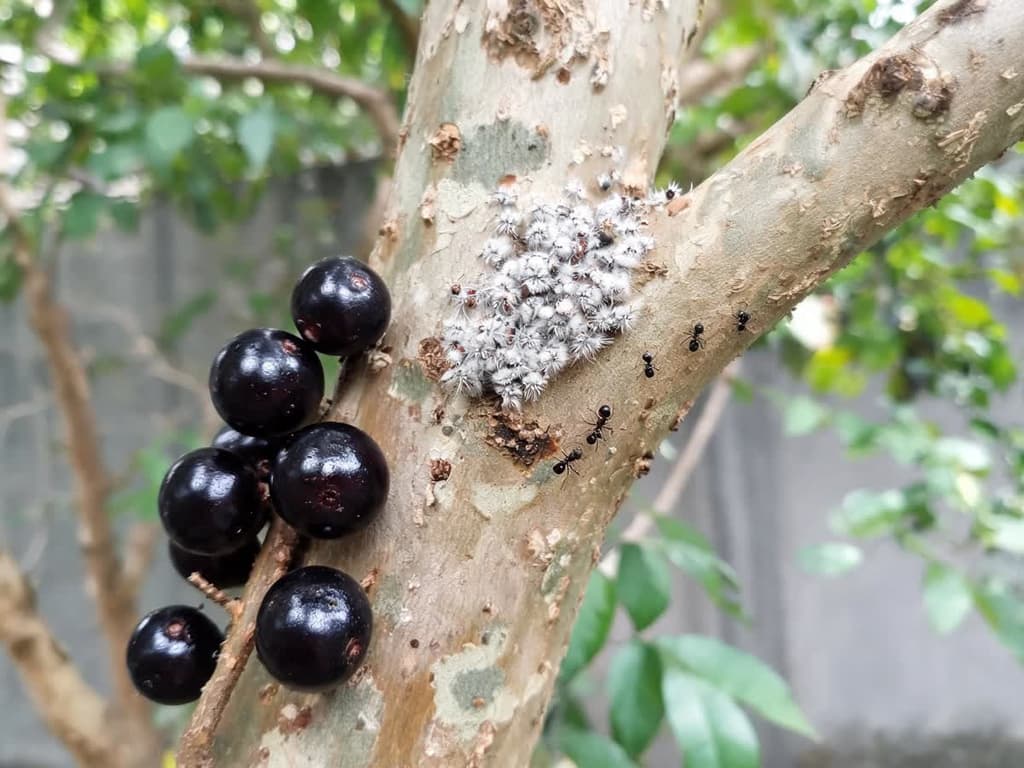
Among jabuticaba pests and diseases, rust is the main disease, according to APTA, the agricultural research agency of São Paulo. It mainly attacks the fruit during warm and rainy periods. Among pests, the most frequently cited are scale insects, the myrtle borer, and the jabuticaba weevil, according to a technical book from Espírito Santo (2016). On the fruit, fruit flies also appear.
The same APTA states that most of these problems appear only occasionally. Because of this, the first step is knowing what you are looking at. This guide shows how to identify each jabuticaba tree (Plinia cauliflora) issue by its signs. For each one, it explains whether it threatens only the harvest or the tree itself, and what to do.
Quick summary:
Yellow powder on shoots, flowers, or young fruit is a sign of rust. Rust-affected fruit remains edible, according to the University of Florida (UF/IFAS).
White cotton with a soft bug underneath is scale. On a backyard tree, treatment starts with pruning and a scrub brush.
A silk web covering the trunk, with tiny loose insects underneath and smooth bark, can be barklice, an insect that does not harm the tree.
Losing most flowers and young fruit is normal: on the 'Sabará' jabuticaba, only 16% to 28% of fruits reached maturity in a study by Esalq/USP.
How to identify the jabuticaba problem by its symptoms
Start with what you see and where it appears. The table brings together the most common signs and the most likely cause of each one, according to the sources in this guide.
What you see | Where it appears | Likely cause | Is it a problem for the fruit or the tree? |
|---|---|---|---|
Bright yellow powder | Shoots, new leaves, flowers, and young fruit | Rust | Both: attacks the fruit and, on araza, causes fruitlets to drop and dries branch tips |
Dark, round spots | Fruit peel, leaves | Rust in an advanced stage | Fruit: the spot is cosmetic and the fruit remains edible |
White cotton with a soft bug underneath | Branches, fruit, branch crotches | Mealybug | From the tree: sucks plant sap |
White crust or felt clinging to the bark | Trunk and thick branches in the shade | Jabuticaba scale | Tree: destroys the bark |
Fine silk webbing, with tiny loose insects underneath and smooth bark | Trunk and branches | Barklice | Neither |
Black powder that wipes off with a damp cloth | Leaves and fruit | Sooty mold (fungus that grows on the sugar secreted by scale insects) | Sign of scale |
Line of ants climbing up the trunk | Trunk | Scale or aphids | Sign of a pest |
White larva inside the fruit | Ripe fruit | Fruit fly | Fruit |
Flowers and tiny green fruits dropping weeks after flowering | Ground under the tree | Normal drop | Neither, if unaccompanied by other signs: on 'Sabará', only 16% to 28% of fruits reach harvest |
Older tree drying out or dying entirely, with no visible pests | Whole tree | Root rot | Tree |
Yellow leaves without any of these signs can come from too much or too little water or fertilizer. The page on jabuticaba tree with yellow leaves separates these causes.
Jabuticaba rust (Austropuccinia psidii)
Jabuticaba rust is caused by the fungus Austropuccinia psidii, the same one responsible for guava rust. APTA considers it the primary disease of this crop. The technical book from Espírito Santo describes attacks on leaves, flowers, fruit, and twigs, showing necrotic, circular spots.
On araza, another fruit from the jabuticaba family (the myrtles), the fungus attacks only new tissue. Embrapa Western Amazon describes the symptoms on this plant: new shoots die, buds, leaves, and young fruit drop, and branches die back from the tip to the base. The same publication lists jabuticaba as susceptible. The report also notes that the disease grows stronger when other plants in the family are nearby, such as guava and rose apple.
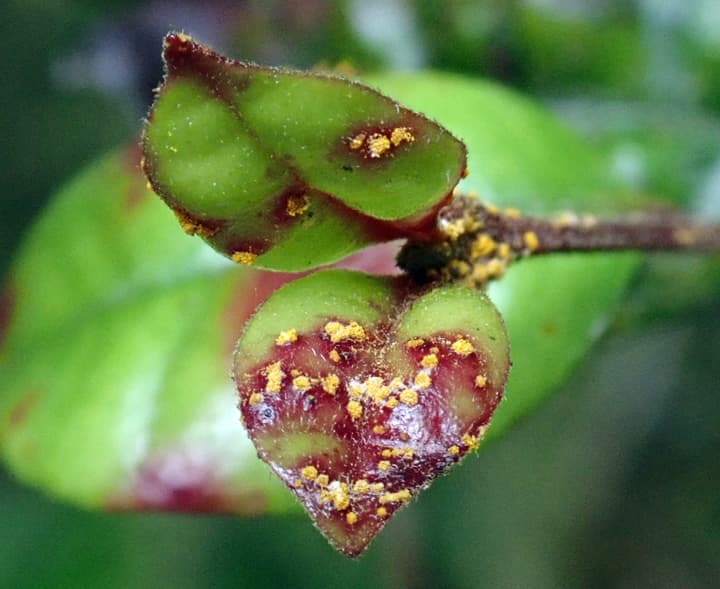
When rust appears
APTA associates rust with hot, rainy periods. The Cargill Foundation, in an outreach guide without a research source, mentions low temperatures.
Sources describing the environment point to leaves staying wet for prolonged periods. On eucalyptus, Embrapa Florestas recorded infection between 18 °C and 25 °C, with dew or drizzle for more than 6 hours, for 5 to 7 consecutive days. In Florida, UF/IFAS observed spots on jabuticaba under heavy rain or long wet periods.
This guide follows APTA, which studied the jabuticaba tree in Brazil. After a sequence of rainy, warm days, look at the shoots, flowers, and small fruit for yellow powder.
What to do against rust
APTA recommends opening up the canopy: cut the branches that cross or close off the center of the canopy, until the sun reaches the inner branches. Leaves that dry faster give the fungus less of a chance. The guide on sanitary pruning for the jabuticaba tree shows which branches to cut without removing those that bear fruit. Water the soil, not the leaves.
For chemical control, APTA cites spraying with copper-based products. Embrapa Florestas lists copper oxychloride, copper hydroxide, cuprous oxide, and Bordeaux mixture for jabuticaba, using data from the 2003 official registry. Before buying, check AGROFIT, the Ministry of Agriculture's registration system, to see if the product remains registered for jabuticaba. Take the dosage and application interval from the label.
In Florida, UF/IFAS says that fruit with rust spots remains edible and that the damage is cosmetic. APTA, in Brazil, treats rust as the main disease and recommends control. UF/IFAS recommends copper on small fruit, right after it forms, for prevention. On a tree that loses new shoots and young fruit every year, the problem has already gone beyond cosmetic.
Scale insects on jabuticaba
Two scale insects appear in the sources on jabuticaba, differing by their appearance and where they settle. The first is jabuticaba scale (Capulinia jaboticabae), a pest from Brazil described in 1898. The second is the mealybug, common on many plants.
How to identify each scale insect
The mealybug is an oval insect covered in fluffy white wax, according to the NC State Extension. To confirm, rub the white spot with a cotton swab: if a soft bug appears underneath, it is a mealybug. It appears on branches, at junctions, and even on the fruit.
The jabuticaba scale insect appears in the technical book from Espírito Santo under the name pulgão ceroso (waxy aphid), despite being a scale insect. Embrapa Western Amazon confirms that it affects the jabuticaba tree. For a relative of it on the guava tree, the same Embrapa describes the attack starting at the shaded base of the trunk. The colony climbs up and destroys the bark and part of the wood.
The mealybug sucks sap and releases a sticky, sugary liquid, according to NC State. Ants climb up to feed on this liquid, and sooty mold, a black fungus resembling soot, grows on it. Because of this, lines of ants and leaves dirtied with black are signs of scale insects or aphids on the tree.
Can a jabuticaba tree with scale insects be saved?
You can try to save it before considering cutting it down. Embrapa controlled a guava scale species, related to the one targeting jabuticaba, using the method below. The test took place on guava trees, so treat this method as the only tested path present in the sources, with no guaranteed outcome:
Perform a sanitary pruning: remove dead branches harboring colonies and those crowding the center of the canopy. Scale insects prefer shade, and sunlight penetrating the canopy kills the insects with heat.
Remove the pruned branches from the site. Embrapa burned them; burying them or leaving them in direct sunlight also works.
On the remaining trunk and branches, scrub the colonies and loose dead bark with a stiff-bristle brush.
Spray only the brushed areas with mineral oil, at a dilution of 1.5 mL of product per 1 L of water. Embrapa used a product containing 75.6% mineral oil: check the label concentration and its registration in AGROFIT.
Repeat the mineral oil treatment 15 days later, applying it only to any lingering hotspots.
For minor infestations, like on a potted sapling, NC State recommends removing the insects with an alcohol-dipped cotton swab. The wax shields the eggs, so inspect the plant weekly and re-treat wherever new insects surface, continuing until two consecutive checks reveal none.
Dish detergent on scale insects: why it can burn foliage
Dish soap can injure the plant and the soil, according to the Colorado State University Extension. Insecticidal soap sold for plants is a different product. It kills only the insects it wets, with no effect after it dries. The same source instructs testing any soap on a branch and waiting 1 or 2 days before spraying the entire tree.
Leaves burned by detergent will not turn green again. If the scale insects persist, switch to the scrubbing and mineral oil method.
Tobacco tea is recommended for scale insects in outreach guides, such as the one from the Cargill Foundation, but no research has tested it on jabuticaba trees. Anyone who prepares and sprays the tea handles nicotine, so use the scrubbing and mineral oil method instead. Nicotine from tobacco passes through the skin. Among tobacco harvesters, it causes dizziness, vomiting, and headaches, according to a study published in Cadernos de Saúde Pública by Fiocruz. In certified organic production, tobacco extract requires authorization and pure nicotine is prohibited, under Ordinance 52 of the Ministry of Agriculture (2021). Colorado State notes that home remedies lack testing that proves they work.
The mealybug also attacks houseplants. The guide on mealybugs on plants shows how to stop them from spreading from one pot to another. For other potted plant insects, see houseplant pests.
White webbing on the jabuticaba trunk
Thin silk webbing covering the trunk and branches, with tiny, loose insects underneath and smooth bark, matches barklice. UF/IFAS describes this insect in the United States: it lives in groups under the webbing and likely eats lichen (the grayish-green layer that grows on the bark). According to the same source, neither the insect nor the webbing harms the tree, and control is not recommended.
The description is from the United States, and no Brazilian source found records barklice on the jabuticaba tree. Because of this, lift a piece of the webbing and look at the bark underneath. If there are only tiny, loose insects and the bark is smooth, leave the webbing as it is. If there is an adhering white crust, dying bark, or soft little bugs, it is scale, and the scrubbing and mineral oil method applies.
The small black spheres on the trunk during harvest months are the jabuticaba fruits themselves. Jabuticaba flowers and fruits directly on its trunk and thick limbs.
Black spots on jabuticaba leaves
Black spots on the foliage have three possible causes, and altering watering amounts solves none of them. Wipe the spot with a damp cloth before doing anything else.
Comes off on the cloth: it is sooty mold, the soot-like layer growing on the sugary secretions left by scale insects. Treat the scale: eliminate it, and you cut off the sugars feeding the mold.
Does not come off and the leaf had yellow powder earlier: it is rust in an advanced stage. The spots turn into dark, dead patches, and the leaf may drop.
Does not come off and never had yellow powder: it may be anthracnose, a disease caused by fungi in the genus Colletotrichum. On jabuticaba, it was recorded on leaves in Japan, in 2013, according to a study from the Journal of General Plant Pathology. No Brazilian source found describes anthracnose on jabuticaba, so there is no tested treatment. The safest option is not to apply any product without an agronomist's diagnosis.
On potted saplings, black spots accompanied by leaf drop call for two checks: wipe the spot with a damp cloth and check the underside of the leaf for white cotton or insects. The page on jabuticaba tree with spots on its leaves shows other causes of spotting. When the spot does not match any description, a photo helps distinguish between fungus, pests, and sunburn. Bloom (available for iOS) identifies the plant from the photo, and the Premium plan diagnoses the problem.
Fruit problems: drop, fruit flies, and wildlife
The 'Sabará' jabuticaba tree drops most of its flowers and young fruit, and this is normal. In an Esalq/USP thesis (2019) on the 'Sabará' jabuticaba tree, the drop peaked twice, at 36 and 42 days after flowering. In the end, only 16% to 28% of the fruit reached harvest. The drop becomes a sign of trouble when it comes alongside yellow powder, scale insects, or ants.
The fruit fly lays eggs in the fruit, and the larva grows inside it. In a survey by the Biological Institute of São Paulo, 494 female flies emerged from the collected jabuticaba fruits, all belonging to the species Anastrepha fraterculus. Discard fruit with larvae.
Other animals also eat the fruit. Embrapa Amapá includes the jabuticaba tree on a list of plants damaged by the irapuá (or arapuá) bee, a stingless bee. UF/IFAS cites birds and small mammals and states that netting over the tree reduces the damage. Fruit splitting on the tree appears in backyard gardening guides, but no found research measured the cause in jabuticaba trees.
Borers, weevils, and root rot
The technical book from Espírito Santo lists the Myrtaceae borer (an insect that tunnels inside the plant) and the jabuticaba weevil (a beetle) among the most common pests damaging the tree. None of the reviewed sources describe the symptoms or control for either. If the tree shows holes in the trunk or punctured fruit without fly larvae, consult an agronomist and provide a branch or insect sample.
Root rot is the other major disease, according to APTA. It strikes older orchards, is caused by a fungus in the genus Rosellinia, and has no effective cure: the tree dies. An old tree that dries up entirely, with no visible pests, may have root rot: contact an agronomist.
Bordeaux mixture on jabuticaba trees: dosage and precautions
Bordeaux mixture is a blend of copper sulfate, lime, and water, used against fungi such as rust. The Ministério da Agricultura factsheet teaches the 1% recipe: 200 g of copper sulfate and 200 g of quicklime (or 300 g of hydrated lime) for 20 L of mixture. No source provides a specific dose for jabuticaba trees.
Precautions outlined by official sources:
Dissolve the copper sulfate in 5 L of water and the lime in 2 L of water (the milk of lime). Slowly pour the sulfate into the milk of lime, never the other way around, according to the Ministério da Agricultura.
Use the mixture within 3 days of preparation. First, test the acidity using pH indicator paper: Embrapa requires a pH between 8 and 9, as acidic mixtures scorch leaves.
On young plants, sprouting shoots, or flowering plants, dilute to 0.5% by adding the same volume of water (an additional 20 L to the 20 L recipe), according to an Embrapa Agropecuária Oeste leaflet.
Do not apply to harvested fruit: the ministry bans copper sulfate post-harvest.
Apply during mild temperatures and test first on a small branch. On guava, which belongs to the same family as jabuticaba, Embrapa advises against using the mixture once the fruit exceeds 2 cm, because it stains the skin.
Use it once the disease has already appeared or on trees that lose new growth and young fruit every year. Copper accumulates in the soil, which is why organic farming sets limits on annual amounts.
How to prevent jabuticaba pests and diseases
A vigorous tree has fewer pests. In Florida, UF/IFAS states that aphids, scales, and whiteflies are rare on jabuticaba. This holds true as long as the tree does not suffer from poor watering, light, or soil, and does not receive excessive nitrogen fertilizer. The same source warns that excess nitrogen burns jabuticaba. Brazilian sources list scale among the most common pests, so inspect the trunk even on healthy trees.
Prevention comes down to the usual care: sun, an open canopy, and well-drained soil. The guide on how to care for a jaboticaba covers watering, light, and fertilization. Inspect new shoots, flowers, and small fruits after hot, rainy periods, when rust finds new tissue and wet leaves.
Potted fruit trees require the same close look at the canopy and the trunk. The potted fig tree and the potted avocado tree also require inspecting the trunk and branch crotches for scale insects. Fig tree pests follow the same inspection logic on a backyard fruit tree.
Frequently asked questions
Can you eat jabuticaba with rust?
Yes. UF/IFAS notes that rust-affected fruit remains edible and the damage is strictly cosmetic. Discard any fruit that is soft, punctured, or contains larvae, since these symptoms point to other issues like fruit flies. If the tree received Bordeaux mixture, wash the fruit thoroughly before eating, as instructed by Embrapa.
What is the best fungicide for a jabuticaba tree?
Against rust, Brazilian sources cite copper-based products and Bordeaux mixture. Before buying, check AGROFIT, the Ministry of Agriculture system, to see if the product is registered for jabuticaba, and follow the dosage on the label. Opening up the canopy with pruning helps the leaves dry and reduces the need for product.
Are ants harmful to a jabuticaba tree?
Ants trailing up the trunk typically indicate another pest. They climb to feed on the sugary liquid secreted by scales and aphids, and they even defend these pests from predators. This is the conclusion of Embrapa Semiárido, which studied the dynamic in vineyards. A line of ants on the trunk calls for an inspection of branches and crotches for white cotton or crust clinging to the bark.
Does a jabuticaba tree die from scale insects?
Sources do not quantify how many trees die. On guava, Embrapa recorded that a scale species related to the one attacking jabuticaba destroys bark and dries out branches. Sanitary pruning, a scrub brush, and mineral oil controlled the pest in Embrapa trials. Cut the tree down only if an agronomist confirms the trunk is dead.
Conclusion
Most jabuticaba pests and diseases surface only occasionally, according to APTA, and chemical treatments should be reserved for trees losing new growth and fruitlets year after year. To identify your issue, wipe white patches with a cotton swab and black spots with a damp cloth.
Related articles

How to Care for Hibiscus: Sun, Watering, Fertilizer, and Pruning for Flowers
How to care for hibiscus: 6 hours of direct sun, evenly moist soil without waterlogging, half-strength fertilizer in spring and summer, and pruning in early spring. Find out why the flower lasts one day and why buds drop before opening.

Do Ferns Like Sun or Shade? It Depends on the Type
Ferns prefer bright shade: plenty of light, but no direct sun on their fronds. Tuberous sword fern is the exception that handles sun. Here is the ideal light for each type, where to place pots, and how fronds show too much or too little light.

African Violet Yellow Leaves: Causes and What to Do
Yellow leaves on an African violet usually stem from overwatering, and the first place to check is the center of the plant. Losing one lower leaf at a time is normal. Identify whether age, watering, cold water, sunlight, cold drafts, or fertilizer is the culprit based on the yellowing pattern, and see what to do today.