Fig Tree Pests: How to Identify and Treat Each One
Fig tree pests are identified by where the signs appear. Dry branch tips mean borers, wormy figs mean flies, webbed leaves mean caterpillars or mites. Learn which ones threaten the plant and what to do.
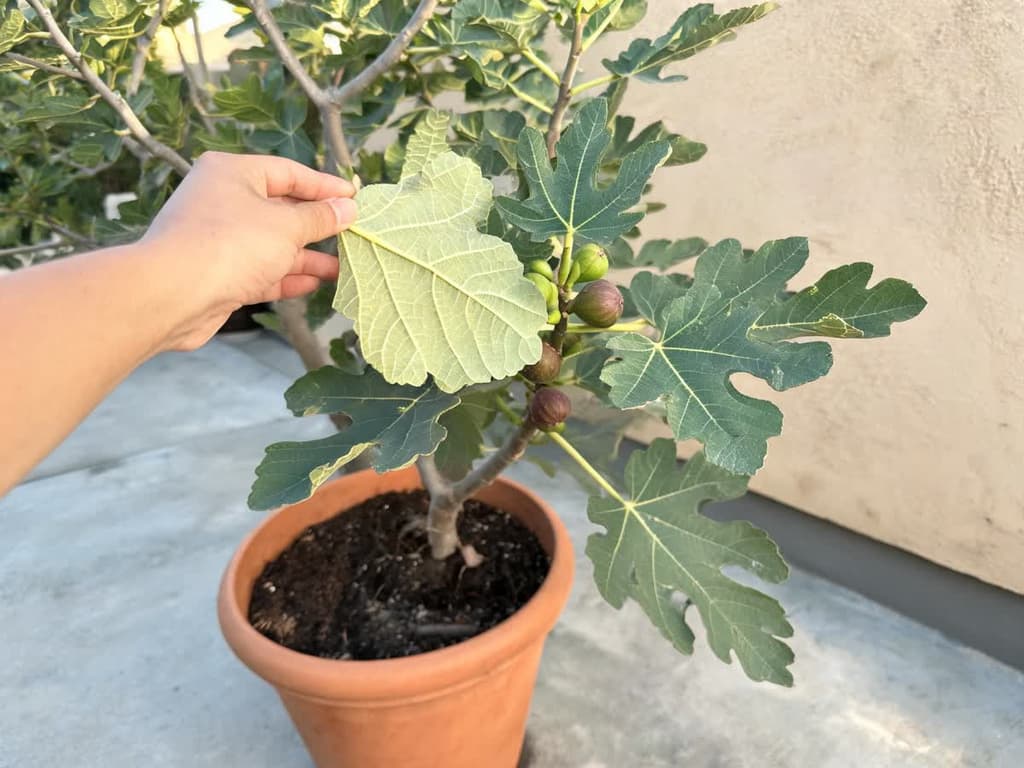
Fig tree pests are identified by where the sign appears: on the leaf, on the fruit, on the branch, or on the root. Leaf pests almost never kill a mature fig tree. The ones that cost you the plant or the harvest are on the branch (the borer), on the fig (the flies), and on the root (the nematode, a microscopic soil worm).
No leaf pest calls for cutting down the entire tree or uprooting the fig tree. Only two problems can force you to uproot the fig tree: root nematodes and fig wilt, a disease that kills the tree.
This guide covers the edible fig (Ficus carica), grown in large pots or in the backyard. Each pest comes with the sign that distinguishes it from similar ones and the treatment recommended by an agricultural extension or a research institute.
Quick summary:
Branch tips wilted and dry, with droppings held by webbing in a hole: fig borer. Cut the branch below the hole and burn or shred the piece.
Green figs that soften and rot with white larvae inside: fig fly. Collect fallen figs and stick an adhesive sticker over the opening at the tip of the green figs.
Leaves curled with white webbing and sections skeletonized down to the veins: leaf skeletonizer caterpillar. Crush the caterpillars inside the roll; mature trees tolerate the damage.
Leaves with light specks and fine webbing underneath: spider mites. Wash the underside of the leaves with a stream of water.
Sticky leaf with white grains and green scales along the veins, in spring: psyllid, a pest recorded in Europe. Wash with a stream of water; it goes away in summer.
Brown bumps or white cottony tufts on the stem and sticky leaves: scale. Remove with a brush and treat with oil when the fig tree is leafless.
Weak fig tree, leaves completely clean, with knots on the roots: nematodes. There is no cure; prevention relies on healthy saplings and clean soil.
Triage table: where the sign appears and which pest it indicates
Where to look | What you see | Likely pest | Where it occurs | Does it threaten the plant? |
|---|---|---|---|---|
Tips of new branches | Leaves and figs at the tip wilt and dry; hole with droppings held by webbing | Fig borer | Backyard | Yes, ruins the harvest |
Trunk and thick branches | Cracked bark that dries out and falls off | Trunk borer | Backyard | Yes |
Green or nearly ripe figs | Soft, rotting fruit with white larvae inside | Fig flies | Backyard | Does not kill the plant; ruins the harvest |
New leaves | Curled leaf with white webbing; areas scraped down to the veins | Leaf caterpillar | Backyard | No, on a mature tree |
Underside of the leaf | Light specks on the upper surface; fine webbing and tiny bugs underneath | Spider mite | Pot and backyard | Only under heavy infestation |
Stem and underside of the leaf | Brown bumps or white cottony tufts; sticky leaves and black spots | Scale | Pot and backyard | Weakens gradually |
Veins on the underside, in spring | Stationary green scales; leaf with white granules, like sugar | Fig psyllid | Backyard | No |
Root | Knots and swellings on the roots; weak tree with stunted growth | Nematode | Backyard and pots with garden soil | Yes, there is no cure |
The fiddle-leaf fig (Ficus lyrata) and weeping fig (Ficus benjamina) are also called figs, but they are different species, and the pests in this guide pertain to the fruiting fig tree. If you inherited a tree and do not know what it is, Bloom (available for iOS) identifies the species from a photo. With Premium, the app also compares a photo of the symptom against known pests and diseases.
Branch tip wilted and dry: fig borer
The fig borer is the caterpillar of a moth, Azochis gripusalis, and is one of the main fig tree pests in Brazil. According to EPAMIG Technical Circular 287, from 2018, it attacks the tips of young branches. The highest infestations in Brazil run from November to April.
The tip of the branch wilts and dries out starting from the attacked point, and the leaves and figs above that point dry up along with it. In the entrance hole, droppings and shreds of dry wood remain trapped by a web that closes the tunnel (gallery) where the caterpillar lives. The caterpillar is pinkish with spots along its back and a brown head, reaching up to 25 mm.
Treatment, according to EPAMIG, consists of pruning attacked branches below the gallery and burning or shredding these pieces. Do not leave cut branches on the ground: the caterpillar remains alive inside them. Embrapa Clima Temperado's Technical Circular 35 adds crushing the caterpillar inside the gallery and keeping the ground under the fig tree free of weeds.
In orchards in southern Minas Gerais, EPAMIG observed that plants with branch tips pruned every 30–35 days did not suffer borer attacks. EPAMIG recommends checking branches starting in November, when the moth begins laying eggs. On backyard fig trees, inspecting the tips during this period helps catch infestations early.
Cracked bark on the trunk: trunk borer
The trunk borer (Colobogaster cyanitarsis) is a beetle whose larva bores galleries directly beneath the bark of thick branches and the trunk. It leaves no sawdust on the outside. According to Embrapa, the frass stays trapped inside the gallery, swells with sap, and cracks the bark, which then dries up and falls off. The larva can reach up to 60 mm.
The home control method recommended by Embrapa is destroying the larva inside the gallery using a wire.
A fig tree that declines and dries up entirely may have fig wilt. Fig wilt is caused by a fungus that a small beetle carries from plant to plant. Embrapa directs uprooting the diseased plant and waiting 1 year before planting another fig tree in the same spot.
Figs with larvae or rotting before ripening: fig flies
In Brazil, the African fig fly (Zaprionus indianus) is the fruit pest. According to a 2002 technical bulletin from Epagri, the female lays eggs in the ostiole of the unripe fig. The ostiole is the "eye" of the fig, the small opening at the tip opposite the stem. The larvae enter the fruit, and it rots in a few days.
Damage can reach up to 80% of production, and the cycle from egg to adult takes under 20 days. The adult fly measures 2.5–3 mm, has red eyes, and features silver stripes across its back. It is attracted to overripe or bruised fruit.
Epagri recommends four measures, all suitable for home use:
collecting overripe, damaged, or bird-pecked figs from the ground and the tree;
burying or burning decomposing fruits and vegetables near the fig tree;
sticking an adhesive sticker over the "eye" of still-green figs, which prevents egg-laying without hindering the growth of the fruit;
bagging figs with waxed paper bags.
In Europe, other flies attack the fig. The RHS, the British horticultural society, lists the fig among the fruits attacked by Drosophila suzukii. This fly lays its eggs under the skin of near-ripe fruit. The RHS recommends traps, mesh netting smaller than 0.98 mm, and collecting overripe fruit. In Portugal, the INIAV fig tree good practice manual cites the black fig fly (Silba adipata), which destroys green figs. The manual also cites the Mediterranean fruit fly, which attacks the fig 2–3 weeks before it ripens.
Leaves curled with webbing and transparent patches: leaf skeletonizer caterpillar
The fig leaf skeletonizer caterpillar (Choreutis nemorana) is the caterpillar of a small moth of Mediterranean origin. The RHS has recorded the species in the United Kingdom since 2014, and the fig tree is the plant it attacks. The caterpillar is light green with tiny black dots and reaches up to 15 mm.
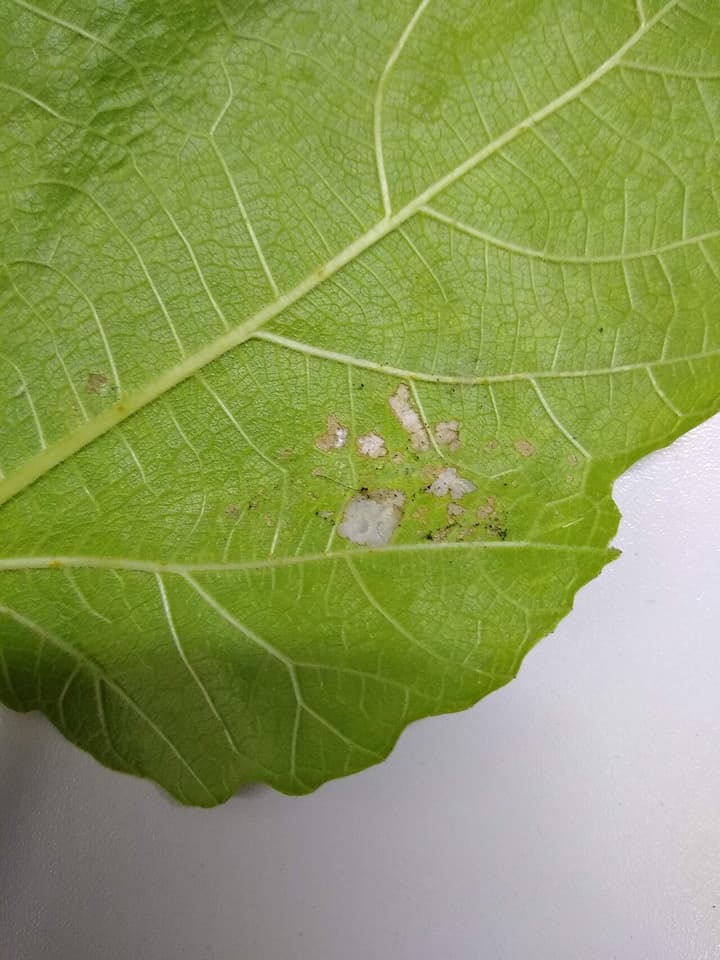
At first, the caterpillar scrapes the upper surface of the leaf, leaving pale patches. Later, it consumes the entire leaf between the veins, leaving only the veins behind. The caterpillar lives under a white web and ultimately folds the leaf margin to build a cocoon. There are two generations per year, and figs touching an infested leaf can also be scraped.
According to the RHS, damage from the fig leaf skeletonizer does not affect the health or vigor of an established fig tree. INIAV, in Portugal, notes that the pest has grown in importance in recent years and that treatment was not necessary. To reduce the number of caterpillars, the RHS recommends:
opening rolled leaves and webbing to crush caterpillars and cocoons;
inspecting the fig tree frequently to act before the population grows;
protecting figs with lightweight mesh bags.
Curled leaves without webbing and without droppings inside are not caused by caterpillars. In that case, check watering and heat before searching for pests.
Light specks and fine webbing underneath: spider mites on fig trees
The most common mite on fig trees is the two-spotted spider mite (Tetranychus urticae), a pest smaller than 1 mm that sucks sap from the leaf. According to the RHS, the upper surface of the leaf develops pale specks. On the underside, greenish-yellow mites with two dark spots appear, along with the white shed skins they leave behind as they grow. A 10x magnifying glass helps you see them.
Spider mites thrive in hot, dry weather. In severe infestations, a fine web appears, and the leaves lose color, dry out, and drop. The University of California pest management program notes that the attack starts on the lower leaves and that a tree properly watered and fertilized tolerates spider mites much better.
The first treatment is water. Wash the underside of the leaves with a stream of water and repeat whenever specks and webbing return. Additionally, for indoor potted fig trees, mist the leaves to maintain humid air around the plant. The RHS notes both measures against two-spotted spider mites.
There is another mite, the fig mite (Aceria ficus). According to the Pacific Northwest Plant Disease Management Handbook, it transmits the fig mosaic virus and overwinters in unopened buds. Its sign is that of mosaic: yellow spots and deformed leaves.
Bumps on stems and sticky leaves: scale on fig trees
Scale is a sap-sucking insect that stays stationary on the stem and underside of the leaf, covered by a waxy shell. According to the RHS, many species excrete honeydew, a sugary, sticky liquid. Sooty mold, a black fungus that soils the leaf, grows on the honeydew. Ants crawling up and down the fig tree are usually a sign of scale. According to the RHS, ants harvest honeydew from sap-sucking insects and even protect them from predators.
In orchard fig trees, Embrapa cites the scale insect Morganella longispina as an important pest in the producing municipalities of São Paulo. In Portugal, INIAV cites Ceroplastes rusci, common near olive groves. Both sources recommend spraying mineral oil (INIAV specifies paraffinic oil, a type of mineral oil) when the fig tree is leafless, after pruning and before budbreak. Follow the label dilution. With the fig tree in leaf, Embrapa considers control difficult.
The mealybug is the one that looks like cotton. According to the RHS, it first appears as tufts of white wax in leaf axils, and each insect is up to 4 mm long. UF/IFAS, from the University of Florida, cites mealybugs and ants among the most common insects on fig trees.
The RHS notes scale insects and spider mites as the primary issues for fig trees grown in greenhouses. The RHS also advises tolerating small infestations on a well-tended plant. When the bumps spread, remove the scale insects with a soft brush or a damp cloth and wash the sticky leaves with water.
Green scales along the veins in spring: fig psyllid
The fig psyllid (Homotoma ficus) is a small insect of Mediterranean origin that is easily confused with scale insects. According to the Gardening Academy of the state of Rhineland-Palatinate in Germany, the larvae form stationary green scales along the veins on the underside of the leaf. The upper surface develops white grains, as if the leaf were coated in sugar.
The psyllid has one generation per year. In mid-summer, adults leave the fig tree for other trees, such as oak and chestnut, and damage to the fig tree stops. The figs grow normally. Treatment consists of a strong jet of water on the underside of the leaves, which knocks off the larvae and washes away the honeydew. The same source notes that, in Germany, there is no registered product against the psyllid for home gardens.
Thrips on fig trees
Thrips are slender, small insects that scrape leaves. One thrips species is almost exclusive to fig trees, Pseudodendrothrips stuardoi, recorded in Brazil, Argentina, and Chile. According to an assessment by the California Department of Food and Agriculture, the only report of major damage dates back to 1930 in northern Chile. The assessment found no other reports of damage to fig trees since then, nor does it describe a sign unique to this thrips. With no studied treatment, the safest option for the plant is the same as for mites: a jet of water on the underside of the leaves.
Weak fig tree without leaf symptoms: root-knot nematodes
The root-knot nematode is a microscopic worm that lives in the soil and forms knots on the roots. According to the University of Georgia Extension, it is the leading cause of fig tree death in south Georgia, in the United States. To confirm, push back the soil and look at some of the fine roots. According to the same source, the knots and swellings cannot be confused with any other fig tree problem.
A fig tree with nematodes cannot be cured with chemicals. The University of Georgia recommends pruning the top of the tree so it is balanced with the weakened root system, as well as watering and fertilizing carefully, which prolongs its life. The source does not provide measurements for this pruning. The UF/IFAS, from the University of Florida, notes that the problem is worse in sandy soil and that mulch reduces the damage.
Prevention relies on planting material and soil. Embrapa recommends purchasing nursery stock from trusted sources and avoiding root suckers taken from old fig trees due to nematode risks. For potted fig trees, use fresh bagged potting soil rather than soil dug from vegetable plots or old garden beds.
Rust-colored powder on the underside of leaves: fig rust
Fig rust causes tiny yellow specks on the upper leaf surface and rust-colored powder on the underside. It is a fungus rather than an insect, so insecticides do not resolve it. How to identify and treat it is covered in the guide on yellow fig tree leaves.
Pests on indoor potted fig trees and backyard trees
On indoor potted fig trees or those in greenhouses, common pests include scale, mealybugs, and spider mites. Hot, dry air favors spider mites, according to the RHS. Potted fig trees can also acquire nematodes when the pot receives soil taken from vegetable gardens.
On backyard fig trees, borers, fig flies, leaf skeletonizer caterpillars, psyllids, and nematodes can also appear. A fig tree watered and fertilized properly tolerates spider mites better, according to UC IPM. Watering, fertilizing, and pruning the whole plant are covered in the guide on how to care for a fig tree.
Insecticides on home fig trees: when they are worthwhile
It is almost never worth it. Embrapa and EPAMIG mention insecticides, but for commercial orchards, with registered products and a pre-harvest interval. The pre-harvest interval is the minimum time between application and harvest. On a backyard fig tree, the fig is eaten soon, and the physical measures in this guide solve most cases. Oil against scale insects, when the fig tree is leafless, is the exception.
Frequently asked questions
What pest makes holes in fig tree leaves?
In Europe, the fig leaf skeletonizer caterpillar (Choreutis nemorana) is one of the leaf pests most cited by gardening sources. It skeletonizes the leaf down to the veins and lives under a white web. Mature trees tolerate the damage without treatment. Open the rolled leaves and crush the caterpillars to reduce the infestation.
Is there a wasp inside the fig?
No, not in the common-type fig tree. According to UF/IFAS, common-type varieties form the fig without pollination and do not need the pollinating wasp. Embrapa classifies Roxo de Valinhos, the most widely planted variety in Brazil, as common type.
Does neem oil get rid of fig tree pests?
None of the sources in this guide (Embrapa, EPAMIG, Epagri, INIAV, RHS) recommend neem oil for fig trees, so there is no evidence that it gets rid of pests. The substantiated option is mineral oil applied against scale when the fig tree is leafless. Yellow leaves with bugs that will not come off can indicate scale protected by a waxy cover. Fig rust and improper watering also cause leaves to turn yellow.
Do fig tree pests spread to other garden plants?
It depends on the pest. Two-spotted spider mites attack so many plants that, according to the RHS, few species are immune. Each scale species has its preferred host plants. The leaf skeletonizer caterpillar targets fig trees. Uprooting the fig tree does not protect the garden bed: treat the pest where it occurs.
The fig tree has an insect in the trunk. What should be done?
Cracking bark that dries out and falls off indicates the trunk borer, whose larva feeds beneath the bark. Embrapa recommends destroying the larva inside the gallery using a wire. If the fig tree declines and dries up entirely, it could be fig wilt. In that case, Embrapa directs uprooting the plant and waiting 1 year before planting another fig tree in that location.
What to do today with an infested fig tree
Examine your fig tree in four locations, in this order: branch tips, figs, leaf undersides, and the trunk. Wilted tips with droppings secured by webbing indicate borers: cut below the hole and burn the piece. Soft, green, wormy figs indicate flies: collect fallen figs and tape over the eye opening on new figs.
Leaves with webbing, specks, or small bumps call first for water, a brush, and your hands. Horticultural oil is reserved for scale once the fig tree drops its leaves. If the fig tree declines without any leaf symptoms, dig down and examine the roots for knots.
Related articles

How to Care for Hibiscus: Sun, Watering, Fertilizer, and Pruning for Flowers
How to care for hibiscus: 6 hours of direct sun, evenly moist soil without waterlogging, half-strength fertilizer in spring and summer, and pruning in early spring. Find out why the flower lasts one day and why buds drop before opening.

Do Ferns Like Sun or Shade? It Depends on the Type
Ferns prefer bright shade: plenty of light, but no direct sun on their fronds. Tuberous sword fern is the exception that handles sun. Here is the ideal light for each type, where to place pots, and how fronds show too much or too little light.

African Violet Yellow Leaves: Causes and What to Do
Yellow leaves on an African violet usually stem from overwatering, and the first place to check is the center of the plant. Losing one lower leaf at a time is normal. Identify whether age, watering, cold water, sunlight, cold drafts, or fertilizer is the culprit based on the yellowing pattern, and see what to do today.