Gardenia buds turning black and falling off before opening: causes and what to do
Gardenia buds turning black and falling off before opening are almost always cultural stress, and sometimes thrips or fungus. Learn how to tell causes apart by the bud itself and what to do today.
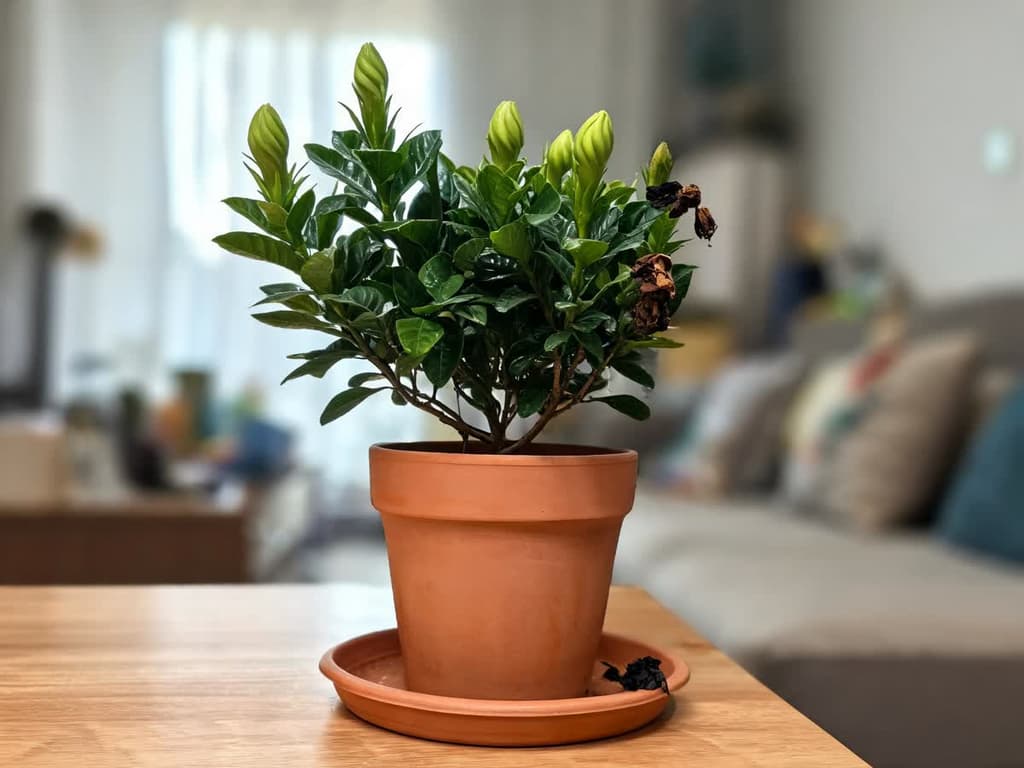
Gardenia buds turning black and falling off before opening are, most of the time, a sign of cultural stress. Cultural stress is anything in the care or environment that the plant cannot tolerate. The plant drops buds when watering fluctuates, when it moves to a new spot, when nights get too warm, or when the air gets dry. Thrips, tiny insects that attack the bud from the inside, and a fungus called gray mold also cause bud drop.
The plant can almost always be saved. A bud that has turned black will never open, but buds that are still green and firm can open if the cause is corrected right now. Clemson, a university in the United States, treats bud drop as a cultural problem rather than a disease.
The sources for this guide come from university extension services in the United States, university programs that advise the public on plants. They also include two botanical gardens: New York (NYBG) and Missouri (MOBOT). They also include a study published in Acta Horticulturae. These sources are from the Northern Hemisphere: months cited with "in Brazil" have already been converted for here. In English, the loss of buds appears as bud drop or bud blast.
What to do today about black gardenia buds
When faced with black buds on your gardenia, do not cut off all the buds. Follow these four steps on the same day:
Remove only the black, dried, or soft buds, and collect any that have fallen into the pot or onto the ground.
Pry open two or three of these buds with your fingernail over a sheet of white paper, and look inside with a magnifying glass if you have one.
Do not repot the plant or move it to a different spot while it still has green buds.
Stick your finger into the soil and water only when it feels dry down to 1 cm deep. Water until it runs out the drainage hole of the pot.
In step 2, what appears inside the bud separates stress, thrips, and fungus, and each cause calls for a different fix.
Throw the collected buds into the trash, not into the compost bin. The University of Kentucky recommends destroying diseased plant parts when gray mold is present, because the fungus survives in plant debris.
What a black gardenia bud reveals inside
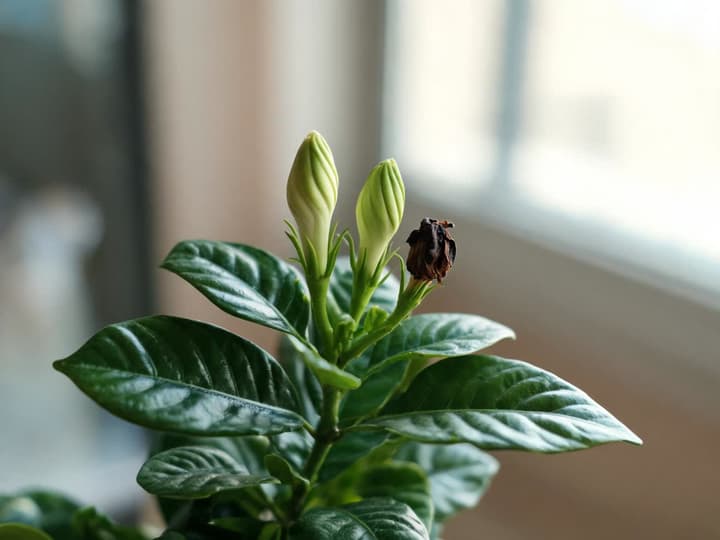
None of the consulted sources separates a brown bud from a black bud. A dying bud darkens, and color alone does not point to the cause. What reveals the cause is the texture of the bud and what appears inside it.
What you see | Probable cause | What to do |
|---|---|---|
Dry, crispy bud, clean inside, several falling at the same time | Cultural stress: watering, moving the pot, warm nights, dry air, or low light | Adjust watering, spot, nighttime temps, dry air, and light (sections below); no product fixes this |
Slender, dark insects up to 1.6 mm long crawling on the white paper; inner petals darkened or distorted | Thrips | Remove attacked buds; use insecticide only if the attack continues |
Darkened bud covered in fuzzy gray to light-brown mold during humid weather | Gray mold (botrytis) | Remove and discard diseased buds; allow air to circulate between plants without direct drafts; do not wet the buds |
Clusters of tiny insects on new shoots and at the base of the bud | Aphids | Insecticidal soap or horticultural oil |
Aphids cluster on new shoots, leaves, and buds, according to Clemson. UF/IFAS recommends insecticidal soap or horticultural oil, and our guide on aphids on plants shows how to recognize the insect.
When the bud is dry and clean inside, the cause lies in the plant's environment: watering, location, temperature, air humidity, light, or fertilizer.
Thrips on gardenia buds
Thrips are dark, slender insects with fringed wings and measure less than 1.6 mm long. According to Clemson's gardenia pest factsheet, they hide between the petals and scrape the tissue to suck sap. One of the symptoms listed by Clemson is buds dying before they open.
Thrips are so small that you can barely see them with the naked eye, and the damage usually appears before the insect does. Clemson teaches three tests. Hold a stiff sheet of white paper under the bud and tap the bud lightly with your finger: in sunlight, thrips crawl across the paper. Blowing into the flower also makes thrips move. A magnifying glass focused on new shoots helps spot the insect.
UF/IFAS, the extension service of the University of Florida, lists thrips among the pests that cause the most damage to gardenias. Thrips also cause open flowers to turn brown prematurely.
Start by removing attacked buds and any that have fallen. If thrips return to the new buds, use a systemic foliar insecticide, which the plant absorbs through the leaf. Clemson says it controls thrips inside the bud better. Spinosad is one of them. Contact insecticide, which only acts on the insect it touches, does not reach thrips hidden inside the bud. Use only a product registered for ornamental plants and follow the label. Clemson advises repeating the application in 7 to 10 days, if necessary.
Gray mold (botrytis) on gardenia buds
Gray mold is caused by the fungus Botrytis, which attacks the bud during humid weather. According to the University of Kentucky, the fungus can kill buds suddenly before they open. The diseased tissue becomes covered with a fuzzy, gray to light-brown mold. Kentucky's factsheet addresses the fungus across many plants and is not specific to gardenias.
The fungus requires high humidity and mild temperatures. Kentucky's factsheet lists the ideal humidity for infection at 90%, or 80% when plant tissue is wounded. The optimal temperature for the fungus ranges from 15.5 to 24 °C, and infection stops occurring above 29 °C.
Remove diseased buds and flowers as soon as they appear, and throw everything into the trash. Kentucky recommends removing spent flowers as well, as they feed the fungus. Water directly at the soil in the morning so the plant dries before nightfall. NYBG notes that standing water droplets on the bud stain the flower and encourage fungi, so do not mist the buds with water.
Newly purchased gardenia dropping buds
A newly bought gardenia drops buds because it came out of a greenhouse with a controlled climate. NYBG states that simply changing locations can cause buds to drop, and that any sudden change can trigger bud drop. The most frequent cause, according to NYBG, is high indoor temperatures.
Leave the gardenia in the pot it arrived in. NYBG says repotting right after purchase causes flower drop. Horticulturist Melinda Myers gives the same advice: repotting stimulates new foliage and delays blooming.
A plant that spent the summer outdoors will also drop buds when brought back inside. NYBG explains that light levels indoors are lower and nighttime temperatures do not drop as they do outside. For this plant, NYBG recommends 6 to 8 hours of sunlight per day and nights that are 5.5 to 8 °C cooler than daytime temperatures. The NYBG care sheet calls for a difference of up to 5.5 °C. A night roughly 5.5 °C cooler meets both guidelines.
Irregular watering and soil drying out between waterings
Both overwatering and underwatering cause bud drop, according to Clemson and UF/IFAS. Poorly draining soil causes bud drop as well. Watering heavily one week and lightly the next forces the soil to swing between waterlogged and bone-dry, and that fluctuation is the stress factor.
Trade the calendar for the finger test. In a container, NYBG instructs watering when the top 1 cm of soil feels dry to the touch. Water until water drains out the bottom hole, and after 15 minutes, empty any standing water left in the saucer.
The finger test tells you the right moment in any season. On hot, dry days, potted soil dries out faster, and the next watering arrives sooner. In the garden, Clemson directs watering gardenias once a week during summer dry spells.
Warm nights, unseasonal cold, and dry air
Among environmental causes, nighttime temperatures vary the most from one source to another. Here are the ranges:
NYBG: nighttime temperatures between 15.5 and 17 °C while buds are forming, with daytime temperatures no more than 5.5 °C higher.
MOBOT: 15.5 to 18 °C is ideal for bud formation; with nighttime temperatures above 21 °C, buds drop; below this range, buds emerge malformed.
Clemson: nighttime temperatures of 10 to 13 °C for garden gardenias to set buds.
Makridou and Economou study (2000): in growth chambers, enclosed rooms with controlled light and temperature, young plants subjected to nighttime temperatures of 12, 18, and 24 °C formed buds at all three temperatures.
These ranges measure two different things. The study measured whether buds form at all, not whether they drop afterward. Dropping is what MOBOT, NYBG, and Clemson describe. No source has measured bud drop under strictly controlled conditions. This guide follows the threshold from MOBOT, the only source providing a specific number for bud drop: keep nighttime temperatures below 21 °C while buds are present.
Cold temperatures also trigger bud drop. Clemson cites unusually cold weather and rapid temperature drops, and UF/IFAS also lists unseasonably cold weather. In the garden, a cold snap following warm days can cause buds to fall. Indoors, keep the plant away from air conditioners, heaters, and exterior doors (NYBG).
Dry air causes buds to turn brown and drop, while leaf tips dry out. NYBG says potted gardenias suffer when relative humidity falls below 60%. Dry air also attracts the spider mite, which leaves yellow stippling on foliage and fine webbing on branches.
To raise humidity, place a wide pebble tray filled with water under the pot, keeping the water level below the pot's base. This tray is completely separate from the watering saucer, where water must never sit stagnant. A humidifier near the plant also works. A hygrometer, an inexpensive tool that measures humidity, shows whether your plant stays above 60%.
Low light and excess fertilizer
Without enough light, gardenias do not form flowers (NYBG), and Clemson lists low light among the causes of bud drop. Gardenias flower best with morning sun and afternoon shade, according to Clemson. Indoors, choose the brightest window in the house once and leave the plant there. In Brazil, a north-facing window receives the most sun.
Overfertilizing also triggers bud drop, according to Clemson and UF/IFAS. MOBOT warns that too much fertilizer leads to salt buildup in container soil. MOBOT recommends flushing these salts periodically by watering thoroughly until plenty runs out the drainage hole, without specifying a set frequency. The safest method is to do this during a normal watering once the top 1 cm dries, emptying the saucer after 15 minutes.
What does not work against bud drop
Clemson states that no chemical spray is recommended for bud drop. Neem oil, fungicides, and foliar fertilizers do not prevent buds from falling when the cause is environmental.
Applying fungicide with no visible gray mold: a dry bud that is clean inside has no fungus to treat.
Using contact insecticide against thrips: it cannot reach pests sheltered deep inside the bud, and Clemson warns it kills natural predators of thrips.
Misting buds with water: standing water droplets stain petals and encourage fungal infections (NYBG).
Repotting to "help": repotting triggers flower drop (NYBG).
Moving the plant daily to find the perfect spot: every shift introduces fresh stress (NYBG).
Not sure if what is on your bud is a pest or a fungus? Bloom (available for iOS) identifies plants from a photo and, on the Premium plan, provides a diagnosis of the problem.
How to get a gardenia to bloom again with buds that open
To bloom again, a gardenia needs light, stable nighttime temperatures, fertilizer formulated for acid-loving plants, and pruning at the right time. Acid-loving plants thrive in acidic soil, like azaleas and camellias.
Short days help the bud form. In Makridou and Economou's study, plants with 8 or 12 hours of light formed more buds than plants with 16 hours. Indoors, buds usually form in the fall and winter, according to NYBG. In Brazil, this period runs from March to August.
Use fertilizer formulated for acid-loving plants at half the package dose every 2 to 4 weeks during the growing season (NYBG). In Brazil, this season runs roughly from September to March. Do not fertilize in the fall: Clemson states that fertilizer during this season stimulates tender shoots, which the cold kills.
Prune right after flowering ends. Clemson and UF/IFAS advise pruning at this time. UF/IFAS says that heavy pruning after early fall reduces the following year's flowering. In Brazil, that means avoiding heavy pruning starting in April.
NYBG shares a tip to prevent bud drop: pinch out the new vegetative shoot that emerges right beside a developing flower bud. According to NYBG, this directs the plant's energy straight into the bud. Camellias, another acid-loving shrub, also drop buds from water stress and cold. Our guide on camellia buds falling off outlines the same fix for a different plant.
Frequently asked questions
Does a black gardenia bud contaminate other buds?
It depends on the cause. A bud that dried out from cultural stress cannot spread anything to others. Thrips stay on the plant and feed on buds and tender leaves (Clemson). With gray mold, an infected bud can trigger infections on other parts of the plant (Kentucky). Remove diseased buds as soon as you spot them and throw them in the trash, not the compost.
Can I use standard flower fertilizer on my gardenia?
Yes, if diluted. Melinda Myers recommends any houseplant blooming fertilizer at a weak dilution, preferably one formulated for acid-loving plants. MOBOT suggests an acidic fertilizer applied at half strength. Acid-loving plant fertilizer is best because it helps keep the soil acidic, which gardenias prefer.
Should I mist my gardenia with water to raise humidity?
Not on the buds or open flowers. NYBG warns that standing water droplets on buds stain petals and foster fungal diseases, such as gray mold. To raise air humidity, set a wide tray filled with pebbles and water beneath the pot or place a humidifier nearby.
How long does a gardenia take to form new buds?
None of the consulted sources measures this timeframe. In the meantime, keep the plant in the same spot, water using the finger test, and keep nights below 21 °C. Indoors, NYBG says buds usually form in the fall and winter. In Brazil, this period runs from March to August. The study by Makridou and Economou showed that short days, with 8 to 12 hours of light, help buds form.
Conclusion
Black buds dropping before opening are almost always caused by cultural stress, and your gardenia is still very much alive. Snip off black buds and pry open two or three over white paper. If the bud is dry and clean inside, fix the environment: water using the finger test, keep the plant in one stable spot, maintain nights below 21 °C, and keep humidity above 60%. Thrips and gray mold require clearing away affected buds before reaching for any treatment.
Sources
Clemson Cooperative Extension. Gardenia diseases and other problems (HGIC 2058), 2026; Scott, J. M.; Williamson, J. Gardenia insects and related pests (HGIC 2059), 2026; Gardenia (HGIC 1065), 2024.
UF/IFAS Extension. Park Brown, S.; Bradshaw, J. Gardenias at a glance (EP338).
New York Botanical Garden. Gardenia (Gardenia jasminoides): houseplant care, 2026; Why do the buds of my gardenia fall after bringing it in from summering outdoors?
Missouri Botanical Garden. How do I care for my gardenia?
University of Kentucky. Gauthier, N. et al. Botrytis blight (PPFS-GEN-19), 2021.
Makridou, E. P.; Economou, A. S. Flower initiation and development in gardenia plants as affected by photoperiod and night temperature. Acta Horticulturae 515, 2000.
Myers, M. Flower buds falling off gardenia.
Related articles

How to Care for Hibiscus: Sun, Watering, Fertilizer, and Pruning for Flowers
How to care for hibiscus: 6 hours of direct sun, evenly moist soil without waterlogging, half-strength fertilizer in spring and summer, and pruning in early spring. Find out why the flower lasts one day and why buds drop before opening.

Do Ferns Like Sun or Shade? It Depends on the Type
Ferns prefer bright shade: plenty of light, but no direct sun on their fronds. Tuberous sword fern is the exception that handles sun. Here is the ideal light for each type, where to place pots, and how fronds show too much or too little light.

African Violet Yellow Leaves: Causes and What to Do
Yellow leaves on an African violet usually stem from overwatering, and the first place to check is the center of the plant. Losing one lower leaf at a time is normal. Identify whether age, watering, cold water, sunlight, cold drafts, or fertilizer is the culprit based on the yellowing pattern, and see what to do today.