Gardenia Pests: Scale, Aphids, and Sooty Mold
Diagnose gardenia pests by the sign you see: black soot, white cotton in leaf axils, scale armor on stems, or stippled leaves. Learn which pest it is, how to get rid of it, and why it returns after treatment.
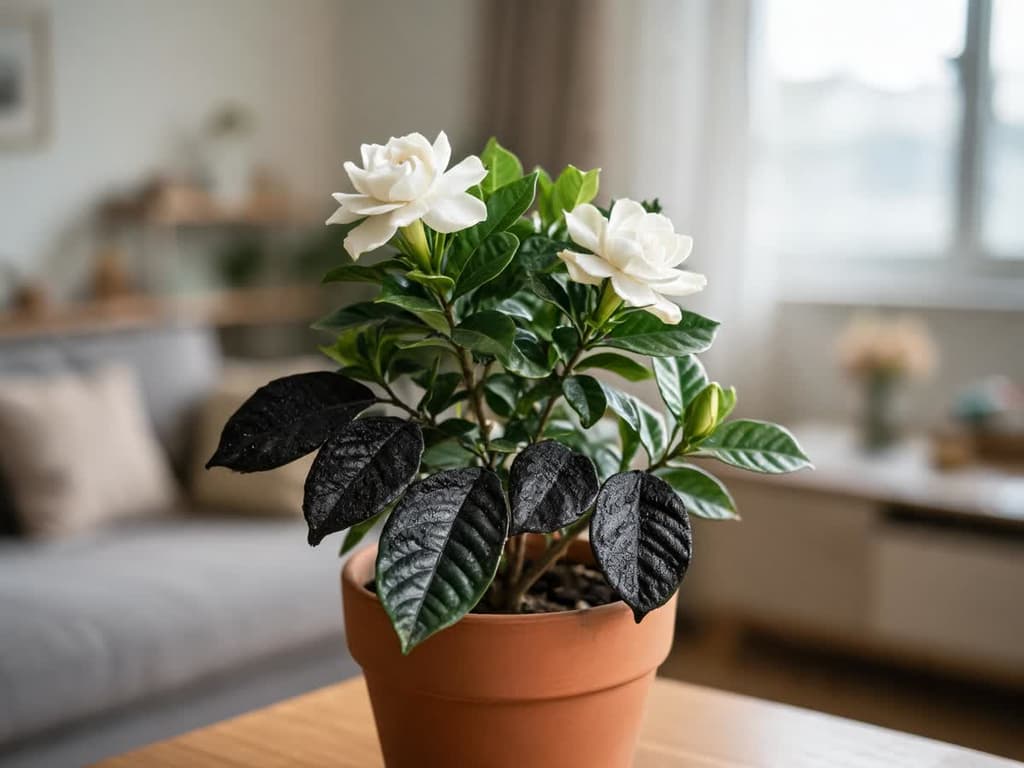
Gardenia pests (Gardenia jasminoides) are almost always sap-sucking insects: scale, aphids, and whiteflies. The black, sticky soot on the leaves is sooty mold, a fungus that grows on the sugary liquid these insects secrete. It does not attack the leaf from the inside. Treat the insect, and the soot disappears over time.
You can treat a gardenia without throwing it away. Clemson, a university extension in South Carolina, provides treatments for whiteflies, aphids, and armored scale, calling sooty mold "primarily a cosmetic problem." What matters is the insect behind it and how long it remains untreated.
Which pest is on your gardenia: identify by the sign
Each sign you see on the plant points to a specific group of pests and tells you where to search for the insect.
What you see | Likely pest | Where to look |
|---|---|---|
A black, soot-like layer on top of leaves, plus sticky foliage | Sooty mold, a sign of sap-sucking insects | Under the leaves and on branches above the black coating |
White, cottony tufts in the leaf axils | Mealybugs | Leaf axils, branch bases, and undersides of leaves |
Brown shields or white wax bumps attached to stems | Scale insects | Thin stems, branches, and the underside midribs of leaves |
A cloud of tiny white flies taking flight when you touch the plant | Whiteflies | Under leaves, where motionless nymphs remain attached |
Curled new growth tips with clusters of green or black bugs | Aphids | New shoots, flower buds, and tender young leaves |
Stippled leaves with yellow dots and fine webbing underneath | Spider mites | Under leaves, viewed with a magnifying glass |
Buds that die before opening and browning petals | Thrips | Between petals and inside developing buds |
Dark, sunken lesions on the stem near the soil line | Canker, a fungal disease | Base of the main stem |
Ants marching up and down your gardenia are another key sign. Ants feed on the sugary honeydew. For this reason, UF/IFAS, the University of Florida extension, recommends inspecting the plant for scale whenever ants are present.
The gardenia pests page in the Bloom catalog provides descriptions of aphids, whiteflies, and mealybugs along with photos of each pest.
Sooty mold on gardenias: black soot comes from an insect
Sooty mold is a black fungal coating that feeds on the sweet excretion left behind by sap-sucking pests. This liquid is called honeydew. According to Clemson, the fungus does not infect the gardenia's internal plant tissues. It simply resides on the leaf surface, consuming the honeydew.
The pests that produce honeydew on gardenias include aphids, mealybugs, soft scales, and whiteflies, based on Clemson's list. NC State Extension (North Carolina) notes that gardenias heavily infested with whiteflies and blackened by sooty mold often suffer premature leaf drop.
How to confirm that black spots are sooty mold
Wipe a dampened paper towel across a blackened leaf. Clemson describes sooty mold as a layer that can typically be wiped or peeled away, revealing healthy tissue beneath. If the black residue wipes off cleanly to show an undamaged green leaf underneath, it is sooty mold.
If the black mark does not rub off, the issue lies inside the leaf tissue itself rather than being sooty mold. The gardenia leaf spots page lists the causes behind that symptom.
Sooty mold vs. sunburn on gardenias
Sticky foliage is a sign of honeydew, and honeydew comes from sap-sucking insects. If the black mark rubs off on a damp paper towel, it is sooty mold, even if the plant just went into the sun. Moving the gardenia into full sun does not solve sooty mold, because the fungus comes from honeydew, not from a lack of light. To care for a gardenia, Clemson recommends light shade to partial shade, preferably with morning sun and afternoon shade. UF/IFAS also accepts full sun. During treatment, keep the gardenia in partial shade, because soap and oil burn the foliage in full sun.
Intense sun can also ruin your treatment efforts. NC State Extension advises against applying insecticidal soap (a specially formulated plant soap that kills target pests on contact) in direct sunlight or when temperatures exceed 32 °C (90 °F), as the foliage can burn.
How to clean sooty mold off leaves
Wipe down foliage using a damp cloth, just as the RHS (Royal Horticultural Society in the UK) advises for aphid-related sooty mold. Support each leaf with the palm of your hand and gently wipe across its surface without bending or creasing it.
Insecticidal soap cleans the foliage as well. NC State Extension notes that it removes both honeydew and sooty mold. Horticultural oil (a plant-safe oil diluted in water that suffocates insects) helps loosen the black crust, allowing the sooty mold to weather away faster over time, according to NC State.
Cleaning the foliage is purely cosmetic. Without tackling the insect problem, honeydew will accumulate again and sooty mold will quickly return. Once the insect population is controlled, sooty mold typically flakes off and disappears on its own over time, according to UF/IFAS.
Whiteflies on gardenias
Clemson states that whiteflies are the single most common gardenia problem across South Carolina. Mississippi State writes that the citrus whitefly (Dialeurodes citri) is "especially common on gardenias." Adult whiteflies measure 1.6 to 2.5 mm, are powdery white, and resemble tiny moths.
The most obvious clue is the white cloud that flutters up whenever you disturb the branches. Clemson describes how adults fly up briefly before settling back down. The immature stage (nymph) is flattened, pale green, scale-like, and completely immobile. NC State measures these stationary scales at about 1.5 mm, tucked against the undersides of the foliage.
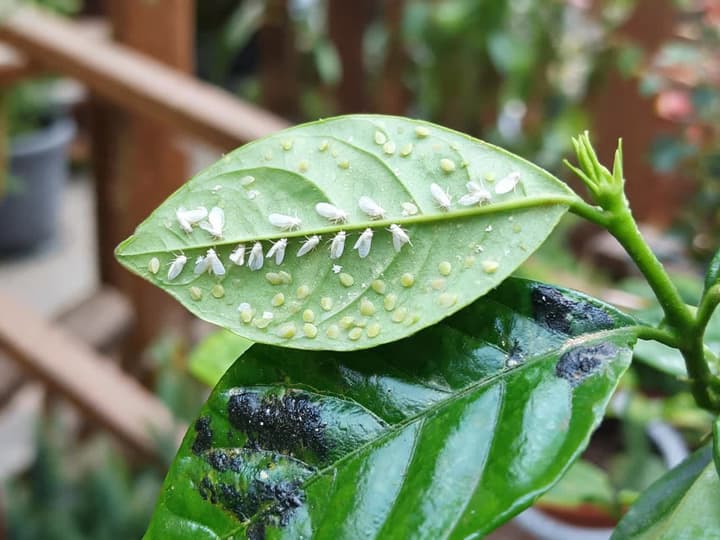
For light infestations, Clemson suggests insecticidal soap or horticultural oil. Cover both sides of the leaves thoroughly and repeat 3 times, leaving 5 to 7 days between each application. Iowa State Extension warns that on indoor houseplants, soaps and neem oil (an extract from the neem tree used as a natural insecticide) often work less effectively against whiteflies than expected. They recommend several weekly applications, making sure to coat the leaf undersides every time.
Mealybugs on gardenias: white cottony tufts
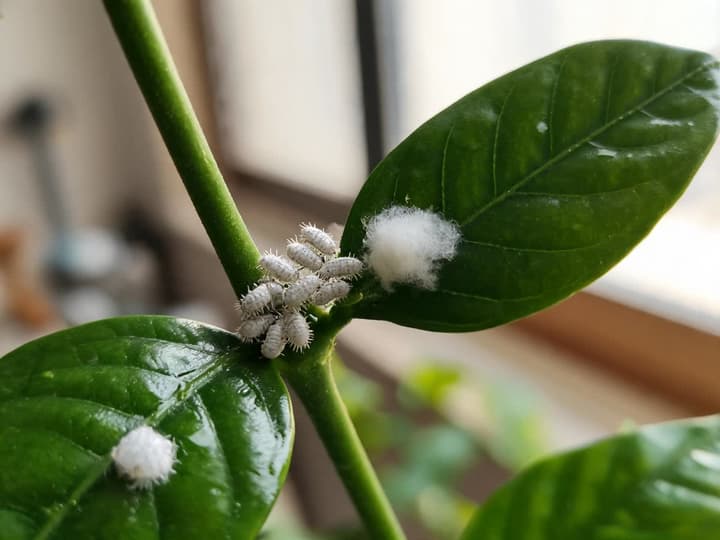
Mealybugs are small, oval-bodied insects blanketed in white wax that looks like cotton fluff or flour. The RHS states they are usually first noticed as a white tuft tucked into leaf axils, the joint where the leaf connects to the stem. UF/IFAS lists mealybugs among typical gardenia pests.
Mealybugs know how to hide. NC State Extension notes that small colonies of mealybugs easily go unnoticed. They squeeze into tight crevices across the plant, frequently congregating around the base of branches. When the initial egg clutches hatch, a full-blown infestation seems to appear all at once.
How to remove mealybugs from your gardenia
If only a few insects are present, pick them off by hand. Iowa State recommends dipping a cotton swab in rubbing alcohol and touching it directly to each insect and cottony egg cluster. They note that no single method eliminates 100% of mealybugs, so manual removal should always be paired with an insecticidal spray.
For indoor plants, Iowa State points to insecticidal soap, neem oil, and pyrethrin (a botanical insecticide extracted from chrysanthemum flowers) as relatively safe options. Apply treatments weekly, because sprays target juvenile crawlers best, which hatch every few weeks. Our article on scale insects breaks down the various scale types and how they present on houseplants.
Armored scale on gardenias: tiny shields on the stem
Scale insects blend seamlessly with plant stems. Clemson notes that they are frequently mistaken for the bark itself or confused with fungal diseases. The mature adult female has no visible legs and cannot walk. She remains protected beneath a waxy shell whose appearance and color vary by species.
They fall into two distinct groups, and the difference changes the symptoms you see on the leaves:
Soft scale: the protective wax layer is fused directly to the insect's body. Soft scales excrete honeydew, meaning they are frequently accompanied by sooty mold. On gardenias, NC State highlights the Japanese wax scale, which forms white, waxy lumps up to 6 mm across on the stems.
Armored scale: the hard shell is separate and can be lifted off to reveal the bug beneath. Armored scales do not secrete honeydew and do not cause sooty mold. Clemson cites tea scale (Fiorinia theae), which settles on the undersides of leaves.
How to treat scale insects
Scrape off light infestations using a fingernail. Prune out heavily infested branches and throw them away, as advised by Clemson. To verify whether a scale insect is still alive, UF/IFAS recommends crushing it: dead scales are dry and brittle, whereas living scales release moisture.
The hard protective shell shields adult scales from most contact sprays (products that only kill insects they physically touch). The life stage easiest to control is the mobile newly hatched crawler. Horticultural oil is the exception: Clemson notes that it controls all life stages of armored scale on gardenias and works against soft scale as well.
Clemson's seasonal schedule for applying horticultural oil:
Apply in early spring (March or April, in the Northern Hemisphere).
Apply a second spray once new spring foliage begins to unfurl.
Follow with 2 more spring applications, spacing them 5 to 6 weeks apart.
Clemson recommends a 1% oil dilution for tender new growth, which equates to roughly 10 mL per liter of water. On mature leaves, use a 2% dilution, approximately 20 mL per liter. Spray when ambient temperatures fall between 7 °C and 32 °C (45 °F and 90 °F) in the late afternoon, ensuring no rainfall is forecast within the next 24 hours. Always prioritize the instructions on your specific product label over these general ratios.
Aphids on gardenias: curled tender shoots
Aphids are soft-bodied, pear-shaped insects measuring roughly 3 mm in length. On gardenias, they can appear green, yellow, pink, or black, congregating in clusters on tender shoots, flower buds, and juvenile foliage, according to Clemson. Classic damage includes twisted, curled terminal shoots and reduced flower development.
To start, dislodge aphids using a strong blast of water across both upper and lower leaf surfaces, repeating the spray whenever you spot them returning. This is Clemson's primary recommendation. If water sprays fail to control them, Clemson suggests insecticidal soap or horticultural oil. The RHS prefers avoiding chemical pesticides, recommending that gardeners simply crush aphid colonies with their fingers. For gardenias, prioritize Clemson's advice, as their guidance is written specifically for this plant. Both contact sprays must directly hit the pests to work: apply 3 treatments, spaced 5 to 7 days apart.
Aphids reproduce at a rapid rate. Clemson cautions that a single surviving aphid can rebuild an entire colony, explaining why pests often bounce back after a seemingly successful cleanup. Our guide on aphids on plants explains how to spot infestations and leverage natural aphid predators.
Ants on gardenias: control ants alongside the pests
Ants actively protect aphids. Clemson notes that ants feed on the excreted honeydew and chase off natural predators that would otherwise consume the aphids. For this reason, if ants are present, you must manage them at the same time. UF/IFAS adds that ants transport sap-sucking pests to new plants, establishing fresh infestations elsewhere.
Spider mites and thrips: speckled foliage and stunted buds
Spider mites are not true insects. They are arachnids related to spiders, featuring eight legs and measuring approximately 0.5 mm in length. Clemson identifies the two-spotted spider mite (Tetranychus urticae) as the primary spider mite infesting gardenias in South Carolina. They produce yellow or white stippling on top of the leaves along with fine silken webbing underneath.
To check for them, hold a sheet of plain white paper under a branch and tap the stem firmly. Clemson explains that if mites are present, wiping your hand across the paper will leave reddish streaks. Spray the undersides of the foliage with a firm jet of water, repeating the process as long as live mites show up on the paper test. For indoor houseplants, Iowa State points out that boosting ambient humidity suppresses spider mites, which thrive in dry air. Our article on spider mites details the plant damage they cause.
Thrips are slender, dark insects measuring under 1.6 mm, making them tricky to spot without magnification. On gardenias, they attack flower buds and petals. Clemson notes symptoms such as buds that wither without opening, deformed brown blossoms, silvery streaks on leaves, and reddish-purple spotting underneath juvenile leaves. To detect thrips, shake an affected blossom over white paper: if thrips are present, you will see them crawling across the sheet. Clemson recommends avoiding contact insecticides for thrips, because these products kill beneficial predators that naturally keep thrips in check.
Why gardenia pests return after treatment
Pests return because contact sprays like insecticidal soap and horticultural oil only kill the insects they directly hit during application. UF/IFAS notes that the dry residue left behind has no lingering insecticidal power. Sheltered eggs and tucked-away nymphs survive, rebuilding the population just a few days later.
Clemson advises 3 applications spaced 5 to 7 days apart to eliminate whiteflies and aphids, spanning a 10- to 14-day total treatment window. For scale and mites on indoor plants, Iowa State recommends weekly treatments for 4 to 6 weeks. Mealybugs prove especially stubborn: NC State explains that their eggs remain shielded inside an almost water-repellent waxy casing.
Check these factors before assuming your product does not work:
Undersides of leaves: whiteflies, mites, and many scale species live there. Without wetting the underside, the product does not contact the insect.
Hidden spots: mealybugs crawl into deep leaf axils and nestle at branch bases.
Ants: they defend aphids and transport sap-sucking insects back onto the plant.
Overhead and neighboring plants: Clemson reminds growers that honeydew can drip from an infested tree or tall shrub growing above your gardenia. In those cases, the gardenia turns black with sooty mold without harboring any insects of its own.
Excessive fertilizer: UF/IFAS reports that scale insects lay significantly more eggs on plants fed high doses of nitrogen.
Can you use kitchen dish soap on gardenia pests?
It works, provided you proceed with caution. UF/IFAS accepts mild liquid dish soap when commercial insecticidal soap is unavailable. Their suggested outdoor shrub rate is 3 tablespoons (45 mL) per gallon (3.8 liters) of water, which works out to about 12 mL per liter. Never use dish soaps formulated with heavy degreasers or automatic dishwasher detergent, cautions UF/IFAS. Repeat weekly until the pests are gone.
Always test homemade soap mixtures before spraying the entire gardenia. UF/IFAS suggests treating a small section of the plant and waiting 24 hours to monitor for leaf scorch. Clemson emphasizes that soaps and oils are far more likely to burn gardenias suffering from water stress. Water thoroughly the day before, and apply sprays in the late afternoon when temperatures stay below 32 °C.
What Clemson says about systemic insecticides
A systemic insecticide is absorbed into plant vascular tissues, killing pests as they ingest the sap. Clemson mentions soil drench applications of imidacloprid and dinotefuran to control whiteflies on gardenias, adding that dinotefuran also manages scale insects. NC State notes that imidacloprid will not control armored scale.
Imidacloprid comes with drawbacks for pollinating insects. LSU, the Louisiana State University Agricultural Center, notes that imidacloprid raises concern because the active chemical makes its way into pollen and nectar. Consequently, several product labels forbid applications prior to or during bloom, and gardenias are grown specifically for their flowers. For mild infestations, Clemson points first to contact soaps or oils, which leave minimal residue and preserve beneficial insects. If you choose a systemic treatment, follow all label directions and confirm the formula is approved for gardenias.
Canker and other non-pest diseases
Stem canker is caused by the fungus Phomopsis gardeniae, which invades the plant through stem wounds, according to Clemson. Lesions usually appear near the soil line: dark, oval or elongated, sunken, and bordered by raised margins. Over time, the infected area may swell. Affected plants wilt partially or completely, foliage turns dull gray-green, and unopened flower buds drop off.
Clemson states that chemical fungicides typically fail to cure canker in home gardens. The most effective approach involves preventing physical damage to the trunk and pruning away diseased stems. Disinfect pruning shears between every single cut using 70% rubbing alcohol or a 10% bleach solution (1 part bleach to 9 parts water). Water directly at the root zone, avoiding splashing the main stems.
Powdery mildew is another common fungal issue: it forms a white-to-gray powdery film across leaves and fresh shoots, curling foliage and stunting buds, according to Clemson. It tends to flare up during summer when humid, stagnant air surrounds the shrub. Our guide to fungus on gardenias outlines the full list of fungal diseases affecting this plant.
Indoor gardenias with pests: isolate from your other plants
Move an infested gardenia away from your other houseplants while treating it. Iowa State provides this quarantine rule for indoor greenery because pests travel readily from one container to another. For newly purchased plants, the RHS recommends keeping them isolated for at least one month before placing them alongside existing houseplants.
Throwing a plant away should be the absolute last resort. In severe mealybug outbreaks, Iowa State and the RHS suggest that discarding an intensely infested plant can be far easier than eradicating the pests. Iowa State adds that treating the problem is worthwhile if the plant holds special value for you. For whiteflies, aphids, spider mites, and scale, both Clemson and UF/IFAS outline clear recovery treatments rather than advising you to discard the shrub.
Not sure if the shrub on your porch is actually a gardenia, or wondering which pest has moved in? Bloom (available for iOS) identifies plants from a photo and, on the Premium plan, provides instant health troubleshooting. Our guide to indoor plant pests helps you inspect and protect the rest of your collection.
Gardenias are also toxic to dogs and cats. The ASPCA Animal Poison Control Center lists mild vomiting, diarrhea, and hives as typical poisoning symptoms. During treatments, ensure your gardenia remains out of reach of household pets.
Frequently asked questions
Do gardenia pests spread to other houseplants?
Yes, they do. Iowa State instructs growers to isolate infested indoor plants so bugs do not migrate into neighboring pots. Adult whiteflies fly freely, and foraging ants ferry scale and aphids between plants, according to UF/IFAS. Quarantine your gardenia during treatment and inspect the undersides of neighboring foliage once a week.
Does sooty mold kill gardenias?
Sooty mold on its own will not kill the plant. Clemson explains that the fungus does not infect plant cells, describing the issue as primarily cosmetic. However, a dense black coating blocks sunlight from reaching the leaves, weakening the plant alongside ongoing insect feeding. NC State notes that severely infested gardenias coated in sooty mold often drop leaves prematurely.
Why are ants crawling on my gardenia?
Ants on a gardenia indicate the presence of honeydew-secreting pests: aphids, soft scale, or mealybugs. UF/IFAS advises searching thoroughly for soft scale and mealybugs whenever ants are spotted. Clemson explains that ants defend aphids against beneficial predators, which is why ant management must be done alongside pest control.
Does neem oil eliminate gardenia pests?
Neem oil helps, but it does not resolve the issue by itself. Iowa State lists neem oil among relatively safe choices for treating mealybugs indoors. Against whiteflies, however, they warn that neem often yields lower success than growers hope. For results, it must be sprayed directly onto the leaf undersides and reapplied weekly, as Iowa State outlines for whitefly control.
What to do with your gardenia today
Wipe a damp paper towel over a blackened leaf and flip the foliage over to inspect the underside. A dark smudge that rubs off is sooty mold, meaning the bugs hiding under the leaves or nestled in the leaf axils are your true target. Remove visible pests by hand or wash them away with a stream of water, select an insecticidal soap or horticultural oil, and mark your calendar for a follow-up spray in 5 to 7 days. Once honeydew stops falling, the sooty mold will wash away over time.
Related articles

How to Care for Hibiscus: Sun, Watering, Fertilizer, and Pruning for Flowers
How to care for hibiscus: 6 hours of direct sun, evenly moist soil without waterlogging, half-strength fertilizer in spring and summer, and pruning in early spring. Find out why the flower lasts one day and why buds drop before opening.

Do Ferns Like Sun or Shade? It Depends on the Type
Ferns prefer bright shade: plenty of light, but no direct sun on their fronds. Tuberous sword fern is the exception that handles sun. Here is the ideal light for each type, where to place pots, and how fronds show too much or too little light.

African Violet Yellow Leaves: Causes and What to Do
Yellow leaves on an African violet usually stem from overwatering, and the first place to check is the center of the plant. Losing one lower leaf at a time is normal. Identify whether age, watering, cold water, sunlight, cold drafts, or fertilizer is the culprit based on the yellowing pattern, and see what to do today.