How to Fertilize Roses: Which NPK, How Much to Use, and Which Months
Rose bushes spend nutrients with every flush of flowers, but the formula sold for blooming is not the one university extensions recommend. The Brazilian calendar, the measured doses and when to stop.
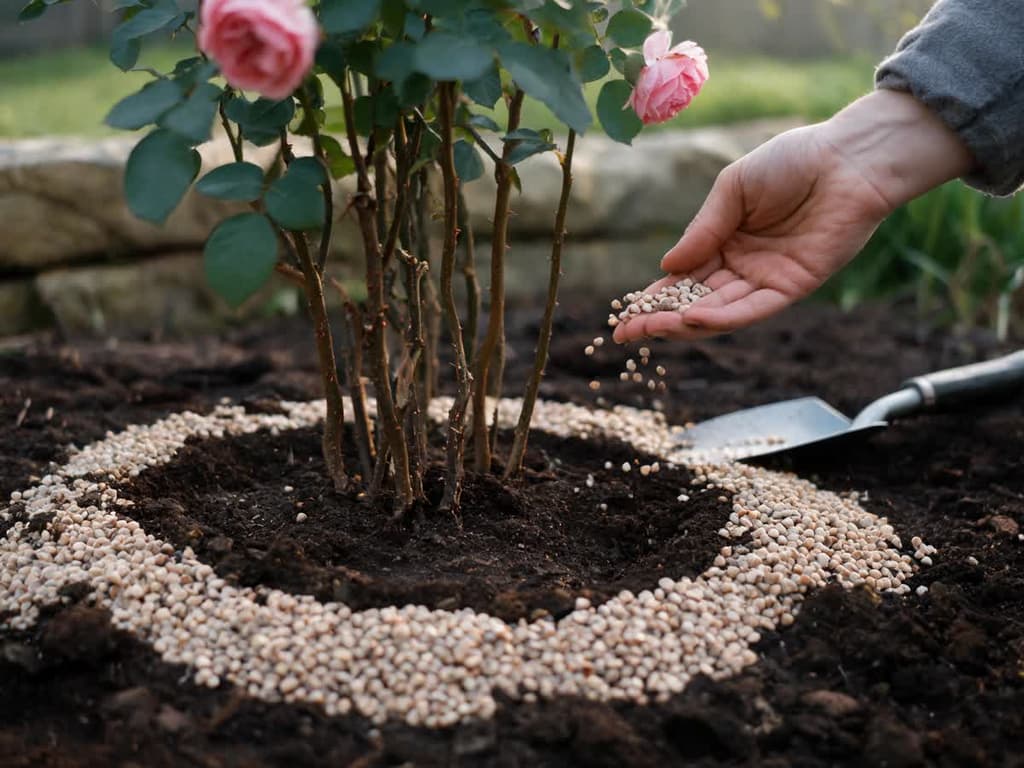
Fertilizing roses is feeding a growing plant, and nothing more. Fertilizer replaces what the rose bush spent to produce its last flush of blooms. It does not cure leaf spots, does not replace sunlight, and does not fix improper watering.
If your rose bush is putting out new shoots and receives at least six hours of direct sun, fertilizing is the right move right now. If it has lost its leaves, is sick, or arrived from the nursery this week, hold off on the fertilizer.
Quick summary:
Repeat-blooming roses (hybrid tea, floribunda, miniature) get 2 to 3 fertilizer applications per year. Once-blooming roses get 1, according to Iowa State University Extension.
In Brazil, the window runs from August, when the plant sprouts after pruning, through fall.
The formula recommended by university extensions is balanced (10-10-10, 12-12-12, 10-4-6), not the high-phosphorus blend sold as bloom fertilizer.
In containers, the dose is smaller and the frequency is higher: watering leaches nutrients through the drainage hole.
Stop six weeks before the cold arrives in your region. Late-fertilized new growth fails to harden off and burns.
Does your rose bush need fertilizer right now?
Fertilizer is food for a growing plant, not medicine. It belongs when the rose bush has new leaves emerging, healthy roots, and enough light to use what it takes in. Without one of these three, fertilizer turns into salt buildup in the soil and worsens the situation.
Fertilize your rose bush at two key moments: when it leafs out after annual pruning and when it finishes a flush of flowers.
Do not fertilize when the plant is defoliated by disease, newly purchased, recently transplanted, wilted from underwatering, or dormant from the cold. Each of these situations has its own reason, detailed in the section on when not to fertilize.
Which roses we are talking about
The number of fertilizations depends on the type of rose bush, and the difference is large. Iowa State University Extension recommends fertilizing modern roses two or three times a year. For shrubs, landscape, species, old garden, and climbing roses, it recommends a single application in the spring.
Modern, in this classification, are those that repeat bloom multiple times in the same season: hybrid tea, grandiflora, floribunda, polyantha, and miniature roses. They are the most sold in flower shops in Brazil.
Miniature roses, floribundas, and climbers also require different pruning, sun, and spacing from one another. The breakdown by group, explaining what changes for each, is in how to care for roses.
Each flush of flowers uses up nutrients, and a plant that produces four flushes a year draws on those resources four times. A plant that blooms once in spring and spends the rest of the year only with foliage consumes far less.
A care profile that lists Rosa as a single plant describes the entire genus, from a 20 cm miniature to a four-meter climber. That is why its ranges run so broad. To decide on fertilization, what matters is your rose's group, not the genus average.
The NPK for roses: what the label promises and what research measures
NPK refers to the three numbers on a fertilizer label. They indicate the ratio of nitrogen, phosphorus, and potassium: nitrogen for foliage and stems, phosphorus for roots and flower buds, and potassium for tissue firmness.
Fertilizers sold "for blooms" usually provide phosphorus levels well above nitrogen, in formulas like 04-14-08. The claim is that extra phosphorus produces more blooms.
University extensions that publish recommendations for roses use something else. Iowa State University indicates 10-10-10 or 10-4-6. The University of Illinois extension indicates 10-10-10 or 12-12-12. In all three formulas, nitrogen is equal to or greater than phosphorus.
Formula | Ratio of N to P | Recommended by |
|---|---|---|
04-14-08 | 1 to 3.5 | bloom fertilizer label |
10-10-10 | 1 to 1 | Iowa State Extension and University of Illinois Extension |
10-4-6 | 2.5 to 1 | Iowa State Extension |
Phosphorus is not a bloom trigger. Horticulturist Linda Chalker-Scott, from Washington State University, writes that phosphorus is "simply a mineral, not a plant growth regulator". In the same text, she notes that phosphorus and calcium are usually adequate in non-agricultural soil. And she adds a side effect: excess phosphorus prevents the plant from forming mycorrhizae. Mycorrhizae are the association between roots and soil fungi that expands the absorption of water and nutrients.
This article follows university extensions and uses a balanced formula. The reason is that they test the soil before making recommendations. The promise of high phosphorus assumes a soil deficiency that no one actually measured. A rose bush that fails to bloom is usually dealing with insufficient sun, improper pruning, or is simply resting between flushes. A lack of phosphorus is the least likely cause.
The Brazilian label complicates the math a bit: it lists P₂O₅ and K₂O instead of pure phosphorus and potassium. The conversion is in how to read a fertilizer label.
When to fertilize roses in Brazil: the calendar
The three extensions agree on the principle and differ only on dates, because they write for the Northern Hemisphere. The principle: start when the plant leafs out after annual pruning, repeat after each flush of blooms, and stop well before cold weather.
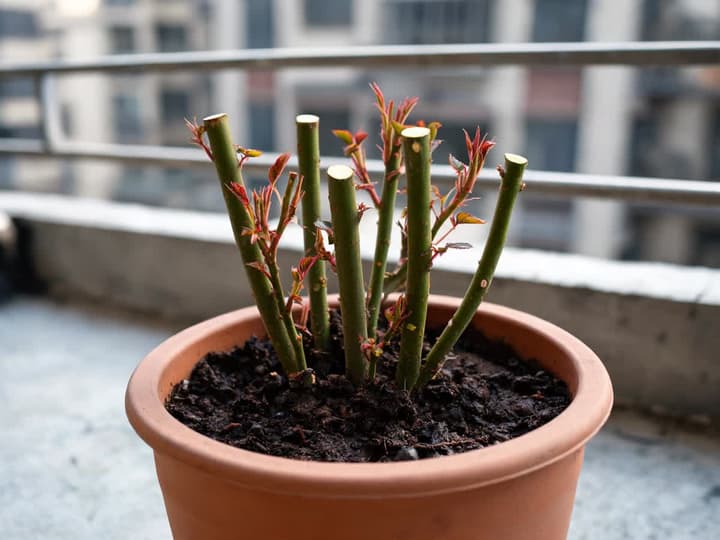
In Brazil, annual pruning of rose bushes falls in July and August, at the end of winter. From then on, the schedule looks like this.
Season | What is happening | What to do |
|---|---|---|
August and September | the plant breaks bud after pruning | first fertilization, full dose |
November and December | the first flush of flowers has ended | second fertilization, full dose |
January and February | intense heat and rain | third fertilization, reduced dose |
Fall | shorter days, cold weather approaching | final fertilization, six weeks before the first frost in your area |
Winter | the plant slows down or drops its leaves | do not fertilize; prune the rose bush in late winter |
Iowa State University Extension writes "do not fertilize after July 31." It explains that late fertilization stimulates succulent growth that may not harden off in time for winter. The University of Illinois Extension provides the same cutoff adapted to its local climate, August 15, with the same reasoning.
The portable version of the rule comes from the Clemson University Extension: stop fertilizing six weeks before the date frost usually hits. This formulation works at any latitude, because it does not depend on the month.
Translating to Brazil: where there is frost, in the South and in the mountain ranges of the Southeast, the last fertilization of the year falls in autumn. The calculation is yours, and it is simple: six weeks before the date when frost usually arrives in your city. In cities without frost, the cue is the plant: stop when it stops producing new leaves.
Nitrogen stimulates the plant to put out new growth, and new growth is soft tissue, full of water. It needs weeks of growth to lignify, which means turning into wood. A shoot that emerges in May in the South of Brazil reaches the cold weather while still soft, and it is the first to blacken and die.
Where roses do not stop growing in winter
Much of Brazil does not have a winter cold enough for roses to enter dormancy, the pause where they stop growing until the cold passes. The University of Florida Extension describes this exact situation. In the northern and central parts of the state, it recommends monthly fertilization from mid-February through November; in South Florida, year-round.
In the North and Northeast of Brazil, the situation is the same. A rose bush that does not lose its leaves in winter and still produces buds in July continues consuming nutrients. A winter pause makes no sense there. The plant becomes your guide: fertilize as long as new leaves keep coming out.
The same Florida extension offers a fix for rainy summers, such as those from December through March. Instead of one large application, it suggests smaller doses every 2 weeks. This keeps rain from washing the nutrients away before roots can take them in. Clemson reaches the same conclusion by another route, telling growers to cut the dose in half during peak heat.
Organic fertilizer for roses: what research supports
Organic fertilizer consists of animal or plant matter that releases nutrients slowly as soil microorganisms break it down. Not everything promoted as organic rose fertilizer carries the same scientific backing.
Well-rotted manure and compost are the points of consensus. The Royal Horticultural Society recommends mulching the soil around roses with well-rotted manure. Leave a four-inch (ten-centimeter) ring clear around the stems. Clemson endorses composted manure as a top-dressing. It is the lowest-risk approach if you took over an established bed and are not sure where to start.
Bone meal divides sources. University of Illinois Extension treats it as a good organic source of phosphorus. It suggests one cup per plant, mixed into the soil of the planting hole when planting a new rose bush. Chalker-Scott of Washington State University argues the opposite: phosphorus and calcium from bone meal are rarely lacking in garden soils, and excess amounts disrupt mycorrhizae.
This article follows Chalker-Scott, for a reason found within Illinois's own recommendation: it is intended strictly for planting time, in soil where no one has tested phosphorus levels. Chalker-Scott requires testing before adding the nutrient.
Castor bean meal requires a warning before the recipe. It is the solid residue left after extracting the oil from castor seeds. It is a potent nitrogen fertilizer. Embrapa Algodão confirms both points in the same document. The high nitrogen content makes it an excellent fertilizer. And "the toxicity of the meal is well known due to the presence of certain constituents, such as ricin, ricinine, and allergenic complexes", write Beltrão and Oliveira in Documentos 217, from 2009.
The ASPCA lists the castor bean plant (Ricinus communis) as toxic to dogs, cats, and horses, with ricin as the toxic principle. The rose bush itself is not the problem: the risk comes from the fertilizer you put in the pot.
The practical instruction: if dogs have access to the pot or the garden bed, choose a different nitrogen fertilizer. If you use castor bean meal anyway, work it into the soil and leave no loose powder on the surface, which is where pets sniff and lick.
Coffee grounds, banana peels, and other home remedies are evaluated one by one in homemade fertilizer: what works, detailing what each one actually delivers.
How much fertilizer to use per rose bush
Different sources provide different doses, and the amounts can vary up to fourfold.
Source | Dose per application | Context |
|---|---|---|
Iowa State Extension | 450 g of 10-10-10 per 9 m² (about 1 lb per 100 sq ft) of bed, or about 60 mL (4 tbsp) per plant | garden bed, temperate climate |
University of Illinois Extension | 120 to 240 mL (1/2 to 1 cup) per plant | garden bed, temperate climate |
Royal Horticultural Society | 70 g per m² (2 oz per sq yd) | garden bed, maritime climate |
They disagree because the dose depends on product concentration, and concentration varies from one brand to another. Application frequency and timing translate well across regions, but exact amounts do not. Because of this, the practical standard is the label on the product you bought, and half-strength is the safer mistake: nutrient deficiencies can be corrected with the next feeding, but excess burns roots.
How you apply the fertilizer varies much less between sources. Iowa State University instructs spreading fertilizer in a 45 cm (18-inch) band, starting 15 cm (6 inches) away from the base of the stems. Then, scratch it lightly into the soil without damaging the rose's shallow roots. Clemson adds two conditions: the soil must be moist beforehand, and fertilizer must never touch the canes or the graft union, the swelling at the stem base where the scion meets the rootstock.
In pots, the rhythm changes. The Royal Horticultural Society recommends applying a liquid fertilizer every 2 weeks from mid-spring to late summer. Container soil is limited, and irrigation leaches nutrients straight through the drainage hole. It suggests a balanced general-purpose fertilizer while the plant is purely growing, switching to a high-potassium formula once flower buds appear. The same reduced-dose principle applies to any plant in low soil volumes, detailed in milliliters in fertilizing succulents.
The exact answer to "how much" is a soil test
The doses from these three sources provide a baseline for soils that have never been tested. The exact recommendation comes from a laboratory soil test that reveals how much of each nutrient is already present. This is why Chalker-Scott requires "a complete soil test" before adding any phosphorus: without one, you risk replenishing a nutrient that might already be excessive.
For a rose bed, the procedure is the same as that of the Instituto Agronômico de Campinas, on a smaller scale. Collect several soil samples from the 0 to 20 cm layer at different spots in the bed, and mix them together in a clean bucket. From there, take about 300 g to send to a soil testing laboratory. The report returns the levels of phosphorus, potassium, organic matter, and pH.
pH matters here: the University of Illinois Extension notes that roses prefer a pH between 6.0 and 7.0. Outside this range, nutrients may be in the soil and still remain unavailable to the roots. No amount of fertilizer fixes this, and the plant starts to show starvation without actually lacking food. The causes of yellowing that are not a lack of fertilizer are gathered in yellow leaves.
Soil testing is not practical for potted plants: the volume is small, potting mixes are manufactured, and nutrients wash out quickly through the drainage hole. The answer there is repotting with fresh mix every one to two years and following the directions on your liquid fertilizer label.
When not to fertilize roses
Six situations where fertilizer does harm, along with the reasoning for each:
A rose bush with dark spots and dropping leaves. This indicates a fungal disease, and fertilizer is not a fungicide. A defoliated plant lacks enough leaves to utilize nitrogen, which merely forces tender growth directly into an active infection. Treat the disease first; the steps are detailed in yellow leaves dropping from rose bushes.
Newly purchased miniature roses. Commercial growers provide them with slow-release fertilizer pellets in the potting mix that release nutrients steadily over weeks. They also arrive in your home dealing with light and humidity shock. Wait four to six weeks and let the first bloom cycle finish.
Recently transplanted roses. The root system is still recovering and takes up very little. Concentrated fertilizer burns injured roots.
Dry soil. Applying fertilizer to dry potting mix or garden soil concentrates fertilizer salts right where dehydrated roots are thirstiest. Water thoroughly first, then fertilize, as Clemson directs.
After the seasonal cutoff date. From your final fertilizer application of the season until the following pruning, do not give the rose bush anything. Applying nitrogen during this window triggers tender growth that frost will kill.
A green, vigorous, heavy-blooming rose that has never been fertilized. If the garden bed already has sufficient organic matter, the plant is signaling that it does not need more. Adding fertilizer anyway just builds up unnecessary salts.
When you are unsure what the leaves are showing rather than how much fertilizer to apply, a photo solves the problem faster. Bloom identifies your plant by photo, and the Premium plan compares symptom photos against a database of plant diseases. The app is available on iOS.
Do roses really need fertilizer every 30 days?
A 30-day feeding schedule applies only to one specific scenario: repeat-blooming roses planted directly in the ground during peak growing season. Under those conditions, it is a reasonable starting point and lines up closely with University of Florida recommendations.
It fails at both extremes. In winter in the South and Southeast of Brazil, the right answer is not 30 days: it is zero. That is the difference between a plant that sprouts well in September and another that had its shoots scorched in May. And for potted roses in full bloom, 30 days is too long. The Royal Horticultural Society calls for liquid fertilizer every 15 days during this phase.
A rigid schedule treats completely different growing conditions as if they were identical. Use biological triggers rather than fixed intervals: fertilize when new shoots appear after pruning, repeat after each flush of blooms, and stop when cold weather nears.
Frequently asked questions
What is the best NPK ratio for roses?
A balanced formula, with nitrogen equal to or higher than phosphorus. Iowa State University Extension suggests 10-10-10 or 10-4-6; University of Illinois Extension recommends 10-10-10 or 12-12-12. High-phosphorus formulas marketed for blooms assume a phosphorus deficiency that rarely exists in garden soils.
What is the best homemade fertilizer for roses?
Well-rotted manure or compost, spread around the plant while keeping stems clear. It is the only organic soil amendment that both the Royal Horticultural Society and Clemson Extension recommend for roses. It improves soil structure and releases nutrients slowly without the root-burning hazards of concentrated fertilizers.
Can I put coffee grounds on rose bushes?
Coffee grounds offer very few immediately available nutrients and, when applied in thick layers, form a crust that blocks water penetration. If you want to use them, dry them first and mix small quantities into compost, rather than applying them directly to the surface of the container.
How often should you fertilize potted roses?
Apply liquid fertilizer every two weeks from mid-spring through late summer, according to the Royal Horticultural Society. Pots hold limited soil and watering leaches nutrients out through the drainage hole. Use a balanced all-purpose fertilizer during vegetative growth, then switch to a formula higher in potassium once buds form.
Can I use castor bean meal on rose bushes?
You can, but not if a dog has access to the soil. Embrapa Cotton notes that the toxicity of the meal is well-known and comes from ricin. The ASPCA lists castor bean as toxic to dogs, cats, and horses. If you use it, incorporate it into the soil without leaving powder on the surface.
Where to start
If your rose bush is breaking bud after pruning, now is the time for the first fertilizer application of the year. In garden beds, proceed in this order: water the plant deeply, distribute the fertilizer in a ring starting six inches (15 cm) from the canes, scratch it lightly into the soil, and water thoroughly again. For containers, use a different technique: liquid fertilizer diluted to the label dose, applied in weaker, more frequent doses. Mark your calendar for the next feeding right after the first flush of blooms, along with the date you will stop for the season.
Related articles
How to Care for a Maidenhair Fern: Light, Water, and Revival Tips
Learn how to care for a maidenhair fern indoors: bright indirect light, consistently moist soil, high humidity, and how to revive it if it dries out completely.
How to Propagate Spider Plants: Root the Pup Before Cutting
The safest spider plant cutting comes from a pup still attached to the mother plant: rest the plantlet on soil in a small pot, wait for roots to establish, and only then cut the stolon. Learn when the pup is ready, whether rooting in water is worth it, how to divide the clump, and why plants fail to produce babies.
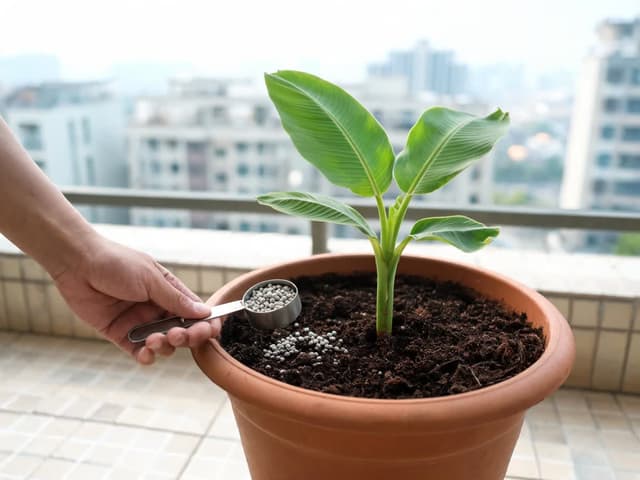
Banana plant fertilizer: fertilizing potted and backyard plants
Banana plant fertilizer needs more potassium than nitrogen, in a 3-1-6 ratio. For a potted plant on a balcony, use the label dose in spring and summer. In the backyard, fertilize every 2 months, adjusting the amount by mat age. Learn the formula, timing in Brazil, and signs of deficiency or excess.