Rose bush yellow leaves: what the yellow is telling you
On a rose bush, yellow leaves are almost never just a watering issue. Two questions resolve nearly every case: where the leaf is on the bush and what appears alongside the yellowing.
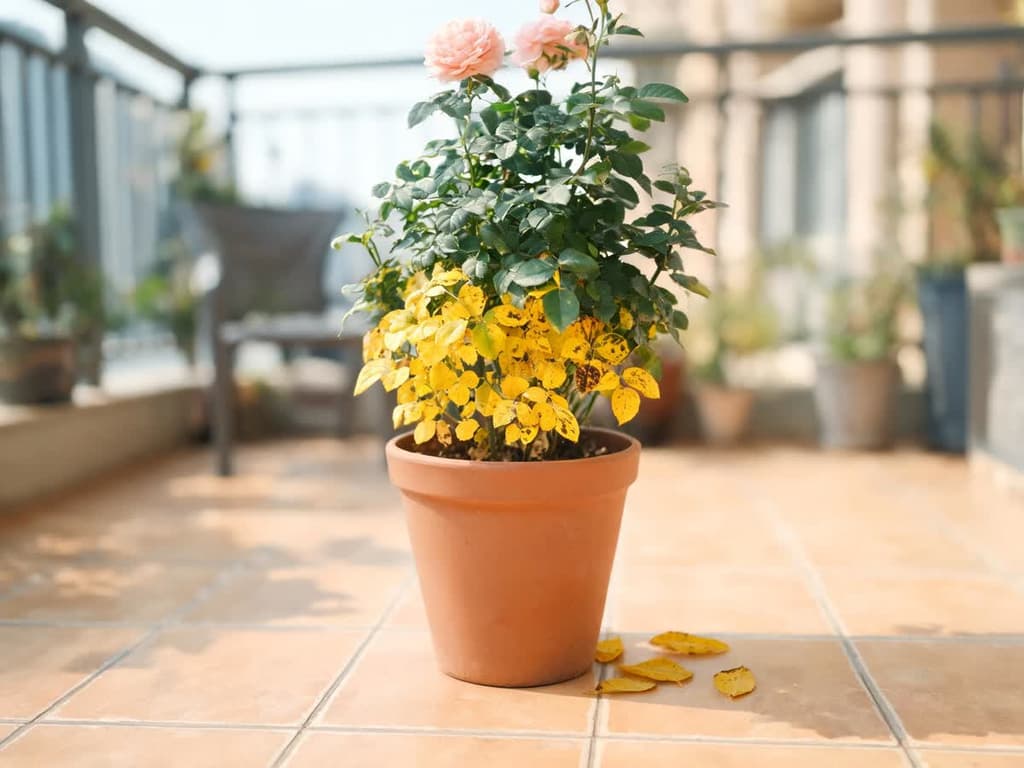
Rose bush yellow leaves are almost never just a watering problem. In most cases, the yellowing is the result of something else: a foliage disease, a nutrient the plant cannot absorb, or the bush's normal cycle. Two questions narrow down these causes in less than a minute, without any equipment: how high up on the bush the yellow leaf is, and what appears alongside the yellowing.
The two answers lead to completely different actions. A dark spot requires you to collect fallen foliage from the ground. Yellowing between the veins calls for a soil adjustment. And an isolated old leaf at the base requires no action at all.
Quick summary:
Lower leaf, dark spot with a fringed border, yellowing around the spot: black spot, the most common rose disease in Brazil.
Young leaf turning yellow with green veins: iron locked out by soil pH. Old leaf with the same pattern: magnesium.
Roses naturally lose their leaves in winter. In the South and Southeast of Brazil, widespread yellowing between June and August is usually dormancy, not disease.
The 30-second reading: where the yellow leaf is and what accompanies the yellowing
Look closely at the yellow leaf and answer two questions. First: is it on the lower part of the bush, on the top, or spread throughout? Second: is there anything on the leaf besides yellowing, such as a spot, powder, pustules, or a vein pattern?
On roses, yellowing foliage is a symptom of more than ten different causes, and some of them require opposite solutions. What sets them apart is the combination of the leaf's height on the bush and the sign appearing next to the yellowing: dark spots, white powder, orange pustules, light stippling, or a pattern of green veins.
What appears alongside the yellowing | Where on the bush | Probable cause |
|---|---|---|
Round dark spot with a fringed margin | Lower leaves first | Black spot |
Irregular spot with a smooth margin, lighter center, and yellow halo | Only on old leaves | Cercospora |
Angular spot, with white down on the underside | Spread throughout, in cool weather | Downy mildew |
White powder, young leaf curled and distorted | Tips and new shoots | Powdery mildew |
Orange pustule on the underside of the leaf | From the bottom up | Rust |
Pale flecks and a bronzed look on the upper surface | Spread throughout, in hot and dry weather | Spider mite |
Green veins with the rest of the leaf yellow | Young leaves | Iron locked out by pH |
Green veins with the rest of the leaf yellow | Old leaves | Magnesium |
Uniform yellow, with no pattern at all | Old leaves | Nitrogen or watering |
Nothing besides yellowing, on one or two leaves | Base, shaded by the top | Old leaf finishing its cycle |
The same image, green veins with a yellow center, appears twice in the table, with different nutrients. The height of the leaf is what tells the two apart.
Why "water every 7 days" does not complete the diagnosis
Care guides list fixed intervals because they need to fit on a single line. The interval works for anyone who lacks a routine and wants a starting point. It does not work for diagnosing a yellow leaf.
The same seven-day interval causes overwatering in a small clay pot on a balcony. In a garden bed, in the middle of summer, seven days is underwatering. What decides the issue is the condition of the soil on that day, not the number of days since the last watering.
Published size measurements for roses have the same limitation. The genus Rosa includes thousands of varieties, from miniatures to climbers reaching several meters. A height range covering the entire genus does not describe your rose. Every rose size, from miniature to climber, requires a different pruning and fertilizing routine.
Yellowing with dark spots: black spot and the two diseases that mimic it
Black spot (Diplocarpon rosae) is described by the University of Wisconsin-Madison Extension as a common and potentially serious leaf disease. It occurs wherever roses are grown.
The lesion is round, dark, and reaches about 10 mm across. What no other rose spot has is the fringed margin, with edges spreading into the green tissue like fringe. Yellowing appears around the spot, and the leaf drops even with few lesions. The disease starts on the lower leaves and works its way up.
The Agrolink black spot fact sheet provides the numbers that turn a generic recommendation into a watering schedule. The fungus needs a relative humidity of 80% to 90% to develop. To infect, water must sit on the leaf for more than seven consecutive hours.
Hence the difference between watering in the afternoon and watering in the morning. Wetted in the late afternoon, the leaf stays damp all night long and reaches the seven hours. Watered at the base in the morning, it dries out before the end of the day.
Rose leaves are most susceptible to infection when they are 5 to 14 days old. The new growth you see emerging today is the target for the next two weeks.
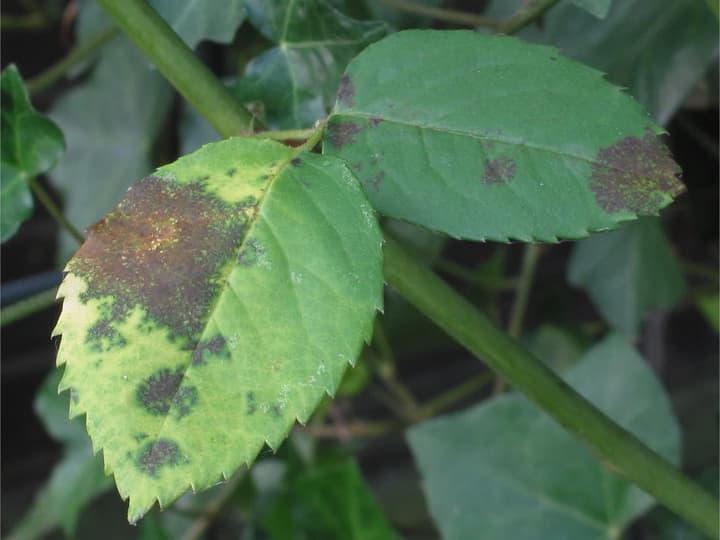
Two other diseases produce dark spots and yellowing, and people confuse them with black spot all the time.
Cercospora leaf spot (Cercospora rosicola) causes irregular, purple to reddish-brown spots with a lighter center and a yellow halo around them. Its edge is smooth, not fringed, and it attacks only old leaves. In Brazil, the Agrolink fact sheet records the disease in Rio Grande do Sul, São Paulo, and the humid mountain ranges of Ceará.
According to the University of Maryland Extension, varieties sold as resistant to black spot are often the most susceptible to Cercospora leaf spot. If your rosebush is resistant and still developed spots, look at the edge of the lesion before concluding that the resistance failed.
Downy mildew produces lesions that resemble black spot at first glance. The difference is that they are angular, almost square: the fungus is bounded by the leaf veins. The underside may show grayish-white down. Downy mildew advances in cool, damp weather, whereas black spot prefers warmth and rain.
White powder, orange pustules, and bronzed leaves
Three common causes of yellowing on roses produce no dark spots at all, and each leaves its own distinct signature.
Powdery mildew covers young leaves, shoots, and flower buds with a grayish-white powder, resembling dusted talcum powder. The young leaf curls, twists, and distorts before the powder becomes visible. Distorted new growth during warm, dry days paired with humid nights deserves a close look.
Rust (Phragmidium spp.) is the only one that requires turning the leaf over. Small yellow spots appear on the upper surface; directly behind them, on the underside, are the orange powder pustules. The University of Wisconsin-Madison Extension notes that rust also starts on the lower leaves. The pustules darken in late summer, which in the Southern Hemisphere falls in February and March.
Spider mites do not produce defined spots: the leaf develops fine, pale speckles on the upper surface, creating an overall bronzed and dull appearance. The mites stay on the underside, measure under half a millimeter, and appear in hot, dry weather. Fine webbing between leaf and stem confirms their presence. A spray of water directed at the underside of the leaves washes away a large portion of the mites without pesticides, and the complete steps are in spider mites.
I already sprayed neem oil and it got worse: what fungicides can and cannot do
Fungicides protect healthy foliage. They do not restore the color of a leaf that already has lesions, and no product exists that can do that.
Anyone who sprays and sees more spots over the following days did not misapply the product. Days pass between infection and visible spotting, which means those spots had already incubated on the leaf when you applied the treatment. Today's spray protects the leaf opening tomorrow.
Before choosing a product, decide whether it is even necessary. The Missouri Botanical Garden considers management practices sufficient in most leaf spot cases, making fungicides unjustified. The University of Wisconsin-Madison Extension shares the same message with a clear-cut rule for roses: if the plant is losing few or no leaves and the weather is dry, no treatment is necessary. This guide follows Wisconsin's criteria because they come from university extension and apply specifically to roses.
When treatment is justified, Wisconsin recommends applying every 7 to 14 days, starting when new leaves unfold. The guidance also calls for alternating active ingredients between applications instead of repeating the same one. Neem oil appears on the list as an organic option for partial control, alongside copper sulfate.
Two practices do more for a rose's health than the choice of product. The first is opening up the center of the bush during pruning so air circulates and leaves dry quickly. The second is watering at the base in the morning without wetting the foliage.
Yellowing with no spots: the height of the leaf reveals which nutrient is missing
When yellowing appears alone, without spots, powder, or pustules, the pattern on the leaf and its height indicate the nutrient.
Iron: new leaves. The interior of the leaf turns yellow while the veins stay green, forming a network pattern. The cause is almost never a lack of iron in the soil. According to the University of Maryland Extension, this symptom usually comes from high pH. Soil pH measures how acidic or alkaline the soil is, and alkaline soil traps iron in a form the roots cannot absorb. Adding more iron to alkaline soil does not solve the problem; correcting the pH does.
Magnesium: old leaves. The pattern is the same, green veins with a yellow interior, but it starts on the lower leaves and at the leaf margin, working inward toward the central vein.
Nitrogen: old leaves, no pattern. The entire leaf turns uniformly yellow-green, without contrast between veins and tissue, and new growth emerges stunted.
What makes height a useful diagnostic criterion is mobility within the plant. Magnesium and nitrogen circulate through the sap: in a deficit, the rose pulls both from old leaves and redirects them to young growth. Iron cannot move once deposited.
For this reason, iron deficiency appears on new tissue, and magnesium deficiency appears on old tissue. Correcting any of the three takes weeks, because only the subsequent flush of growth changes color. Fertilizer dosage and timing change according to the rose's stage of growth.
When yellow leaves on rose bushes are not a problem
Two situations cause yellow leaves on a healthy rose, and treating either one is a waste of effort.
The first is the end of a leaf's life cycle. One or two old leaves at the base of the bush turn yellow and drop while the rest of the plant stays green and continues growing. As the canopy fills out, the lower leaves receive less light, begin consuming more energy than they produce, and the plant sheds them. The diagnostic standard is quantitative: few leaves, all in the shaded base, with the rest of the bush looking normal.
The second is dormancy. NC State Extension describes roses as deciduous woody shrubs. They are plants that lose their entire foliage once a year, like a fig tree.
In Southern and Southeastern Brazil, leaf drop happens between June and August: the leaves yellow, drop, and the bush spends weeks with only bare canes. It is the normal cycle, and new growth returns in spring.
In the Northeast and North of Brazil, winter is not cold enough to induce true dormancy. Widespread yellowing there in July is not part of the plant's cycle: it calls for a diagnosis.
Evergreen species do not go through this stage, and on them, widespread leaf drop in winter always signals trouble. This difference between deciduous and evergreen plants is detailed in yellow leaves on houseplants. On palms, for example, yellow new leaves are almost never an iron deficiency in the soil: they usually stem from suffocated roots in the pot.
Overwatering and underwatering produce different yellow patterns
Overwatering causes uniform yellowing on limp leaves, starting from the lower part of the plant, while the soil remains wet 2 inches deep. Waterlogged roots stop absorbing moisture and the leaf turns yellow despite water being available.
Underwatering causes old leaves to yellow, dry out, and drop, while young leaves remain firm, with dry soil down 2 inches. The plant sacrifices old foliage to preserve new growth.
The check is the same in both situations: insert your finger 2 inches into the soil before watering. Damp soil at that depth means watering can wait.
Roses are full-sun plants: they need 6 hours or more of direct sunlight daily, whether in garden beds or in large, deep containers. Indoor roses lose their lower leaves from lack of light, and no watering change will fix that. Rose watering frequency shifts between summer and winter, and a summer schedule does not suit July.
Supermarket potted miniature roses follow the same rules
The miniature rose sold in small pots at supermarkets and flower shops is a genuine rose, belonging to the same genus Rosa. Breeders selected it to stay small, not to live indoors.
Three factors explain almost every miniature rose that turns yellow and drops nearly all its foliage within its first weeks. The plant sits in insufficient light, and the bottom leaves are the first to drop. The pot usually holds several cuttings planted together, competing for the same handful of soil. And the nursery pot is far too shallow for a plant that develops deep roots.
You can resolve all three on the same afternoon. Move the plant into direct sun and separate the cuttings into individual pots deeper than the original one, with drainage holes. Then water based on the soil test. Alternating between watering less and watering more accomplishes nothing, because water is not the problem.
What to do with fallen leaves (and the mulch underneath them)
Raking up fallen foliage from the ground breaks the disease cycle. The black spot fungus overwinters precisely there: in fallen leaves and in cankered canes. Splashing rain carries the spores back up to fresh leaves the following season.
All sources agree on collecting fallen leaves. They disagree on how to handle the collected material. Agrolink instructs burning or burying, while the University of Wisconsin-Madison Extension allows burning, burying, or composting in a hot pile.
The Missouri Botanical Garden treats composting as acceptable alongside the other options. The Clemson Home & Garden Information Center adds a detail the others do not mention: also remove the mulch where the leaves fell, because spores remain in it.
Given the disagreement, follow the option all four sources accept: bury them far from the bed or throw them in the trash. Standard backyard compost piles are ruled out because they do not reliably reach high temperatures. Infected debris that fails to heat up returns to the garden with live spores.
Gather the foliage in the same session where you prune out cankered canes. Disinfect pruners between cuts by dipping the blades in 70% alcohol for 30 seconds, following instructions from the University of Wisconsin-Madison Extension.
The rose calendar in Brazil
Almost all technical literature on roses comes from the Northern Hemisphere. In it, the end of winter falls in February and blooming comes in May. In Brazil, the dates are reversed, and instructions need to be read by the event, not by the month.
Structural pruning (late winter): July and August, before bud break.
Resuming fertilizer: August and September, as active growth restarts.
Peak bloom: September through November.
Highest risk window for black spot: the rainy summer, December through March, when afternoon rains leave foliage wet overnight.
The South experiences frost and marked dormancy. In the Northeast and North, roses grow almost year-round. There, black spot follows the regional rainy season rather than a specific summer.
Which roses we are talking about
Everything in this guide applies to roses in the genus Rosa: hybrid tea, floribunda, climbing, shrub, and miniature roses. Leaf diagnostics remain the same across all five, because they are the same plant in different growth habits.
Two plants are excluded. Desert rose (Adenium obesum) is a succulent from an entirely different family, and yellow leaves on it typically signal overwatering in the swollen caudex. Any plant sold with "rose" in its common name that does not belong to the genus Rosa follows different rules.
Homeowners who inherit an established bush often do not know which rose they have. The Bloom app identifies the plant by photo and provides disease diagnoses from leaf pictures. Diagnosis is part of the Premium plan; the free version includes 2 identifications per month and a watering-only schedule. The app is available only for iPhone.
Prickles, not poison: rose risks around pets
The ASPCA lists Rosa spp. as non-toxic to dogs, cats, and horses. The real risk a rose bush poses to an animal is physical, not chemical: the prickle, that rigid tip on the stem that everyone calls a thorn.
Yellow leaves fallen on the ground represent diseased plant debris, not chew toys for pets.
Frequently asked questions
Should I cut yellow leaves off my rose bush?
It depends on what caused the yellowing. Leaves with disease spots must come off the plant and go straight into the trash, because they act as spore sources. An old leaf yellowing naturally at the base can stay: it will fall on its own without infecting anything. Removing healthy leaves alongside it slows recovery by reducing the surface area producing energy for the plant.
What are the signs of overwatering in roses?
Uniform yellowing on limp leaves, starting from the lower section of the bush, while the soil remains wet 2 inches deep. It may accompany a sour soil smell in pots and softened cane bases. The diagnostic check is inserting a finger into the soil, not looking at the foliage alone.
How do I bring my rose bush back to health?
Start with the specific cause indicated by the leaf, not a general-purpose fertilizer. Collect fallen foliage and prune out cankered canes. Open the center of the bush to improve airflow and switch to morning watering at the base. After that, adjust fertilizer and soil pH to match the pattern of yellowing.
Do yellow leaves ever turn green again?
A leaf that has turned entirely yellow will not recover its color, regardless of the cause. The sign that treatment succeeded is new growth: if subsequent shoots emerge green and spotless, the issue is resolved. For this reason, results show up over weeks rather than days.
Next steps
Head back to your rose bush and answer the two questions: how high up is the yellow leaf, and what appears alongside the yellowing. If spots are present, inspect their margins before doing anything else, since fringed, smooth, and angular edges point to three separate diseases. If there are no spots at all, the height of the leaf reveals the missing nutrient.
If your bush dropped foliage onto the ground, start there today: raking and discarding does not require diagnosing the disease first. Aphids and mites still feed on roses even after fungal issues are under control, making the undersides of leaves worth a second look. The same photo-based diagnostic method applies to any other houseplant, in diagnosing plant problems from a photo.
Related articles
How to Care for a Maidenhair Fern: Light, Water, and Revival Tips
Learn how to care for a maidenhair fern indoors: bright indirect light, consistently moist soil, high humidity, and how to revive it if it dries out completely.
How to Propagate Spider Plants: Root the Pup Before Cutting
The safest spider plant cutting comes from a pup still attached to the mother plant: rest the plantlet on soil in a small pot, wait for roots to establish, and only then cut the stolon. Learn when the pup is ready, whether rooting in water is worth it, how to divide the clump, and why plants fail to produce babies.
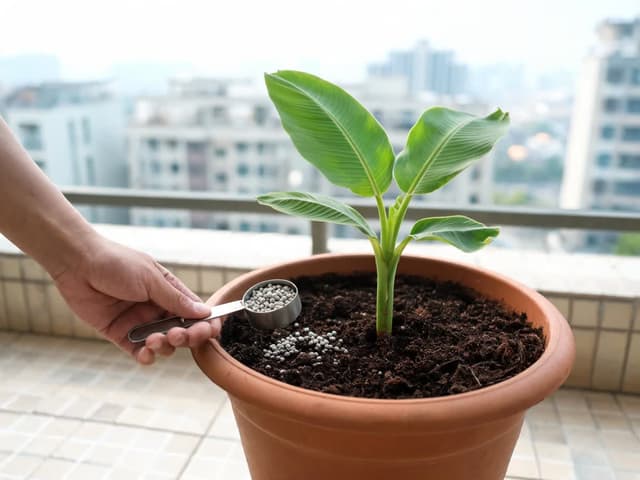
Banana plant fertilizer: fertilizing potted and backyard plants
Banana plant fertilizer needs more potassium than nitrogen, in a 3-1-6 ratio. For a potted plant on a balcony, use the label dose in spring and summer. In the backyard, fertilize every 2 months, adjusting the amount by mat age. Learn the formula, timing in Brazil, and signs of deficiency or excess.