Fig Tree Flower: Where It Is and How to Make Your Fig Tree Fruit
The fig tree flower stays hidden inside the fig and never appears on the outside. Learn why your fig tree is not producing or is dropping green figs, and how to adjust pruning, sunlight, fertilizer, and watering.
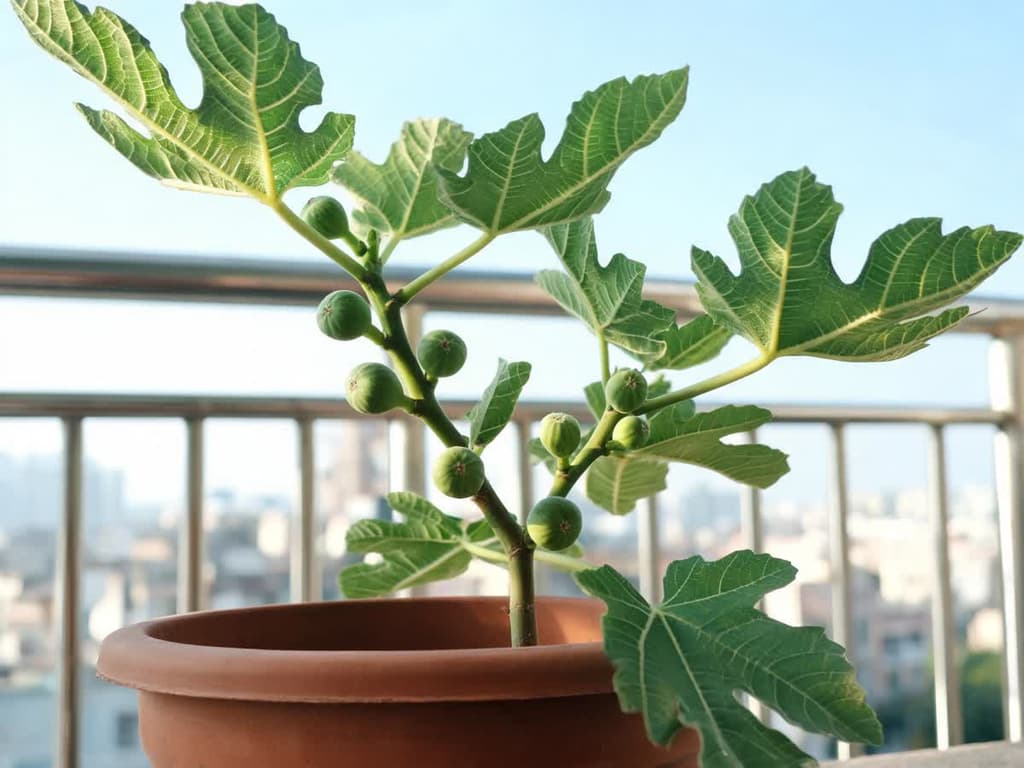
A fig tree flower stays inside the fig, which is why you never see a fig tree bloom. A green fig is a closed pouch lined on the inside with hundreds of tiny flowers. The common fig produces figs without pollination. When a fig tree does not bear figs, the cause is usually a young plant, pruning at the wrong time, too little sunlight, excess fertilizer, or dry potting mix.
This guide covers the edible fig tree (Ficus carica), the fig plant. In Brazil, almost every fig tree is of the Roxo de Valinhos variety, according to EPAMIG.
What you see on the fig tree and what to do
What you see | What it means | What to do |
|---|---|---|
Hard, green little balls along the leaves with no flowers at all | The young fig, which already carries the flowers inside (Gartenakademie RLP) | Leave them on the tree: they are the season's figs |
Tiny figs turning yellow or brown and falling off | A young, vigorous plant, dry potting mix, dry heat, or excess fertilizer (Clemson, RHS) | Check the soil and water if the surface is dry; hold fertilizer before spraying or pruning |
Lots of branches and large leaves, but no figs | Excess fertilizer or too little sun (UF/IFAS, Clemson) | Only fertilize if the current year's shoots grew less than 12 inches; provide 8 hours of direct sun per day |
A 1- or 2-year-old fig tree with no ripe figs | Age: the plant can take 3 to 4 years to ripen figs (Clemson) | Wait and do not force it with fertilizer |
Hard green figs that do not ripen before the cold | A second crop in cold climates (RHS) | Cold climates only: remove figs larger than a pea at the end of the growing season |
Where the fig tree flower is located
The fig flower sits on the inner wall of the fig, facing inward toward the center. A fig is a syconium: the base of the inflorescence (the cluster of flowers) swells, closes up, and forms a pear-shaped pouch. At the tip of this pouch is a tiny opening covered by small scales, the ostiole, commonly called the eye of the fig.
The Gartenakademie Rheinland-Pfalz, the German state horticultural service, describes the fig this way. According to Gartenakademie RLP, the small green spheres that appear along the leaves are already the inflorescences, not finished fruits or a disease. Each sphere enlarges and turns into a ripe fig without ever displaying petals.
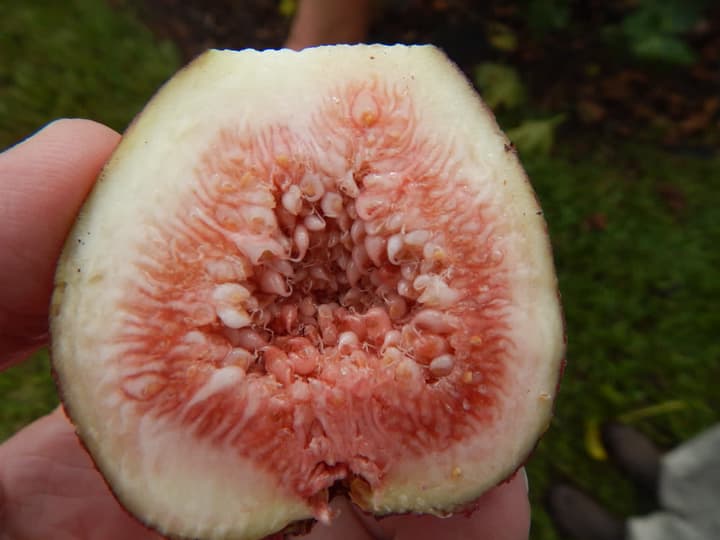
The crunchy bits you feel when eating a fig are the true fruitlets. Each flower becomes a tiny fruit with a hard inner coating, according to Gartenakademie RLP. In figs formed without pollination, these bits remain hollow but still crunch because the fruitlet's inner layer is hard.
NC State Extension notes that fig flowering occurs in spring, with green flowers concealed within the fruit cavity. Flowering therefore takes place right as the tiny figs appear along the branches.
Does a fig tree need a wasp to produce fruit?
The common fig does not need a wasp or any other insect to produce figs. UF/IFAS classifies fig trees into four types:
Caprifig: has pollen-bearing flowers and serves solely as a pollen source. Its figs are inedible, according to Gartenakademie RLP.
Smyrna: produces only female flowers and requires pollen from the caprifig. The fig wasp (Blastophaga psenes) carries this pollen. Without it, the fig drops before ripening.
San Pedro: forms its first crop without pollination. The second crop, borne on new growth, requires the wasp.
Common: produces only female flowers and develops fruit without pollination. UF/IFAS refers to this fruit as parthenocarpic, meaning it develops without fertilization.
Parthenocarpy means producing fruit without fertilization, which is why the fruit of a common fig tree contains no viable seeds. The RHS, the UK's Royal Horticultural Society, notes the same: the fig develops without fertilization.
Roxo de Valinhos is a common-type fig tree. A Unesp study published in the Revista Brasileira de Fruticultura in 2009 records that Roxo de Valinhos bears seedless fruit. In 2016, Revista Cultivar reported on a project to import the fig wasp. According to the report, Roxo de Valinhos was the only variety grown in the country that did not depend on pollination.
EPAMIG notes that Roxo de Valinhos is the variety known globally as Brown Turkey. Gartenakademie RLP includes Brown Turkey on its list of fig trees that set fruit without wasps.
Planting flowers near your fig tree to attract insects makes no difference for a common fig, since it does not use a pollinator. Clemson Extension considers lack of pollination a rare reason for dropping fruit. If poor pollination does cause fruit drop, replace the plant with a common-type variety.
Breba and the main crop: which branch bears fruit
A fig tree can produce two crops a year, each on a different branch. Clemson Extension describes, in the United States, a small crop in early summer on the previous year's branches. The main crop arrives in mid-to-late summer on shoots that grew during the same year.
UF/IFAS identifies this first crop as the breba crop. Breba figs develop in late summer at the tips of the shoots. According to the RHS, these breba figs overwinter at about the size of a pea and remain on the branch until they ripen. Gartenakademie RLP locates these tiny figs along the top 12 inches of one-year-old wood.
In cold climates, only the breba crop ripens. In the United Kingdom and southwestern Germany, second-crop figs meet cold weather while still green and hard. The RHS and Gartenakademie RLP advise removing late-season green figs from the second crop that will not ripen in time. The RHS removes any figs larger than a pea.
In Brazil, the main crop is the one that counts. In Botucatu, São Paulo, Roxo de Valinhos pruned in August was harvested from December to April, according to a study published in the journal Bragantia in 2010. From a tiny fig to a ripe fig takes about 90 days, according to Penn State Extension.
Why a fig tree does not produce fruit
A fig tree that fails to fruit usually suffers from one of these issues: age, improper pruning timing, inadequate sunlight, or too much fertilizer. Dry potting mix and cold temperatures that freeze young figs also cause trouble. A less common issue is growing a variety that requires a wasp. Start by checking the easiest factors: tree age and daily sun exposure.
The fig tree is still young
A young fig tree can take 3 to 4 years to ripen fruit, according to Clemson Extension. Before that stage, young and vigorous plants form small figs that drop while still green. Clemson recommends stopping fertilization on fig trees growing with excessive vigor.
Pruning removed the fruiting wood
Pruning at the wrong time cuts away the branches that would bear the season's figs. UF/IFAS warns that heavy winter pruning can eliminate the following year's crop. UF/IFAS recommends pruning immediately after harvest so the tree can develop flower buds for the coming year. This approach protects the breba crop.
In Germany's cold climate, Gartenakademie RLP prunes lightly: cutting more leads to excessive shoot growth and fewer fruits. In that climate, hard pruning removes the breba crop, which is the only harvest that matures there.
In Brazil, annual heavy pruning of Roxo de Valinhos in July or August is the technique developed by the IAC (Instituto Agronômico de Campinas), according to EPAMIG. It removes the breba crop and preserves the main crop, which grows on new wood. The Bragantia study measured a good harvest with this pruning. For that reason, this guide follows the July or August pruning, like the guide on how to care for a fig tree in a pot or backyard.
The same Bragantia study highlights mistakes in pruning timing:
Pruning too early, in May: new growth emerges during short days and chilly weather, and the plant sets fewer figs. This finding comes from research cited by the study.
Pruning too late, in October: fruit yield also dropped in Botucatu. Shoots and figs developed at the same time and likely competed for the tree's sugars.
Pruning after the cold ends in colder regions: the tree has already broken dormancy, and cutting removes this fresh growth.
The fig tree does not get enough sunlight
Fig trees need at least 8 hours of direct sun per day during the months they have leaves, according to Clemson. Place the fig tree on the north-facing side of the house, which receives more sun in Brazil. Gartenakademie RLP keeps the center of the fig tree open, without crossing branches in the middle, because the large leaves shade the center of the plant.
Too much fertilizer produces leaves, not fruit
Excess fertilizer causes fig trees to produce rampant vegetative growth and few fruits, according to UF/IFAS. The UF/IFAS rule is to fertilize only if branches grew less than 12 inches during the year. Clemson advises reducing fertilizer when figs fail to ripen, as the cause can be excess nitrogen (the nutrient responsible for foliage growth) or drought stress.
Gartenakademie RLP fertilizes container-grown fig trees weekly from May to September in Germany, as container potting soil depletes quickly. This guide applies the 12-inch shoot-growth rule to containers as well, since it relies on a clear measurement you can check on the branch. Long shoots, huge leaves, and dropping figs tell you it is time to halt fertilizer.
The container dried out
A tight pot encourages a fig tree to fruit, as confined roots check excessive leaf growth, according to the RHS. What causes fruit drop in container plants is dry potting mix: without water, a fig tree sheds foliage and fruit, according to the RHS. During hot spells, inspect the pot daily and water thoroughly until water runs from the drainage holes once the soil surface begins to dry out.
The RHS recommends starting with a pot roughly 12 inches wide and deep. Every 2 years, repot into a container that is only slightly larger.
Cold temperatures damaged the young figs
Frost ruins the tiny figs that overwinter at the tips of the shoots, and with them goes the following year's breba crop, according to the RHS. In Germany, Gartenakademie RLP records damage to fig trees with spring frost below 30 °F (−1 °C). In Brazil, frost occurs from June to August in cold regions. Frost only threatens the breba crop on fig trees that do not receive the heavy pruning in July or August, because that pruning already removes the brebas.
Signs of cold damage to the fig tree appear in this factsheet:
The variety requires a wasp
Smyrna-type figs drop their fruit before ripening without the fig wasp, according to UF/IFAS and Gartenakademie RLP. The second crop of San Pedro-type trees faces the same issue. Roxo de Valinhos does not run into this problem because it does not require a wasp.
Green or brown figs dropping: causes and fixes
Check watering and fertilizer before spraying treatments or cutting branches. Clemson Extension lists these causes, in order of importance, for figs dropping before they ripen:
A young, overly vigorous tree: stop fertilizing.
Heat and drought before figs ripen: mulch the soil surface in pots or beds with dry leaves or straw, and water when the top layer of soil feels dry.
Variety: Celeste, an American variety, sheds figs during hot spells even with proper care.
Root-knot nematodes (microscopic worms that form galls on root systems): make fruit drop worse.
For container fig trees, the primary suspect is dry soil, which causes leaf and fruit drop according to the RHS. None of the four causes on Clemson's list can be fixed by pruning branches.
The fungus Rhizopus stolonifer causes fruit drop in open-eye fig varieties, according to UF/IFAS. Closed-eye varieties suffer far less because the sealed opening keeps out insects and rainwater.
Hard green figs that fail to ripen before cold weather sets in do not indicate disease. In cold climates, the RHS advises removing these figs in late summer, as they lack the warmth to ripen in time.
Frequently asked questions
Is there such a thing as a male fig tree?
There is one, and it is called a caprifig. The caprifig has pollen-bearing flowers, and the fig wasp carries this pollen to Smyrna-type fig trees. The fig of the caprifig is inedible, according to Gartenakademie RLP. You cannot identify a caprifig by its flower, because the flower stays hidden. What reveals the caprifig is the fig. In Brazil, the backyard fig tree is almost always Roxo de Valinhos, a common type.
Will a wild seedling fig tree bear edible fruit?
Only the first ripe fig reveals whether a seedling produces edible fruit. A seed-grown fig can turn out to be a caprifig or a Smyrna type, which drops its fruit without the wasp. If the leaves lack 3 to 5 lobes, you might have another Ficus species: Bloom (available for iOS) identifies species from a photo. If the tree sprouted next to a wall or fence, keep in mind that fig roots spread up to three times the width of the canopy (Gartenakademie RLP).
Do indoor Ficus plants flower?
Every Ficus conceals its flowers: all Ficus species produce a syconium, the closed pouch containing internal flowers, according to Gartenakademie RLP. Weeping fig (Ficus benjamina), rubber plant (Ficus elastica), and fiddle-leaf fig (Ficus lyrata) are different species, grown indoors for their foliage. The edible fig comes specifically from the common fig, Ficus carica.
How do you know when a fig is ripe?
A ripe fig softens, droops on its stem, and develops its variety's color, turning purple in the case of Roxo de Valinhos. The RHS adds that a ripe fig may split slightly when squeezed or release a drop of sweet nectar from its eye. Figs only ripen on the tree, according to Gartenakademie RLP, so do not harvest green figs expecting them to ripen indoors.
Conclusion
A fig tree flower stays inside the fig, and the common fig produces fruit without wasps. For a fig tree to bear figs, provide 8 hours of direct sun and fertilize only if the branch grew less than 12 inches in the year. In Brazil, prune the fig tree in July or August and do not let the pot dry out in the heat. For figs that drop while green, check your watering and reduce fertilizer before applying any product.
Related articles
How to Care for Hibiscus: Sun, Watering, Fertilizer, and Pruning for Flowers
How to care for hibiscus: 6 hours of direct sun, evenly moist soil without waterlogging, half-strength fertilizer in spring and summer, and pruning in early spring. Find out why the flower lasts one day and why buds drop before opening.

Do Ferns Like Sun or Shade? It Depends on the Type
Ferns prefer bright shade: plenty of light, but no direct sun on their fronds. Tuberous sword fern is the exception that handles sun. Here is the ideal light for each type, where to place pots, and how fronds show too much or too little light.

African Violet Yellow Leaves: Causes and What to Do
Yellow leaves on an African violet usually stem from overwatering, and the first place to check is the center of the plant. Losing one lower leaf at a time is normal. Identify whether age, watering, cold water, sunlight, cold drafts, or fertilizer is the culprit based on the yellowing pattern, and see what to do today.