Pruning Jaboticaba: How to Prune Without Cutting Fruiting Wood
Jaboticaba tolerates light pruning: structural training for saplings and maintenance on mature trees. Learn which branches to keep, when to prune, and what to do if it was over-pruned.
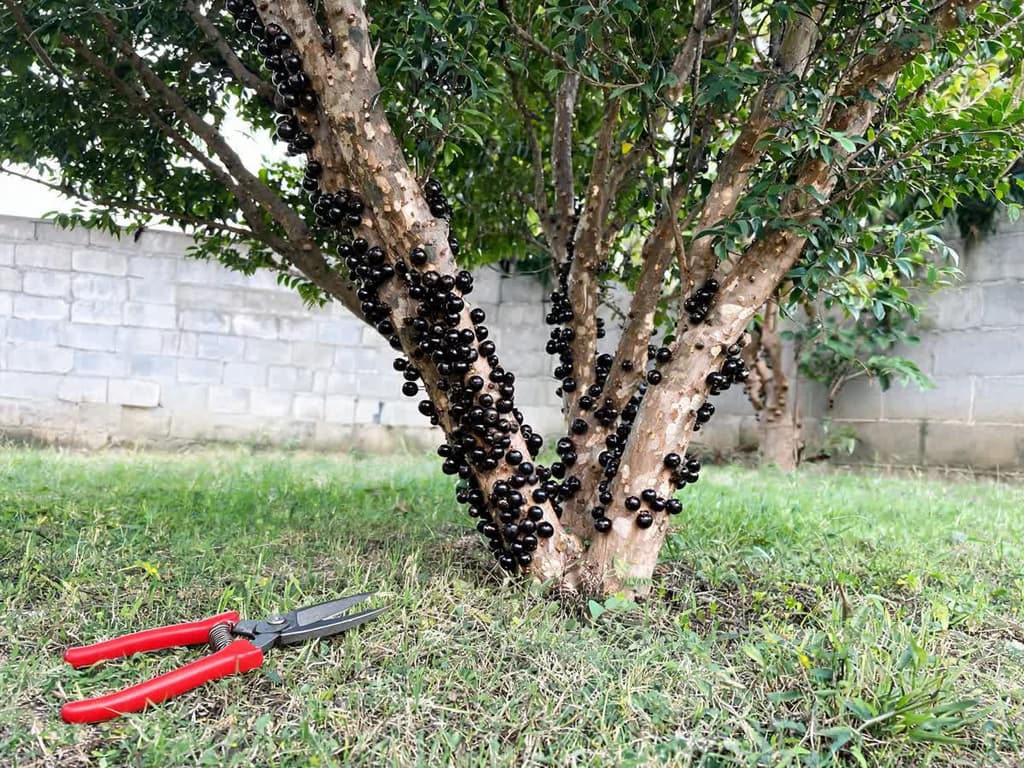
A properly pruned jaboticaba loses very little: dry, diseased, broken, crossing branches, and the thin ones crowding the center of the canopy. Keep thick branches and the trunk, since that is where flowers and fruit grow. For saplings, structural pruning (the cuts shaping the young plant) leaves a 16-to-24-inch trunk before the first branches. On mature trees, wait at least 30 days after harvest before pruning.
This guide shows which types of pruning jaboticaba (Plinia cauliflora) tolerates and how to make each cut. It also shows when to prune in Brazil and what to do if yours has already been pruned too much.
Quick summary:
Jaboticaba bears fruit directly on the trunk and old branches. Because of this, pruning removes only what is dry, diseased, crossing, or crowding the canopy. Avoid cutting healthy thick branches.
On mature trees, prune at least 30 days after harvest; structural pruning of saplings can be done in winter, which runs from June to September in Brazil.
Drastic pruning (removing a large portion of the canopy) is not recommended because jaboticaba recovers slowly. If yours has already been cut back hard, scratch the bark with your fingernail: green underneath means the branch is alive.
Why jaboticaba is not pruned like other fruit trees
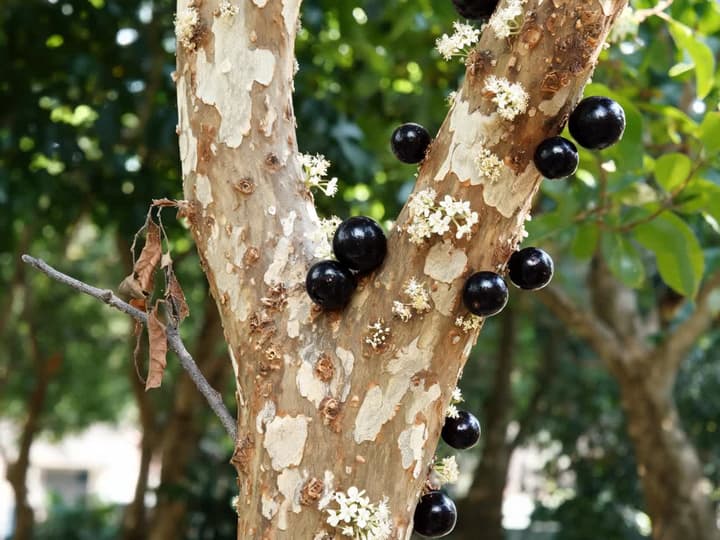
Jaboticaba exhibits cauliflory: flowers and fruit emerge directly from the trunk and older branches, not from the tips of new growth. Because of this, thick jaboticaba branches are where the next harvest will form. Cutting these branches means cutting off fruit.
UF/IFAS, the University of Florida Extension, describes the cauliflory of Plinia cauliflora. From this, it derives the pruning rule: "Cutting large mature branches should be avoided to maintain production." The same publication recommends light pruning of weak or dead branches, because it allows light to reach the mature branches where fruit develops.
Embrapa Clima Temperado reaches the same conclusion regarding canopy training. It calls for branches spaced 8 to 12 inches (20 to 30 cm) apart, "since all of them are productive."
Does jaboticaba need pruning?
Very little. An older UF/IFAS publication notes that little to no pruning is generally required on jaboticaba. Embrapa Clima Temperado points out that pruning on jaboticaba has been widely debated. In the same document, it cites Manica (2000): spaced 33 feet apart, trees grow for years without any pruning, needing neither structural pruning nor pruning to stimulate fruiting.
Sources differ regarding young trees. Embrapa Clima Temperado states that "pruning is necessary on developing trees." UF/IFAS notes that young jaboticaba trees do not require pruning and naturally develop a dense, well-branched canopy. Neither evaluated the impact on harvest yields, so this guide takes the safer route: only train the sapling if you want a clean 16-to-24-inch lower trunk or a single-stem tree.
For orchard trees, Embrapa also describes a fruiting pruning method that retains 4 to 6 main scaffold branches measuring 4 to 5 feet each. No technical source has measured the yield results of this pruning approach on jaboticaba. For backyard trees, this guide follows UF/IFAS and avoids cutting thick, mature branches.
Pruning only makes sense in three situations: saplings you want to train to a single trunk, mature trees with an overly dense canopy, and removing dry, diseased, or broken branches at any age.
Types of jaboticaba pruning
Jaboticaba accepts three types of pruning: structural training, maintenance, and sucker removal.
Pruning type | When to do it | What to cut | What to leave |
|---|---|---|---|
Structural training | On saplings that have not flowered yet, during winter | Branches below 16–24 inches in height and branches growing flush against one another | A 16–24-inch trunk below the canopy (single trunk, if desired) and branches spaced 8–12 inches apart |
Maintenance | On mature trees, 30 days or more after harvest | Dry, diseased, broken, crossing branches, and thin growth crowding the center of the canopy | Trunk and healthy thick branches |
Sucker removal | As soon as they appear | Shoots sprouting from the roots or the tree base, if training to a single trunk | Canopy branches |
Structural pruning for young jaboticaba
Structural pruning establishes a clear 16-to-24-inch trunk above the ground before the canopy begins. To achieve this, prune lateral branches emerging below that height in winter. This spacing is recommended by Embrapa Clima Temperado and Brazilian technical literature to keep an open canopy with evenly distributed branches. Remaining scaffold branches should sit 8 to 12 inches apart. No source specifies an exact age or height threshold to begin these cuts.
UF/IFAS notes that jaboticaba can grow as a single-trunk tree, a multi-stemmed shrub, or in containers for many years. If you want a single trunk, remove root suckers. UF/IFAS recommends doing this after the initial sapling stage, and only on certain varieties.
Maintenance pruning on mature jaboticaba
Maintenance pruning opens the canopy, which naturally becomes dense on jaboticaba. Embrapa Clima Temperado recommends this pruning to reduce pests and diseases and let sunlight reach the branches. UF/IFAS adds that removing crossing branches improves flowering and fruiting. The same applies to branches that cast heavy shade on the inner canopy or trunk bark.
Rust is considered the main disease of the jaboticaba tree, attacking the fruit during hot, rainy periods. APTA, the agricultural research agency of São Paulo, includes pruning branches to let light reach the plant among the measures against rust.
When to prune jaboticaba in Brazil
Prune a mature jaboticaba tree at least 30 days after harvest. That is the recommendation of José Emílio Bettiol Neto, a researcher at the Instituto Agronômico de Campinas (IAC), to Globo Rural in 2015. According to him, the interval allows the tree to recover from the effort of producing fruit. Structural pruning can be done in winter, when the plant is less active, on a sapling that does not yet produce flowers or fruit. No published study has measured the best pruning time for jaboticaba.
The exact month varies by region, because jaboticaba can bloom multiple times. In São Paulo, APTA notes blooms in July and August, then again in November and December. Fruit ripens in August and September, followed by January and February. In Pelotas (RS), during the 2003–2004 cycle, Embrapa observed primary blooming between September and October, with another bloom starting in late January and fruiting through May.
Because of this, time pruning according to your tree's growth cycle:
do not prune during flowering or while fruit is on the branches, since cutting removes the crop;
wait 30 days after the final harvest of the season;
if the tree blooms again within those 30 days, wait 30 days after harvesting that subsequent crop.
Step-by-step jaboticaba pruning
For a backyard jaboticaba, you need sharp bypass pruners for thin branches. Use a pruning saw whenever the hand pruners require excessive force to cut through.
Start with dry and broken branches. Scratch the bark with your fingernail: if it is brown underneath and snaps easily, the branch is dead. Cut right down to the point where the tissue underneath turns green.
Remove diseased branches or those attacked by pests. A moth caterpillar (Timocratica palpalis) damages the bark of trunks and branches. Embrapa Clima Temperado recommends removing severely damaged limbs that defoliate and die back.
Remove crossing branches and thin growth pointing inward. Where two branches rub together, keep the thicker, better-positioned one.
On saplings trained to a single trunk, remove suckers sprouting from the roots and base.
Stop before reaching thick, healthy branches. These are the limbs that bear flowers and fruit directly on their bark.
Cut the branch just outside the collar, the thicker ring where the branch joins the trunk. Leave the collar on the trunk and do not leave a stub. UF/IFAS gives this guidance for trees in general. A flush cut creates a larger wound and increases the chance of wood-decay fungi entering.
No technical source specifies an exact percentage of canopy loss that jaboticaba can tolerate in a single pruning. The safest approach is to cut only what fits steps 1 through 4, then stop.
Bordeaux paste on jaboticaba cuts: what sources say
Sources disagree about applying anything to the cut. On the Brazilian side, the IAC researcher states that protecting the cut is prudent. The Ministério da Agricultura factsheet recommends Bordeaux paste (lime with copper sulfate) after pruning fruit trees. The factsheet cites apple, grape, and mango trees, and does not mention jaboticaba trees.
On the other side, university extensions in the United States address pruning sealers (paint or paste applied to the cut). According to them, sealer does not prevent wood rot. Iowa State states that sealer can even interfere with the tree's natural response to the cut. Colorado State cites 1970s research on woody plants, and UF/IFAS warns that sealer can trap moisture inside the cut.
None of these sources tested Bordeaux paste specifically on jaboticaba. This guide follows university extension guidance based on comparative research: clean cuts outside the collar, without stubs, and no sealant. If you choose to protect the cut, the Ministério da Agricultura factsheet recommends Bordeaux paste for fruit trees.
Pruning container-grown and bonsai jaboticaba
UF/IFAS notes that keeping jaboticaba in containers for years is common due to its slow growth rate. It tolerates root-bound conditions, which can even encourage earlier blooming in some varieties. UF/IFAS also notes that container trees only thrive long term if repotted into larger containers and fertilized. No source specifies an exact repotting interval.
For container trees, UF/IFAS suggests only light pruning of weak branches once the plant reaches an approximately 3-gallon container or 24 to 36 inches in height. This pruning helps the canopy develop its natural rounded shape. Fine feeder roots that absorb water sit in the upper inches of container soil, so UF/IFAS advises regular watering for potted jaboticaba.
If you grow another fruit tree in a container, you need watering, sun, and repotting specific to each species. See how to care for a fig tree and how to care for an avocado tree.
For jaboticaba bonsai, growers usually wait for new shoots to reach six to eight pairs of leaves. Then, they cut the shoot back to the second or fourth pair. This practice comes from bonsai practitioners rather than research, and no source states which month to make this cut. The safest option is the same as for a full-sized tree: outside of flowering and away from fruiting. Repotting the bonsai is usually done every two years, with moderate root pruning. The timing is spring, which in Brazil runs from September to December.
Over-pruned jaboticaba: how to tell if it is still alive
A severely over-pruned jaboticaba can remain alive even without leaves, but recovery takes time. A technical summary by Borges and Melo reviewing Donadio (2000) on jaboticaba cultivation notes that drastic pruning is not recommended "because plant regeneration is slow." No source has tracked the exact weeks required for jaboticaba to push new growth after severe pruning.
To find out if the remaining trunk and branches are alive, use the scratch test. The University of Illinois Extension teaches this test for trees and shrubs. Lightly scrape the bark with your fingernail or a key. If green appears underneath, that section is alive. If it is brown and the branch snaps easily, that section has died.
Perform the test across several branches and down the trunk, repeating further down if an upper branch shows brown. Cut away only dead portions, making cuts just above the point where living green tissue appears. As long as the trunk shows green, the tree remains alive, even without foliage. The test confirms viable tissue, though it cannot predict when new shoots will appear.
While waiting for an over-pruned jaboticaba to push new growth, follow three rules:
Do not prune any further. Every additional cut removes more wood from a tree that already recovers slowly.
Do not waterlog the soil. Embrapa Clima Temperado notes that the jaboticaba tree needs water year-round, but that waterlogging can kill the roots. Stick your finger into the soil: water if the first few inches are dry, and wait if they are moist. Also see the signs of overwatering on a jaboticaba tree.
Do not dig up the tree as long as the trunk shows green in the scratch test. A seed-grown tree takes 8 to 12 years to bear its first fruit, according to APTA (UF/IFAS states 8 to 10). Grafted specimens are propagated from mature scion wood. According to APTA, grafted trees start producing fruit in their third or fourth year after being planted out in their permanent location.
Falling leaves and branch tips drying out after heavy pruning have more than one possible cause, including overwatering and fungus. The guides on jaboticaba leaves falling and dry tips on jaboticaba help isolate the causes. If a black spot grows around the cut or on the leaves, read the guide on jaboticaba fungus. A photo of the leaf in Bloom (available for iOS) identifies the probable disease. Photo diagnosis is part of the Premium plan.
Frequently asked questions about pruning jaboticaba
When is the best time to prune jaboticaba?
On mature jaboticaba trees, prune at least 30 days after harvest, as recommended by researcher José Emílio Bettiol Neto of the IAC. Structural pruning of saplings can be done in winter, which in Brazil runs from June to September. Avoid pruning during flowering or while fruit is on the branch, as cutting removes the harvest with it.
Can you cut back jaboticaba branches?
You can cut dry, diseased, broken, and crossing branches, along with weak twigs crowding the inner canopy. Do not cut the main trunk or thick, healthy limbs, since jaboticaba flowers and fruit develop directly along that wood. UF/IFAS recommends avoiding cuts to large, mature branches to safeguard production. Make cuts just outside the branch collar without leaving stubs.
Does applying cinnamon to jaboticaba cuts help?
None of the reviewed technical sources recommend using cinnamon on pruning wounds. US university extensions state that even commercial pruning sealants fail to prevent fungal wood decay. The most beneficial step for jaboticaba is making a smooth cut just outside the branch collar without leaving a stub. For growers who prefer wound protection, Ministério da Agricultura notes Bordeaux paste for fruit trees.
Does pruning jaboticaba increase fruit yield?
UF/IFAS notes that clearing crossing limbs and shading branches improves flowering and fruit set by letting light penetrate the trunk and heavy scaffold limbs. It does not provide specific yield metrics, and no published studies have quantified this yield boost on jaboticaba. Harsh pruning does the exact opposite: it eliminates fruiting wood, and the tree recovers slowly.
Summary: how to prune jaboticaba
A properly pruned jaboticaba loses only dry, diseased, broken, crossing branches, and thin growth crowding the canopy. The trunk and thick branches stay, because that is where fruit develops. Prune mature trees 30 days or more after harvest, and shape saplings during winter. If your tree was over-pruned, do the scratch test, make no further cuts, and water without waterlogging the soil.
Related articles

How to Care for Hibiscus: Sun, Watering, Fertilizer, and Pruning for Flowers
How to care for hibiscus: 6 hours of direct sun, evenly moist soil without waterlogging, half-strength fertilizer in spring and summer, and pruning in early spring. Find out why the flower lasts one day and why buds drop before opening.

Do Ferns Like Sun or Shade? It Depends on the Type
Ferns prefer bright shade: plenty of light, but no direct sun on their fronds. Tuberous sword fern is the exception that handles sun. Here is the ideal light for each type, where to place pots, and how fronds show too much or too little light.

African Violet Yellow Leaves: Causes and What to Do
Yellow leaves on an African violet usually stem from overwatering, and the first place to check is the center of the plant. Losing one lower leaf at a time is normal. Identify whether age, watering, cold water, sunlight, cold drafts, or fertilizer is the culprit based on the yellowing pattern, and see what to do today.