How to Care for Jasmine: Light, Water, Pruning, and the Chill That Makes It Bloom
How to care for jasmine indoors: identify which jasmine you have, provide 4 hours of direct sun, water before it wilts, offer cool nights for pink jasmine to bloom, and prune right after flowering.
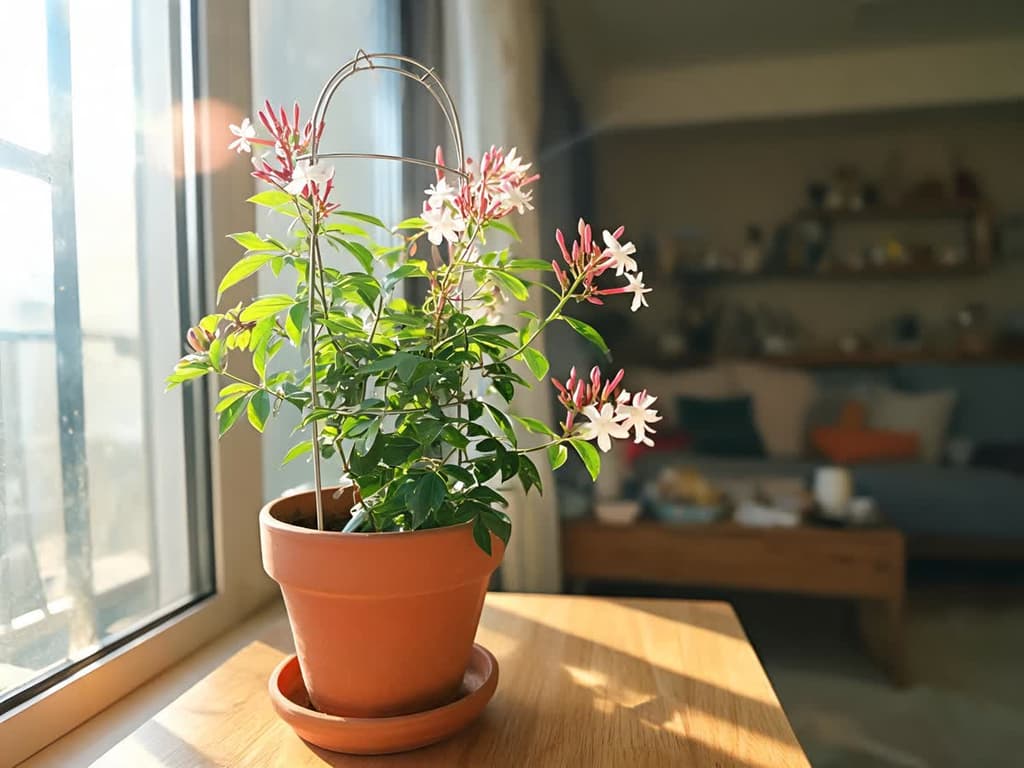
To care for jasmine, provide at least 4 hours of direct sun per day and water when the top 2 cm (about 1 inch) of soil dries out. Prune right after flowering ends. For pink jasmine, sold in bloom in pots, cool autumn nights help set buds. The first step, however, is knowing which jasmine you have: in Brazil, the name applies to plants from different families, with different care needs.
The figures in this guide come from university extensions (university services that provide guidance for plant growers) and the Royal Horticultural Society (RHS) in the United Kingdom. Toxicity data comes from the ASPCA, an American animal protection organization. Blooming facts come from nurseries, always cited as such. The sources originate in the Northern Hemisphere. The months and window orientation are already converted for Brazil.
Quick summary:
True jasmine belongs to the genus Jasminum, in the olive family. Star jasmine, frangipani, and Carolina jessamine belong to other genera.
Indoors, jasmine requires 4 hours of direct sun per day, according to Clemson University. Without direct sun, provide 14 to 16 hours of strong artificial light.
According to nurseries, pink jasmine sets flower buds after weeks of cool nights, below 15.5 °C (60 °F) and without frost.
Jasminum is non-toxic to dogs and cats, according to the ASPCA. Carolina jessamine, a false jasmine, is highly toxic.
How to care for jasmine: care guide at a glance
Care factor | What to do |
|---|---|
Light | 4 hours of direct sun per day; in Brazil, a north-facing window (an east-facing one only if it gets the 4 hours of sun) |
Watering | Water when the top layer of soil (about 2 cm / 0.8 in) feels dry to the touch; never let the plant wilt |
Temperature | Daytime between 20 and 22 °C (68 to 72 °F); nighttime between 10 and 13 °C (50 to 55 °F) (Arabian jasmine: night above 15.5 °C / 60 °F) |
Flowering | Pink jasmine: cool nights in autumn, below 15.5 °C (60 °F) and frost-free; one nursery uses about 4 weeks |
Fertilizer | Liquid, high in potassium, once a month, from October to April |
Pruning | Right after flowering; do not prune pink jasmine after early February |
Pests | Spider mites and mealybugs (insects covered in white wax resembling cotton), most common indoors |
Pets | Jasminum is non-toxic to dogs and cats (ASPCA) |
Which jasmine you have: Jasminum and false jasmines
True jasmine is any species in the genus Jasminum (the group of related species), in the olive family. There are more than 200 species of vines and shrubs with opposite leaves, in pairs at the same point on the stem. The figures come from the Florida Division of Plant Industry (FDACS). It counts another 29 plants from 12 families that also go by the name jasmine.
In Brazil, no Jasminum is native. The Flora e Funga do Brasil, from the Rio de Janeiro Botanical Garden, records all species of the genus as exotic. The same database shows that common names overlap. "Jasmim-dos-poetas" is the name for three Jasminum species. "Jasmim-amarelo" also names three.
The most common true jasmines grown in pots are these:
Pink jasmine (Jasminum polyanthum): a vine with pinkish buds that open into white, highly fragrant flowers. It is the jasmine sold blooming in pots. Profile: pink jasmine.
Common jasmine (Jasminum officinale): a white-flowering vine, also known as poet's jasmine. Profile: common jasmine.
Arabian jasmine (Jasminum sambac): an entire-leaved shrub with waxy white flowers. Dried blossoms scent jasmine tea, according to the FDACS.
Primrose jasmine (Jasminum mesnyi): a shrub with long arching branches that cascade, bearing yellow flowers.
Azores jasmine (Jasminum azoricum): a vine with white flowers and leaves made of three leaflets (the distinct parts into which a compound leaf divides). Profile: Azores jasmine.
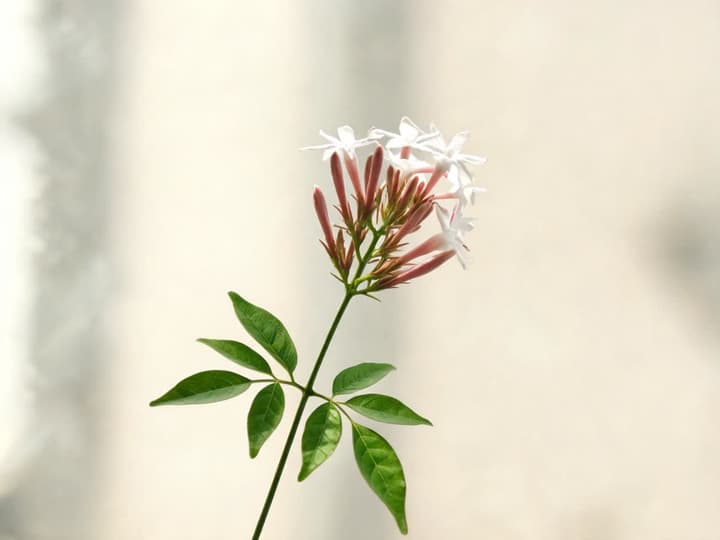
Leaves and flowers set each plant apart. The table below lists only characteristics described by the cited sources.
Plant | Leaf | Flower | Source |
|---|---|---|---|
Pink jasmine (J. polyanthum) | Compound, with 5 to 7 narrow leaflets | White, with a long tube, opening from a pink bud | RHS, Kwantlen Polytechnic University |
Common jasmine (J. officinale) | Compound, with 5 to 9 leaflets | White, 5-lobed, in clusters | Clemson, FDACS |
Arabian jasmine (J. sambac) | Entire (simple), oval | White and waxy, sometimes double (full of petals) | FDACS |
Primrose jasmine (J. mesnyi) | 3 glossy leaflets | Yellow, often semi-double (with extra petals) | FDACS |
Star jasmine (Trachelospermum jasminoides) | Opposite; the stem produces milky sap | White, with 5 twisted petals, like a pinwheel | FDACS |
Carolina jessamine (Gelsemium sempervirens) | Opposite | Yellow, tubular, 5-lobed | FDACS |
Three false jasmines appear frequently in Brazil. Star jasmine is a vine from a different family, with milky sap. In Brazil, "jasmim-manga" is the frangipani (Plumeria), a tree. Madagascar jasmine is Stephanotis, also called bridal wreath. Night-blooming jasmine (Cestrum nocturnum) and Cape jasmine, which is gardenia, also carry the name.
The flower of Carolina jessamine is yellow, like that of primrose jasmine. The plant, however, is highly toxic, according to the North Carolina State University (NC State) Extension. When in doubt between the two, identify the plant before allowing children or animals near it.
To identify plants from a photo, the Bloom app (available for iOS) identifies species from a picture of a leaf or flower. The care tips in this guide apply to Jasminum. The general profile for jasmine covers the genus.
Vine or shrub: support and potted size
Pink jasmine is a twining climber that reaches up to 7.5 meters, according to the RHS. Common jasmine grows from 3 to 4.5 meters as a sprawling shrub. To climb, it needs a trellis or another support, according to Clemson University. The RHS states that it reaches up to 12 meters as a climber; in a pot, pruning keeps the plant much smaller. Arabian jasmine is a shrub that climbs up to about 1.5 meters.
In a pot, most jasmines stay between 1.2 and 1.5 meters (4 to 5 feet) and tolerate pruning to maintain their size, according to NC State. For vines, place an arch or a trellis in the pot itself. Wrap new shoots around the support as they grow.
Primrose jasmine has long, arching branches that can spill over walls and tall planters, according to the FDACS. With support, it becomes a climber, according to Oregon State University. Other sun-loving climbers require different supports: bougainvillea must be tied to its support. Mandevilla twines like pink jasmine.
How much light jasmine needs
Indoors, jasmine needs at least 4 hours of direct sun per day, according to Clemson. Without a sunny window, the alternative is 14 to 16 hours of strong artificial light. In Brazil, the window with the most sun faces north. An east-facing window provides weaker morning sun.
For pink jasmine, sources differ. The American nursery White Flower Farm says the plant prefers bright light without direct sun. Kwantlen Polytechnic University, in Canada, indicates full sun (direct sun, without shade), and the RHS indicates bright light filtered through a curtain. This guide follows Clemson, a university extension: 4 hours of direct sun per day.
NC State notes that jasmines require full sun or at least bright light to stay healthy. If your plant produces leaves but no flowers, move the pot to a spot with at least 4 hours of direct sun.
How to water jasmine
Water jasmine when the top layer of soil, about 2 cm (0.8 in), feels dry to the touch. Water thoroughly until moisture runs out of the drainage hole, and empty the saucer once drainage stops. Standing water in the saucer keeps the roots waterlogged.
Pink jasmine suffers when underwatered. According to White Flower Farm, plants that wilt do not recover without developing brown leaves. In hot weather, potting soil dries faster: perform the finger test more frequently during summer.
In winter, the plant grows less and uses less water. The RHS recommends watering Arabian jasmine moderately in winter, while NParks advises watering Arabian jasmine only when the soil is dry. For both jasmines, follow the same test: water only when the top 2 cm (0.8 in) dries out.
Temperature and humidity
Indoors, warm-climate jasmines thrive at 20 to 22 °C (68 to 72 °F) during the day, according to Clemson. At night, 10 to 13 °C (50 to 55 °F) is ideal. Tropical Arabian jasmine requires nights above 15.5 °C (60 °F), according to the New York Botanical Garden (NYBG). For pink jasmine, place the pot near a window where nights are cooler.
Hot air from a heater or wind from a fan blowing directly on the plant dries out the leaves, according to White Flower Farm. The Iowa State University Extension states that dry air turns leaves brown until they drop. Move the pot away from hot air vents and direct drafts from a fan or air conditioner.
To raise humidity around the plant, White Flower Farm suggests misting the foliage or setting up a humidity tray. Fill the tray with pebbles and water, keeping the pot base above the water level.
Pink jasmine needs protection from frost: its minimum recommended temperature is 4 °C (40 °F), according to the Miller Library at the University of Washington.
How to make jasmine bloom
Pink jasmine sets buds after a period of cool nights. The American nursery Logee's says that nights below 15.5 °C (60 °F), always above 0 °C (32 °F), initiate bud set. White Flower Farm chills plants to 5.5 °C (42 °F) at night, with a minimum of 4.4 °C (40 °F), for about 4 weeks. Then, it gradually warms them up to 18 °C (64 °F).
This is the practice of growers, not the result of a study. We found no published studies on how many weeks of cold pink jasmine needs. The nursery itself thinks that shorter autumn days also help, but states it has no data to prove it.
The RHS offers different advice. If pink jasmine spent the summer outdoors, the RHS recommends bringing it inside before night temperatures drop below 13 to 15 °C (55 to 59 °F). The RHS focuses on shielding the plant from harsh cold, whereas commercial nurseries target bud set. No source has tested both approaches side by side. The safest option for the plant is cool nights between 5 and 15 °C (41 to 59 °F), without any frost.
No source has measured the blooming calendar for pink jasmine in Brazil. Due to the reversal of the seasons, cool nights arrive in autumn, from March to May, in the South and mountain regions. By that calculation, pink jasmine blooms in late winter and early spring, from August to October. Where nights do not drop below 15.5 °C (60 °F), the signal nurseries use to trigger flower buds is missing.
For other jasmines, no source requires cold for blooming:
Arabian jasmine: none of the consulted sources say that it needs cold. The New York Botanical Garden (NYBG) recommends nights above 15.5 °C (60 °F). It blooms in summer and, in smaller amounts, at other times, according to the RHS.
Common jasmine: blooms best with night temperatures down to 12.8 °C (55 °F), according to the NYBG. Flowering spans from summer to early autumn, according to the RHS.
On pink jasmine, a lack of flowers can stem from low light or late pruning. Logee's points out that it needs abundant light even in winter, and late pruning removes the wood that would carry flowers. Sources do not measure this across other species.
How to prune jasmine
Prune jasmine right after blooming ends. Most jasmines bloom on the previous year's growth, according to NC State. Pruning immediately after flowering spares older stems, where the next season's blooms develop. The RHS instructs to cut each flowered stem back to a strong lower side shoot.
Pink jasmine has a pruning deadline. White Flower Farm stops pruning in early August in the Northern Hemisphere to avoid losing buds. In Brazil, this corresponds to early February. After that date, only remove dead stems.
Common jasmine tolerates hard pruning after flowering, according to NC State. In Arabian jasmine, pruning increases flower production by encouraging new shoots, according to the Singapore National Parks Board (NParks). Prune it lightly immediately after flowering, according to Arizona State University (ASU).
Soil, pots, and fertilizer
Plant jasmine in well-draining potting mix, using a pot with drainage holes. The RHS recommends a loam-based, peat-free (decomposed moss material) potting soil for pink jasmine and primrose jasmine.
To encourage more blooms, the RHS recommends a high-potassium liquid fertilizer, the same type used for tomatoes, for potted jasmines. White Flower Farm fertilizes pink jasmine once a month at half the label strength. In Brazil, do this from October to April, while the plant is growing.
Arabian jasmine requires a low-nitrogen fertilizer applied once a month during its growing season, according to the RHS.
Brown leaves, crispy tips, and yellow leaves on jasmine
Brown, crispy foliage on jasmine usually stems from one of these causes, according to Iowa State and White Flower Farm:
The plant wilted from lack of water: leaves turn brown after wilting. Water earlier, using the 2 cm (0.8 in) test.
Dry or hot air: leaf tips and margins turn brown. Keep the pot away from heaters, air conditioners, and fans.
Overwatering: leaves turn yellow and drop while the soil stays wet days after watering. Water less frequently and empty the saucer.
Sudden light changes: the plant drops leaves after being moved, as well as in excessively strong or weak light.
A lack of fertilizer also turns leaves yellow, according to Iowa State. If the soil is not soggy and the plant has gone months without fertilizer, nutrient deficiency is the likely cause. The page on crispy tips on jasmine covers these symptoms in detail.
Spider mites and webbing on jasmine
According to the RHS, indoor jasmine can harbor aphids, scale, mealybugs, and spider mites. NC State confirms that pests occur more frequently on plants overwintering indoors. Two-spotted spider mites are tiny arachnid relatives that suck sap from leaf undersides.
Signs of spider mites include leaves with light-colored specks and fine webbing between leaves and stems. To confirm, tap a stem over a sheet of white paper. If moving specks appear, it is spider mites, according to Iowa State.
The initial treatment uses only water, making it safe for homes with cats. Rinse the plant in the shower, thoroughly spraying the underside of the leaves. Trim severely infested stems and boost air humidity, since spider mites thrive in dry air, according to Iowa State. Repeat the shower and the paper test until no moving specks remain.
If the mites return, the guide on spider mites on plants shows which products to use and how to apply each one. White, cotton-like masses where the leaf meets the stem are a sign of mealybugs, another common indoor jasmine pest.
Is jasmine toxic to cats and dogs?
True jasmine is non-toxic to dogs, cats, and horses, according to the ASPCA, which evaluates the entire Jasminum genus. The ASPCA also classifies star jasmine and Madagascar jasmine as non-toxic.
Two false jasmines are toxic. Cape jasmine (gardenia) is toxic to dogs and cats, according to the ASPCA, and causes mild vomiting and diarrhea. Carolina jessamine is toxic to pets, according to the Pet Poison Helpline, a veterinary service in the United States. NC State classifies the plant as having high toxicity in all its parts. The list of plants toxic to pets gathers other common species found at home.
How to propagate jasmine
Pink jasmine propagates by semi-ripe cuttings (a piece of this year's shoot that has begun to harden) in summer, according to the RHS. Another method is layering in fall: a stem bent down and pegged into the soil takes root while still attached to the mother plant. The RHS recommends the same two methods for Arabian jasmine and primrose jasmine. In Brazil, summer cuttings run from December to February, and fall layering from March to May.
Frequently asked questions about jasmine
Can you grow jasmine indoors?
Yes, as long as the jasmine sits in a window with at least 4 hours of direct sun per day. The other option is 14 to 16 hours of strong artificial light, according to Clemson. In Brazil, the best window faces north. Pink jasmine also needs cool nights in autumn to bloom.
Does jasmine do better in pots or in the ground?
Both work. In the ground, vines grow larger: pink jasmine reaches 7.5 meters (25 feet), according to the RHS. In pots, most stay between 1.2 and 1.5 meters (4 to 5 feet), according to NC State. A container allows you to move the plant to a cooler spot in autumn and shield it from frost.
Do you need to prune jasmine every year?
Yes, to keep the plant strong and flowering, according to the RHS. Prune once a year, right after blooming, and cut each flowered stem back to a strong side shoot. For pink jasmine, finish pruning by early February in Brazil. After that, cutting removes the buds.
Why do jasmine flowers drop?
None of the consulted sources measured flower drop in jasmine. White Flower Farm notes that pink jasmine blooms last longer in cool temperatures. It also states the plant dislikes hot air and drafts from fans. Keep the pot in a cool spot and water according to the 2 cm (0.8 in) test.
Which jasmine has the strongest fragrance?
No source ranks fragrance intensity among species. According to NC State, a single common jasmine plant perfumes an entire room. Arabian jasmine blossoms open late in the afternoon, according to University of California Master Gardeners, releasing fragrance into the night. Clemson and the JC Raulston Arboretum note that primrose jasmine has little to no fragrance, though the FDACS describes it as fragrant.
Jasmine care summary
Jasmine needs 4 hours of direct sun, watering when the top 2 cm (0.8 in) of soil dries out, and nights cooler than days. According to nurseries, pink jasmine sets buds with nights below 15.5 °C (60 °F) in autumn and, in Brazil, blooms from August to October. Prune right after flowering. Before anything else, confirm that the plant is a Jasminum: false jasmines require different care, and Carolina jessamine is toxic.
Related articles

How to Care for Hibiscus: Sun, Watering, Fertilizer, and Pruning for Flowers
How to care for hibiscus: 6 hours of direct sun, evenly moist soil without waterlogging, half-strength fertilizer in spring and summer, and pruning in early spring. Find out why the flower lasts one day and why buds drop before opening.

Do Ferns Like Sun or Shade? It Depends on the Type
Ferns prefer bright shade: plenty of light, but no direct sun on their fronds. Tuberous sword fern is the exception that handles sun. Here is the ideal light for each type, where to place pots, and how fronds show too much or too little light.

African Violet Yellow Leaves: Causes and What to Do
Yellow leaves on an African violet usually stem from overwatering, and the first place to check is the center of the plant. Losing one lower leaf at a time is normal. Identify whether age, watering, cold water, sunlight, cold drafts, or fertilizer is the culprit based on the yellowing pattern, and see what to do today.