Oleander pests: how to identify and treat each one
Oleander aphids, scale, spider mites, and caterpillars leave distinct signs on oleander. Learn how to identify each pest by the traces it leaves and how to treat them safely without poisoning yourself with the sap.
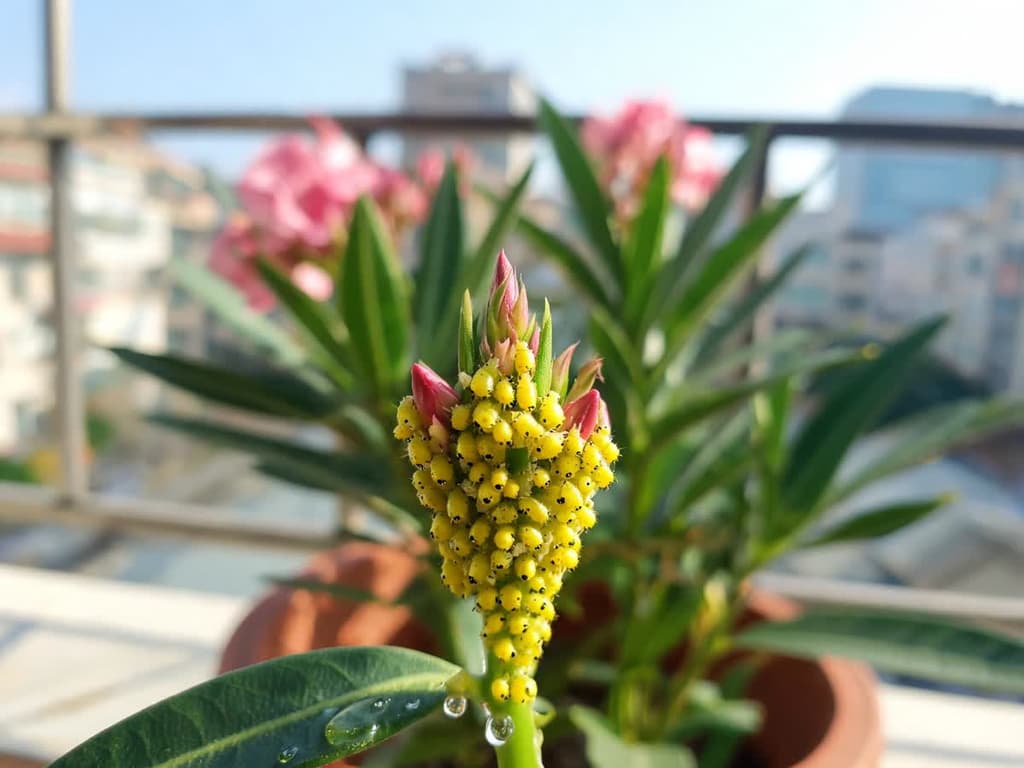
Three oleander pests appear most often: oleander aphids (bright yellow, on shoot tips), scale insects, and spider mites. The black layer covering the leaves, called sooty mold, comes from pests that excrete honeydew and is not an additional bug. You can almost always save the plant. Wear gloves from the first touch, because oleander sap is toxic.
Quick summary:
Honeydew, the sticky, sugary liquid excreted by some insects, points to aphids, mealybugs, or soft scale. A dry white crust without stickiness is oleander scale, which does not produce honeydew.
The oleander aphid measures 1.5 to 2.6 mm, is yellow with black legs, and comes off with a strong blast of water.
The oleander caterpillar (orange with black tufts) and oleander knot (black warts on the branches) require pruning the branch. Bag the clippings, put them in regular trash, and never burn them.
Before touching oleander: gloves, sealed bag, and regular trash
Oleander (Nerium oleander), also called rosebay, is one of the most toxic plants in the garden. The NC State Extension classifies the plant's poison as high severity and notes that the sap causes contact dermatitis. Almost every pest treatment involves cutting branches or scrubbing leaves, and this contact is how the sap reaches your skin.
Gloves and long sleeves to prune, scrape scale, or pull off leaves.
Sealed bag in regular trash for removed branches, leaves, and caterpillars. Do not leave cut branches within reach of dogs, cats, or horses.
Never burn pruning scraps. NC State warns that smoke from burning is harmful.
Wash your hands after disposing of the material. The University of Florida (UF/IFAS) provides this guidance in its oleander caterpillar fact sheet.
For dogs, cats, and horses, the ASPCA, the American animal protection association, lists oleander as toxic. Signs range from drooling and diarrhea to depression and death. If your pet chews on leaves, keep it away from oleander and check what else it might bite on this list of plants toxic to pets.
Which pest is it: start with the sign you see
Each oleander pest leaves its own distinct mark. Check the undersides of the leaves and the tips of new shoots first, preferably with a 10x magnifying glass. Then find your case on this list:
Bright yellow bugs clustered on tips and buds, with stickiness below: oleander aphids.
Flat, round white dots measuring 1 to 2 mm, stuck to the leaf, without stickiness: oleander scale.
Raised brown bumps on the branch, with stickiness and ants: soft scale.
White cottony tufts where the leaf attaches to the branch: mealybugs.
Leaves with light stippling on the upper surface, a dull look, and fine webbing underneath: spider mites.
Light brown shoot tips, with leaves scraped down to the veins, or entirely chewed leaves: oleander caterpillars.
Matte black powder coating the leaf surface: sooty mold, which comes from one of the pests that excrete honeydew.
Black spots with yellow borders on the leaf and cracking black warts on the branch: oleander knot, a disease caused by bacteria.
Yellow leaves without any of these signs usually stem from another cause, such as watering or cold. In frosty climates, it could be a lack of light in the room where the plant spends the winter.
Oleander aphids: the yellow bugs on the tips
The oleander aphid (Aphis nerii) is the most typical oleander pest. The UF/IFAS publication EENY-247 describes it as bright yellow, with black legs, antennae, and cornicles at the end of the abdomen. It measures 1.5 to 2.6 mm and lives in colonies on new tips and flower buds.
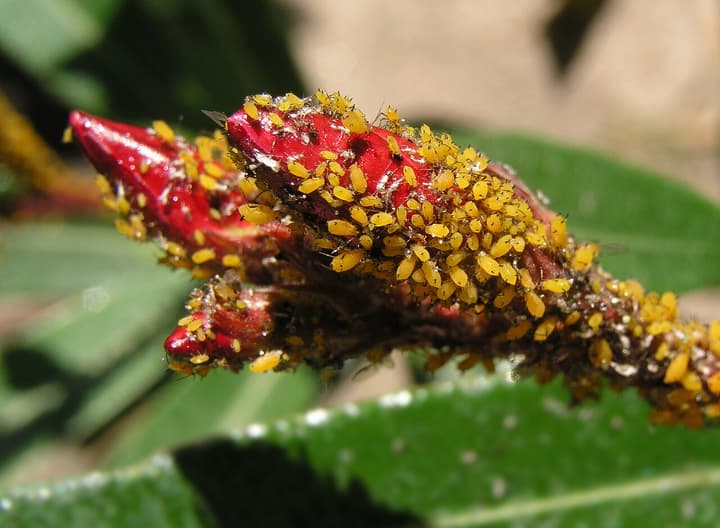
The colony grows fast because, as far as is known, only females exist. They do not need males and give birth to live young, without eggs, which soon reproduce as well. The damage, according to the same fact sheet, is mainly visual. The aphid deforms the shoot tips and releases honeydew, the sugary, sticky liquid that later turns black with sooty mold. According to UF/IFAS publication EP574, it is usually most numerous in spring, but it appears whenever the plant is growing.
Aphids of other colors appear as well. The RHS, the Royal Horticultural Society of the United Kingdom, records green, black, pink, and white species. A little black bug walking on the shoot tip is an aphid; stationary black powder on the leaf is sooty mold.
The RHS suggests tolerating a few aphids because, if you wait a bit, natural enemies usually take care of them. Treat when the colony covers the tips.
How to treat oleander aphids, from mildest to strongest:
A strong blast of water on the tips, top and bottom. Repeat until the tips are clean.
Prune heavily infested tips, wearing gloves, and dispose of them in a sealed bag.
Insecticidal soap or oil only with heavy infestations. UF/IFAS states that these two products usually solve the problem and that, in home gardens, other insecticides are unnecessary.
Prune only the covered tips and cut back on excess fertilizer and water. EP574 notes that disturbing the plant's growth less is the most effective way to control aphids. Fertilizer, water, and pruning stimulate the tender new growth they feed on.
Before applying any product, look for swollen, light brown, papery, motionless aphids. These are aphid mummies: aphids with a parasitic wasp developing inside, which UF/IFAS considers a sign of natural control in progress. If you see many mummies, hold off on the soap and inspect the tips again before deciding, because soap also kills natural enemies. For more details on aphids in general, see the guide on aphids on plants.
Scale on oleander: sticky or non-sticky
Three types of scale attack oleander, and stickiness tells them apart. Soft scale and mealybugs excrete honeydew. Oleander scale does not.
Oleander scale: the white crust that does not stick
Oleander scale (Aspidiotus nerii) forms flat, round white bumps measuring 1 to 2 mm, stuck to the upper or lower surface of the leaf. The RHS notes that it does not produce honeydew and reproduces year-round on sheltered plants. Because of this, the leaf looks crusty, but does not get sticky.
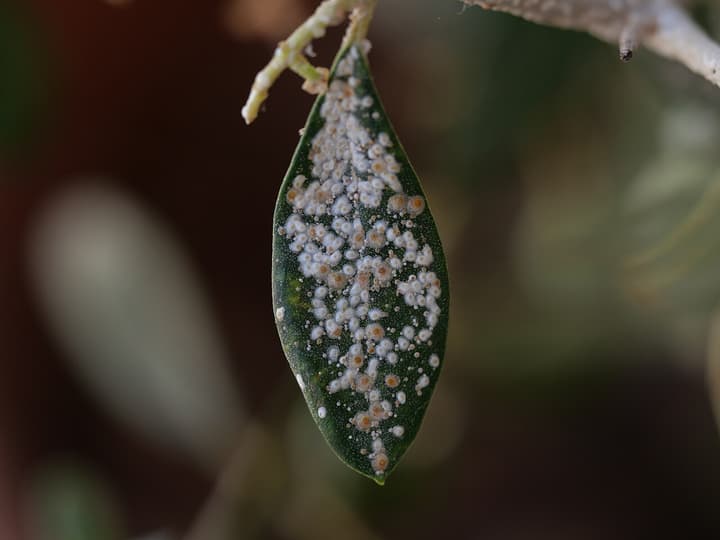
Sources disagree on the damage. The University of California Integrated Pest Management Program (UC IPM) says this scale insect generally does not threaten plant health. UF/IFAS publication EP574 describes severe cases with wilting, deformed leaves, and even plant death. Both are university extensions, and neither measured how many scales separate a mild case from a severe one. The safest choice: with crusting on a few leaves, observe; with the branch covered, scrape and prune.
Neem oil or soap spray on adult scales does not penetrate the cover. UF/IFAS explains that the hard cover protects the insect at every stage except as a newly hatched crawler, which still moves around the plant. What works:
Scrape and wipe away the scales using a soft brush or a damp cloth while wearing gloves. EP574 and the Chamber of Agriculture of North Rhine-Westphalia (LWK NRW) recommend scraping the scales off.
Prune the most heavily covered branches, provided this does not remove a large portion of the plant's leaves. UC IPM recommends this limit.
Use horticultural oil when a magnifying glass reveals tiny crawlers moving around, thoroughly coating the affected parts as UC IPM directs. The crawlers emerge in waves. Because of this, the Bavarian State Institute for Viticulture and Horticulture (LWG) advises repeating the treatment several times, every 3 to 5 days.
Move the infested pot away from other plants. According to EP574, scale rarely moves on its own. It spreads through plant-to-plant contact and by transporting cuttings.
Soft scale: the one that sticks and attracts ants
LWK NRW describes two types of scale insects on oleander that have a domed, brown or whitish shell. Only one of them, soft scale, produces honeydew, and sooty mold grows over it. Ants running up and down the stem are another sign, as they collect the honeydew, as noted by the German magazine Mein schöner Garten. Treatment is the same as for oleander scale: scrape and prune the affected branch.
Mealybugs: cotton where the leaf meets the stem
The RHS lists oleander among the plants attacked by mealybugs. The first sign is fluffy white wax where the leaf joins the stem. Beneath it lie the insect or pink-orange eggs. In heavy infestations, the plant loses vigor and drops leaves prematurely.
The Iowa State University Extension recommends removing every insect and egg sac from lightly infested plants. Use a gloved hand or a cotton swab dipped in rubbing alcohol. A strong spray of warm water helps knock off what remains. The same extension warns that control requires persistence, so repeat the inspection and treatment until you find no more insects. For an inexpensive houseplant, Iowa State notes that discarding it is sometimes best, while the RHS rarely considers replacement necessary. On an established oleander, keep inspecting and scraping. The guide on scale insects on plants shows the same method on other species.
Spider mites on oleander: light stippling and fine webbing
The two-spotted spider mite is related to spiders, measures 0.5 mm, and feeds by sucking on the underside of the leaf. The RHS describes the signs: fine, pale mottling on the upper leaf surface, with yellowish-green mites bearing two dark spots on the underside. They show up clearly under a 10x magnifying glass. In severe attacks, a fine webbing appears, and the leaves lose color, dry up, and fall off.
They thrive in heat and dry air. This makes the problem more common in summer and in heated, closed winter quarters.
Spray the leaves top and bottom whenever the air is hot and dry. The RHS notes that misting with water and keeping the air humid reduces the risk, but does not provide a specific interval.
Prune the most damaged branches, as directed by LWK NRW.
Use predatory mites if the infestation continues. LWK NRW recommends Amblyseius californicus, sold by beneficial insect and mite retailers. It notes that you must release the predators multiple times. The RHS warns that this predator offers little control against heavy attacks. For heavy infestations, the RHS recommends Phytoseiulus persimilis.
A German gardening magazine and a German gardening store suggest covering small plants with a clear plastic bag to raise the humidity. Mein schöner Garten suggests about 2 weeks for the mites to die, and Plantura suggests 3 to 4 days. No extension service has measured this timeframe, so check the leaves with a magnifying glass before removing the bag. The guide on spider mites on plants has more details on this relative of spiders.
Oleander caterpillar: brown tips and chewed leaves
The oleander caterpillar (Syntomeida epilais) is bright orange with tufts of black hair and reaches up to 40 mm. The UF/IFAS EENY-009 publication, reviewed in 2022, states that it is the only caterpillar that causes serious problems on this plant. The hairs do not sting the skin, unlike other hairy caterpillars.
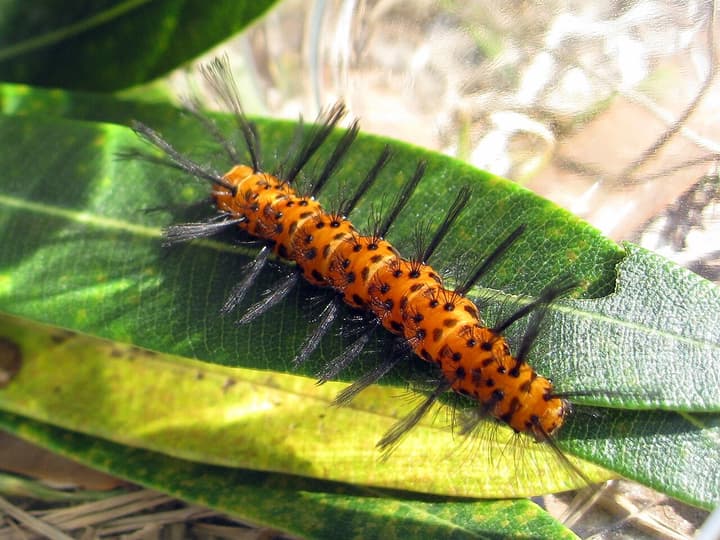
The first signs appear before the caterpillars grow large. The moth lays 12 to 75 yellowish eggs on the undersides of new leaves. Young caterpillars feed in groups, skeletonizing the leaves down to the veins, turning the shoot tip light brown. Turn over the brown leaves and those just below them: the cluster of tiny caterpillars is right there. Once grown, each caterpillar eats entire leaves all by itself.
Defoliation can look alarming, but UF/IFAS reports that it will not kill the oleander. The danger comes from repeated defoliation: stripped year after year, the plant becomes more vulnerable to other pests, like scale. To treat:
Prune the branch holding the group of young caterpillars, wearing gloves, and seal it in a plastic bag. UF/IFAS advises freezing the bag for 24 hours before throwing it away and washing your hands immediately afterward.
Handpick large caterpillars, wearing gloves, and freeze them the same way, or drop them into a bucket of soapy water.
Use *Bacillus thuringiensis* (Bt) if the plant is too tall to prune, while the caterpillars are still small, as noted by EP574. Follow the label rate. It is a bacterium sold as a biological insecticide that, according to UF/IFAS, kills only caterpillars and spares beneficial insects.
UF/IFAS places this caterpillar from the Caribbean to the southeastern United States, Central America, Mexico, and northern South America. In the GBIF biodiversity database, there is no record of it in Brazil (retrieved on 10/12/2026). Records are concentrated in the United States (3,646) and Mexico (905). There are also no records in Europe. A caterpillar eating oleander in Brazil or Europe is likely another species. Cutting the branch and using Bt still work, because Bt acts on caterpillars in general.
Sooty mold: the black layer that follows pests
Sooty mold is a black fungus that grows on honeydew, the sugary liquid that aphids, soft scale, and mealybugs excrete. The RHS describes it as a black or brown powder on the upper surface of leaves that does not attack the plant and comes off with a damp cloth.
Wiping the leaves without tackling the pest will not help, because honeydew will return and the fungus will regrow. Look for pests above the black patches, as honeydew drips downward. If you spot ants climbing up, the RHS explains that they protect aphids to harvest honeydew and chase away aphid predators.
Oleander knot: black warts are a disease, not pests
Oleander knot is caused by the bacterium Pseudomonas syringae pv. savastanoi, according to the Chamber of Agriculture of North Rhine-Westphalia (press release of 08/11/2022). Black spots appear on the leaves, raised or sunken, with a yellowish border. Cracks and dark brown warts develop on the branches, and the shoot tips can become deformed.
No product cures oleander knot. The Bavarian State Institute for Viticulture and Horticulture (LWG) states that you can save the plant if you remove diseased branches in time. Heavily attacked plants, according to the same institute, must be discarded. Cut each branch back to healthy tissue, wearing gloves. Clean and disinfect your shears between cuts so you do not spread the bacteria to healthy branches. Mein schöner Garten recommends 70% alcohol for this. Dispose of the branches in a sealed bag in the regular trash, like all other debris from this plant.
How to prevent oleander pests
Four practices help reduce pests on oleander:
Fertilize moderately. Excess fertilizer produces tender growth, and UF/IFAS publication EP574 links this type of growth to aphids.
A cool winter spot. In frosty climates, oleanders spend the winter sheltered indoors. Mein schöner Garten notes that if winter storage averages above 15 °C, scale insects develop readily. LWG recommends 4 to 8 °C, with good light and ventilation. Find details in oleander winter care.
Inspection before sheltering. LWG recommends checking the plant for pests before moving it to its winter quarters.
Space between pots. EP574 recommends keeping distance between plants so scale does not spread from one to another.
If you cannot identify a spot, Bloom (available for iOS) diagnoses plant diseases from photos of symptoms under its Premium plan. It also identifies plants from photos.
Frequently asked questions
Which pests attack oleander most often?
According to the plant protection service of LWK NRW, scale insects, aphids, and spider mites appear most frequently. NC State Extension also cites caterpillars as an occasional pest. Black sooty mold results from honeydew-secreting pests, while oleander gall, marked by black warts on branches, is a bacterial disease.
Do home remedies work against oleander pests?
They work in part. A strong blast of water knocks off aphids, according to UF/IFAS and LWK NRW. For mealybugs, Iowa State recommends a warm blast of water and an alcohol-dipped cotton swab. No source has tested home recipes against oleander scale, and extension services advise scraping and pruning infested branches.
Can an oleander covered in scale still be saved?
In most cases, yes. UC IPM states that oleander scale usually does not threaten the plant's health, though UF/IFAS notes severe cases. Scrape off the scales, prune the most heavily coated branches, and isolate the pot from other plants. The RHS considers discarding heavily infested plants rarely necessary.
Can I treat oleander if I have a dog or cat at home?
You can, but the greatest risk to your pet is the oleander itself, which the ASPCA lists as toxic to dogs and cats. Keep pets away during treatment and dispose of all pruned leaves and branches on the same day. Read the pet-safety instructions on any product label before applying it.
Conclusion
To treat oleander pests, first identify the symptom: stickiness, dry crust, stippling, skeletonized leaves, or warts. For aphids, scale, and caterpillars, extension services primarily recommend water sprays, manual scraping, and pruning covered branches. Your next step today is to turn over the leaves at the branch tips with a magnifying glass and wear gloves throughout, bagging all clippings for the regular trash.
Related articles

How to Care for Hibiscus: Sun, Watering, Fertilizer, and Pruning for Flowers
How to care for hibiscus: 6 hours of direct sun, evenly moist soil without waterlogging, half-strength fertilizer in spring and summer, and pruning in early spring. Find out why the flower lasts one day and why buds drop before opening.

Do Ferns Like Sun or Shade? It Depends on the Type
Ferns prefer bright shade: plenty of light, but no direct sun on their fronds. Tuberous sword fern is the exception that handles sun. Here is the ideal light for each type, where to place pots, and how fronds show too much or too little light.

African Violet Yellow Leaves: Causes and What to Do
Yellow leaves on an African violet usually stem from overwatering, and the first place to check is the center of the plant. Losing one lower leaf at a time is normal. Identify whether age, watering, cold water, sunlight, cold drafts, or fertilizer is the culprit based on the yellowing pattern, and see what to do today.