Palm tree yellow leaves: the leaf's position reveals the cause
One bottom leaf at a time that dries up within a few days is just normal leaf senescence. Yellow on new leaves, on several older leaves, or on a half-dead leaf lingering for months has a specific cause, and its position tells you which.
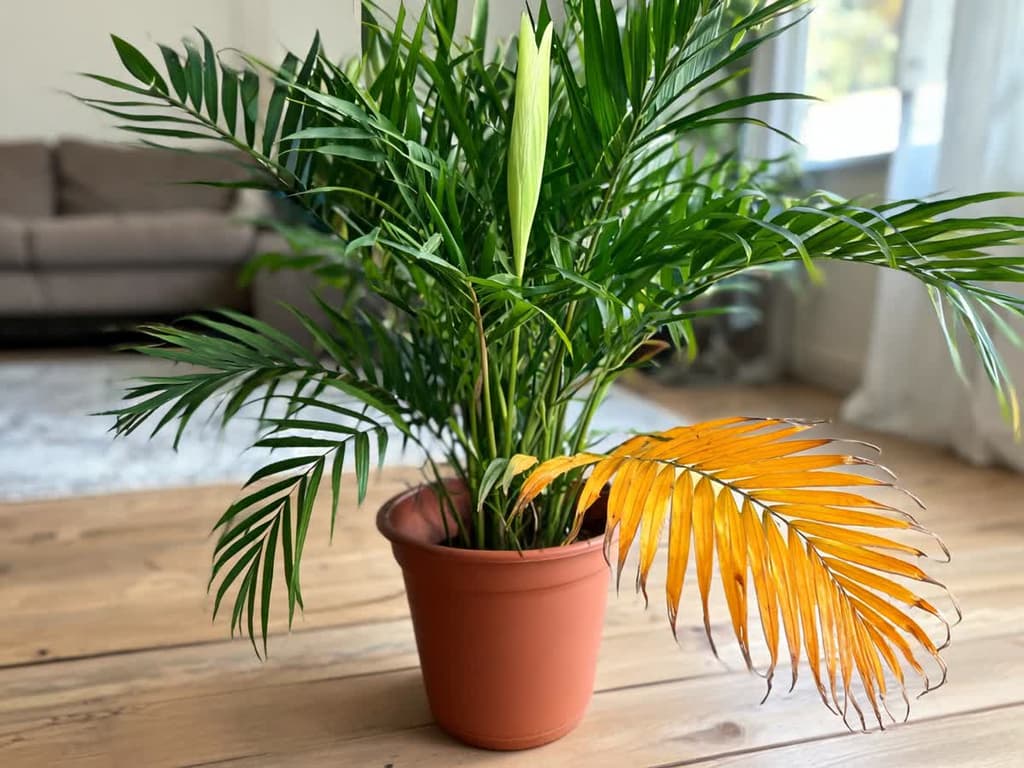
Yellow leaves on a palm tree are not always a problem. A bottom leaf turning yellow, drying up in a few days, and dropping is the normal end of that leaf's life, as long as new fronds keep emerging from the center. Yellow indicates a problem when it appears on new fronds or across several older fronds at the same time. It also signals trouble when a half-dead frond stays on the plant for months.
The position of the yellow frond points directly to that cause. Old fronds and new fronds turn yellow for different reasons, and the yellow pattern across the leaf separates nutrient deficiencies from each other. As long as the frond still has green on it, do not cut it off: on a palm, an aging yellow frond still feeds the new growth.
This guide applies to potted palms sold in Brazil: areca palm (Dypsis lutescens), lady palm (Rhapis excelsa), parlor palm (Chamaedorea elegans), kentia palm (Howea forsteriana), pygmy date palm (Phoenix roebelenii), majesty palm (Ravenea rivularis), and round-leaf fan palm (Livistona rotundifolia). Each has its own symptoms, described further below.
Quick summary:
One bottom frond at a time, turning brown and dropping in a few days: normal end of life. You do not need to do anything.
Bottom fronds evenly yellow, whole plant looking paler: nitrogen deficiency, the most common issue in containers.
Bottom fronds with orange spots and dry tips, worse toward the leaf tip: potassium deficiency.
Bottom fronds with a yellow band along the edge and a green center: magnesium deficiency.
New fronds turning yellow: almost always suffocating roots caused by waterlogged or degraded potting mix, rather than a lack of iron in the soil.
All leaves yellowing together, with the soil staying soggy for days: overwatering.
A yellow frond on a palm: normal or a problem?
Senescence is the natural end of a leaf's life: the plant reclaims nutrients from it and lets it dry up. On a healthy palm, this happens to the oldest frond, the bottom one, one at a time. According to UF/IFAS, the frond is green one day, orange-brown the next, and brown on the third.
A frond lingering half-green and half-yellow for weeks or months is not undergoing that process. The same UF/IFAS publication notes that an older, half-dead frond remaining on the trunk for months typically signals potassium deficiency.
The resting angle of the dead frond provides another clue. On palms that do not drop their leaves cleanly on their own, a dead frond hangs down flush against the trunk. A frond suffering from potassium deficiency stays in its normal spread-out position among the green fronds.
What separates normal from a problem comes down to quantity and speed. One bottom leaf at a time on a palm actively producing new leaves is normal. Three older fronds yellowing in the same week, or middle and upper leaves yellowing along with them, point to a cause.
Where the yellow appears on the palm frond and what it means
The general guide on why leaves turn yellow divides causes between older leaves and newer leaves. On palms, this division holds true, with two distinct details documented by UF/IFAS. Magnesium deficiency presents as a broad yellow band along the frond margin rather than between the veins. In addition, high-pH (alkaline) soil binds manganese primarily, rather than iron.
Where the yellow is | What it looks like | Probable cause | What to do first |
|---|---|---|---|
One bottom frond at a time | Turns completely orange-brown in 2 or 3 days and dries up | Normal end of life | Nothing. Prune only when it is completely dry |
Bottom fronds, then the whole plant | Even light green, no spotting, stalled growth | Nitrogen deficiency | Fertilize with a complete fertilizer |
Bottom fronds | Yellow or orange flecks, dry and curled tips, worse toward the frond tip | Potassium deficiency | Fertilize with a palm fertilizer. Do not prune the frond |
Bottom fronds | Broad yellow band along the margins, green center, no dry tip | Magnesium deficiency | Fertilizer containing magnesium. The frond will not turn green again |
New fronds | Evenly yellow or with greener veins | Suffocating roots (waterlogged, degraded, or compacted mix) | Check the soil and roots before applying fertilizer |
New fronds | Yellow with brown streaking, worse at the frond base, frizzled leaflets | Manganese deficiency (alkaline or cold soil) | Fertilizer containing manganese |
Deformed new frond | Fronds that are wrinkled, bent, or fail to open | Boron deficiency | Fertilizer with micronutrients |
Several fronds at once | Yellowing with soil wet for days | Overwatering | Stop watering and inspect the roots |
Scattered fronds | Tiny pale specks, fine webbing under the leaf | Spider mites | Wash the frond and treat for spider mites |
The pattern within the frond separates potassium from magnesium. With potassium deficiency, the frond is green at the base, yellow or orange in the middle, and dead at the tip. With magnesium deficiency, the yellow band runs evenly from base to tip and the center remains green. According to UF/IFAS, magnesium deficiency never leaves a dead tip. If a frond with a yellow band has a dry tip, both deficiencies are present together.
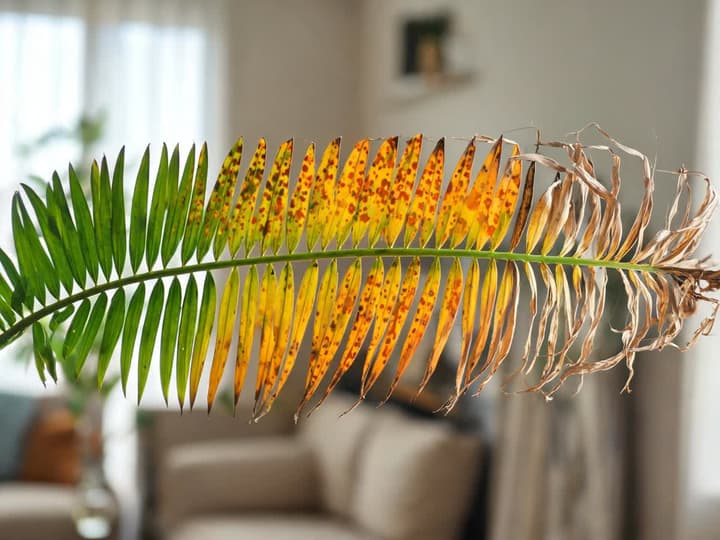
Manganese moves in the opposite direction from potassium. Brown streaks are worse at the base of the new leaf and lessen toward the tip, according to UF/IFAS. In severe cases, the new frond emerges frizzled and small.
Potted palms: the most common causes of yellowing indoors
In pots, the order of causes changes. Potassium deficiency is the most common in garden palms, but UF/IFAS considers it relatively uncommon in containers. Indoors, the most frequent deficiencies are nitrogen, iron, and, after months in the same pot, magnesium.
Nitrogen is, by far, the most critical deficiency for potted palms. Potting mix contains high amounts of bark and peat, and the microorganisms decomposing this organic matter consume the available nitrogen. They compete for nitrogen against the palm's roots, and regular watering leaches out whatever remains. Symptoms start on the oldest fronds as a uniform light green and progress until the entire plant looks washed out, except for the spear leaf at the center.
A yellow new frond almost always originates in the root zone. UF/IFAS explains that over time, bark and peat break down into a fine, airless sludge. Roots starved of oxygen cannot absorb iron, even when iron is present in the medium. An oversized pot that holds moisture too long and root rot trigger the exact same symptom.
Magnesium deficiency shows up over time. Dolomitic limestone mixed into potting soil releases magnesium slowly and runs out in about 6 months, according to UF/IFAS. A palm that spends years in the same pot without magnesium fertilizer begins to develop yellow bands on its bottom fronds.
Overwatering versus underwatering in palms
Both conditions turn fronds yellow, but the soil's moisture level tells them apart. Insert your finger an inch into the soil. Soil that has stayed wet for days, limp yellow fronds, and brown, mushy roots when unpotting point to overwatering. Bone-dry soil, brittle yellow fronds, and leaflets with dry tips point to underwatering.
Before changing your watering routine, check the container setup. Many palms come in a plastic nursery pot with drainage holes nestled inside a decorative cachepot without holes. Runoff collects at the bottom of the cachepot, leaving the root system sitting in water for days. Lift the inner pot out after watering and dump any standing water.
Majesty palms and areca palms need consistently slightly moist soil, according to NC State, and suffer first from underwatering. Parlor palms and lady palms tolerate drying out slightly between waterings, according to the NC State Extension. Sources disagree on how much to let them dry: the Clemson Extension says never to let them dry out, while NC State accepts letting parlor palms dry out slightly. The safest approach for the roots is to water when the top inch of soil feels dry. And never leave standing water at the bottom of the pot.
Should you cut off yellow palm fronds?
Not while the leaf still shows green. Remove only fronds that are completely brown and dry. Potassium, nitrogen, and magnesium are mobile within the plant: when soil supplies drop, the palm translocates them from the oldest fronds to build new foliage. The yellowing lower frond serves as the plant's nutrient reserve.
UF/IFAS cites a study conducted on pygmy date palms (Phoenix roebelenii), the same palm sold in pots in Brazil. Frequently trimming older potassium-deficient leaves accelerated the plant's decline. Without the older leaf, the palm begins pulling potassium from the next green leaf.
To remove a dry frond, take clean pruning shears and cut the petiole close to the trunk without wounding the trunk itself. Do not yank or tear off a stubborn frond: UF/IFAS warns that pulling strips away stem tissue and opens entry wounds for fungi. The guide on how to care for palms also covers safe pruning boundaries for landscape palms.
How symptoms vary across palm species
Palms sold in Brazil do not all turn yellow the same way. UF/IFAS and NC State describe distinct symptoms for each species.
Areca palm (Dypsis lutescens)
The areca palm has a yellowish-green stem and frond stalk, and the name lutescens itself means "becoming yellow." But UF/IFAS attributes the strong golden color of the stalk and the base of the fronds, common in potted areca palms, to nitrogen deficiency. A yellowish-green stalk with dark green fronds is typical of the species. A golden stalk with pale old fronds calls for fertilizer. When lacking potassium, the areca palm shows yellow or orange, translucent spots on older fronds.
Kentia (Howea forsteriana)
NC State identifies potassium deficiency as the most serious problem for the kentia palm. The symptom is dead, dry leaflet tips on older fronds, with almost no yellow spotting. New kentia fronds can show manganese deficiency, with dead tips on the leaflets at the base of the frond.
Lady palm (Rhapis excelsa)
The lady palm has its own specific sign of iron deficiency: a new yellow frond covered in 2 to 4 mm green spots, according to UF/IFAS. The same publication states that the lady palm is especially prone to this deficiency in alkaline soil. The lady palm tolerates low light and dry air. However, NC State advises bringing the pot indoors whenever the temperature drops below 10 °C.
Parlor palm (Chamaedorea elegans)
The parlor palm tolerates low light and dry air better than almost any other. The issue that NC State highlights for it is overwatering, from poorly draining soil or watering too frequently. NC State also mentions spider mites and scale insects. It usually comes with 3 or more seedlings in the same pot, and some lose the competition and dry up over time. An entire stem turning yellow in a clump that remains green can be one of these seedlings losing the competition.
Majesty palm (Ravenea rivularis)
NC State warns that the majesty palm can be difficult to keep indoors. It needs high humidity, bright indirect light, and consistently moist soil. Yellow leaves on it stem from low light, improper watering, dry air, or nutrient deficiencies. Nitrogen deficiency is common in this species even when planted in the ground, according to UF/IFAS. Older fronds yellowing from the bottom up, accompanied by fine webbing, require attention: check for spider mites.
Pygmy date palm (Phoenix roebelenii)
With potassium deficiency, the pygmy date palm turns the tip portion of the oldest fronds orange. The leaflet tips die, become brittle, and break off, leaving the edge of the frond looking ragged, according to UF/IFAS. The petiole remains green, and the orange fades gradually into the green without the sharp demarcation seen in magnesium deficiency.
Footstool palm (Livistona rotundifolia)
On fan palms like the footstool palm, magnesium deficiency displays a different visual pattern. According to UF/IFAS, the yellow band surrounds each individual leaflet rather than forming solely along the perimeter of the entire frond.
Sago palms (Cycas revoluta) and ponytail palms (Beaucarnea recurvata) are commonly called palms, but neither is a true palm. The causes of yellowing for them are entirely different, and the guidelines in this article do not apply to them.
How to get a palm green again
It depends on the cause. A frond with nitrogen deficiency turns green again after fertilization, according to UF/IFAS. A frond with iron deficiency also recovers if the underlying cause is resolved. A frond with potassium or magnesium deficiency never recovers; it is simply replaced by healthy new fronds.
That is why recovering from potassium deficiency takes one to two years or even longer. The palm has to cycle through and replace its entire crown with symptom-free fronds. During that period, new fronds emerging green and spotless prove that your treatment is working.
For yellowing on new fronds, applying iron fertilizer generally does not fix the problem. UF/IFAS recommends correcting the medium: shake the degraded, compacted mix away from the root system and repot into fresh, well-aerated potting soil in a pot that is only slightly larger. Once the roots can breathe again, new fronds will emerge green.
For nitrogen, potassium, and magnesium deficiencies, the treatment is to fertilize with a complete fertilizer that also contains magnesium. Clemson Extension recommends fertilizing indoor palms only 2 or 3 times a year while they are actively growing. Spraying Epsom salt on the fronds does not resolve magnesium deficiency: UF/IFAS states that foliar sprays deliver less magnesium than the palm needs.
If you are unsure which palm you have at home, photograph the leaf with Bloom, which identifies the species from a picture. The guide on how to find out what is wrong with your plant runs through a full diagnostic screening from leaf to root. On the Premium tier, the app also diagnoses symptoms straight from a photo.
Bloom is currently iPhone-only.
Landscape palms: potassium, cold, and lethal yellowing
Planted in the ground, the palm follows a different order of causes. Potassium deficiency is the most common nutritional disorder of palms in the world, according to UF/IFAS. Rain leaches potassium from sandy soil. Old fronds with orange spots and dry tips, on a canopy with few fronds, are the typical sign.
Cold temperatures also discolor and burn foliage. NC State recommends keeping majesty palms outdoors only in warm-winter climates where winter minimums stay above approximately -1 °C. After a freezing night, wait until all threat of subsequent frost passes before pruning damaged fronds, advises UF/IFAS.
Lethal yellowing is a coconut palm disease documented by UF/IFAS in Florida and the Caribbean. The first sign is the premature drop of nearly all coconuts. Afterward, fronds yellow from the bottom up. Control requires an antibiotic injected into the trunk by a professional, and coconut palms with more than 25% of their fronds discolored must be removed.
Frequently asked questions
Does Epsom salt fix yellow leaves on palms?
As a foliar spray, no. Even when the root cause is magnesium deficiency (a broad yellow band along the margins of older leaves with a green center), misting Epsom salt (magnesium sulfate) delivers very little magnesium to the palm, according to UF/IFAS. Without that distinct marginal pattern, the yellowing comes from another issue and magnesium will not solve it. The most reliable approach is using a dedicated palm fertilizer that already contains magnesium.
How long does it take for a palm to recover?
It depends on the deficiency. Once you correct nitrogen or iron, the discolored leaves themselves turn green again. With potassium or magnesium deficiencies, affected fronds never regain their green color. According to UF/IFAS, replacing the entire canopy with healthy fronds takes one to two years.
Can harsh sun turn palm leaves yellow?
Yes, especially on indoor palms. Direct sunlight scorches the fronds of majesty palms, according to NC State. Areca, kentia, and lady palms also thrive best in bright indirect light indoors. If leaves yellowed only on the side facing the window pane, pull the pot back until direct sunbeams no longer hit the foliage.
Are potted palms safe for cats and dogs?
It depends on the species. The ASPCA, the American animal welfare organization, lists areca palm, parlor palm, kentia palm, pygmy date palm, and majesty palm as non-toxic to dogs and cats. Sago palm (Cycas revoluta) is sold under the palm name despite not being a palm. According to the ASPCA, it is toxic to dogs and cats and can cause liver failure.
What to do today with a palm showing yellow leaves
Inspect which fronds turned yellow. One bottom frond at a time, drying within a few days, is just normal leaf turnover.
Insert your finger an inch into the soil. If it has stayed wet for days, check the cachepot and inspect the roots; if dry, water thoroughly until it flows out the drainage holes.
Examine the yellow pattern on the older fronds: evenly pale foliage, flecks with dry tips, or marginal bands indicate nitrogen, potassium, or magnesium deficits.
Do not remove fronds that still retain green tissue. Prune only fully brown fronds, cutting flush near the stem.
If only new fronds are emerging yellow, evaluate the potting mix before buying iron supplements.
On areca palms, the page on causes of yellow leaves on areca palms gathers the pests and diseases that also produce this symptom. Other indoor foliage plants turn yellow for other reasons. On crotons with yellow leaves, the yellow leaf pattern, along the veins and spots, is natural to the plant and does not indicate a problem. On calatheas with yellow leaves, fluoridated tap water leaves a brown edge with a yellow band, rather than turning the entire leaf yellow.
Sources
UF/IFAS Extension (Broschat), Nutrient Deficiencies of Landscape and Field-Grown Palms in Florida (EP273): nitrogen, potassium, magnesium, manganese, iron, and boron deficiencies, with the position of each on the plant and on the leaf.
UF/IFAS Extension (Broschat), Potassium Deficiency in Palms (EP269): symptoms by species (pygmy date palm, kentia palm, areca palm, fan palm), gradient from base to tip, recovery taking one to two years, cutting off old fronds accelerates decline (Broschat, HortScience 29:823, 1994).
UF/IFAS Extension (Broschat), Magnesium Deficiency in Palms (EP266): band along the margin and green center, no necrosis, limestone depleted in about 6 months in containers, foliar magnesium sprays rarely effective.
UF/IFAS Extension (Broschat), Iron Deficiency in Palms (EP265): new yellow leaf from suffocated roots, 2 to 4 mm green spots on lady palms, potting soil that degrades.
UF/IFAS Extension (Broschat), Nitrogen Deficiency in Palms (EP268): most important deficiency in containers, golden petiole of the areca palm, majesty palm, leaf turning green again.
UF/IFAS Extension (Broschat), Manganese Deficiency in Palms (EP267): new frond with streaks, worse at the base, alkaline soil.
UF/IFAS Extension (Broschat), Nutrition and Fertilization of Palms in Containers (EP262): order of deficiencies in containers, potassium deficiency uncommon in containers, replacing degraded potting soil.
UF/IFAS Extension (Broschat), Pruning Palms (EP443): healthy frond turning from green to brown in 3 days, half-dead frond lingering for months and potassium, dead frond hanging down, cutting without injuring the trunk, cold-damaged fronds.
NC State Extension, Gardener Plant Toolbox: Ravenea rivularis, Chamaedorea elegans, Dypsis lutescens, Rhapis excelsa, and Howea forsteriana: light, watering, cold, pests, and the most serious problem for each species.
Clemson Cooperative Extension, Home & Garden Information Center, Indoor Palms (2015 revision): watering without letting the soil dry out and without standing water, slow-release fertilizer 2 or 3 times a year during the growing season.
UF/IFAS Extension, Lethal Yellowing (LY) of Palm (PP146): fruit drop, yellowing from the bottom up, trunk antibiotic injections, removal when more than 25% of fronds are discolored.
ASPCA, Toxic and Non-Toxic Plants list: areca palm, parlor palm, kentia palm, pygmy date palm, majesty palm, and sago palm.
Related articles
How to Care for a Maidenhair Fern: Light, Water, and Revival Tips
Learn how to care for a maidenhair fern indoors: bright indirect light, consistently moist soil, high humidity, and how to revive it if it dries out completely.
How to Propagate Spider Plants: Root the Pup Before Cutting
The safest spider plant cutting comes from a pup still attached to the mother plant: rest the plantlet on soil in a small pot, wait for roots to establish, and only then cut the stolon. Learn when the pup is ready, whether rooting in water is worth it, how to divide the clump, and why plants fail to produce babies.
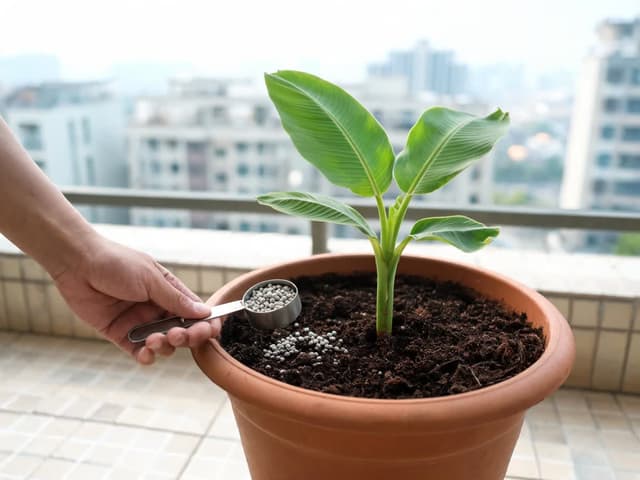
Banana plant fertilizer: fertilizing potted and backyard plants
Banana plant fertilizer needs more potassium than nitrogen, in a 3-1-6 ratio. For a potted plant on a balcony, use the label dose in spring and summer. In the backyard, fertilize every 2 months, adjusting the amount by mat age. Learn the formula, timing in Brazil, and signs of deficiency or excess.