Cold-Hardy Palms: Which Ones Tolerate Frost and How to Protect Them
The easiest cold-hardy palm to find is the windmill palm, which tolerates about −12 °C once mature. See the minimum temperature each species survives, how to protect potted and in-ground plants, and what to do if frost damaged the leaves.
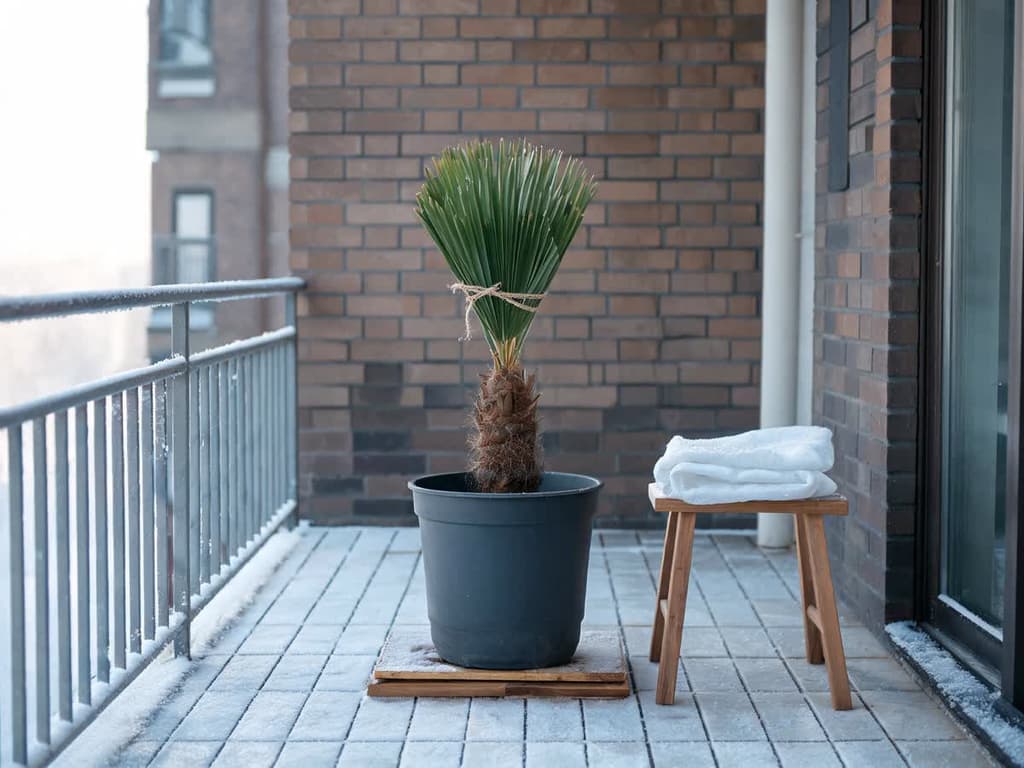
The easiest cold-hardy palm to find in stores is the windmill palm (Trachycarpus fortunei), with fan-shaped leaves and a trunk wrapped in brown fiber. Once mature and well-established, it survives about −12 °C (10 °F). The needle palm (Rhapidophyllum hystrix) tolerates even colder conditions, but it is rare on the market. Coconut palms, areca palms, and royal palms suffer damage well before temperatures drop to 0 °C.
In Brazil, the question carries weight for those living in the South or in the highlands, where frost occurs between June and August, and for anyone keeping a palm on a cold balcony. Two native palms from here withstand frost: the pindo palm and the queen palm.
Quick summary:
For frost-prone areas, choose windmill palm, needle palm, pindo palm, or Mediterranean dwarf palm.
Temperature limits apply to mature specimens established in the ground for a few years. Young seedlings and potted plants tolerate less cold.
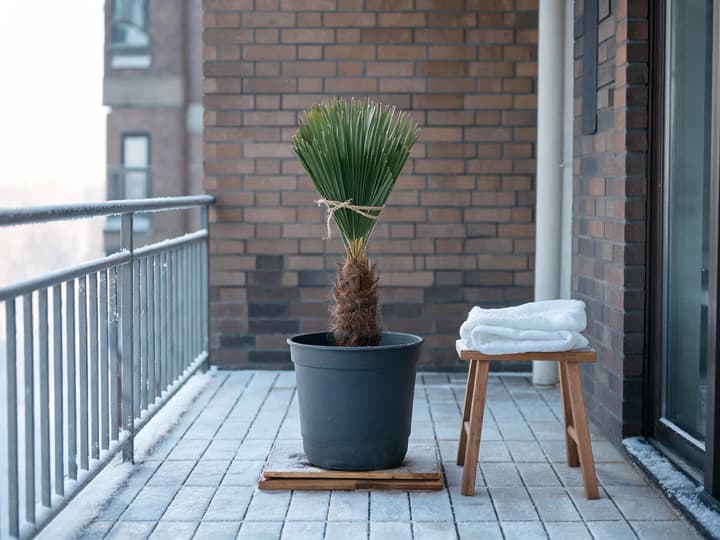
In containers, roots freeze before the leaves do. Lift the pot off the ground, place it against an exterior wall, and insulate the container itself, not just the fronds.
Use frost blankets only on freezing nights, keep them from touching foliage directly, and anchor them down to the ground. Remove them during the day.
If frost burns your palm, do not cut anything until the cold season ends. Gently tug the central spear: if it stays firm, the palm is alive.
Which palms survive winter
A cold-hardy palm is any species that, once mature, can endure freezes below −5 °C without dying. Nearly all of them originate from mountains, open plains, or arid landscapes rather than tropical rainforests. The windmill palm, native to the mountains of China, is the most widely planted species in cold climates.
The table uses a single source so that the numbers are directly comparable. It is the University of Florida (UF/IFAS) palm list for North Florida, which provides the lowest recommended temperature for each species planted in the ground (Palms for North Florida, UF/IFAS). Where another reliable source provides a different number, it appears in the final column.
Palm | How to identify | Cold tolerance (UF/IFAS) | Other sources and notes |
|---|---|---|---|
Needle palm (Rhapidophyllum hystrix) | low clustering habit, no tall trunk, long sharp spines at the center | −15 °C (5 °F) | it is rarely sold in Brazil |
Sabal minor | fan-shaped leaves, trunkless appearance, reaches up to 2 m | −15 °C (5 °F) | rare in Brazil |
Windmill palm (Trachycarpus fortunei) | fan-shaped leaves, slender trunk wrapped in brown fiber | −12 °C (10 °F) | the Missouri Botanical Garden gives the same rating for mature plants, "sometimes colder" |
Trachycarpus wagnerianus | similar to the previous species, with smaller and stiffer fronds | −11 °C (13 °F) | handles wind better |
Washingtonia filifera | fan-shaped fronds with dangling white threads, stout trunk | −11 °C (12 °F) | requires sharp drainage |
Pindo palm (Butia odorata) | bluish feather fronds, gracefully arching downward | −10 °C (14 °F) | the same university notes −12 °C (10 °F) in another publication |
Chilean wine palm (Jubaea chilensis) | massive smooth trunk, feather-like fronds | −10 °C (14 °F) | records of −16 °C and −22 °C in France |
Woolly jelly palm (Butia eriospatha) | bluish feather fronds, base of leaf petioles covered in brown fuzz | −9 °C (15 °F) | native to the highlands of southern Brazil |
Mediterranean dwarf palm (Chamaerops humilis) | fan fronds, multi-stemmed clumping habit, spiny petioles | −9 °C (16 °F) | the blue-leaved form tolerates less cold than the green form |
Canary Island date palm (Phoenix canariensis) | deep green feather fronds, heavy trunk | −7 °C (19 °F) | avoid waterlogged soils |
Washingtonia robusta | fan fronds, tall slender trunk | −6 °C (22 °F) | the less hardy of the two Washingtonia species |
Queen palm (Syagrus romanzoffiana) | bright green feather fronds, hanging clusters of orange fruit | −5 °C (23 °F) | grows wild in southern cities that have recorded −10.4 °C |
The last column has three sources beyond the table. The Missouri Botanical Garden says that the adult windmill palm usually survives −12 °C and sometimes lower. The UF/IFAS publication on the pindo palm gives −12 °C and explains that the correct name for this palm is Butia odorata, not Butia capitata, as the UF/IFAS palm list still calls it. Trees and Shrubs Online, a reference work by the International Dendrology Society, records the Chilean wine palm alive after −16 °C in France and after −22 °C in Perpignan, France, in 1956.
For the queen palm (jerivá), the Brazilian data comes from Embrapa Florestas. The species occurs naturally as far south as Caçador (SC), where the recorded minimum temperature was −10.4 °C, and in regions with up to 57 frosts per year (Jerivá, Brazilian Tree Species, Embrapa). This describes the climate where the palm grows wild, not the cold limit of a purchased seedling. For this reason, the chart uses UF/IFAS’s −5 °C, the safer figure for the plant.
Six of these palms have their own care guides:
Why different sources list different minimum temperatures for the same palm
The windmill palm appears with −12 °C, −15 °C, and even −18 °C depending on who is writing. UF/IFAS lists what changes the outcome: the plant's age, height, and health, along with wind. Humidity, freeze duration, and site microclimate also factor in (Cold-Hardy Palms, UF/IFAS Gardening Solutions). A weak palm, one without fertilizer, or one with too many pruned leaves suffers more at the same temperature.
Three factors matter most:
Acclimation. A palm that cools down gradually over weeks tolerates far more than one that goes from a warm night to a cold one. Florida Extension shows this even with tropical palms: accustomed to nights at 21 °C, they can burn on a night at 7 °C (Cold Damage on Palms, UF/IFAS).
Type of freeze. On clear, calm nights, fronds radiate heat directly into the open sky and can dip below 0 °C even when ambient air stays several degrees above freezing. During these radiational freezes, damage looks patchy: one frond burns while an adjacent leaf stays unharmed. During windy advective cold snaps, the entire canopy cools uniformly.
Container or in-ground. Garden soil almost never freezes. The soil in a small container can stay frozen for several consecutive hours (Cold Protection of Landscape Plants, UF/IFAS). For this reason, the same species tolerates less cold in a pot.
The values in the chart apply to mature specimens planted in the ground during short freezes lasting a few hours. Young seedlings, newly planted palms, and potted specimens have thresholds several degrees warmer.
Palms that cannot tolerate cold
Tropical palms suffer damage before temperatures reach 0 °C. According to UF/IFAS, this chilling damage without freezing appears in tropical species at temperatures as high as 10 °C (Cold Damage on Palms, UF/IFAS). Coconut palms, areca palms, royal palms, and most indoor palms fall into this group. The areca palm, for example, performs best where the average annual minimum stays between 2 °C and 4 °C (35 °F to 40 °F), according to the UF/IFAS fact sheet.
Three plants frequently sold as "palms" are not botanical palms at all. The sago palm (Cycas revoluta) belongs to an entirely different plant group and is highly toxic to dogs and cats. The ponytail palm (Beaucarnea recurvata) and yucca (Yucca) are related to agaves. None of these three species align with the cold chart above.
In Brazil, who needs to protect their palm in winter
In Brazil, frost occurs in the South and in mountain ranges between June and August. People living in these regions need to choose species based on the chart and set up protection before the year's first frost. Species native to the South are already adapted: the jelly palm, mountain jelly palm, and queen palm grow on their own in areas with yearly frost.
In frost-free areas, winter affects potted palms differently. Reduced sunlight and lower ambient warmth cause potting soil to dry much slower; keeping summer watering schedules will quickly waterlog roots. The same principle applies to other patio plants, such as winter-hardy eucalyptus, whose roots are similarly the first part to suffer in cold containers.
Protecting potted palms in winter
A potted palm suffers cold stress before an in-ground palm does because root balls freeze first. Protection begins with the container itself:
Push the container against an exterior house wall, shielded from prevailing winds. The masonry radiates stored daytime heat back out during the night.
Lift the pot off freezing pavement by resting it on a wooden board or a sheet of styrofoam.
Wrap the sides of the container with burlap, cardboard, or bubble wrap, and topdress the soil with 5 cm of pine bark mulch or dried leaves.
If you have more than one pot, group them all together before the frost. UF/IFAS recommends this to reduce heat loss through the sides of the containers (Cold Protection of Landscape Plants, UF/IFAS).
Bring manageable pots indoors before frosty nights and set them back outside once temperatures recover. Place them in a bright location far from heating vents.
Winter watering advice is conflicting. One side tells you to keep the soil moist all winter, and the other tells you to water sparingly. UF/IFAS explains that moist soil stores more heat from the sun and releases that heat at night, which is why watering before a freeze protects the plant (Cold Protection of Landscape Plants, UF/IFAS). Follow both approaches, each at the right time. Water the day before a freeze if the soil is dry; for the rest of the winter, water only when the top 3 cm dries out. Waterlogged soil for weeks rots cold roots.
Protecting in-ground palms from frost
A mature palm established in the ground for several years needs no protection as long as forecasts stay above the minimum limit for that species in the chart. Young seedlings and palms planted fewer than 2 winters ago need help, as they handle less cold.
To protect palms in the ground:
Mulch the soil around the base with a 10 cm layer of pine bark, straw, or dry leaves. Mulch traps ground heat and insulates roots.
Gather the fronds upward and tie them loosely with soft twine. This shields the central bud from which new growth emerges.
On nights with severe frost, drape the canopy with horticultural frost cloth (the lightweight non-woven fabric sold in garden centers), an old bedsheet, or a blanket. The cover must extend all the way to the ground and be weighted down with stones.
In the morning, once the sun comes up, remove the cover or open its sides.
Does wrapping a palm cause mold?
We found no study that measured mold on winter-wrapped palms. The risk UF/IFAS points out is different: fabric resting against the foliage injures the leaves, and sealed plastic in the sun overheats and suffocates the plant (Cold Protection of Landscape Plants, UF/IFAS). The safest option is to use breathable fabric covers only on freezing nights. Never wrap the palm in plastic for weeks on end.
Can you save a frost-burned palm?
Most of the time, it does. What matters is the center of the palm, where new fronds emerge, not the brown fronds. According to UF/IFAS, the leaf bases and the growing point are the most cold-tolerant parts (Cold Damage on Palms, UF/IFAS).
Follow these steps in order:
Do not prune any fronds until all winter cold has passed. Even when completely dried out, dead leaves shield the central spear from subsequent freezes.
Gently tug the central spear, the upright, unopened leaf emerging from the core. If it stays firmly anchored, its base remains alive, meaning the heart below is still healthy.
If the central spear pulls free in your hand, remove it to promote airflow and allow the crown cavity to dry. UF/IFAS notes that drenching the bud area with a copper fungicide may help suppress rot, though this has not been scientifically validated. Only apply products formulated and labeled as garden fungicides, never raw copper sulfate, which burns palm tissue.
Once warm weather returns and growth resumes, prune off only entirely brown leaves. Keep any frond showing green tissue, as it continues to photosynthesize and nourish the plant.
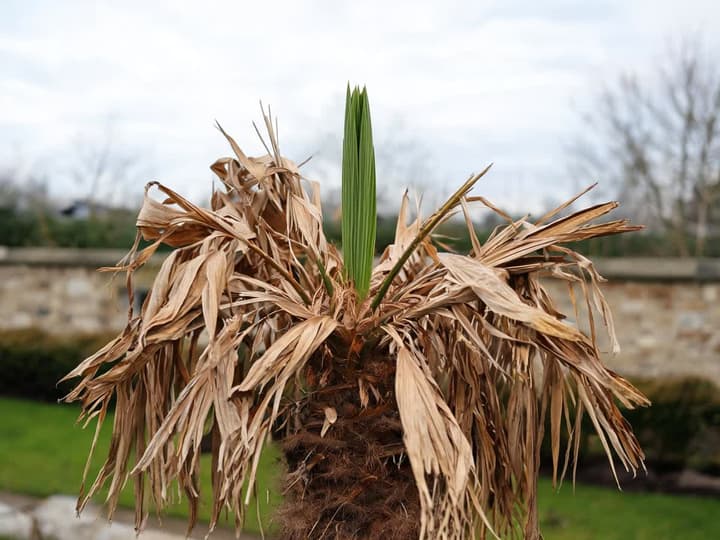
Initial fronds emerging after freeze damage may display blunt, truncated tips or necrotic bands across the leaflets. UF/IFAS explains that these leaves were already forming inside the stem during the freeze, and that subsequent fronds usually emerge normal.
Internal trunk damage can take a long time to manifest. On queen palms, UF/IFAS documented internal trunk rot that took at least 2 years following a freeze to show visible outward failure, sometimes longer. If a canopy suddenly wilts during the first heatwave following a severe winter, the vascular trunk tissue was compromised and the palm will not recover.
If you are unsure which palm you have because you inherited the plant or lost its tag, determine the species before planning winter care. Cold thresholds vary widely across the chart. The Bloom app (iOS) identifies your plant from a photo of a frond. For symptoms unrelated to cold exposure, consult the plant symptom checker by plant part.
Brown tips on patio palms
Brown leaf tips will not kill your palm. The true indicator of vigor is the central spear: as long as it emerges green and firm, the palm is alive. Brown tips during winter generally stem from two distinct issues, easily identified by where they appear on the plant.
Drying from cold wind. Dry wind and sun draw more water from the leaf than cold roots can replace (Cold Protection of Landscape Plants, UF/IFAS). Tips dry out on leaves of all ages, more heavily on the windward side. Move the pot close to a wall.
Potassium deficiency. The tips dry out first on the oldest, bottom leaves, and damage is most severe at the tip of the leaf (Cold Damage on Palms, UF/IFAS). Fertilize with palm fertilizer in spring, when the plant resumes growth.
Increasing water will not correct either condition. Trim away only the brown portions using sanitized shears, leaving a thin margin of dry tissue without cutting into green areas.
Indoor palms in winter
Indoor palms are tropical: areca, lady palm, parlor palm, kentia, and pygmy date palm. Planted in the ground in Florida, lady palm, parlor palm, kentia, and pygmy date palm tolerate only −4 °C to −6 °C, according to the UF/IFAS table. The areca palm is not even listed, and all of them suffer cold damage below 10 °C. Indoors in Brazil, winter changes light and watering.
Move containers closer to your brightest window.
Water only after the top 3 cm of soil has dried out. In winter, this takes noticeably longer than in summer.
Do not fertilize during the winter months.
Keep pots away from exterior doors. At night, move them away from cold drafts near glass windowpanes.
Receiving less light, palms consume far less water, meaning summer watering routines quickly saturate the root system, just as seen with succulents in winter.
Are palms toxic to dogs and cats?
The ASPCA, an animal poison control center in the United States, lists the windmill palm as nontoxic to dogs and cats. The sago cycad, sold as "sago palm," is toxic to dogs, cats, and horses.
Frequently asked questions
Which palm is the most cold-hardy?
Among those sold commercially, the windmill palm (Trachycarpus fortunei) is the hardiest: it withstands about −12 °C once mature, according to UF/IFAS. The needle palm and Sabal minor tolerate −15 °C, but they are rare in Brazil. Among species native to the South, the jelly palm tolerates from −10 °C to −12 °C.
Can I leave my palm outside during winter?
Yes, provided your local minimum temperatures stay above the threshold for your species listed in the chart and the palm has been established in the ground for a few years. Potted palms tolerate less cold because their root systems freeze first. In frost zones, shift pots against a wall, elevate them off the ground, and insulate containers during severe freezes.
Which small palm stays compact and tolerates cold?
The Mediterranean dwarf palm (Chamaerops humilis) and Sabal minor remain low-growing while withstanding freezes: down to −9 °C and −15 °C respectively according to UF/IFAS. The needle palm forms a dense shrub up to 1.5 m tall and handles −15 °C. Trachycarpus wagnerianus is a more compact form of the windmill palm, with a limit of −11 °C.
Which palms survive sub-zero temperatures?
All species in the chart tolerate below-freezing temperatures once mature: from the queen palm at −5 °C to the needle palm at −15 °C, according to UF/IFAS data. Coconut palms, areca palms, royal palms, and typical indoor species cannot endure freezing weather. These tropical palms suffer chilling damage below 10 °C, well before frost forms.
Should I water my palm before a frost?
Yes, if the soil feels dry. UF/IFAS notes that moist soil stores daytime solar warmth and radiates it upward during the night, providing frost protection. Water thoroughly on the morning prior to an expected freeze. Throughout the rest of winter, water only when the top 3 cm dries, as cold, saturated soil promotes root rot.
What to do before the next frost
Check your local low temperature forecast and compare it against your palm's cold tolerance in the chart. If temperatures approach that threshold, bundle and tie the fronds, mulch the ground around the base, and have frost cloth ready for the night. If your palm is in a container, move it against an exterior wall and elevate it off cold flooring today.
Related articles
How to Care for a Maidenhair Fern: Light, Water, and Revival Tips
Learn how to care for a maidenhair fern indoors: bright indirect light, consistently moist soil, high humidity, and how to revive it if it dries out completely.
How to Propagate Spider Plants: Root the Pup Before Cutting
The safest spider plant cutting comes from a pup still attached to the mother plant: rest the plantlet on soil in a small pot, wait for roots to establish, and only then cut the stolon. Learn when the pup is ready, whether rooting in water is worth it, how to divide the clump, and why plants fail to produce babies.
Banana plant fertilizer: fertilizing potted and backyard plants
Banana plant fertilizer needs more potassium than nitrogen, in a 3-1-6 ratio. For a potted plant on a balcony, use the label dose in spring and summer. In the backyard, fertilize every 2 months, adjusting the amount by mat age. Learn the formula, timing in Brazil, and signs of deficiency or excess.