How to Propagate a Ponytail Palm: Seeds, Offshoots, and What Fails
Growing from seed is the only reliable way to get a ponytail palm with a swollen trunk base. Here is what experts say about base pups, stem cuttings, and sowing at home.
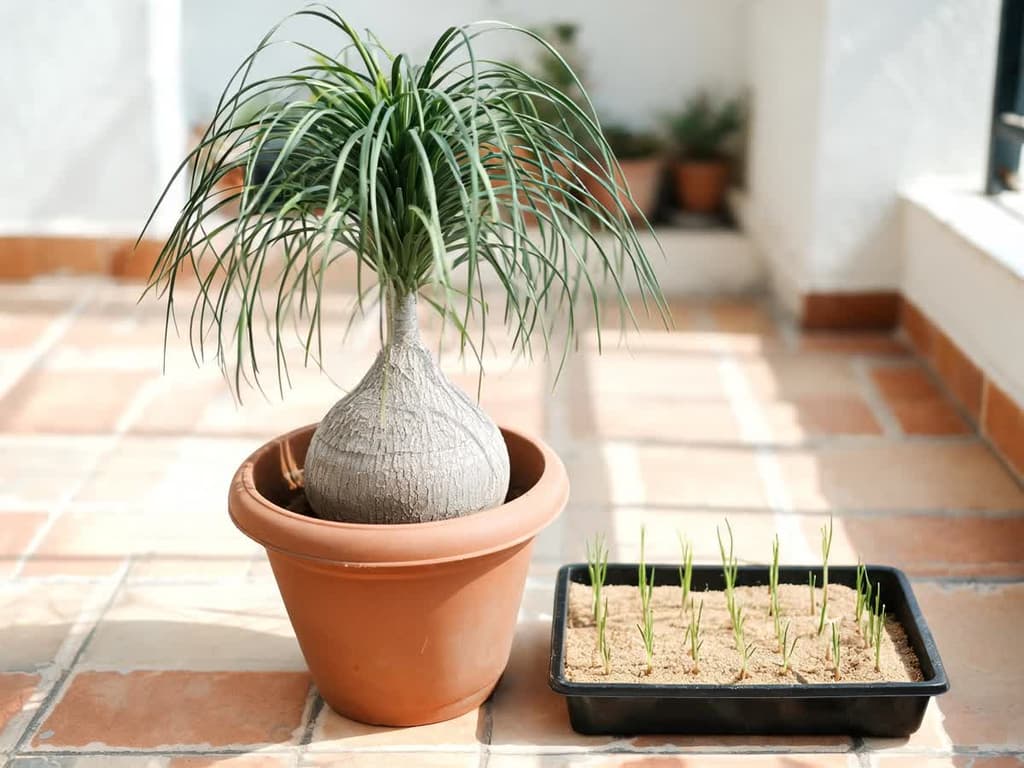
When propagating a ponytail palm, seeds are the only method with consistent results. The offshoots that sprout along the swollen trunk base divide the experts. One US university extension states they will not root, while the Royal Horticultural Society advises rooting them in spring. As for cutting off the top of the trunk, that piece almost never produces a viable plant.
The ponytail palm (Beaucarnea recurvata) is native to the dry parts of Mexico. It features a bulbous, swollen trunk base and a fountain of narrow, cascading leaves. Despite its common name, it is not a true palm. Spineless yucca is sometimes confused with it, but that is an entirely different species with its own propagation rules.
Quick summary:
The University of Wisconsin reports that ponytail palms reproduce only by seed, and only female specimens produce them.
Trunk offshoots can be trimmed flush with the base without harming the parent plant, though sources disagree on whether those cuttings will take root.
Removing the outer seed husk before planting yielded a 60% germination rate in a Brazilian study, compared to just 37% with the husk intact.
According to a 1980 botanical study, plants started from seed develop the signature swollen base, whereas vegetative cuttings do not.
Ponytail palm propagation: what works and what fails
People usually try three different parts of a ponytail palm to start new plants: seeds, basal offshoots, and stem cuttings from the top. Each comes with very different odds.
Method | What the sources say | Does it form a swollen caudex? |
|---|---|---|
Seed | Primary method recommended by the University of Wisconsin and the University of Florida | Yes |
Basal offshoot | Wisconsin says they will not root; the RHS recommends rooting them in spring | No, based on a 1980 study |
Stem tip cutting | A 2018 study found them difficult to root, succeeding only with heavy rooting hormone | No, based on a 1980 study |
Leaf | None of our consulted sources mention leaves as a propagation method | No data |
A 2019 article published in the Mexican journal Entreciencias cites botanist D. W. Stevenson (1980): a ponytail palm grown from seed develops the swelling at the base of the trunk. A plant propagated vegetatively, that is, from a piece of another plant, does not.
Propagation recipes for other houseplants do not work here either. The peace lily divides into rooted clumps, while the ponytail palm has a single trunk. The peperomia grows a new plant from a leaf, and no source mentions this method for the ponytail palm. The hoya roots from a node on a slender stem. A ponytail palm branch, when present, is a thick continuation of the trunk itself.
Trunk offshoots: prune them, leave them, or try to root them
The shoots that appear on the swollen base are small clusters of leaves attached to the trunk. They emerge from the same trunk as the parent plant and, if left alone, become branches.
The two sources that discuss these offshoots disagree:
The University of Wisconsin Extension states that trunk offshoots "will not root to produce new plants." It tells you to cut them flush with the trunk if you want a single-trunked plant, or leave them to grow if you want branches.
The Royal Horticultural Society (RHS), the UK's horticultural society, lists "rooting offshoots in spring" as a method, alongside seeds.
We defer to the University of Wisconsin on your odds of success, as university extension research carries more scientific weight than general horticultural society tips. Neither source shares a verified success rate. Testing an offshoot cutting costs you nothing more than that pup. Pruning it flush will not hurt the parent plant, and Wisconsin treats that cut as normal maintenance. No extension service lists a minimum pup size for removal.
An offshoot emerging from the soil beside the trunk might already have its own root system. Our sources do not document that scenario. Your safest route for the parent plant is still a clean slice with a sharp knife, without pulling, knowing that rooting the pup remains a long shot.
Step-by-step guide to rooting an offshoot
Wait for spring, from March to May. That is the time the RHS recommends for rooting offshoots.
Wipe a knife blade with 70% alcohol, as Iowa State University recommends.
Slice the pup off right where it meets the trunk. Never twist or yank the shoot off by hand.
Let the cutting sit in a dry, shaded area until the cut surface feels completely dry to the touch. None of the research studies specify an exact drying duration for ponytail palms.
Tuck the pup into a small draining pot filled with cactus and succulent mix. This fast-draining medium is explicitly recommended for ponytail palms by North Carolina State University.
Water only after the potting mix has dried out completely.
New leaf growth at the center of the pup usually indicates that it rooted, but none of the consulted sources confirm this sign for ponytail palms. None of the sources published how long this takes. A soft, dark base while the soil is still moist means rot. In that case, throw the pup out and, on the next one, wait for the soil to dry out completely before watering.
Growing a ponytail palm from seed
Seed is the only method the University of Florida cites. The UF/IFAS fact sheet states that propagation "is by seed, which usually must be imported from Mexico."
The ponytail palm is a dioecious plant: each plant is either male or female, and only the female produces seeds. According to Wisconsin, usually only large trees bloom. North Carolina State University records that it rarely blooms indoors in containers. For this reason, ponytail palm seeds almost always come from a store, and not from a houseplant.
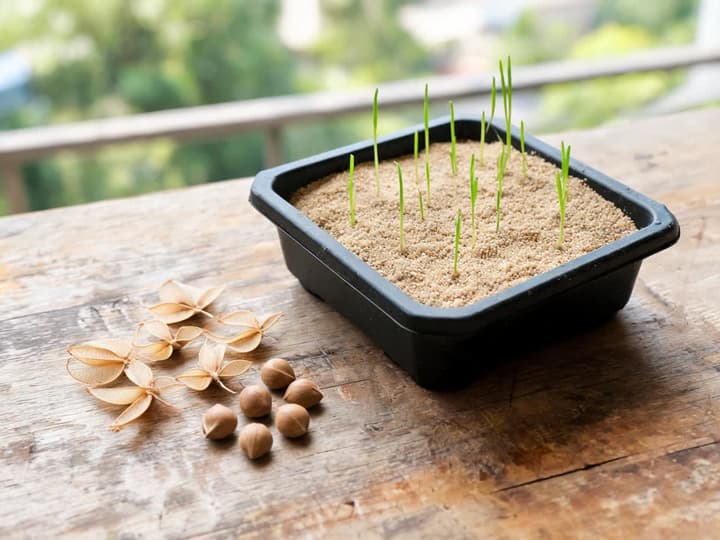
Step-by-step seed sowing guide
Sow in spring, from March to May. The RHS recommends a temperature of 18 °C to 21 °C (64 °F to 70 °F), and Wisconsin calls for at least 20 °C (68 °F).
Remove the fruit husk (the pericarp) surrounding each seed. The Brazilian study by Jardim Rosa and colleagues was published in 2014 in the journal Ornamental Horticulture. In it, 60% of seeds without the husk germinated, compared to 37% with the husk.
There is no need to pre-soak. In that same study, soaking seeds in water for up to 96 hours did not increase total germination, only how quickly they sprouted.
Use a blend of one part potting soil, one part coarse sand, and one part powdered charcoal. That exact mix yielded the heaviest seedlings with the thickest stems in the trial.
Cover the seeds with a light dusting of the potting mix and keep it barely moist, never soaked, until seedlings emerge.
The University of Wisconsin notes that ponytail palm seeds "germinate easily without special treatment." None of our sources give a verified day count for when sprouts will appear.
Stem cuttings do not work
The top section of the trunk, with its tuft of leaves, almost never roots. A study published in 2018 in the Malaysian Journal of Sustainable Agriculture classifies the ponytail palm as "difficult-to-root." The only cutting that rooted received the highest tested hormone dose, 4,000 mg per liter of IBA (a rooting hormone). The title of the study calls the result "unexpected."
Cutting off the top changes the plant left in the pot. According to Wisconsin, the plant branches when the trunk is cut or broken while still thin, under 15 cm (6 inches) in diameter. Growers make this cut on purpose to produce three-headed plants.
A branched ponytail palm is simply one plant with multiple heads. Removing one of those branches to start a cutting leaves you with the same low odds of success as a trunk top.
How long does a ponytail palm take to grow?
Ponytail palm seedlings are notoriously slow growers. Both NC State Extension and the University of Florida classify their growth rate as slow. The RHS estimates it takes 20 to 50 years for a specimen to reach mature size.
No research gives an exact timeline for when a seed-grown plant develops its swollen trunk base. The 2014 study recorded seedling stem thickness, but did not follow them through mature caudex development.
Early care for young plants
An adult ponytail palm is a full-sun plant. North Carolina State University indicates 6 hours or more of direct sun per day. The RHS and the Missouri Botanical Garden also classify it as a full-sun plant. No source states how much sun a newly sprouted seedling can tolerate. The safest option is to start with morning sun and increase the hours of sunlight over a few weeks.
North Carolina State University states that the ponytail palm tolerates down to 10 °C (50 °F). In winter, from December to February, bring the pot to a sheltered spot on nights below 10 °C.
Overwatering is the primary killer. The University of Wisconsin flags excess water as the most frequent cause of plant loss and advises letting the soil dry thoroughly between waterings. A soft, dark, sour-smelling base indicates root rot:
Yellow leaves, spots, or pests on the young plant have other causes, and the guide what's wrong with my plant breaks down each one by symptom.
Is it a ponytail palm or a spineless yucca?
These two plants are occasionally confused in retail shops, but their propagation methods are completely different. The ponytail palm has thin, weeping leaves and a noticeably wide, swollen trunk base. Spineless yucca (Yucca elephantipes) features stiff, wide, upright leaves with pointed tips.
If you do not know which of the two plants you have at home, the Bloom app identifies the species from a photo of the whole plant.
Frequently asked questions
What should I do with the offshoots on my ponytail palm?
You can cut the offshoots flush with the trunk using a clean knife if you want a single-trunked plant. If you leave them, they become branches. The University of Wisconsin says these offshoots do not root, while the RHS says they root in spring. Testing an offshoot cutting costs you an offshoot and will not harm the parent plant.
Does a ponytail palm prefer full sun or shade?
Ponytail palms thrive in bright light. NC State Extension recommends full sun, meaning six or more hours of direct light daily. The University of Florida notes they tolerate full sun to partial shade. Introduce young seedlings to direct sunlight gradually, starting with gentle morning exposure.
Can you propagate a ponytail palm from a branch cutting?
Branch cuttings almost never take root. A 2018 study categorized the plant as difficult to root, with only heavily hormone-treated cuttings showing any response. Furthermore, vegetative cuttings will not develop the iconic swollen trunk base. If you want a plant with that bulbous caudex, growing from seed is your only reliable path.
Is the ponytail palm toxic to cats and dogs?
The ASPCA, the animal poison control center in the United States, lists the ponytail palm as non-toxic to dogs, cats, and horses. There, it appears under its English name, ponytail palm. If your pet ate part of the plant and became ill, consult a veterinarian and provide the plant's name.
Where to start
Look at the swollen base of your ponytail palm. If it has pups and spring has started, cut one off flush with the trunk using a clean knife and plant it in cactus soil. If you want a new plant with a swollen base, buy seeds and sow them without the fruit husk.
Bloom is an iPhone (iOS) app that identifies the plant by photo and builds its watering schedule.
Sources
University of Wisconsin–Madison, Division of Extension, Wisconsin Horticulture: Ponytail Palm, Beaucarnea recurvata. Accessed on September 18, 2026.
Royal Horticultural Society: Beaucarnea recurvata. Accessed September 18, 2026.
University of Florida IFAS, EDIS: Beaucarnea recurvata: Ponytail Palm (ST093). Accessed September 18, 2026.
Missouri Botanical Garden, Plant Finder: Beaucarnea recurvata. Accessed September 18, 2026.
NC State Extension Gardener Plant Toolbox: Beaucarnea recurvata. Accessed on September 18, 2026.
Iowa State University Extension and Outreach, Yard and Garden: How do I sanitize my pruning shears?. Accessed September 18, 2026.
ASPCA Animal Poison Control: Pony Tail. Accessed September 18, 2026.
Jardim Rosa, Y. B. C. et al. Effect of substrate, pericarp and pre-germinative treatments on ponytail seedling emergence. Ornamental Horticulture, v. 20, n. 1, p. 13–20, 2014.
Rodríguez Trejo et al. Germinación de semillas de Dasylirion lucidum y Beaucarnea gracilis. Entreciencias, v. 7, n. 20, 2019 (cites Stevenson, D. W., 1980, on Beaucarnea recurvata).
Sedaghathoor, S. and Rostami Shahrajil, H. Unexpected Rooting in Shoot-Tip Cuttings of Ponytail Palm (Beaucarnea recurvata). Malaysian Journal of Sustainable Agriculture, vol. 2, no. 2, 2018.
Related articles
How to Care for a Maidenhair Fern: Light, Water, and Revival Tips
Learn how to care for a maidenhair fern indoors: bright indirect light, consistently moist soil, high humidity, and how to revive it if it dries out completely.
How to Propagate Spider Plants: Root the Pup Before Cutting
The safest spider plant cutting comes from a pup still attached to the mother plant: rest the plantlet on soil in a small pot, wait for roots to establish, and only then cut the stolon. Learn when the pup is ready, whether rooting in water is worth it, how to divide the clump, and why plants fail to produce babies.
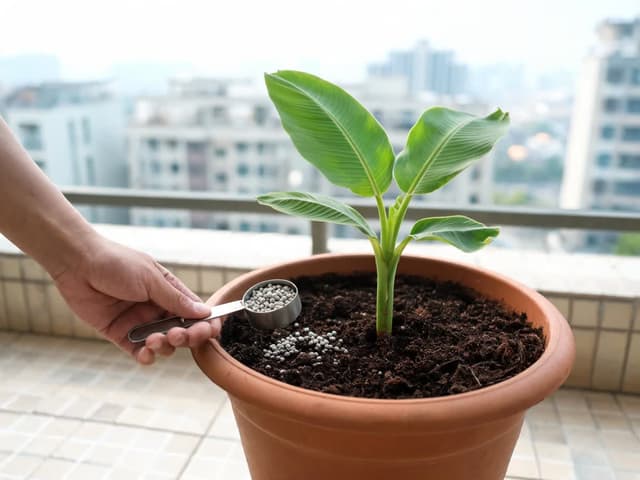
Banana plant fertilizer: fertilizing potted and backyard plants
Banana plant fertilizer needs more potassium than nitrogen, in a 3-1-6 ratio. For a potted plant on a balcony, use the label dose in spring and summer. In the backyard, fertilize every 2 months, adjusting the amount by mat age. Learn the formula, timing in Brazil, and signs of deficiency or excess.