Does the Ponytail Palm Bloom? When Flowers Appear and What to Do
In a pot and indoors, the ponytail palm rarely blooms. Flowers appear on large, old plants, almost always planted in the ground in warm climates. Learn what the flower looks like, when it appears, if the plant dies afterward, and what to do with the stalk.
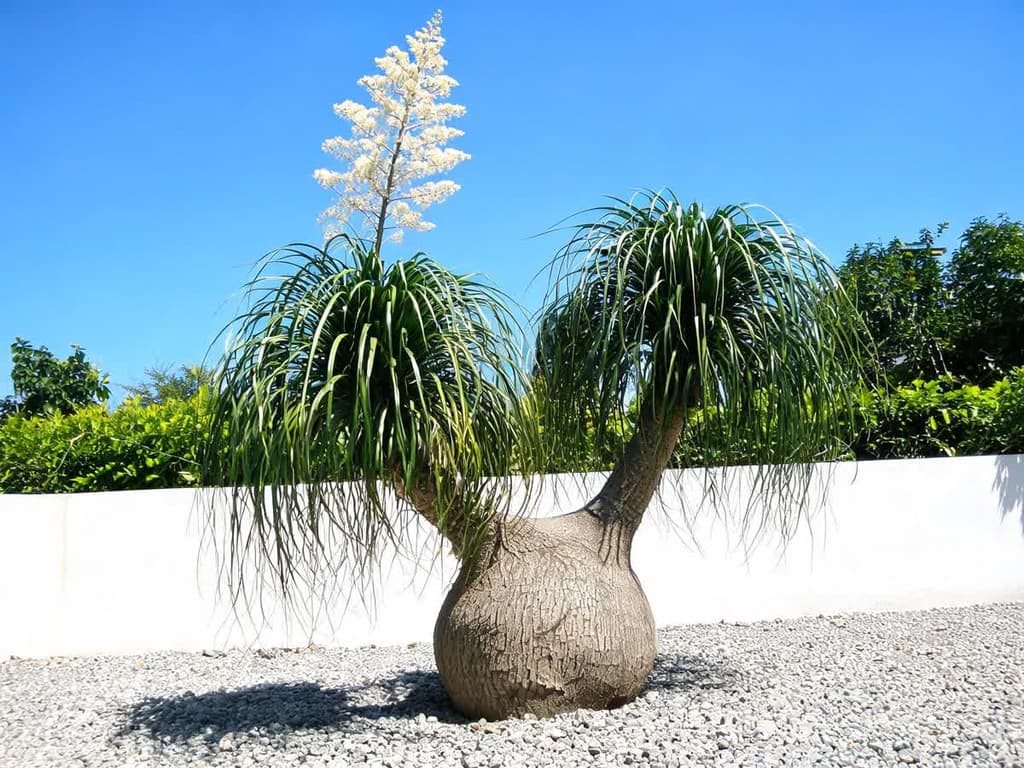
In a pot and indoors, the ponytail palm rarely blooms (NC State Extension, the extension service of North Carolina State University). The flower appears on large, old plants, almost always planted in the ground and in warm climates. The species is native to Mexico. There, only plants taller than 3 m were blooming in the field survey by CONABIO, Mexico's biodiversity commission.
No consulted source shows a fertilizer or trick that makes the ponytail palm bloom. What increases the chance is giving the plant time and space to grow, in full sun. If yours has already bloomed, it is not dying: after flowering, the plant usually forms new branches (University of Wisconsin).
Quick summary:
Question | Answer | Source |
|---|---|---|
Does it bloom in a pot? | Rarely, but it happens | NC State, Wisconsin |
At what size does it bloom in the wild? | Over 3 m (10 ft) tall | CONABIO |
What does the flower look like? | A branched cluster from 0.7 to 1.3 m (2.3 to 4.3 ft) long, with many tiny flowers that are cream, green, yellow, pinkish, or reddish | CONABIO, UF/IFAS, Wisconsin |
At what time of year? | Spring and summer; in Brazil, from September to March | UF/IFAS |
Does the plant die afterward? | No. It can bloom again and usually forms branches. | UF/IFAS, Wisconsin |
Does it produce seeds indoors? | Only female plants, and only with a flowering male plant nearby | Wisconsin, CONABIO |
Does a cold winter trigger blooming? | None of the scientific sources consulted say so. Three German guides say it does | NC State, German guides |
Why the ponytail palm rarely blooms in a pot
The ponytail palm (Beaucarnea recurvata) only blooms when it reaches the size of a mature tree, and in a pot it almost never gets there. According to the University of Wisconsin, normally only large trees bloom. The only field data comes from CONABIO, which tracked wild populations in Veracruz, Mexico. There, flowering plants were over 3 m (10 ft) tall.
The pot limits its growth. Planted in the ground, the ponytail palm can reach 9 m (30 ft). In a pot, it stays much smaller and grows slower (Wisconsin). NC State gives 1.8 to 2.4 m (6 to 8 ft) for potted plants. That height remains below the 3 m (10 ft) where CONABIO observed blooming.
None of the university or botanical garden sources consulted give a specific number of years until the first bloom. The RHS, the UK's horticultural society, estimates 20 to 50 years for the plant to reach maturity. That timeframe is not necessarily when the first flower appears.
Climate also matters. The University of Arkansas Extension notes that flowers appear only on very old plants and only in tropical climates. Arizona State University (ASU) records blooming as rare in Arizona and common on old plants in Southern California, which does not have a tropical climate. The sources agree that only old plants bloom, which is why this article refers to warm climates without requiring a tropical climate.
Flowering in a pot is rare, but it happens. The University of Wisconsin page shows photographic proof of the flowering sequence of a potted ponytail palm.
What the ponytail palm flower looks like
The ponytail palm flower is a panicle: a long, branched cluster packed with tiny blossoms that emerges from the center of the leaf rosette. In Mexico, CONABIO measured panicles between 0.7 and 1.3 m (2.3 to 4.3 ft) long, varying from yellow to reddish in color. UF/IFAS, the University of Florida Extension, describes creamy-yellow flowers on stalks about 90 cm (3 ft) long.
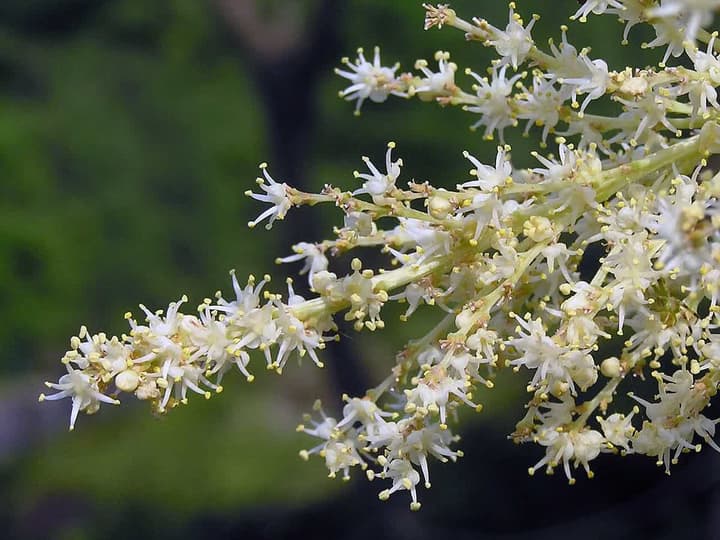
Each flower is very small: the petals measure 1.5 to 2.5 mm (CONABIO). The flowers are numerous and can be green, cream, or pinkish (Wisconsin). They strongly attract bees, according to the same university. The stalk emerges upright above the leaves and droops over time or under the weight of the fruit (UF/IFAS).
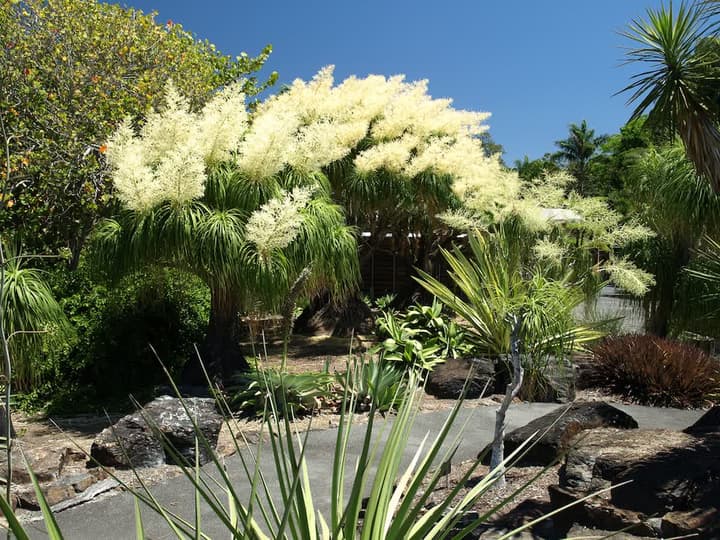
The ponytail palm is dioecious: each plant bears only male flowers or only female flowers (CONABIO, Wisconsin). A guide from a German plant shop states that male flowers are cream and female flowers are pinkish. We found no scientific source confirming this color difference. Therefore, do not rely on color to determine your plant's sex.
Male flowers last 3 to 4 days. Female flowers stay on the stalk and develop into fruit in 4 to 5 months (CONABIO). The fruit is dry, has 3 wings, and contains a single seed.
In Brazil, the name pata-de-elefante (ponytail palm) is sometimes also used for the spineless yucca (Yucca gigantea). Its old name, Yucca elephantipes, comes from the thick trunk, which resembles an elephant's foot. The yucca's flower is very different: large white bells in clusters on a tall stalk (NC State). If you inherited the plant and do not know which of the two you have at home, Bloom (available for iOS) identifies the species from a photo.
When the ponytail palm blooms
The ponytail palm blooms in spring or summer, and the flowering stalk lasts for several weeks (UF/IFAS). In the Southern Hemisphere, where Brazil is located, this corresponds to the period from September to March. Some mature plants bloom 2 or even 3 times in the same year, according to UF/IFAS. This data applies to landscape plants in the South Florida climate.
In its native habitat, flowering began in May 2002, the end of spring in Mexico. That year, plants across the studied populations bloomed at the same time (CONABIO). The same report notes that mature plants grown outside their native range also bloom, but less frequently, and few produce seeds.
Does the ponytail palm die after flowering?
No. The ponytail palm stays alive after flowering and can bloom again, sometimes more than once in the same year (UF/IFAS). The University of Wisconsin explains that the plant starts with a single trunk and develops branches with age and after flowering.
Some plants die after flowering. Agave forms a rosette of leaves, sends up a single huge flower stalk, and dies after blooming (NC State). The ponytail palm belongs to the same botanical family as agave, but it does not have this cycle.
After flowering, the tuft of leaves that bloomed may take time to produce new growth. This appears in reports from owners on forums, and no scientific source measures how long it lasts. To tell if the plant is fine, squeeze the base of the trunk, the swollen part that stores water. A firm base indicates a healthy plant. A soft base indicates rot: stop watering and remove the plant from the pot to inspect the roots.
What to do when a ponytail palm blooms
When a ponytail palm blooms, keep your care routine the same as before. The flower requires no extra fertilizer or change in location. Water your ponytail palm only when the soil dries out completely down to the bottom of the pot, just like during the rest of the year.
There is no need to rush to cut the flower off, as it does not harm the plant. Once the stalk dries out, you can remove it to keep the plant looking tidy, as UF/IFAS suggests. Cut the dry stalk off at the base where it emerges from the tuft, using clean pruners and taking care not to nick the leaves.
If your plant is female and a flowering male plant is nearby, the stalk can develop dry, 3-winged fruits. Only the female produces seeds (Wisconsin). You can use these seeds to propagate ponytail palm from seed, the only propagation method recommended by the University of Wisconsin. Male plants do not produce seeds, and outside of Mexico few female plants do (CONABIO).
Sticky or dripping flower stalk on a ponytail palm: nectar or pests?
Female ponytail palm flowers have nectaries at their base, which are the glands that produce nectar (CONABIO). None of the consulted sources describe the flower dripping or leaving the stalk sticky. Therefore, before assuming the stickiness is nectar, check for pests.
NC State lists mealybugs and armored scales as pests of the ponytail palm. Mealybugs suck sap and excrete a sweet, sticky honeydew (Iowa State University). The honeydew falls onto the leaves and the ground beneath the infested spot.
To tell the two apart, look at where the stickiness is located:
Only on the flowers, with no visible pests: it could be nectar, though no sources confirm this. Check the leaves and trunk again after 7 days.
On the leaves, trunk, or floor beneath the plant, accompanied by white fuzz or hard brown bumps: you have scale insects. The guide to scale insects shows how to eliminate the pest.
Does winter drought stress a ponytail palm into blooming?
None of the consulted sources links the ponytail palm flower to drought or stress. The flower indicates a mature plant that has reached flowering size.
A dry winter is normal for the species. In its habitat, it rains in the summer and the winter is mostly dry. The University of Wisconsin recommends mimicking this rhythm in a pot: deep watering only when the soil dries out, and much more spaced-out waterings in winter. In Brazil, winter runs from June to August.
If you watered sparingly over winter and the plant bloomed in spring, you did not do anything wrong. To ensure the plant is healthy, squeeze the swollen base of the trunk. A firm base indicates a healthy plant.
What increases the chances of a ponytail palm blooming
No method guarantees blooms. What the sources support is allowing the plant to grow to mature size, and three conditions help with that:
Full sun. Provide 6 hours or more of direct sunlight per day, as NC State recommends. In Brazil, a north-facing window receives the most sun. The guide on how to care for a ponytail palm explains how to acclimate the plant to the sun without burning the leaves.
In the ground, in frost-free areas. Planted in the ground, it grows larger and faster than in a pot (Wisconsin). UF/IFAS recommends this plant for landscapes in USDA hardiness zones 10A through 11. In these zones, the coldest day of the year stays above roughly −1 °C (30 °F).
A pot that grows with the plant. If it must stay potted, move it up to the next pot size when the swollen base touches the rim. The University of Wisconsin notes that the plant stays small if kept in a small container. Even so, in a pot it reaches 1.8 to 2.4 m (6 to 8 ft) (NC State), and blooming remains rare.
Three German gardening guides, two of them from plant shops, recommend a cold winter to induce flowering. Each gives a different range: 10 to 15 °C (50 to 59 °F), 6 to 12 °C (43 to 54 °F), or at least 7 °C (45 °F). None of the scientific sources consulted links cold temperatures to flowering. NC State gives 10 °C (50 °F) as a risk threshold for potted plants. Because of this, this article follows university extension guidelines and does not recommend cold temperatures to force blooming.
Measure | Are there sources to back up helping it bloom? |
|---|---|
Allow the plant to reach mature size | Yes (CONABIO, Wisconsin, Arkansas) |
Full sun | Only indirectly: helps the plant grow (NC State, Wisconsin) |
Planting in the ground, in a frost-free climate | Helps the plant grow larger and faster (Wisconsin, UF/IFAS) |
Intentional cold winter | No, and temperatures below 10 °C (50 °F) in a pot pose a risk (NC State) |
Bloom fertilizer | No sources found |
Pruning the trunk | No source links pruning to blooming. On young plants with a trunk under 15 cm (6 in) in diameter, pruning causes multiple trunks to sprout (Wisconsin) |
Frequently asked questions
How often do ponytail palms bloom?
In a pot, most plants never bloom, and those that do are typically large and old (NC State, Wisconsin). The chances are higher for a mature plant growing in the ground in a warm climate. In that scenario, UF/IFAS records plants blooming 2 or even 3 times in the same year, throughout spring and summer. None of the sources consulted specify whether a mature plant blooms every single year.
How long does the ponytail palm flower last?
The blooming stalk stays showy for several weeks, according to UF/IFAS. Individual male flowers last 3 to 4 days (CONABIO). On female plants, the flowers remain on the stalk and turn into dry fruits over 4 to 5 months. After the stalk dries out, you can cut it at the base where it emerges from the tuft.
Does an indoor ponytail palm produce seeds?
Almost never. Ponytail palms have separate male and female plants, and only females produce seed (Wisconsin). For that to happen, a male plant must bloom nearby at the same time. Outside Mexico, few mature plants produce seeds (CONABIO). For growing, seeds almost always must be sourced from Mexico, according to UF/IFAS.
Is the ponytail palm toxic to cats and dogs?
The ASPCA, an animal poison control center in the United States, lists the ponytail palm as non-toxic to dogs, cats, and horses. The ASPCA warns that eating any plant can cause vomiting and an upset stomach. If your pet ate many leaves and became ill, call the veterinarian.
Ponytail palm without blooms: what to do today
Gradually move the ponytail palm to the spot with the most direct sun in the house to avoid burning the leaves. Squeeze the swollen base: a firm base indicates a healthy plant. If the base already touches the rim of the pot, repot to the next size up in the spring, from September to November in Brazil. If the plant bloomed, leave the stalk until it dries out and only then cut it at the base, where it emerges from the cluster.
Not sure if you have a ponytail palm or a spineless yucca? Bloom identifies the species from a photo and builds its custom watering schedule.
Sources
Contreras Hernández, H. A., Osorio Rosales, M. L., Echavarría Domínguez, E. U., and Contreras, R. Estado de conservación de las poblaciones silvestres de la palma monja (Beaucarnea recurvata) y su cadena de valor. Instituto de Ecología A.C., final report of SNIB-CONABIO project NE006, 2017.
University of Florida IFAS Extension: Beaucarnea recurvata: Ponytail Palm (ST093), Gilman and colleagues.
University of Florida IFAS, Gardening Solutions: Ponytail "Palm".
University of Wisconsin–Madison, Division of Extension: Ponytail Palm, Beaucarnea recurvata, Susan and Dan Mahr.
NC State Extension, Gardener Plant Toolbox: Beaucarnea recurvata, Agave americana, and Yucca gigantea.
University of Arkansas Division of Agriculture, Plant of the Week: Ponytail Palm.
Arizona State University, C. Martin: Beaucarnea recurvata.
Royal Horticultural Society: Beaucarnea recurvata.
Iowa State University Extension and Outreach, Yard and Garden: Mealybugs.
ASPCA Animal Poison Control: Pony Tail.
Related articles

How to Care for Hibiscus: Sun, Watering, Fertilizer, and Pruning for Flowers
How to care for hibiscus: 6 hours of direct sun, evenly moist soil without waterlogging, half-strength fertilizer in spring and summer, and pruning in early spring. Find out why the flower lasts one day and why buds drop before opening.

Do Ferns Like Sun or Shade? It Depends on the Type
Ferns prefer bright shade: plenty of light, but no direct sun on their fronds. Tuberous sword fern is the exception that handles sun. Here is the ideal light for each type, where to place pots, and how fronds show too much or too little light.

African Violet Yellow Leaves: Causes and What to Do
Yellow leaves on an African violet usually stem from overwatering, and the first place to check is the center of the plant. Losing one lower leaf at a time is normal. Identify whether age, watering, cold water, sunlight, cold drafts, or fertilizer is the culprit based on the yellowing pattern, and see what to do today.