Is Ponytail Palm Toxic to Cats and Dogs? What the ASPCA and CliniTox Say
The ASPCA lists the ponytail palm as non-toxic; CliniTox, from Zurich, lists it as toxic only in large quantities. Here is what to do if your cat chewed on it.
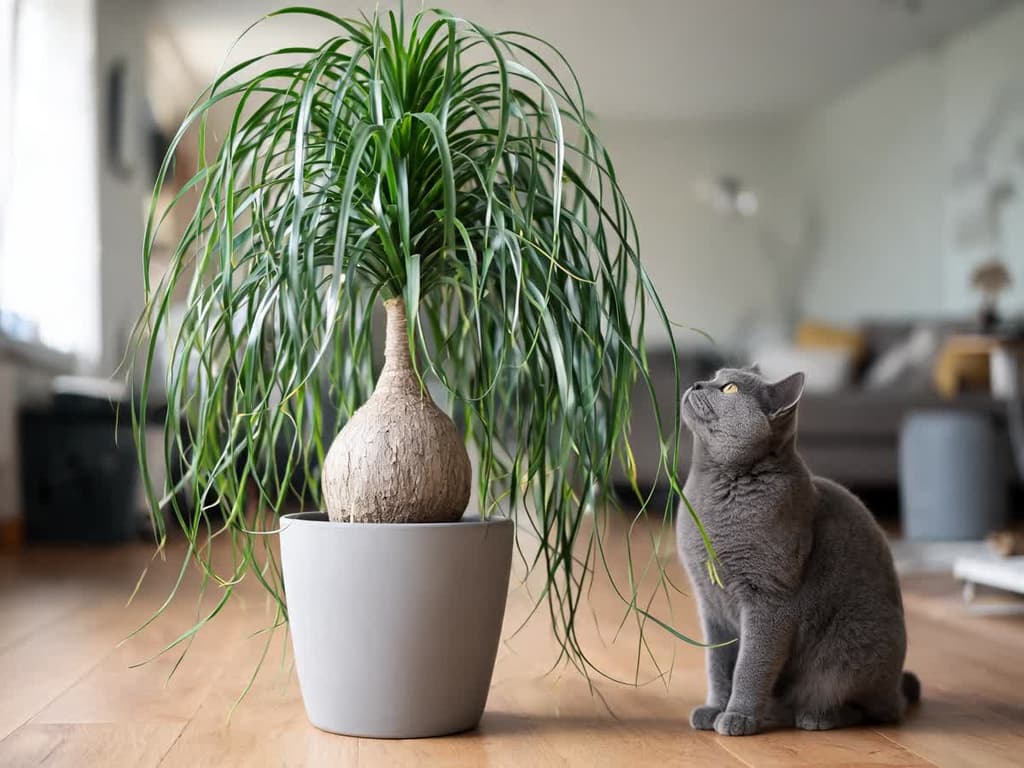
The ASPCA, an animal poison control center in the United States, lists the ponytail palm (Beaucarnea recurvata) as non-toxic to cats, dogs, and horses. CliniTox, a veterinary toxicology database from the University of Zurich, disagrees: it considers the ponytail palm toxic to cats and other animals, at a low level. On the CliniTox scale, symptoms appear only after the animal eats a large amount of the plant.
If your cat or dog took a bite of a few leaves and is acting normally, it is not an emergency. If they vomit or have diarrhea, call your vet immediately. If your cat chews the plant every day, move the ponytail palm away from them: CliniTox notes that frequent consumption can cause intestinal inflammation.
Quick summary:
ASPCA and NC State Extension (the extension service of North Carolina State University, in the United States): nontoxic to cats and dogs.
CliniTox (University of Zurich): low-grade toxicity, with symptoms only after a large amount of the plant.
The foliage contains saponin, a substance that irritates the mouth and stomach. A 2011 study isolated 13 different saponins in the leaves.
Expected symptoms: vomiting and diarrhea. CliniTox records a cat that vomited for more than 24 hours.
Do not induce vomiting at home. If the pet vomits or has diarrhea, call the vet and provide the scientific name of the plant.
What the ASPCA and CliniTox say about the ponytail palm
The two veterinary databases disagree. The ASPCA places the ponytail palm on its non-toxic plant list, while CliniTox puts it on its toxic plant list, at the second of four levels.
Source | Classification | What else it says |
|---|---|---|
ASPCA (United States) | Non-toxic to dogs, cats, and horses | Warns that eating any plant can cause vomiting and stomach upset in dogs and cats |
NC State Extension (United States) | Non-toxic to cats, dogs, and horses | No symptom details |
CliniTox, University of Zurich (Switzerland) | Low-grade toxicity ("giftig +") | Symptoms only after large quantities; saponin irritates the mouth and stomach; case of a cat vomiting for over 24 hours |
The CliniTox scale has four levels of toxicity. The ponytail palm's level means "symptoms after eating a large quantity of plant material." The highest level means "symptoms with a minimal quantity."
The case recorded by CliniTox came from Tox Info Suisse, the Swiss poison information center. A cat vomited violently for over 24 hours after eating from a Beaucarnea. CliniTox also states that eating the plant frequently can cause chronic intestinal inflammation.
For an isolated bite, this article follows the ASPCA. According to them, symptoms from plants on the non-toxic list should not be life-threatening to the animal. For a cat that chews the plant every day, the article follows CliniTox. As long as the two databases disagree, that is the safest approach for your pet.
Does the ponytail palm contain saponins?
It does. In 2011, a laboratory in Reims, France, isolated 13 different saponins from ponytail palm leaves (Eskander and colleagues, journal Phytochemistry). Another study, from 1996, isolated 7 saponins from the stem. Saponin is a plant-produced compound that foams when mixed with water. In an animal, it irritates the mouth and stomach.
Containing saponins does not single-handedly determine a plant's classification. The ASPCA itself lists dracaena as toxic to dogs and cats due to saponins, as shown in the dracaena care guide. Yet the ASPCA places the ponytail palm on its non-toxic list. Neither of the two studies measured the effect of these saponins on cats or dogs.
Cat or dog chewed a ponytail palm: what to do
Follow the steps the ASPCA recommends for any chewed plant:
Remove the pet from the plant's vicinity and pick up any leaf pieces from the floor.
Watch to see if they act normally, vomit, or have diarrhea.
If they vomit or have diarrhea, call the vet and give them the scientific name: Beaucarnea recurvata.
Take your pet straight to the clinic if they are unresponsive, having trouble breathing, bleeding, or having seizures.
Do not try to make the animal vomit at home. The ASPCA explains that salt, frequently used for this, can raise blood sodium to a dangerous level. Sticking your finger down the animal's throat also does not work and can injure their throat.
The signs that CliniTox associates with ponytail palm are those of an irritated stomach and intestine: vomiting and diarrhea. Call your vet if the animal vomits, even though the ASPCA lists the plant as non-toxic. The case recorded by CliniTox involved vomiting for more than 24 hours. The treatment described by CliniTox takes place at the clinic, with anti-vomiting medication and stomach protectants.
Why cats chew ponytail palms and how to protect the plant
No consulted source explains why cats chew ponytail palms. What is obvious are the long, slender leaves hanging right within their reach. NC State describes ribbon-like leaves cascading from the top of the trunk. UF/IFAS, the University of Florida extension, notes that the leaf margin is serrated. No consulted veterinary source evaluated whether this serrated edge cuts a cat's mouth.
To protect both the plant and the cat:
Put the ponytail palm in a room the cat cannot enter. Another option is a balcony they do not have access to, provided it gets direct sun.
A high shelf only works if the leaf tips remain out of reach, too. Leaves draping down to the middle of a bookcase stay well within a cat's grasp.
Offer another plant for the cat to chew. The ASPCA lists spider plant (Chlorophytum comosum) and areca palm (Dypsis lutescens) as non-toxic to dogs and cats.
The ASPCA lists sago palm and azalea as toxic to dogs and cats, and lilies as toxic to cats. The guide to toxic plants for pets details the symptoms of each.
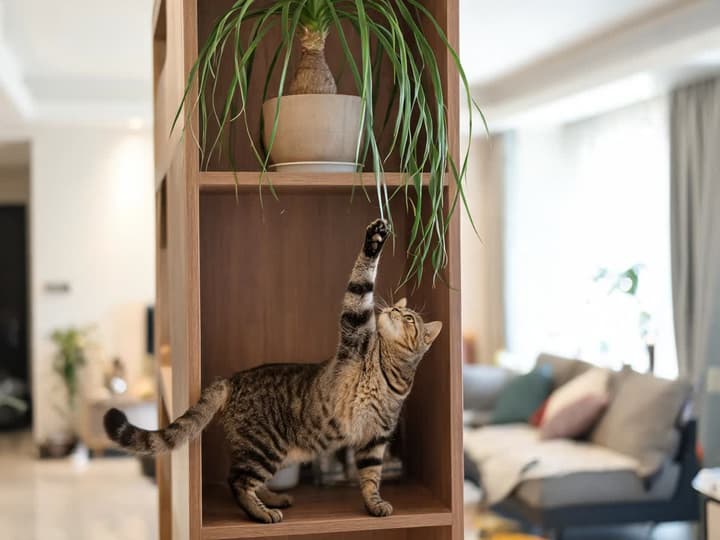
Chewed ponytail palm leaves: trim and wait
Using clean shears, trim only the brown, dry part of the leaf, following the shape of the tip without cutting into the green tissue. A chewed tip that stays green should be left alone. The NYBG (New York Botanical Garden) says the brown portion of the leaf can be trimmed off.
Recovery is slow. According to the NYBG, the ponytail palm grows slowly, and given enough light, pushes new leaves from the crown atop the trunk. Do not cut the trunk to force the plant to "renew." The NYBG reserves that cut for plants that have grown too tall or lost too much foliage, warning that results are not guaranteed. If you want another plant, the offsets growing at the base of the trunk can be propagated.
Leaves that dry up without bite marks stem from a different cause. According to the NYBG, erratic watering, low light, cold drafts, and fertilizer salt buildup are among the culprits. The swollen base stores water, and the guide to watering ponytail palms shows how to tell if it is getting too much water.
Frequently asked questions
Can a ponytail palm kill a cat?
None of the reviewed sources records a cat or dog death caused by a ponytail palm. The ASPCA lists the plant as non-toxic. CliniTox classifies it at the second of four toxicity levels and notes that the lethal dose is unknown. The most severe case it documents is a cat that vomited for more than 24 hours.
Is a ponytail palm toxic to dogs?
The ASPCA and NC State list the ponytail palm as non-toxic to dogs. The rating CliniTox gives the plant is not restricted to a single animal species. The case it records involves a cat. If your dog vomits or has diarrhea after eating the plant, call your vet immediately. If they chew the plant every day, move the ponytail palm away from them, just as you would with a cat.
Are ponytail palm, pata-de-elefante, and Nolina recurvata the same plant?
Yes. Nolina recurvata is the former scientific name for Beaucarnea recurvata, and ponytail palm is its common English name. Other Beaucarnea species are sold under that same name, according to the NYBG. The classifications in this article apply to B. recurvata. Bloom (available for iOS) identifies the species from a photo, giving your vet the exact scientific name they need.
Is it worth getting a ponytail palm if your cat chews plants?
Yes, if you can keep it where the cat cannot reach the foliage. The plant is easy to care for, as shown in the ponytail palm care guide, but it grows slowly. New leaves take a long time to replace chewed ones, and a cat chewing on it every day can strip the plant bare.
What to do next
If your cat or dog took a bite of the plant and seems fine, watch for vomiting or diarrhea. If either shows up, call the vet immediately and mention Beaucarnea recurvata.
If your pet chews the plant every day, move the ponytail palm somewhere they cannot reach even the leaf tips.
Trim only the brown, dried portion of the leaves and wait for new growth, which emerges slowly from the crown atop the trunk.
Sources
ASPCA Animal Poison Control, Pony Tail (Beaucarnea recurvata): non-toxic to dogs, cats, and horses; toxic and non-toxic plant lists; profiles for Dracaena, Chlorophytum comosum, and Dypsis lutescens. Accessed 10/26/2026.
ASPCA, What to Do if Your Pet Is Poisoned and Is It Ever Safe to Induce Vomiting?.
CliniTox, Institute of Veterinary Pharmacology and Toxicology, University of Zurich, Beaucarnea recurvata: "giftig +" level, saponins, symptoms, Tox Info Suisse case, treatment. Accessed 10/26/2026.
Eskander J., Lavaud C., Harakat D. Steroidal saponins from the leaves of Beaucarnea recurvata. Phytochemistry, 72(9), 2011.
Mimaki Y. and colleagues. Steroidal saponins from Nolina recurvata stems. Phytochemistry, 42(6), 1996.
NC State Extension, North Carolina Extension Gardener Plant Toolbox, Beaucarnea recurvata.
UF/IFAS, Beaucarnea recurvata (publication ST093): serrated leaf margins.
New York Botanical Garden, Houseplant care: Ponytail Palm (Beaucarnea recurvata).
Related articles
How to Care for Hibiscus: Sun, Watering, Fertilizer, and Pruning for Flowers
How to care for hibiscus: 6 hours of direct sun, evenly moist soil without waterlogging, half-strength fertilizer in spring and summer, and pruning in early spring. Find out why the flower lasts one day and why buds drop before opening.

Do Ferns Like Sun or Shade? It Depends on the Type
Ferns prefer bright shade: plenty of light, but no direct sun on their fronds. Tuberous sword fern is the exception that handles sun. Here is the ideal light for each type, where to place pots, and how fronds show too much or too little light.

African Violet Yellow Leaves: Causes and What to Do
Yellow leaves on an African violet usually stem from overwatering, and the first place to check is the center of the plant. Losing one lower leaf at a time is normal. Identify whether age, watering, cold water, sunlight, cold drafts, or fertilizer is the culprit based on the yellowing pattern, and see what to do today.