Desert Rose with Yellow Leaves: Causes and What to Do
A desert rose with yellow leaves might just be in winter dormancy. See how the season, the caudex, and the soil tell normal shedding apart from rot, spider mites, and root mealybugs.
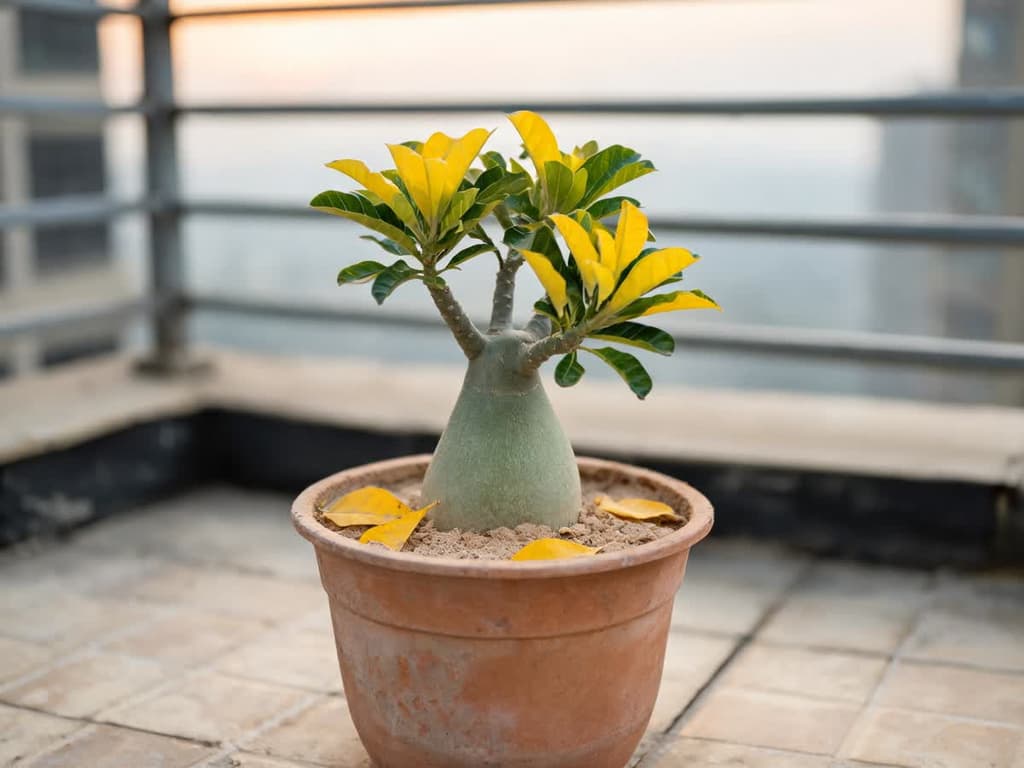
A desert rose with yellow leaves almost always fits into one of two scenarios. Either the plant is entering winter dormancy, which is normal, or the roots are getting too much water. Three quick tests tell the two apart: the time of year, how firm the caudex feels, and the moisture level of the pot's soil.
The desert rose (Adenium obesum) is a succulent that goes dormant. Dormancy is a pause in growth during which the plant sheds its leaves to endure the dry season. The caudex is the swollen base of the trunk where the plant stores water. As long as it stays firm, the plant retains its reserves and almost always bounces back. A soft caudex is the only sign requiring action that very day.
Quick summary:
Yellow leaves dropping between June and August, with a firm caudex and dry soil, mean winter dormancy. This applies to Southeast and South Brazil. Stop watering and wait.
Yellow, soft leaves outside of winter, with soil that has stayed moist for days, mean overwatering. Hold off on watering until the soil dries out completely.
A soft, dark, or sunken caudex near the soil line indicates rot. Unpot the plant today.
Pale specks on the leaves with fine webbing underneath point to spider mites. White powder on the roots combined with dry soil indicates root mealybugs.
Desert rose with yellow leaves: the three tests before touching the plant
Before watering, fertilizing, or repotting, run through these three tests in order.
The season. Between June and August in the Southeast and South, dropping yellow leaves is the species' standard pattern. In April and May, as nights turn chilly, yellowing can mark the start of this drop. Outside those months, look for another cause.
The caudex. Press the base of the plant with your thumb near the soil line. Firm like a raw carrot means healthy. If it yields under pressure, or if the bark wrinkles while the soil sits wet, rot is present.
The soil. Push a wooden skewer down to the bottom of the pot and pull it out after one minute. A clean, dry skewer indicates dry soil; a damp skewer or one with soil clinging to it points to standing water around the roots.
What you see | Caudex and soil | Likely cause | What to do |
|---|---|---|---|
Leaves turn yellow and drop between June and August | Firm caudex, dry soil | Winter dormancy | Stop watering and fertilizing. New leaves will sprout in spring. |
Soft, yellow leaves outside of winter | Firm caudex, soil wet for days | Overwatering | Hold off on watering until the skewer comes out dry. Check the pot's drainage hole. |
Yellow leaves, soft or dark base | Soft caudex, wet soil | Caudex and root rot | Unpot today and trim away soft tissue. |
Leaves turn yellow a few days after a cold night | Firm caudex | Cold | Move the plant to a sheltered spot whenever the forecast hits 13 °C or lower. Do not water until it resumes growing. |
Leaves yellow after repotting or moving spots | Firm caudex | Acclimation | Wait for new leaves before watering more or fertilizing. |
Pale or beige patches only on the sun-exposed side | Firm caudex | Sunburn | Move back to partial shade and ramp up sunlight over two weeks. |
Pale specks on leaves, fine webbing on the underside | Firm caudex, dry soil | Spider mites | Do the white paper test and spray the undersides with water. |
Yellow leaves with dry soil and white powder on the roots | Firm caudex | Root mealybugs | Remove all soil and treat roots with alcohol. |
Lower leaves yellow in summer while branch tips stay green | Firm caudex, dry soil | Nitrogen deficiency | Resume fertilizing if the plant went a year without fertilizer. |
With a firm caudex, every row in the table can be treated. Even rot can be managed, according to the University of Arizona Extension. Adenium (another name for the desert rose, from the genus Adenium) can recover after losing a significant portion of its roots and caudex. For this to happen, enough of the plant must remain healthy.
A recently repotted plant often drops leaves for two or three weeks, even with clean roots and fresh soil. If you have already refreshed the soil, inspected the roots, and the caudex remains firm, daily leaf drop does not mean the plant is dying. Let the soil dry out and wait for new growth at the branch tips.
A swollen-stemmed plant received as a gift is not always a desert rose. The ponytail palm (Beaucarnea recurvata) also features an enlarged base and requires different care. Bloom (available for iOS) identifies the species from a photo, and with Premium, it compares leaf photos against pest and disease symptoms.
The guide on how to care for desert roses covers the plant's entire year: sun, watering, soil, and flowering.
Yellow leaves in fall and winter: desert rose dormancy
The desert rose loses its leaves in winter because that is how it gets through the cold, dry season. The cultivation guide from UF/IFAS for Adenium obesum advises withholding water for three to four months during cold weather. All leaves and flowers drop, and this is part of the species' natural cycle.
Yellowing begins as nights cool off, and the plant may stay completely bare until the end of winter. In Southeast and South Brazil, this takes place between June and August. The sources cited here originate from the Northern Hemisphere, where the same cycle falls in December and January.
Not every desert rose loses all its leaves. The Arizona Extension notes that some specimens retain part of their foliage during rest. In parts of the North and Northeast, night temperatures stay above 10 °C. Where that occurs, the plant may keep its foliage and continue growing year-round. In that situation, continue your warm-season watering routine.
During dormancy, the plant requires you to stop doing three things:
Do not water mature plants. UF/IFAS instructs withholding water for three to four months. The Arizona Extension allows light watering that dampens only the top two or three centimeters of soil. That applies to plants under a year old or those kept in hot, sunny spots, and only if the caudex visibly wrinkles. When in doubt, do not water: the same extension links root rot directly to watering during dormancy.
Do not fertilize. The Arizona Extension permits fertilizer only while nighttime temperatures stay above 10 °C.
Do not pull off yellow leaves. Let them drop naturally.
Resume watering only when nighttime temperatures exceed 10 °C and the plant produces new growth, both conditions met together. Afterward, allow the soil to dry out thoroughly between waterings. New leaves during chilly nights are not yet a green light to water.
Yellow, soft leaves and wet soil: overwatering
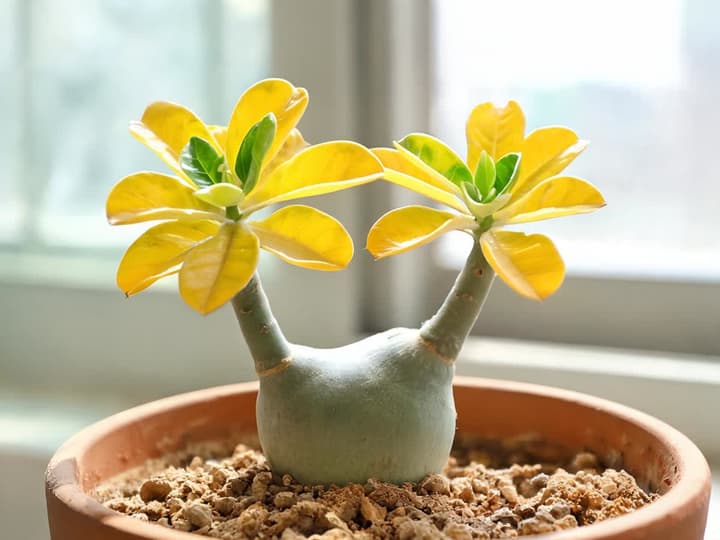
An overwatered desert rose develops yellow leaves that turn mushy and drop whole, with soil remaining damp days after watering. This occurs outside of winter while the plant is actively growing. The caudex stays firm as long as the roots have not rotted.
A reader described this scenario to the Nassau County UF/IFAS Extension. The plant sat on a porch in full afternoon sun, in a pot with good drainage. He watered every other day, and the leaves turned yellow and dropped in three days. The response was to switch to watering every one to two weeks.
The fix is to let the potting mix dry out completely before watering again. During the warm season in a sunny pot, this typically means a 7 to 14 day interval. Dry surface soil does not guarantee dry soil at the bottom, and the wooden skewer test for succulents highlights the difference.
Inspect the pot as well. Clogged drainage holes, water sitting continuously in saucers, and decorative cachepots without outlets trap water around the roots regardless of temperature. Charlotte County UF/IFAS notes that the plant tolerates heavy rainfall above 27 °C if the soil drains freely. Problems start when moisture pairs with cold.
When overwatering persists, it turns into rot. The telltale sign is the caudex: soft to the touch, dark, or sunken near the soil line. The NC State Extension profile sums up the process in one sentence: overly wet soil produces rot.
If the caudex turns soft, the procedure is to unpot the plant the very same day and rinse the roots clean. Slice away all soft or discolored tissue with a clean knife until you reach firm, light-colored tissue. The Arizona Extension advises cutting away decayed areas as soon as they are spotted and keeping the remaining tissue dry. Wear gloves: NC State notes that the plant's milky sap causes skin irritation. None of the consulted extension services recommend household fungicides for this situation.
If the entire caudex has rotted through, a healthy branch cut above the decay can still be propagated. A desert rose branch cutting roots into an exact copy of the parent plant with identical blooms.
Repot only once cut surfaces have dried, using fresh, dry potting mix. Rot is the exception to the rule against repotting in fall and winter: it cannot wait for spring. The guide on how to repot a desert rose explains when to resume watering post-cut, depending on root condition.
Yellow leaves after cold snaps, moving spots, or repotting
Leaves turning yellow within days of a chilly night, a change in location, or repotting represent the plant reacting to change. The caudex remains firm in all three scenarios. The plant rebuilds its foliage once temperature, placement, and container settle into stability. Extra watering does not speed leaf return.
Cold. Bring the plant to a sheltered location whenever forecasts predict 13 °C or lower, the threshold NC State sets for the species. The UF/IFAS fact sheet notes it tolerates temperatures between 13 °C and 2 °C, though it may yellow and drop foliage within this range. The Arizona Extension records cold damage below 10 °C. Charlotte County UF/IFAS notes damage to branch tips below 4 °C. The Arizona Extension further notes that frozen or cold-stressed plants are susceptible to rotting. For this reason, avoid watering cold-stressed plants until active growth resumes.
Repotting. The Arizona Extension recommends repotting only during the warm season, as early as possible within it, and advises against fall and winter. In Brazil, this window runs from October to March. If repotted in April or May, the plant loses roots just as it enters dormancy, and the leaves yellow along with it. Even when repotted at the right time, it may stop growing and drop a few leaves for two or three weeks.
Relocation and sunburn. The Arizona Extension records that adenium burns when moved straight from shade into strong sun. Sunburn does not turn leaves an even yellow. Instead, it creates pale, beige, or bleached patches exclusively on the leaf surface that faced the sun. Introduce plants bought from covered nurseries to direct sun gradually over two weeks.
Pale speckling and fine webs: spider mites on desert roses
Leaves mottled with dozens of pale specks that turn yellow and dull indicate spider mites. The spider mite is a tiny creature related to spiders that feeds on leaf sap. The Arizona Extension includes spider mites among desert rose pests alongside aphids and scale.
Iowa State University describes the progression of damage on potted plants. First, the leaf becomes speckled with pale dots. With heavy mite numbers, it turns from yellowish-green to brown and drops. A severe infestation leaves fine webbing between the leaf and the stem.
The simplest test also comes from Iowa State. Hold a sheet of white paper beneath a branch and tap the branch sharply. If tiny specks begin moving across the page, they are spider mites. The RHS, the British horticultural society, adds that mites and their shed skins linger on leaf undersides. A 10x hand lens helps spot them.
Dry conditions encourage spider mites. Colorado State Extension notes that all spider mites feed more actively in dry air. Consequently, attacks typically appear during hot, rainless stretches and on indoor plants exposed to dry air.
The first treatment is water. The Arizona Extension advises dislodging spider mites with a strong stream of water directed at leaves and branches. Spray the leaf undersides without waterlogging the pot's soil. If the infestation persists, Iowa State recommends insecticidal soap or horticultural oil, applied consistently to leaf undersides. The guide on spider mites on houseplants outlines the three-week protocol, repeating applications every 5 to 7 days.
Winter also helps. The Arizona Extension records that spider mites, aphids, and scale do not thrive on plants that drop their foliage in winter.
Yellow leaves with dry soil: root mealybugs
A desert rose yellowing in dry soil without cold exposure or spider mites may harbor root mealybugs. The root mealybug is a tiny soil-dwelling insect that feeds on roots. Because this pest does not appear on leaves, it easily goes unnoticed. The Arizona Extension describes the warning sign: a white, powdery or ashen deposit across the roots, through the soil, and along the pot's inner walls.
To check, slip the plant from its container and inspect the roots and root ball. A white, powdery deposit on the roots, soil, and pot wall indicates root mealybugs. Healthy roots feel firm and look pale without this powder.
The treatment from the Arizona Extension consists of four steps:
Remove all soil from the roots. Wear gloves due to the sap.
Spray 70% alcohol onto the roots.
Keep the plant unpotted for a few days, repeating alcohol sprays during this period.
Discard the old soil and wash the pot before reusing it.
Do this during the warm season, between October and March in Brazil, when the plant regrows roots faster. The foliage mealybug is related to this pest, appears as white cotton in the branch axils, and requires different treatment.
Lower leaves yellowing in summer while the plant keeps growing
If lower leaves turn yellow in summer while branch tips remain green and growing, nitrogen deficiency may be the cause. Nitrogen is the fertilizer nutrient plants use to build leaves. Iowa State explains the pattern: nitrogen is mobile inside the plant. When supplies run short, the plant pulls nitrogen from older foliage and redirects it toward new growth. Lower leaves turn pale green and eventually yellow.
This diagnosis applies only after ruling out watering issues, with soil drying between waterings and a firm caudex. It also applies solely to plants that have gone a year or more without fertilizer, or have occupied the same container for years. The guide on fertilizer for desert roses provides measured dosages for the species along with proper application timing.
Excess fertilizer also yellows foliage. Nassau County UF/IFAS lists overfertilizing as one of the species' three main pitfalls, alongside overwatering and low light. Dormant plants, recent repots, or specimens with soft caudices should receive no fertilizer because their roots cannot absorb it.
Iowa State notes that nitrogen deficiency progresses over time, turning additional parts of the plant yellow. If yellowing climbs upward along the stems, return to the three diagnostic tests and recheck your watering before applying fertilizer.
Low light: yellow leaves, thin stems, and zero blooms
The desert rose requires six hours or more of direct sunlight daily. NC State defines the species' full-sun requirement this way, and the UF/IFAS fact sheet connects that same duration to flowering. With less light, UF/IFAS notes the plant fails to bloom, and the Arizona Extension reports weak growth and sparse flowering. Nassau County UF/IFAS includes insufficient light among the species' top three problems in a response concerning yellow foliage.
Indoors, only a window that gets direct sun for a good part of the day comes close to six hours. In Brazil, this is almost always a north-facing window. Place the pot against the glass, without a curtain. If the plant spent months away from the window, move it into the sun gradually over two weeks to avoid scorching the leaves.
Frequently asked questions
Do yellow desert rose leaves turn green again?
Probably not. None of the consulted sources report yellow desert rose foliage reverting to green. During dormancy, the UF/IFAS fact sheet notes all foliage sheds. What does return is fresh foliage at the branch tips once the underlying cause is resolved.
Why is my desert rose dropping its leaves?
Between June and August in the Southeast and South, this is winter dormancy. With a firm caudex and dry soil, stop watering and wait for spring. Outside winter, the most common triggers are overwatering, sudden cold, and changes in environment. A soft caudex points to rot.
How often should you water a potted desert rose?
In the warm season, water whenever the potting mix dries out completely. For a container in full sun, this works out to every 7 to 14 days. Between June and August, do not water mature plants. The UF/IFAS fact sheet advises three to four months without water during cold periods.
Should I pull yellow leaves off my desert rose?
No need. Yellow leaves drop naturally without having to be pulled. Clear fallen leaves off the soil surface, as they act like an organic mulch layer. Charlotte County UF/IFAS advises against mulch around the plant base because it holds moisture against the caudex. Wear gloves if handling stems due to the milky sap.
Does Epsom salt fix yellow leaves on desert roses?
None of the consulted sources measure the effect of Epsom salt (magnesium sulfate) on desert roses, so do not use it. The University of Washington horticulture library cites Linda Chalker-Scott from Washington State University. Chalker-Scott does not recommend Epsom salt for home gardeners, only for crops with a confirmed magnesium deficiency.
What to do today with a yellow-leafed desert rose
Check the calendar, feel the caudex, and insert a skewer into the soil, in that exact order. Between June and August, with a firm caudex and dry soil, the plant is dormant and you should withhold water. Outside of winter, with damp soil, stop watering. With a soft caudex, unpot the plant today.
If none of the three tests pin down the diagnosis, inspect leaf undersides for spider mites and root systems for root mealybugs. For other houseplants, the guide on yellow leaves on potted plants covers general causes.
Related articles

How to Care for Hibiscus: Sun, Watering, Fertilizer, and Pruning for Flowers
How to care for hibiscus: 6 hours of direct sun, evenly moist soil without waterlogging, half-strength fertilizer in spring and summer, and pruning in early spring. Find out why the flower lasts one day and why buds drop before opening.

Do Ferns Like Sun or Shade? It Depends on the Type
Ferns prefer bright shade: plenty of light, but no direct sun on their fronds. Tuberous sword fern is the exception that handles sun. Here is the ideal light for each type, where to place pots, and how fronds show too much or too little light.

African Violet Yellow Leaves: Causes and What to Do
Yellow leaves on an African violet usually stem from overwatering, and the first place to check is the center of the plant. Losing one lower leaf at a time is normal. Identify whether age, watering, cold water, sunlight, cold drafts, or fertilizer is the culprit based on the yellowing pattern, and see what to do today.