Rubber Plant with Yellow Leaves: Causes and What to Do
When your rubber plant has yellow leaves, first check if the soil is overly wet, but losing one lower leaf at a time is normal turnover. Learn how to read the yellowing pattern, what to do in each case, and when to cut the leaf.
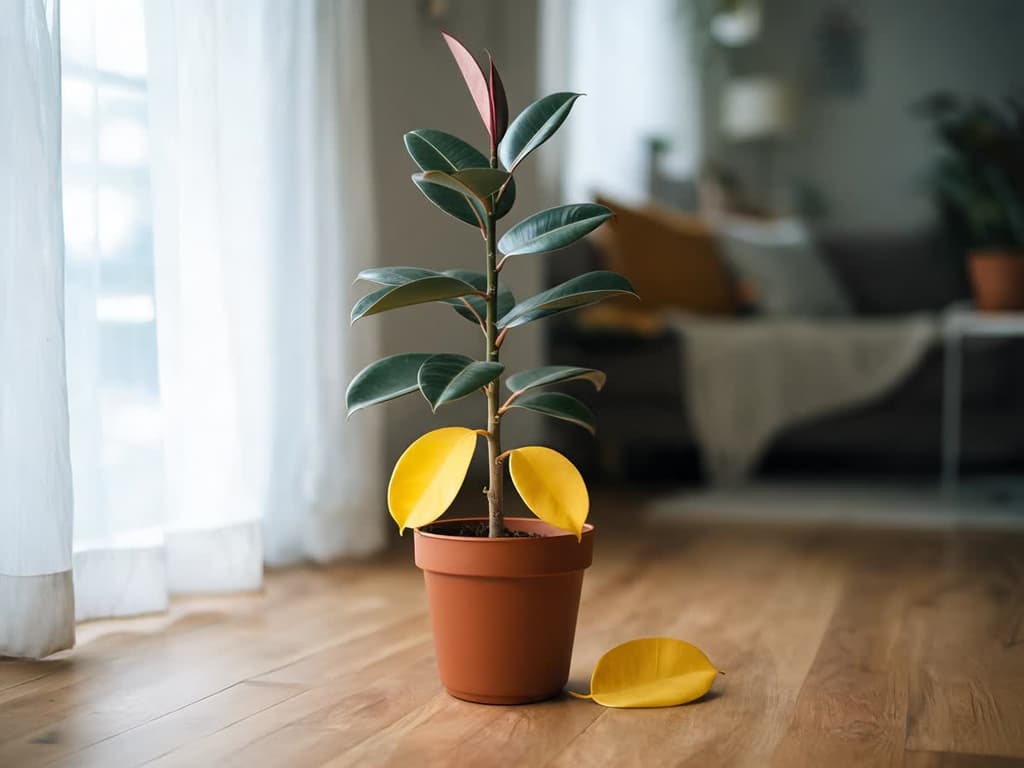
On a rubber plant with yellow leaves, the first cause to check is overly wet soil. Clemson University Extension, a service of the American university that guides plant growers, links rubber plant leaf yellowing to overly wet soil. The University of Maryland calls excess water the number 1 reason houseplants fail to thrive, across any species. It also states that excess water turns leaves yellow.
Before changing your watering routine, count the leaves. An occasional yellow lower leaf with new growth emerging at the top is just normal shedding of old leaves. You do not need to do anything in that case. Several leaves turning yellow in the same week mean you need to inspect the soil, the plant's location, and the undersides of the leaves, in that order.
Quick summary:
One bottom leaf at a time, plant actively growing at the top: normal shedding. Let it drop or trim it once it turns completely yellow.
Multiple yellow leaves and moist soil 2 inches deep: overwatering. Stop watering until the soil dries out, and if the yellowing continues, check the roots.
Leaves dropping during the first few weeks in your home or after moving the pot: adjusting to new light levels. Do not change anything else.
Pale speckles and fine webbing: spider mites. Hard bumps on stems and sticky foliage: scale insects.
Spots that appeared after spraying neem oil: possible spray burn.
Rubber plant with yellow leaves: what the pattern tells you
Where the yellowing appears and the moisture level of the soil distinguish almost every cause. Poke your finger 2 inches into the soil near the rim of the pot, then check the table. The Source column lists the institution describing each cause, and their full names appear in the references list at the end.
What you see | Soil at 2 inches | Likely cause | Source | What to do |
|---|---|---|---|---|
1 lower leaf turning yellow at a time, new leaf at the top | neither waterlogged nor bone dry | normal aging | NC State, RHS | nothing; remove the leaf when it is completely yellow |
Multiple yellow leaves at once, starting from the bottom | damp for days | overwatering | Clemson, Maryland | stop watering until dry and inspect roots |
Yellow leaves dropping | dry, pot feels light | underwatering | UF/IFAS, Colorado State | water until it drains out the bottom hole |
Leaves dropping during the first weeks in your home | any | change in light | UF/IFAS | keep it in the brightest spot and do not change your watering routine |
Green leaves dropping, plant far from a window | any | low light | UF/IFAS, Clemson | move closer to a window |
Dark, mushy patches, heavy leaf drop after cold exposure | any | cold damage | UF/IFAS, Clemson | move away from window glass and AC vents |
Pale speckles, fine webbing on leaves and stems | any | spider mites | Iowa State | wash the leaves in the shower |
Hard bumps on stems, sticky leaf surface | any | scale insects | Maryland, NMSU | remove with a cotton swab dipped in rubbing alcohol |
Entire plant turns pale green, older leaves yellower | any | nutrient deficiency | UF/IFAS | fertilize in spring and summer |
The rubber plant yellow leaves guide lists 22 potential causes, one by one. The rows in this table bring together the causes that sources link specifically to the potted rubber plant (Ficus elastica) or to houseplants in general. Each row highlights the telltale sign separating one cause from another.
One lower leaf at a time: normal aging of older foliage
It is normal for some lower leaves of the rubber plant to turn yellow and drop, according to the NC State Extension. The Royal Horticultural Society (RHS), the British gardening charity, says the same for an adult houseplant. For them, an occasional lower leaf turning yellow and dropping is no cause for concern.
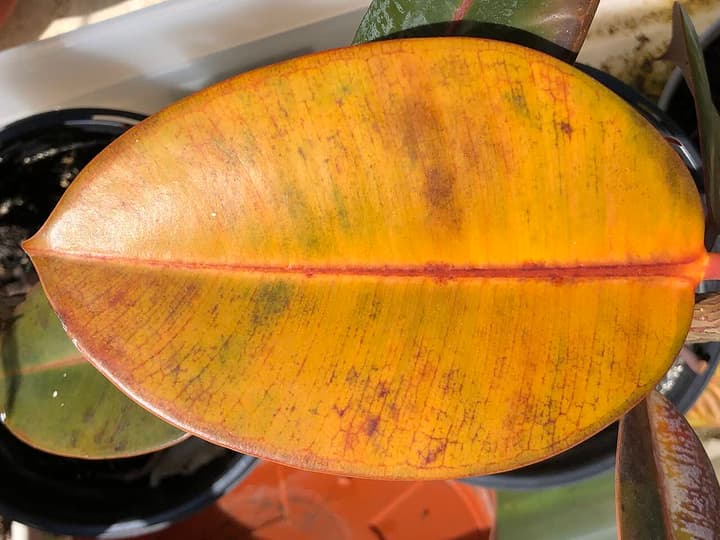
A new leaf unfurling at the top is a reassuring sign that the plant is still growing. A rubber plant's new leaf emerges from a pinkish or purplish cap at the top of the stem called a stipule, a coloration noted by NC State. If a new leaf opens up top while only one lower leaf turns yellow, the plant is likely just trading an old leaf for a new one.
No authoritative source gives a strict number, so use this practical rule of thumb: losing one leaf every few weeks falls within normal turnover. Two or more leaves turning yellow in the same week, or yellowing leaves in the middle and upper canopy, point to something else.
Multiple yellow leaves and moist soil: overwatering your rubber plant
Multiple leaves turning yellow while the soil stays damp 2 inches down days after watering point to overwatering. Clemson connects yellow leaves to excessively wet soil. NC State notes that overwatering can cause a rubber plant to drop its leaves. Stop watering until the top 2 inches of soil dry out, even if that takes a while.
Overwatering does not always stem from watering too frequently. Clemson points out two origins for root rot in rubber plants: watering too often and using soil that fails to drain quickly. A cachepot is a decorative outer pot without drainage holes that holds the plastic nursery pot. A cachepot, a pot without drainage, or standing water left in the saucer keeps the root system wet even if you apply little water.
If leaves keep yellowing while the soil remains wet, ease the plant out of its pot and inspect the roots. Healthy roots are light-colored and firm. Rotted roots are brown to black and mushy, according to the University of Maryland. Roots that are orange to light brown indicate underwatering, according to the University of Illinois. If roots have rotted, Illinois advises stopping watering until the soil dries out. If there is no improvement after 2 weeks, repot the plant into fresh soil.
The 2-inch test and the step-by-step guide for an overwatered rubber plant are in the rubber plant watering guide. It also shows what to do when the stem has already gone soft.
Newly purchased rubber plants or recent location changes
A rubber plant that just arrived home often sheds leaves in the first few weeks, even without watering mistakes. UF/IFAS, the University of Florida extension, explains that ficus (the plant group that includes the rubber plant) is sensitive to drastic shifts in light. The cited example is moving from a greenhouse nursery into the dim light of a home interior. The ficus production guide from the same university discusses plants grown under high light: brought indoors without acclimation, they drop leaves excessively.
What happens is a leaf turnover. Leaves developed under the nursery sun do not work in living room light. The plant drops some of them, starting with the oldest ones, so the rest of the plant survives. NC State describes this mechanism in the bulletin Acclimatization of Foliage Plants ("acclimatization of foliage plants").
For at least 4 weeks after bringing the plant home, UF/IFAS recommends not moving the pot, pruning, repotting, or fertilizing. If the pot is not already in the brightest spot in the house, move it once right near a window and leave it there. Water only when the top 2 inches dry out. Do not swing between watering more and watering less to see if leaf drop stops: that only piles a second stress onto the first.
Once those 4 weeks pass, if yellowing or leaf drop persists, the University of Illinois recommends moving the plant to a different location and re-evaluating watering. During the first 4 weeks, follow UF/IFAS guidelines, which focus specifically on ficus.
Low light causes green leaves to drop
Without adequate light, a rubber plant usually sheds leaves that are still green. The UF/IFAS ficus troubleshooting chart links green leaf drop to low light. That same chart links yellow leaf drop to watering issues, whether underwatering or overwatering. Clemson also includes low light among the causes of leaf loss in rubber plants.
Clemson says that potted rubber plants tolerate a low-light corner, but prefer bright light. NC State accepts even partial shade. Colorado State calls for medium to strong filtered light, because unfiltered direct sun damages the leaf. This guide follows Clemson and Colorado State, because low light causes leaf drop. Keep the plant in a bright spot, near a window, without harsh sun hitting the leaf in the middle of the day. In Brazil, the window that receives the most sun faces north. The east-facing window gets sun only in the morning. The rubber plant care guide shows the position for each window and how to handle a tall plant with no lower leaves.
Leaves dropping after cold exposure, drafts, or air conditioning
Clemson recommends avoiding temperatures below 55°F (13°C), sudden temperature drops, and cold drafts for rubber plants. In Brazil, the risk is higher from June to August and on cold nights near window glass. Air conditioning blowing directly on the plant causes the same effect at any time of year.
Cold temperatures can turn many leaves yellow at once, according to the RHS, but the hallmark symptom on ficus is spotting. UF/IFAS describes cold damage on ficus as dark, water-soaked, mushy patches on foliage, followed by heavy leaf drop all at once. The same guide recommends keeping ficus above 60°F (16°C) at all times, including during shipping and at retail. At home, keeping the plant above 60°F is the safest choice. Clemson's 55°F (13°C) is the absolute lower limit. Because of this, a plant purchased on a cold day can arrive home already suffering from cold damage on a rubber plant.
Move the pot away from cold window glass on chilly nights and away from direct air conditioning vents year-round.
Yellow leaves after returning from a trip
When you return from a trip, the condition of the soil tells the story. Insert your finger 2 inches into the soil before watering.
Soil dry at 2 inches and pot feels light when lifted: the plant went thirsty. The UF/IFAS troubleshooting guide links yellow leaf drop to watering issues, either underwatering or overwatering. Colorado State University notes that too little water will also drop leaves. Water slowly until water runs freely from the drainage hole. If water drains out almost immediately without wetting the core of the root ball, water thoroughly again 30 minutes later.
Soil is wet: someone overwatered your plant while you were away, or water sat in the saucer. Hold off on watering until the soil dries out using the finger test, and check the roots if leaves continue turning yellow.
Do not spray oil or insecticidal soap on a plant that just suffered severe drought stress. The University of Connecticut (UConn) Extension cautions that these products can scorch the foliage of drought-stressed plants.
Yellow and brown spots after spraying neem oil
Neem oil (oil pressed from the seeds of an Indian tree) and insecticidal soap can burn leaves. The University of Maryland classifies retail neem oil for plants as a horticultural oil, a plant- or mineral-based oil used against pests. UConn warns that horticultural oils and insecticidal soaps can cause leaf burn under four conditions:
above 90°F (32°C) according to UConn, or 85°F (29°C) per the University of Maryland, the safer threshold;
under direct, full sun;
on drought-stressed plants;
in high humidity where spray droplets cannot dry quickly on the foliage.
A plant that went days without water and received neem oil right after you returned from a trip fits that third scenario. The spots appearing over the following days may be phytotoxicity from the spray rather than damage from a pest.
If you sprayed and spots appeared afterward, stop using the product. Then check the soil 2 inches deep: dry soil needs water, while wet soil calls for a break. Before applying any oil again, run the University of Maryland's spot test: apply it to a small area and watch for 1 or 2 days. Only apply horticultural oils after you have actually found pests on the plant.
Intense sun creates similar damage. The RHS notes that excessive midday sun can scorch foliage and turn leaves yellow. Colorado State notes that unfiltered direct sun damages rubber plant leaves. Sunburn on a rubber plant typically shows up on the foliage facing directly toward the window.
Pale speckles and fine webbing: spider mites on rubber plants
Leaves with a stippled look and pale speckles, gradually turning yellow-green and then straw-colored, indicate spider mites. Spider mites are tiny arachnids that pierce and suck plant juices from leaves. Iowa State University describes this damage pattern and notes that heavy infestations produce fine webbing across leaves and stems. Spider mites thrive in dry indoor air. NC State cites spider mites as a known pest of rubber plants.
Take the plant to the shower and wash the foliage thoroughly, as recommended by Iowa State. New Mexico State University (NMSU) Extension advises repeating these rinses once or twice a week for 2 to 3 weeks. Raising humidity around the plant slows spider mite reproduction, according to Iowa State.
Bumps on stems and sticky foliage: scale insects
Hard brown bumps clustered on stems and leaf midribs, accompanied by sticky lower leaves, point to scale insects. NMSU explains that these bumps are mature scale insects protected beneath a waxy shell. The sticky residue is honeydew, a sugary fluid they excrete. The University of Maryland lists ficus among susceptible plants. According to the university, scale causes leaves to turn yellow and induces premature leaf drop.
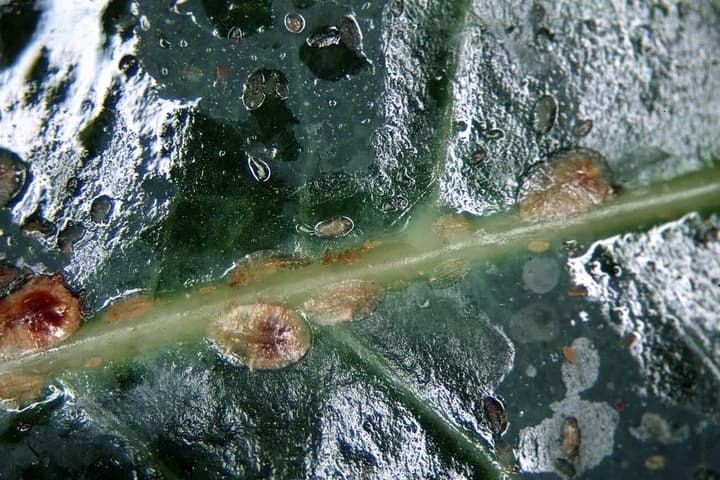
Mealybugs, another pest cited by Clemson on rubber plants, produce white, cotton-like fluffy clusters. They also secrete honeydew. Over time, honeydew turns black with sooty mold, a fungus that grows on the residue, according to Iowa State.
For light infestations, dip a cotton swab in rubbing alcohol and rub each insect directly, applying enough pressure to dislodge it along with its protective shell, as advised by NMSU. The University of Maryland notes that rubbing alcohol can damage foliage, whereas Iowa State accepts alcohol sprays. Stick to a cotton swab because it avoids wetting the broader leaf surface. For widespread infestations, Maryland recommends insecticidal soap or horticultural oil formulated for houseplants, after running a patch test on a small area.
Entire plant looks washed out: too little or too much fertilizer
A rubber plant that turns light green all over, with older leaves turning yellower, lacks nutrients. That is how the UF/IFAS ficus production guide describes an under-fertilized plant. Clemson recommends a water-soluble fertilizer formulated for indoor plants in spring and summer, which in Brazil run from September to March. Use the package dose.
Over-fertilizing also triggers leaf drop. UF/IFAS links excess fertilizer salts in the potting mix to older leaf loss. New foliage emerges unusually dark before turning yellow. The UF/IFAS ficus production guide explains that a ficus kept in low light and given excess fertilizer sheds leaves heavily. For this reason, do not fertilize a newly bought rubber plant or one sitting in a dim corner, even if it appears weak.
The general yellow leaves guide for indoor plants illustrates how the specific yellowing pattern across a leaf distinguishes between different nutrient deficiencies.
Variegated rubber plants: creamy leaf patches are not a disease
Variegated rubber plants feature foliage mottled with cream, pale yellow, pink, or white, and these colors are natural characteristics of the plant. Clemson describes cultivars showing green, cream, and pink variegation. NC State highlights 'Tineke', which bears green leaves variegated with creamy or pale yellow markings.
A cultivar's natural variegation is present from the moment a new leaf unfurls. Yellowing caused by culture problems develops later on a leaf that was previously solid green, spreading across the blade.
Variegated plants can lose their markings and revert to solid green. The RHS connects the permanent loss of variegation to insufficient light, once genetic reversion (a shoot reverting completely to green growth) is ruled out. If a solid-green shoot emerges, the RHS advises pruning it out, as it grows more vigorously and will outcompete the variegated growth.
Should you prune yellow leaves off a rubber plant?
Prune a rubber plant leaf once it has turned completely yellow, or let it detach naturally. None of the university extensions consulted specify a strict moment to prune. NC State simply notes that losing some lower leaves to yellowing and drop is normal. If the leaf still retains green areas, leaving it on the plant until it turns entirely yellow is the safest course.
Trim the petiole, the small stalk attaching the leaf to the stem, close to the main trunk using clean shears. Wear gloves: Clemson cautions that the milky white sap of rubber plants can irritate skin. Trimming off leaves does not resolve the root cause. If multiple leaves are turning yellow, test soil moisture with your finger and inspect the undersides of the foliage before pruning anything.
Can you save a rubber plant that has lost most of its leaves?
Yes, as long as the main stem stays firm. Squeeze the stem just above the soil line: a firm trunk and a green tip indicate a living plant that can produce fresh leaves once you fix the underlying cause.
A stem that feels soft, dark, and mushy near the base in damp soil indicates advanced root rot. The University of Maryland advises discarding severely affected plants and taking cuttings (a stem piece for rooting) exclusively from healthy tissue. Cut a firm section from the upper stem and root it in fresh potting medium.
Do not cut the entire stem just because it lost its lower leaves. The bare stem branches out again when you prune it in the right place, at the right time. In Brazil, that time runs from August to October. The rubber plant care guide shows where to cut and how to air-layer, a technique that roots a branch while it is still attached to the plant.
Frequently asked questions
How many leaves can a rubber plant shed without it being a problem?
None of the scientific sources provide an exact count. NC State refers to "a few lower leaves" and the RHS describes an occasional leaf dropping now and then. In practice, losing one lower leaf every few weeks while new foliage continues emerging up top represents normal turnover. Several yellowing in the same week, or leaf drop affecting the mid and upper canopy, requires checking your soil.
Do rubber plant leaves turn yellow in winter?
The rubber plant grows less in winter, from June to August in Brazil, and the soil usually takes longer to dry out. NC State advises reducing watering from fall to late winter. If you kept up your summer watering, the leaves can turn yellow from overwatering. Do the 2-inch (5 cm) test before each watering.
Is the rubber plant toxic to dogs and cats?
Yes, as a standard precaution. The ASPCA Animal Poison Control Center lists weeping fig (Ficus benjamina), which belongs to the same genus (Ficus) as the rubber plant, as toxic to dogs and cats. It does not publish a standalone entry for the rubber plant. The toxic principles cited are ficin and ficusin, causing oral, gastrointestinal, and dermal irritation. For the rubber plant specifically, Clemson notes that the milky white sap can cause skin irritation and gastrointestinal upset if swallowed. Keep the plant out of reach of pets.
How do you know if the plant really is a rubber plant?
The potted rubber plant has thick, glossy, oval leaves, and new leaves emerge from a pinkish sheath at the top of the stem. It is not the Amazon rubber tree (Hevea brasiliensis), which produces natural rubber. If you received the plant without a name, Bloom (available for iOS) identifies the species from a photo.
What to do today for a rubber plant with yellow leaves
Count the yellowing leaves and check whether a new leaf is growing at the top.
Push your finger 2 inches into the soil. If moist, hold off on watering. If dry, water thoroughly until it runs out the drainage hole.
Empty the saucer and lift the nursery pot out of any decorative cachepot after watering.
Inspect the undersides of 3 or 4 leaves, looking closely for speckles, fine webs, raised bumps, or sticky sap.
Move the pot away from cold glass and direct air conditioning airflow, even if the plant arrived less than 4 weeks ago.
Do not spray horticultural oils or apply fertilizer until you identify the underlying cause.
Other houseplants for medium light:
Sources
Ficus Production Guide, RH-91-16, UF/IFAS CFREC-Apopka (Henley, Chase, and Osborne), archived copy
Acclimatization of Foliage Plants: What Is It?, NC State Hortscans (W. C. Fonteno)
Yellowing Leaves on Indoor Plants, University of Maryland Extension
Root Rots of Indoor Plants, University of Maryland Extension
Scale Insects on Indoor Plants, University of Maryland Extension
Mealybugs on Indoor Plants, University of Maryland Extension
Pesticide Profile: Horticultural Oil, University of Maryland Extension
Insecticides: Low Toxicity Options, UConn Home & Garden Education Center
Troubleshooting Houseplants, University of Illinois Extension
Diagnosing Houseplant Problems Caused by Insect Pests, Iowa State University Extension
Dealing with spider mites on houseplants, NMSU Southwest Yard & Garden
Rubber Plant, PlantTalk 1326, Colorado State University Extension
Related articles

How to Care for Hibiscus: Sun, Watering, Fertilizer, and Pruning for Flowers
How to care for hibiscus: 6 hours of direct sun, evenly moist soil without waterlogging, half-strength fertilizer in spring and summer, and pruning in early spring. Find out why the flower lasts one day and why buds drop before opening.

Do Ferns Like Sun or Shade? It Depends on the Type
Ferns prefer bright shade: plenty of light, but no direct sun on their fronds. Tuberous sword fern is the exception that handles sun. Here is the ideal light for each type, where to place pots, and how fronds show too much or too little light.

African Violet Yellow Leaves: Causes and What to Do
Yellow leaves on an African violet usually stem from overwatering, and the first place to check is the center of the plant. Losing one lower leaf at a time is normal. Identify whether age, watering, cold water, sunlight, cold drafts, or fertilizer is the culprit based on the yellowing pattern, and see what to do today.