283 Easy Succulents | 2026 Guide - Page 5
Find 283 easy succulents. Complete guide for your garden.
283 Succulents with easy level
Showing 145-180 of 283

Paddle Plant
Kalanchoe thyrsiflora
Kalanchoe thyrsiflora is a striking succulent native to South Africa, prized for its large, flat, paddle-shaped leaves that form a neat basal rosette. The fleshy grey-green leaves develop vivid red margins when exposed to full sun and cool temperatures. A monocarpic species, it produces a tall flowering stalk with sweetly scented yellow-white tubular flowers in late winter to spring, after which the main rosette dies but produces offsets.
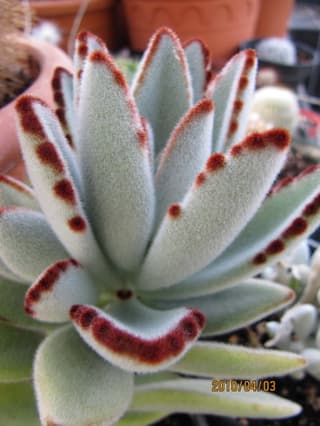
Panda Plant
Kalanchoe tomentosa
The Panda Plant (Kalanchoe tomentosa) is an ornamental succulent native to Madagascar, celebrated for its oval leaves densely covered in soft silver-white felt with distinctive brown or reddish tips — giving it an unmistakable panda-like appearance. Belonging to the Crassulaceae family, it grows slowly and compactly, reaching up to 45 cm in height. The tiny hairs (trichomes) coating its leaves are not merely decorative: they act as thermal insulation and dramatically reduce water loss, making this plant exceptionally drought-tolerant and resilient.
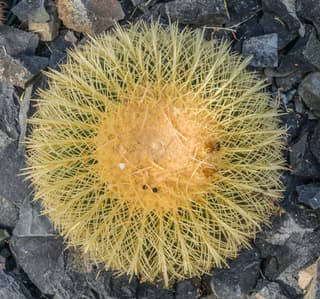
Golden Barrel Cactus
Kroenleinia grusonii
The Golden Barrel Cactus (Kroenleinia grusonii, synonym Echinocactus grusonii) is a globose cactus native to central Mexico, belonging to the Cactaceae family. It is recognizable by its spherical, ribbed body covered with dense golden spines (a white-spined variety also exists) which, with age, can take on a more oblong shape, exceeding one meter in height. It grows very slowly and can live for decades; in nature, it is considered endangered due to poaching and dam construction in its original habitat.
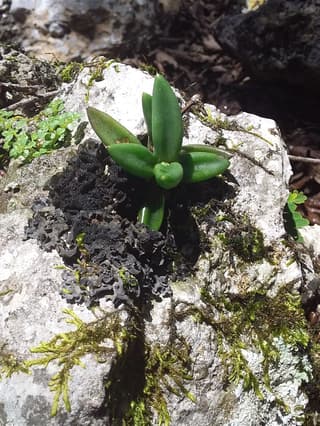
Lenophyllum acutifolium
Lenophyllum acutifolium
Lenophyllum acutifolium is a small perennial succulent from the Crassulaceae family, native to northeastern Mexico (Coahuila and Nuevo León) and southern Texas. It forms compact rosettes of fleshy, opposite, sharp-tipped leaves that range from olive green to coppery-bronze when exposed to full sun. It reaches about 4 to 6 inches in height and produces small greenish-yellow flowers in racemes on terminal stems. It is extremely easy to propagate: naturally fallen leaves root on their own in the substrate.

Chilean Cactus
Leucostele chiloensis
The Chilean cactus (Leucostele chiloensis, formerly Echinopsis chiloensis) is a tree-like columnar cactus endemic to central Chile, growing up to 8 m tall with multiple ribbed branches arising from the base. It produces large white, funnel-shaped flowers that open during the day from November to January, followed by round, edible green fruit. It is extremely drought-tolerant and adapted to sunny, rocky slopes of Chile's coastal cordillera.
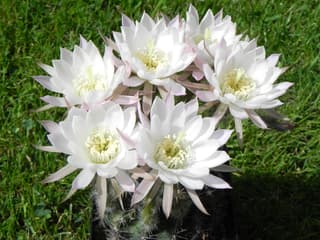
Easter Lily Cactus
Lobivia ancistrophora
Lobivia ancistrophora is a small globular cactus native to Argentina and Bolivia, belonging to the Cactaceae family. It forms compact clumps of ribbed, dark green globes adorned with hooked central spines. In summer it produces spectacular large white fragrant flowers that open at night and last less than 24 hours, repeating several times throughout the season.
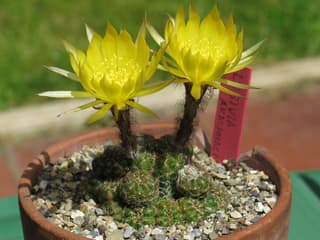
Spider Cactus
Lobivia arachnacantha
Lobivia arachnacantha is a small, globular to short cylindrical cactus from the Cactaceae family. It grows in clusters, producing numerous offsets over time. In spring and summer, large funnel-shaped flowers bloom during the day, typically in yellow or orange, and more rarely in white, red, or violet. This species is known for being very floriferous and is well-suited for beginners. It stores water in its body and survives dry periods without difficulty.
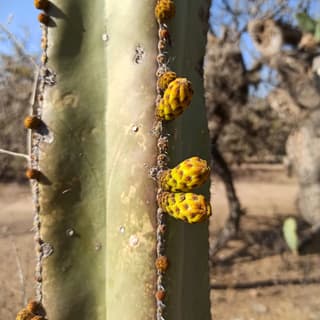
Mexican Fencepost Cactus
Lophocereus marginatus
The Mexican Fencepost Cactus (Lophocereus marginatus) is a tall columnar cactus native to Mexico, traditionally used as a living fence in rural areas. Its upright, spine-laden stems form effective natural barriers. It grows rapidly, potentially exceeding 20 feet, and produces small pinkish-red flowers in spring and summer.
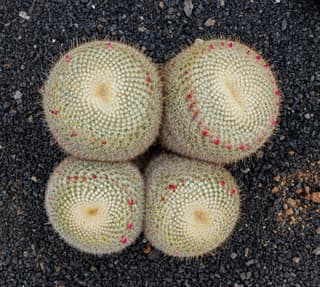
Pincushion Cactus / Nipple Cactus (genus)
Mammillaria
Mammillaria is one of the largest genera in the cactus family Cactaceae, comprising over 200 species native primarily to Mexico. Recognized by their distinctive nipple-shaped tubercles and crown-like rings of flowers, they are compact, ornamental plants beloved by collectors and beginners alike.
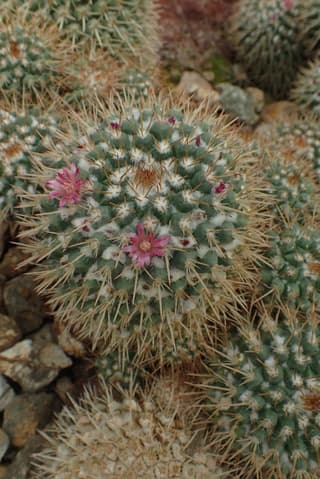
Backeberg's Pincushion Cactus
Mammillaria backebergiana
Mammillaria backebergiana is a small, globular-to-columnar cactus native to cliffs and rocky slopes in Guerrero, Michoacan and the State of Mexico. Its clear green stem, covered in spirally arranged tubercles tipped with golden-yellow to reddish hooked spines, grows slowly to about 30 cm tall and 6 cm in diameter, often forming offsets that build dense clumps over time. In spring, a striking ring of small magenta-pink flowers with green stigmas crowns the growing tip, followed by slender red fruits. It is a popular compact potted cactus that thrives on bright light and minimal water.

Powder Puff Cactus
Mammillaria bocasana
Mammillaria bocasana, commonly known as the powder puff cactus or snowball cactus, is a small globular cactus native to central Mexico, belonging to the Cactaceae family. It is characterized by its compact, rounded stems densely covered in fine, silky white hairs resembling cotton, interspersed with reddish-yellow hooked central spines. Over time, it forms clusters of multiple stems, creating a soft, cushion-like mound. In spring and summer, it produces a ring of small, funnel-shaped flowers in shades of creamy white to pink, followed by rosy-pink to red fruits.
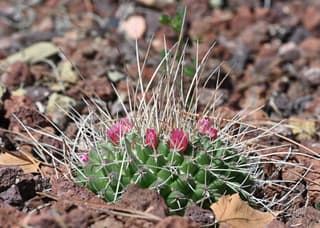
Mother of Hundreds
Mammillaria compressa
Mammillaria compressa, commonly known as Mother of Hundreds, is a clustering globular cactus native to central and northern Mexico, belonging to the Cactaceae family. It forms dense mounds of cylindrical stems covered in pale spines and produces a ring of purplish-pink flowers around the crown in late winter and early spring. This slow-growing, low-maintenance cactus is ideal for sunny windowsills, cactus gardens, and containers.
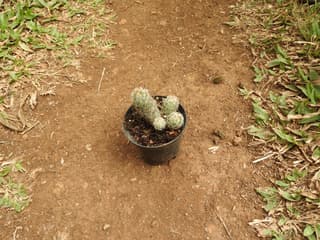
Ladyfinger Cactus
Mammillaria elongata
Mammillaria elongata is a small cactus native to central Mexico, valued for its clustered cylindrical stems that form dense, compact mounds. Its golden or copper-colored spines give it a bright, decorative appearance. Ideal for beginners due to its resilience and easy care.
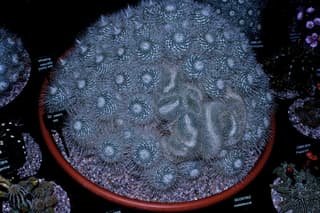
Twin-spined Cactus
Mammillaria geminispina
Mammillaria geminispina, commonly known as the twin-spined cactus, is a clustering globular cactus native to central Mexico, found in the states of Hidalgo, Queretaro and San Luis Potosi. Its spherical stems, roughly 8 cm in diameter, are covered in white wool and long white spines that emerge in distinctive pairs at the tip of each conical tubercle, giving the species its name. Over the years it forms dense colonies that can spread well beyond 50 cm across. In spring and summer, a crown of small carmine-pink flowers appears around the top of each stem.
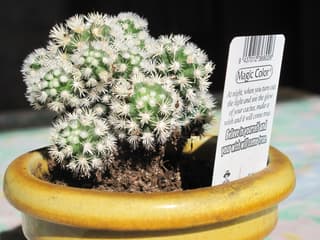
Thimble Cactus
Mammillaria gracilis
Mammillaria gracilis, commonly known as the Thimble Cactus, is a small clustering cactus from the Cactaceae family, native to central Mexico. It forms compact clumps of cylindrical stems densely covered in white, silky spines that resemble a sewing thimble. It is one of the most widely cultivated Mammillaria species, admired for its delicate beauty, ease of care, and generous blooming.
Haage's Pincushion Cactus
Mammillaria haageana
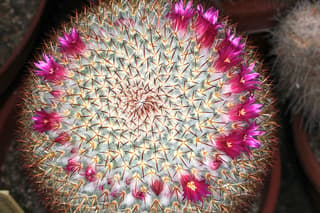
Mammillaria haageana is a small, spine-covered cactus native to the highlands of central and southern Mexico, where it grows wild among oak forests, pine woodlands, and volcanic lava flows at elevations between 450 and 2,600 meters. Its stem is globular when young and becomes more cylindrical with age, reaching up to 15 cm tall and 3-10 cm in diameter, often forming dense clusters as it produces offsets around its base. The stem is covered in small, cone-shaped tubercles called mammillae (the trait that gives the genus its name), each topped with an areole bearing 8 to 30 fine white radial spines and a handful of darker central spines that fade from black or reddish-brown to grey with age. In late winter and early spring the plant rewards patient growers with a crown of funnel-shaped flowers in shades of deep magenta-pink to pale pink, each only 8-20 mm across but often appearing in a ring around the growing tip. Slow-growing and undemanding, it is a favorite among beginner cactus collectors for its compact size and reliable, colorful blooms.
Old Lady Cactus
Mammillaria hahniana
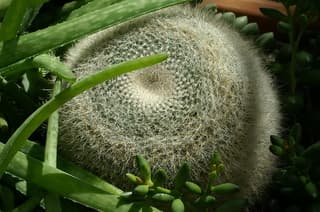
The Old Lady Cactus (Mammillaria hahniana) is a small globose cactus native to Mexico, famous for the long white hairs that cover its entire body, resembling an elderly lady. It produces a crown of small pink-purple flowers in spring, making it highly decorative. One of the most popular cacti for collections and indoor growing.
Royal Cross
Mammillaria karwinskiana
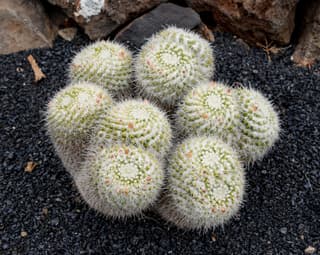
Mammillaria karwinskiana is a globular cactus native to south-central Mexico (Oaxaca, Puebla, Chiapas, Morelos, Guerrero, Michoacán and Colima) and Guatemala, growing wild in tropical deciduous forest and xerophilous scrub between 150 and 2,100 m elevation. It forms a solitary or basally branching stem, globose to short-cylindrical, up to 20 cm tall and 12 cm in diameter, with areoles bearing six pale radial spines with brown tips and no central spines. In spring it produces funnel-shaped, cream-to-yellow flowers with purplish midveins that open in a ring near the growing tip, giving rise to the common name "Royal Cross". The species is rated Least Concern by the IUCN and includes four recognized subspecies.
Mammillaria polythele
Mammillaria polythele
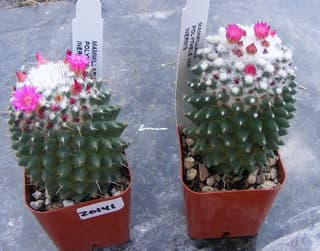
Mammillaria polythele is a solitary, cylindrical cactus native to the highlands of central Mexico, from Jalisco to Veracruz, where it grows among rocky desert and dry shrubland at 1,700-2,400 m elevation. Its dark green to bluish-green stem can reach up to 60 cm tall and 10 cm in diameter, densely covered in pyramidal tubercles tipped with spine clusters and woolly axils. In spring and summer it produces a ring of small deep pink to magenta flowers near the crown.
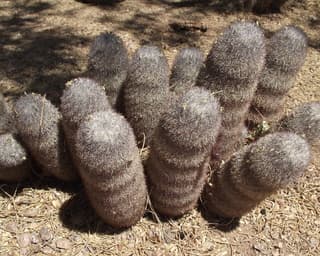
Rat-tail Nipple Cactus
Mammillaria pottsii
Mammillaria pottsii is a small, clustering cactus native to the Chihuahuan Desert of northern Mexico and the Big Bend region of West Texas. It forms clumps of slender cylindrical stems up to about 30 cm tall, covered in tubercles and fine white spines. Small pink to red flowers appear from late winter to spring, followed by red berries.
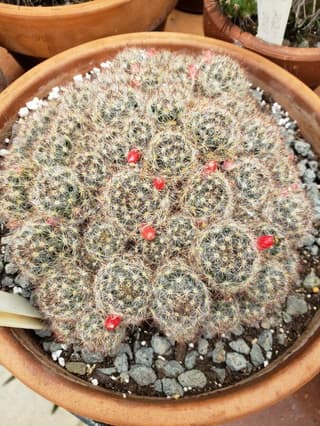
Little Candles
Mammillaria prolifera
Mammillaria prolifera is a small, clustering globular cactus native to Mexico, Texas, Cuba, the Dominican Republic, and Haiti. It readily produces offsets around the mother plant, forming dense cushion-like colonies covered in fine, hair-like spines. In spring and summer it produces small yellowish-white, cream, or pinkish-yellow flowers around the crown. It is a slow-growing, drought-tolerant, and easy-care cactus, well suited for beginners.
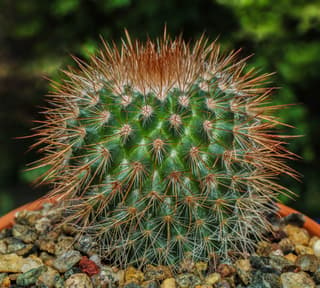
Spiny Pincushion Cactus
Mammillaria spinosissima
Mammillaria spinosissima, the Spiny Pincushion Cactus, is a cylindrical cactus endemic to the states of Guerrero and Morelos in central Mexico. It thrives at elevations between 1,600 and 1,900 meters in dry tropical forests and xerophilous scrub. It is celebrated for its dense bristly red-brown spines and rings of carmine-pink flowers that appear in spring.
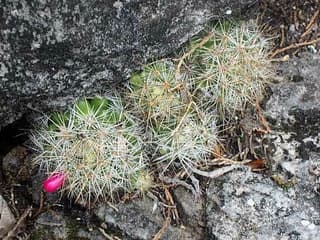
Golden Stars Cactus
Mammillaria vetula
Mammillaria vetula is a small, clustering cactus native to central Mexico (Hidalgo, Guanajuato and Queretaro), prized in cultivation as the popular subspecies gracilis. It forms dense mounds of cylindrical, bluish-green stems covered in fine white radial spines, topped in spring and summer with tiny pale-yellow, funnel-shaped flowers. It readily produces offsets that detach easily, making it one of the easiest cacti to propagate and share.
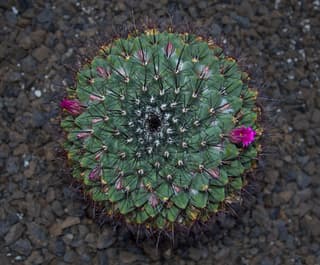
Saltillo Pincushion Cactus
Mammillaria winterae
The Saltillo pincushion cactus (Mammillaria winterae) is a slow-growing, globular cactus native to the mountains of Nuevo León and Coahuila, Mexico, where it grows among limestone rocks at high elevation. It typically has a solitary, flattened stem covered in radial spines and produces yellowish-white or greenish-yellow flowers in spring.
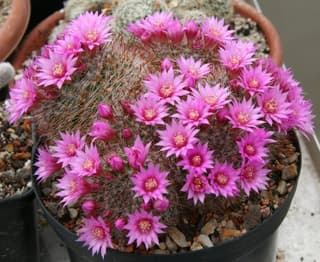
Rose Pincushion Cactus
Mammillaria zeilmanniana
Mammillaria zeilmanniana, commonly known as the Rose Pincushion Cactus, is a small, clustering cactus native to central Mexico. It forms compact, globular stems covered in dense, hooked white-to-yellow spines and produces abundant rosy-purple flowers in spring and summer. Popular as a compact houseplant, it is prized for its easy care and prolific blooming even in small pots.
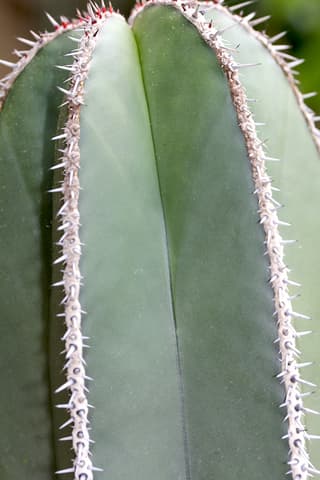
Mexican Fence Post Cactus
Marginatocereus marginatus
Marginatocereus marginatus, also known as Pachycereus marginatus, is a columnar cactus native to central Mexico. It forms erect, ribbed green stems about 7-10 cm thick that grow densely and parallel to each other, reaching over 6 meters in the wild with a slow growth rate. The spines are short and relatively harmless. In spring, reddish funnel-shaped flowers appear at the top of the stems—though these are rare on young potted specimens—followed by spherical fruits about 4 cm wide covered in spines and fuzz. In Mexico, cuttings are used to create living fences.
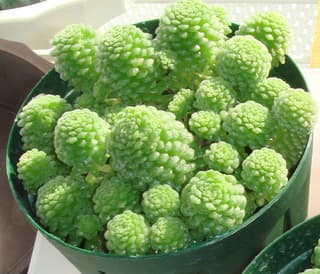
Monanthes polyphylla
Monanthes polyphylla
Monanthes polyphylla is a small perennial succulent endemic to the Canary Islands (Gran Canaria, Tenerife, La Palma, and La Gomera), where it grows in very localized areas within shaded cliff crevices and damp rocks between 100 and 1500 meters in altitude. It forms dense mats of tiny, globose rosettes composed of tightly packed fleshy leaves, resembling succulent moss, and barely reaches 10-12 cm in height. Between late spring and summer, it produces small star-shaped flowers in shades of purple, pink, yellowish, or greenish on thin stems that rise above the foliage.
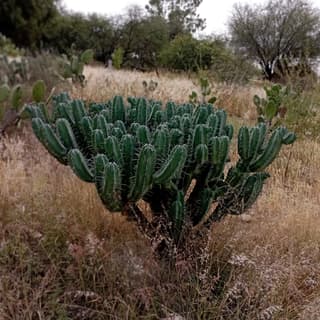
Blue Candle Cactus
Myrtillocactus geometrizans
Myrtillocactus geometrizans, commonly known as the Blue Candle Cactus, is a striking columnar cactus native to central and northern Mexico. Its branching stems display a distinctive blue-green hue that intensifies with sun exposure, and the plant can reach heights of up to 5 meters in its native habitat. It produces small, edible berries called garambullos, similar in appearance to blueberries and long used by indigenous Mexican communities. It is widely cultivated as an ornamental specimen in dry gardens and as a grafting rootstock.
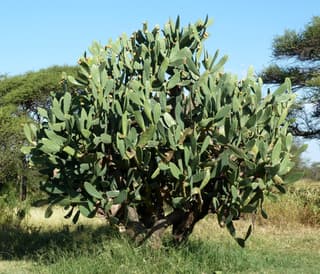
Prickly Pear Cactus
Opuntia
Opuntia, commonly known as prickly pear or nopal, is a genus of cacti native to the Americas, especially Mexico. Its flattened pads (cladodes), spines, and showy flowers make it one of the most recognizable plants in the world. It produces edible fruits (tunas) and pads (nopales) that have been used in Mexican cuisine for millennia.
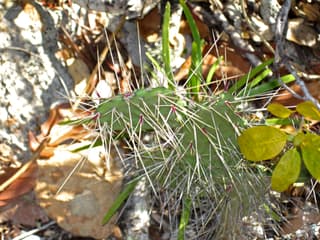
Sweet Prickly Pear
Opuntia dillenii
Opuntia dillenii, commonly known as the Sweet Prickly Pear, is a robust cactus native to the Caribbean and coastal Americas. Its oval, spine-covered pads produce vibrant yellow flowers in spring and summer, followed by edible reddish-purple fruits. Exceptionally drought-tolerant and heat-resistant, it thrives in poor, sandy soils with minimal care.
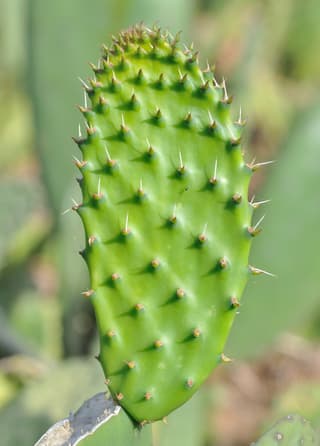
Prickly Pear
Opuntia ficus-indica
Opuntia ficus-indica, commonly known as prickly pear or Indian fig, is a large tree-like cactus native to Mexico. It features flattened stem segments called cladodes (pads) armed with clusters of tiny glochids. It produces showy yellow to orange-red flowers in spring and summer, followed by edible fruits called tunas or prickly pears. One of the most economically important cacti in the world.
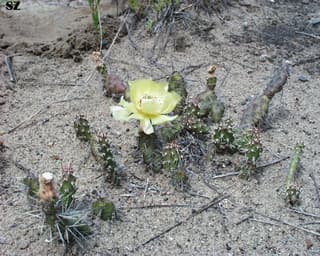
Brittle Prickly Pear
Opuntia fragilis
Opuntia fragilis, known as the brittle prickly pear, is a low-growing, mat-forming cactus native to prairies and rocky outcrops across western North America, from British Columbia to Texas. It is the most cold-hardy cactus species in North America, surviving winter temperatures below -30 C. Its small, easily detached stem segments (cladodes) break off at the slightest touch and root readily wherever they land, giving the plant its "fragilis" name and its efficient means of vegetative spread.
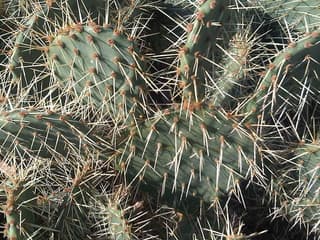
Eastern Prickly Pear
Opuntia humifusa
Opuntia humifusa, the Eastern Prickly Pear, is a low-growing, mat-forming cactus native to the eastern and central United States. It produces flat, paddle-shaped pads armed with glochids and occasional spines, stunning yellow flowers up to 4 inches wide in late spring and early summer, and edible red-purple fruits in late summer. One of the most cold-hardy cacti in the world, it thrives in USDA zones 4–9 and can survive temperatures as low as -12°C (10°F).

Twistspine Pricklypear
Opuntia macrorhiza
Opuntia macrorhiza is a low-growing, mat-forming prickly pear cactus native to the central and southern United States and northern Mexico, from Colorado and Utah east to Wisconsin and Missouri and south into Texas. One of the most cold-hardy Opuntia species, it survives winters down to USDA zone 3a. Its flattened, blue-green pads (cladodes) are armed with twisted, often reflexed spines, and in early summer it produces bright yellow flowers with a red-orange eye, followed by fleshy edible fruit.
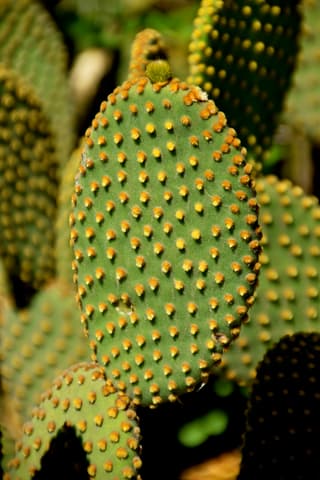
Bunny Ears Cactus
Opuntia microdasys
Native cactus from central and northern Mexico, known for its characteristic oval pads covered with white or yellow glochids that give it a velvety appearance. Forms dense bushes up to 60 cm tall and is highly valued as an ornamental plant both indoors and outdoors.
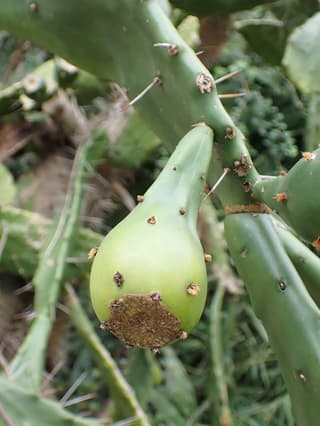
Drooping Prickly Pear
Opuntia monacantha
Opuntia monacantha, commonly known as the Drooping Prickly Pear, is a cactus native to South America (Brazil, Argentina, Uruguay, and Paraguay). It features flat, bright-green pads with yellow flowers and colorful edible fruits. A tough, drought-tolerant species, it thrives in full sun and well-draining sandy soil, making it an excellent choice for low-maintenance gardens and sunny interiors.
Easy Care Succulents
Our selection of 283 easy succulents combines the characteristics of this category with reduced care needs. Perfect for beginners who love this category.
Why Choose Easy Succulents?
Combining the beauty of succulents with easy difficulty level lets you enjoy this category without excessive maintenance worries. Each plant was selected to offer the best characteristics of the category at the care level you are looking for.