Desert rose fertilizer: what to use, how much, and when to stop
The most common recommendation for fertilizing desert roses is a high-phosphorus formula. The only published trial on the species tested the opposite and produced more blooms. Here is the measured dose and when to stop.
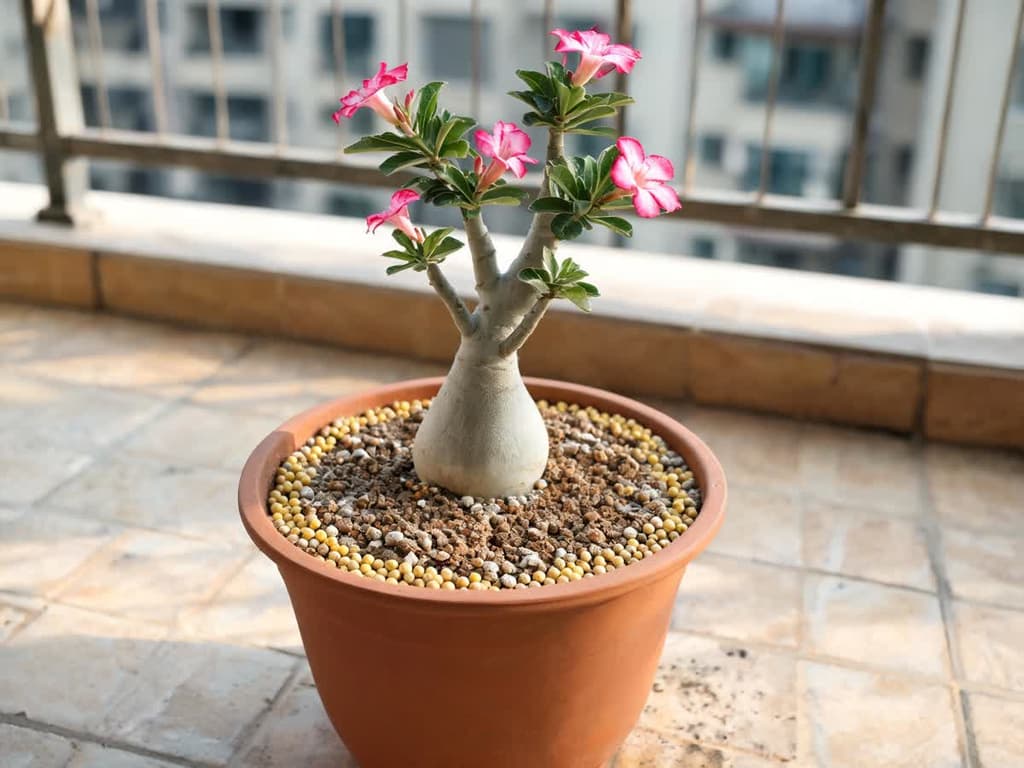
The desert rose fertilizer backed by measured data is a slow-release granule with nitrogen well above phosphorus. The dose is 6 grams per liter of substrate, which is the potting mix in the container. Slow-release means a granule that releases nutrients gradually, over the course of months. This dosage applies while the plant has leaves and is actively growing, from September to March in Brazil. When it drops its leaves in winter, fertilization stops.
The plant is Adenium obesum, the thick-stemmed succulent that many people describe as a chubby little bonsai before learning its name. That swollen base is called a caudex, and it is where the plant stores water. Two unmeasured recipes circulate widely: fertilizer to fatten the caudex and high-phosphorus formulas to trigger blooming.
Quick summary:
The only published dosage trial on Adenium obesum used a fertilizer with 18% nitrogen and 2.6% phosphorus. The plants produced more flowers as the dosage increased, up to 6 to 8 grams per liter of potting mix.
Nitrogen did not inhibit flowering in the only experiment that tested it.
The caudex thickens with time, a larger pot, and well-draining potting mix. No published study has compared a "caudex formula" against standard fertilizer.
A dormant plant (one that stopped growing and dropped its leaves for winter) or one with a soft stem should not receive fertilizer. Without active roots taking up nutrients, the fertilizer stays in the pot and turns into salt.
What fertilizer to use on a desert rose
A slow-release granular fertilizer where the first number on the label is significantly higher than the middle number. Scatter it across the surface of the potting mix once at the start of the growing season, just like in the experiment that measured the dosage. The three numbers on the label represent NPK: nitrogen, phosphorus, and potassium, in that order. In a small pot, liquid fertilizer diluted in irrigation water works just as well, provided you apply it only during the growing months.
This recommendation comes from the only published dosage experiment on the species. It was measured by Kaitlyn McBride and colleagues at the University of Florida (dissertation, 2012; results in HortScience 49(4), 2014). They grew 'Red' and 'Ice Pink' desert roses in 1.25-liter pots. The slow-release granular fertilizer used had 18% nitrogen, 2.6% phosphorus, and 6.6% potassium, seven times more nitrogen than phosphorus.
The cultivation guide from the same university recommends a balanced slow-release granular fertilizer for outdoor plants (UF/IFAS ENH1213). For indoor plants, it recommends a low dose of liquid fertilizer once a week during the summer. Neither scenario calls for a high-phosphorus formula.
If you do not know how to read a fertilizer label yet, the first number is the one that needs to be highest here. The guide on how to fertilize plants explains what each number means and how to convert the label dosage for your container.
High phosphorus is not what makes a desert rose bloom
The Florida experiment measured flowers per week across three dosages of the same nitrogen-rich fertilizer. At 2 grams per liter of potting mix, the plants averaged 1.4 flowers per week; at 4 grams, 2.3; at 6 grams, 3.4. More nitrogen, more flowers. A second experiment, using 1.25-liter and 3.0-liter containers with dosages up to 8 grams per liter, repeated the result over 20 weeks.
The most widely repeated advice claims the opposite: that excess nitrogen promotes leaf growth at the expense of flowers. That claim has no experimental measurements on desert rose behind it, whereas the opposite view does. I follow what was actually measured on the plant in question.
Linda Chalker-Scott from Washington State University summarized what is known about phosphorus in other plants in The Myth of Phosphate Fertilizer. Non-agricultural soils rarely lack phosphorus. In excess, it competes with root absorption of iron and manganese. High levels also harm mycorrhizae, the fungi that help roots take up nutrients.
I will not claim that a 4-14-8 formula is worse. No one has compared the two formulas side by side in Adenium, and inventing that verdict would repeat the very mistake this guide aims to correct. The trial supports a narrower statement: the claim that "nitrogen prevents flowering" was false in the only study that tested it on this plant.
Too much shade stops flowering even with the right fertilizer
In that same study, plants grew under full sun, 30% shade, and 50% shade. Under 50% shade, the average dropped to 1.2 flowers per week, compared to 3.0 under 30% shade and 2.8 under full sun. The highest visual quality rating also came under 30% shade, not under full sun.
At home, a desert rose needs at least 6 hours of direct sun per day to bloom. Without that light, it stretches and fails to open flowers, and indoors you can only achieve that in a very bright window. The succulent light guide shows the exact same pattern across other species.
How much fertilizer per pot: the tested dosage
6 grams of slow-release granules per liter of potting mix. The pot used in the experiment held 1.25 liters with a 6-inch opening, receiving roughly 7.5 grams. A 3-liter pot takes 18 grams. The highest dosage tested was 8 grams per liter, and no published data exists for higher rates on this plant: that is where I stop.
How to apply it, in three steps:
Apply on a watering day: soak the pot until water drains out the bottom and wait for it to stop dripping. Applying fertilizer to dry potting mix concentrates salts around the roots.
Scatter the granules across the surface of the potting mix near the rim of the pot, keeping them off the caudex. Concentrated salt in a single spot burns whatever plant tissue touches it.
Water lightly once more, just enough to settle the granules. The slow-release coating does the rest over the growing months.
If you prefer liquid fertilizer, follow the dilution on the label and apply it in your watering once a week during the summer. That is what the UF/IFAS fact sheet recommends for indoor plants. The University of New Hampshire Extension is explicit on both points: never mix a stronger solution than the label states, because excess salt burns root tips and leaf margins.
If you worry about "burning roots with chemicals," your fear has a physical basis, and the mechanism is salt. According to the University of Maryland Extension, dissolved fertilizer is a salt: as water evaporates, the salt remains in the potting mix and competes with the roots for moisture until it dehydrates tissue. The dose matters more than the brand.
When to stop: the desert rose has two seasons
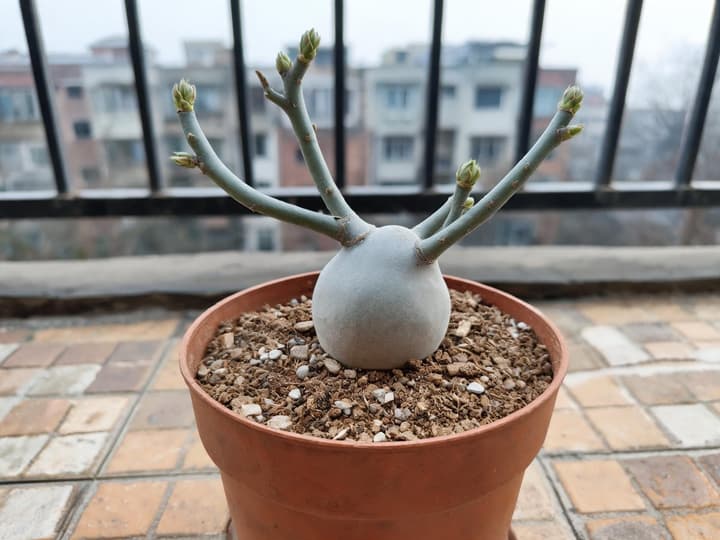
Desert roses do not grow year-round. In winter, they enter dormancy, a period when growth halts and leaves drop. The UF/IFAS fact sheet describes the cycle: in winter, withhold water and let the plant rest for 3 to 4 months. All leaves and flowers drop, which is part of its natural cycle.
In Brazil, this period runs from June to August across most of the country, and the growing season runs from September to March. The plant gives the signal, not the calendar: fertilize while new leaves are emerging, and stop when leaves start to drop. In the North and Northeast, where there is no cold winter, it may not enter dormancy and can continue receiving fertilizer.
Fertilizing a dormant plant will not wake it up. The University of New Hampshire Extension guideline is to fertilize only while the plant is actively growing, because only then do the roots take up nutrients. Without that uptake, the fertilizer lingers in the substrate. Water evaporates, salts accumulate, and eventually the roots end up losing water instead.
Watering needs to change as well, so a fixed schedule does not work for the entire year. During the growing season, a typical interval is 7 to 14 days, letting the potting mix dry out completely between waterings. In dormancy, water once a month or less. Caring for succulents in winter follows the same reduction, with the difference that a desert rose loses every leaf and looks dead during this stage.
If your plant sat with fertilizer in its soil through winter, leach the substrate before starting up again. The University of Maryland Extension provides the procedure: pour three times the pot volume in clean water through the container in one go, letting it all drain out. For a 3-liter pot, use 9 liters of water.
A thick caudex does not come from fertilizer
No published study has compared a product sold to fatten the caudex against standard fertilizer. The two measurements that exist on this topic point to other factors entirely.
Ronan Colombo and colleagues at the State University of Londrina measured caudex diameter in desert roses grown in six different potting mixes (Australian Journal of Crop Science 10(2), 2016). All plants received the same fertilizer: 50 mL of monthly 6-4-4 NPK per pot. With identical fertilizer across all treatments, caudex diameter still varied, and the substrate caused the difference. The two best mixes contained coconut coir.
In the Florida experiment, plants in 3.0-liter pots produced significantly higher shoot and root dry weights than those in 1.25-liter pots. Fertilizer rates were identical for both sizes. A bigger pot produced a bigger plant.
What thickens a caudex, then, is time in the sun, water during the active season, and root room. To that, add raising the caudex during repotting, a practice UF/IFAS notes as common for the species: it exposes part of the thick root and changes what you see without changing the plant. Fertilizer serves as one growth factor, not a shortcut that replaces the rest.
Why standard succulent care does not entirely apply here
The desert rose is a succulent, but of a different type than cacti and fleshy-leaved plants. McBride's thesis notes the distinction. Leaves of Adenium photosynthesize via the C3 pathway, not the CAM pathway used by cacti and leaf succulents. The reason is the caudex: because it stores the water, the leaves do not need to. The leaf pores stay open during the day rather than closed like in leaf succulents.
In practice, the plant consumes more water and nutrients than a leaf succulent of comparable size while in leaf. When leafless, it consumes almost nothing. A leaf succulent keeps its foliage all year and takes a low dose during the growing season, as outlined in the succulent fertilizer guide. With a desert rose, the gap between the two seasons is wider.
Common desert rose fertilizing mistakes
Fertilizing a plant with a soft stem. A soft caudex with yellowing leaves usually signals root rot, not hunger. Rotted roots cannot absorb anything, and fertilizer only adds salt to the problem. Address the rot first and wait to fertilize until new leaves appear.
Fertilizing during dormancy. A leafless plant consumes no nutrients, and whatever remains turns into salt buildup. Wait for the first new leaf.
Unanalyzed homemade fertilizers. Manure teas and diluted grounds carry no guaranteed analysis: the same recipe can turn out extremely potent or almost inert. The measured dose for this plant is 6 grams per liter of a product with a declared label. An unknown dose is the exact hazard you want to avoid here.
Applying fertilizer to dry mix. Without moisture, salts remain concentrated right against the roots. Water first.
Handling the plant without gloves. The desert rose is toxic to dogs, cats, and horses, and the toxic principle is cardiac glycosides, substances that affect the heart of any animal that ingests the sap (ASPCA). Milky sap appears at any cut, so wear gloves when pruning and taking cuttings. Keep the granules out of reach of a dog that digs in pots.
When symptoms do not match any of these issues, comparing a photo to the problem beats guessing. Bloom identifies the plant species from a photo and, on Premium, compares the symptom photo against known problems for that plant. The free version includes 2 identifications per month and the watering schedule. The guide on what is wrong with my plant walks through the symptoms one by one.
Frequently asked questions
What NPK should I use to make my desert rose bloom?
An NPK formula where the first number is higher than the middle number. The only published rate study on the species used 18% nitrogen against 2.6% phosphorus and recorded more flowers at higher doses. For outdoor plants, the UF/IFAS fact sheet also accepts a balanced slow-release granular fertilizer, such as 10-10-10. That is a secondary option from the same extension service, not a formula tested to increase flower count.
What is the best homemade fertilizer for desert roses?
No homemade recipe offers a known dose, and dosage determines the outcome here. Diluted manure can vary widely in nitrogen content from one batch to the next. The measured dose for this plant is 6 grams per liter of potting mix. With that target in hand, a commercial product with a guaranteed analysis on the label is the safest route.
What can I give my desert rose to make it bloom?
Sunlight, before any product. In the Florida trial, flower production dropped from 3.0 to 1.2 blooms per week simply by going from 30% to 50% shade. Once you provide 6 hours of direct sun daily, fertilizer handles the rest: slow-release granules, 6 grams per liter of potting mix, during the growing season.
What time of year does the desert rose bloom?
During the growing season, when it has leaves. In Brazil, this runs from September to March across most of the country. During the dormant months, it drops leaves and flowers. UF/IFAS describes this rest as 3 to 4 months of a normal cycle, not as a symptom of a problem.
Can I fertilize a desert rose that has a soft trunk and yellow leaves?
No. A soft caudex with yellow leaves points to damaged roots, and rotted roots cannot take up nutrients. Fertilizing in that condition adds salt to an already waterlogged medium. Correct the drainage and rot first, and only resume fertilizing once new leaves emerge.
Conclusion
Fertilizing desert roses comes down to dosage and calendar, not the formula on the label. The approach backed by measurement is a slow-release granular fertilizer with higher nitrogen, at 6 grams per liter of substrate. In Brazil, it goes in between September and March. The rest of the blooming comes from the sun, and the caudex comes with time.
Your next practical step is to measure the volume of your container before buying anything: volume dictates the dosage, and it is the one number almost no one checks before fertilizing.
Related articles
How to Care for a Maidenhair Fern: Light, Water, and Revival Tips
Learn how to care for a maidenhair fern indoors: bright indirect light, consistently moist soil, high humidity, and how to revive it if it dries out completely.
How to Propagate Spider Plants: Root the Pup Before Cutting
The safest spider plant cutting comes from a pup still attached to the mother plant: rest the plantlet on soil in a small pot, wait for roots to establish, and only then cut the stolon. Learn when the pup is ready, whether rooting in water is worth it, how to divide the clump, and why plants fail to produce babies.
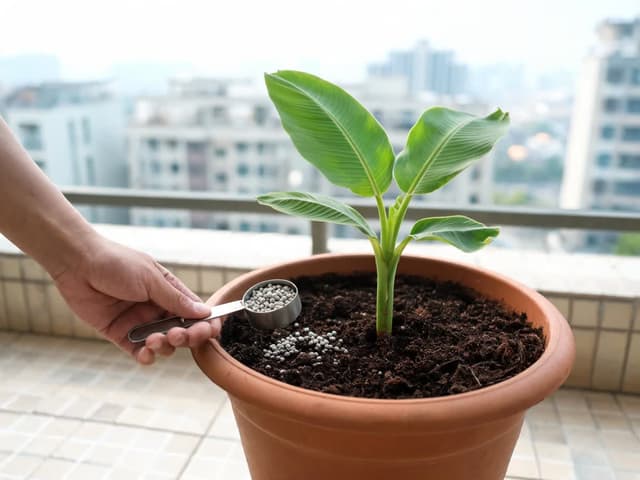
Banana plant fertilizer: fertilizing potted and backyard plants
Banana plant fertilizer needs more potassium than nitrogen, in a 3-1-6 ratio. For a potted plant on a balcony, use the label dose in spring and summer. In the backyard, fertilize every 2 months, adjusting the amount by mat age. Learn the formula, timing in Brazil, and signs of deficiency or excess.