Whiteflies on Plants: How to Identify and Get Rid of Them
The whitefly is a sap-sucking insect that rises in a cloud when you disturb your plant. The damage comes from nymphs resting under the leaves. Here is how to confirm it in 1 minute, why it returns after soap, and a 4-week schedule that wipes it out.
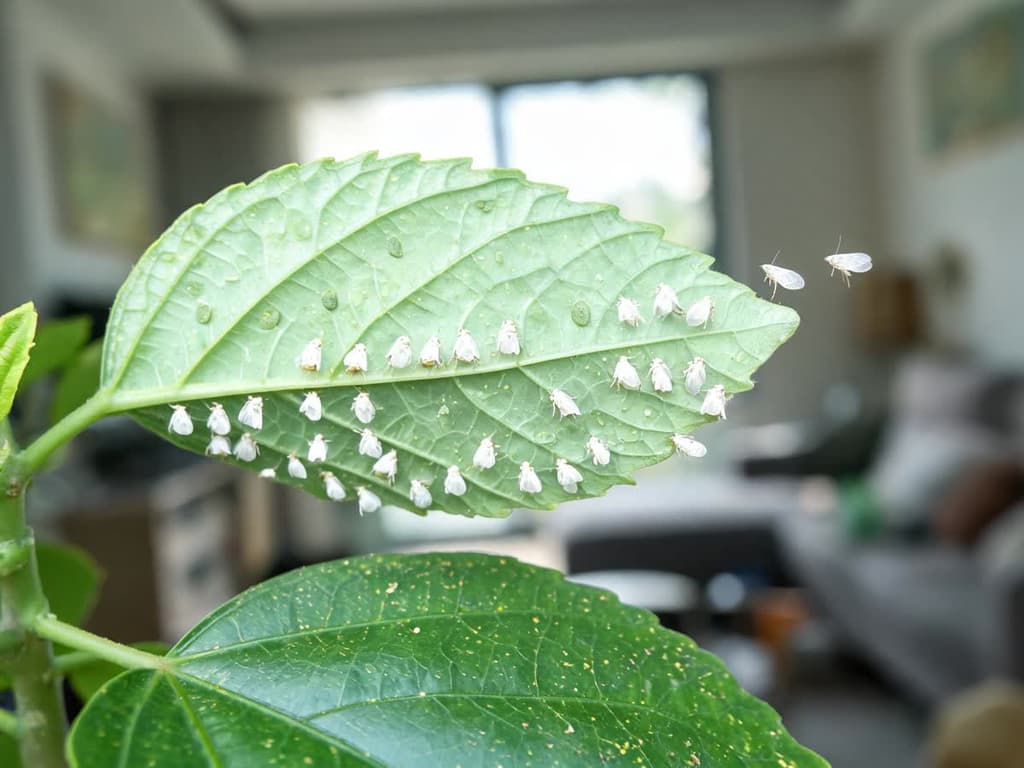
The whitefly on plants is a 1.5 mm sap-sucking insect (which feeds on plant sap), related to aphids and scale insects, and is not a true fly. The sign is the cloud of tiny white bugs that rises when you water or disturb the plant. Most of the damage comes from the nymphs, the immature stage: flat, stationary scales on the underside of the leaf, according to the Royal Horticultural Society (RHS), the British horticultural society.
The fix that works is targeting the nymphs on the underside of the leaf, once a week, for at least 4 weeks. A single application does not solve the problem. The egg and the resting stage (when the nymph stops feeding, before turning into an adult) do not die from the spray, warns Iowa State University Extension. That is why whiteflies return when treatment stops early.
Quick summary:
Shake the plant and turn a leaf over: white adults taking flight and stationary scales underneath the leaf mean whiteflies.
Dark gnats flying out of the potting soil are a different insect, fungus gnats.
A sticky leaf, later covered in black powder, points to whiteflies: they secrete a sugary liquid (honeydew), and black fungus grows on top of it.
Apply insecticidal soap at 1% or 2% to the undersides of the leaves once a week for at least 4 weeks, and only stop after two consecutive checks without new nymphs.
Yellow sticky traps show how many whiteflies are present, but they will not eliminate them.
Can you save a plant with whiteflies?
In most cases, yes. Whiteflies weaken the plant gradually, and affected leaves turn yellow and drop prematurely, according to Iowa State. A plant that still has most of its leaves green and firm will tolerate the 4 weeks of treatment.
Throwing it away is also a valid choice. Iowa State itself notes that discarding a heavily infested plant cuts your losses and keeps the pest from spreading to others. This is our practical guideline, not a measured rule. Discard the plant when more than half of the leaves are already yellow or falling off and you have other plants in the same room.
A large, established plant, such as one passed down from a family member, is worth treating when it meets the condition above. It has leaves to spare while weekly applications knock down the population.
Whiteflies or another pest: the 1-minute test
Tiny white specks flying up when you water are almost always whiteflies. To be sure, do three things:
Disturb the upper stems. Adult whiteflies flutter around briefly and land back on the plant within seconds, Iowa State describes.
Turn over 3 young leaves at the tips of the stems. Adults congregate there, holding their white wings closed like a roof.
Check the undersides of older leaves for oval, flattened, greenish-white scales measuring just over 1 mm. These are the nymphs anchored to the leaf and the resting pupal stage that follows, neither of which moves (RHS).
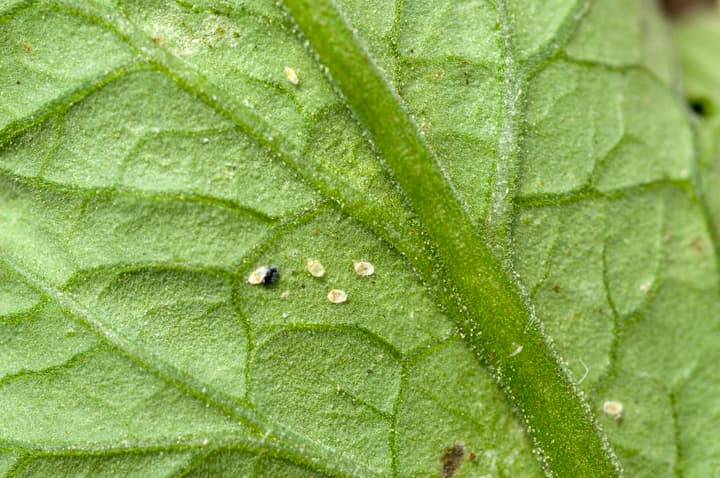
A black scale instead of a greenish-white scale is a nymph killed by a parasitic wasp, Encarsia. Loose white specks on top of the leaf are usually cast skins left by aphids when molting, according to the RHS.
What you see | Where it stays | Flies when disturbed? | Pest |
|---|---|---|---|
White adult, roof-like wings, 1.5 mm | Underside of young leaves | Yes, in a cloud, and lands back | Whitefly |
Dark gnat, long legs | Potting soil | Yes, emerges from the soil | Fungus gnat |
Fuzzy white bug, stationary | Crevices of leaves and stems | No | Mealybug |
Soft green, black, or yellow insect | New growth | No, almost never | Aphid |
Dark gnats rising from the soil when you water are fungus gnats, which live in moist potting mix rather than on the undersides of leaves. White fluff that does not fly is a mealybug, and a stationary cluster on new shoots is aphids. All three require different treatments than whiteflies.
Yellow, sticky leaves: whitefly damage
Yellow, sticky leaves accompanied by small white insects point to whiteflies rather than improper watering. Adjusting your watering routine will not help because the insect sucking sap is the actual cause.
The damage unfolds in three stages:
Light, yellow spots. The upper surface of the leaf turns pale or develops small light spots because the insect sucks sap from underneath. This is described by UF/IFAS, the University of Florida extension.
Sticky foliage. Adults and nymphs excrete a sugary liquid called honeydew, which drips onto the leaves below (RHS).
Black powder. Sooty mold, a dark fungus that blocks incoming sunlight, develops on top of the honeydew. UF/IFAS notes that it interferes with photosynthesis (the process plants use to make food with light) and causes premature leaf drop.
Yellow leaves stem from issues other than pests as well. If you find no insects underneath, our guide to yellow leaves on houseplants helps you distinguish between watering, light, and fertilizer issues. In vegetable gardens, certain whitefly species also transmit plant viruses, according to UF/IFAS.
Why whiteflies return after neem oil and soap
Whiteflies return because the spray only kills the nymphs and adults it directly contacts. Eggs and the final nymphal stage, which stops feeding before pupating into an adult, escape the application, Iowa State explains.
The life cycle, according to Iowa State:
the egg hatches in 5 to 7 days;
the nymph crawls briefly, settles, and feeds on sap for 2 to 3 weeks;
it enters a resting stage without feeding until the adult emerges;
from egg to adult, it takes 4 to 6 weeks indoors.
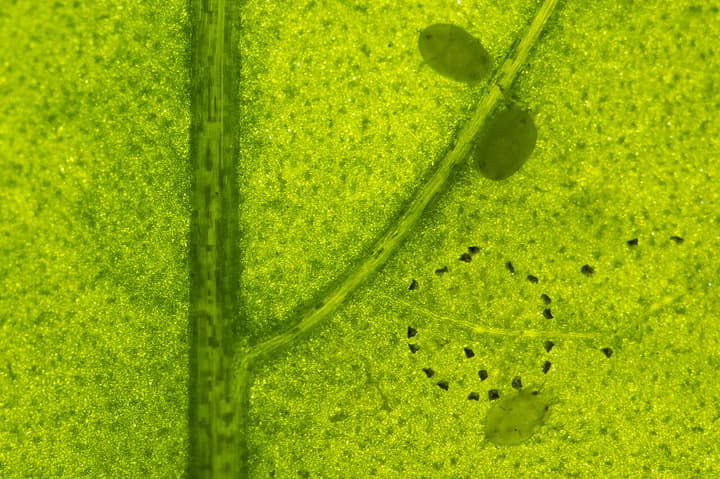
Temperature changes this timeline. At 21 °C (70 °F), the entire cycle takes about 3 weeks, and at 10 °C (50 °F), it takes several months, according to the RHS. UF/IFAS reports 4 weeks in the summer to 6 months in the winter. Iowa State gives 4 to 6 weeks for indoor plants. The schedule below uses this longer timeframe, because it also covers the 3-week cycle.
Insecticidal soap also leaves no residual effect once dry, according to NC State Extension, part of North Carolina State University. One application kills what was exposed that day. Eggs hatch the following week, and the population starts over.
How to get rid of whiteflies: the 4-week schedule
The way to eliminate whiteflies is to drench the undersides of the leaves every week until no new nymphs emerge. Iowa State and UF/IFAS recommend repeating applications at weekly intervals. Gather a spray bottle, insecticidal soap (potassium salts of fatty acids), concentrated or ready-to-use per the label, and a phone flashlight to inspect beneath foliage.
Day 1:
Move the plant away from others, ideally into a different room. The RHS instructs isolating new plants specifically so pests can be caught before spreading.
Cut off the leaves most heavily infested with nymphs and throw them away in a sealed bag. The University of California (UC IPM) recommends removing leaves loaded with nymphs and the resting stage (pupae), which do not move.
Wipe the undersides of the remaining leaves with a damp cloth, or rinse them with a stream of water in the shower. Iowa State suggests wiping for small plants; UC IPM recommends a water spray to knock down adults.
Test the soap on a single leaf and wait 24 hours. NC State instructs doing this test because some plants are sensitive and scorch from soap.
On Day 2, if the test leaf shows no damage, spray the entire plant. Drench the undersides of the leaves until runoff occurs, as UF/IFAS advises.
Weeks 1, 2, 3, and 4 (7, 14, 21, and 28 days after the first spray): spray again once a week, always targeting the undersides. Before each round, check 5 leaves of different ages for newly emerged, greenish-white nymphs.
When to stop: only after 4 weeks and two consecutive weekly checks showing no new nymphs and no flying adults. This criterion is ours, based on the 4-to-6-week cycle cited by Iowa State. In a cool home during winter, development slows, and the schedule may need to extend beyond 4 weeks.
Insecticidal soap safety tips, all from NC State:
Mix at the dilution rate on the label. Products typically range between 1% and 2%, which equals 10 to 20 mL per liter of water.
Never spray in direct sunlight or when temperatures exceed 32 °C (90 °F).
Do not spray a drought-stressed plant: water it the day before.
Kitchen dish soap and laundry detergents pose a higher risk of scorching leaves than proper insecticidal soaps formulated for plants.
Neem oil and horticultural oil (refined oil sold for use on plants) also target nymphs on the underside of the leaf, according to the University of Maryland Extension. UF/IFAS gives horticultural oil the same weekly interval as soap. Run the same single-leaf test before spraying the entire plant.
Yellow sticky traps: useful for monitoring, not eradicating
Yellow sticky traps capture only flying adults. Eggs and nymphs stay on the foliage. Iowa State does not expect them to clear whiteflies from a houseplant. UC IPM notes they are more effective for pest detection than for control.
Use the traps to track your progress: hang one near the plant and count caught adults weekly. A count declining week over week indicates treatments are working. The RHS warns that sticky traps also catch the parasitic wasp Encarsia, so take traps down when using biological controls.
Homemade recipes: what remains untested
Boiled garlic, vinegar, baking soda, and grated bar soap appear in many DIY whitefly sprays. None of the university extensions consulted for this article measure the efficacy of these mixtures. NC State warns that homemade soaps carry a greater risk of foliage burn than commercial insecticidal soap.
The safest option for your plant is insecticidal soap formulated for gardening, mixed per the label instructions. It works on the same principle as bar soap, but with verified, controlled concentrations.
What about systemic insecticides?
Systemic insecticides are taken up through roots and spread into leaf tissue. Iowa State notes such products exist for foliage plants, provided they are applied strictly according to the label. This guide does not recommend systemics for indoor houseplants. Soap applied to the undersides for 4 weeks controls the infestation without introducing chemicals into the leaf. On edible plants, use only products explicitly labeled for vegetables.
Biological control: when Encarsia makes sense
Encarsia formosa is a tiny wasp that lays an egg inside the whitefly nymph. The parasitized nymph turns black and dies, allowing you to track results with the naked eye, according to the RHS. The wasp is sold by biological control suppliers.
Encarsia works best released early, before the plant is heavily infested: the RHS notes that it does not provide immediate control. It also requires warmth. A 1982 study from the journal Environmental Entomology measured the minimum developmental temperature for whiteflies and Encarsia. Whiteflies develop starting at 8.3 °C, while Encarsia develops only from 12.7 °C. In cold conditions, the pest grows while the wasp remains inactive.
The RHS recommends Encarsia for greenhouses, where wasps remain enclosed near the infestation. For a single houseplant in an apartment, the soap schedule is the simpler approach. Under heavy infestations, our non-measured guideline is soap first and wasps later, keeping yellow sticky traps away during that time. The wasp functions best at low pest densities (RHS), which is why it should follow population knockdown via soap.
Houseplants, greenhouses, and gardens: what changes
Indoors, whiteflies are hard to eradicate, and Iowa State puts prevention first. Check the undersides of the leaves of every purchased plant and every plant brought inside from the balcony in the fall. In Brazil, fall runs from March to June. Whiteflies are far less common indoors than the most common indoor plant pests, such as mealybugs and spider mites.
In greenhouses, whiteflies reproduce year-round. The RHS recommends good ventilation, thorough winter greenhouse sanitation, and clearing out unwanted plants that shelter lingering populations.
In vegetable gardens, natural enemies usually control whiteflies throughout the season, and early problems can disappear on their own, according to the University of Maryland. Parasitized whitefly nymphs appear as black specks, resembling ground pepper. The same source advises against spraying soap on very hot days and recommends checking seedlings before buying: shake the seedling and watch for any whiteflies flying up.
In Brazil, Embrapa Cotton describes the whitefly as an insect that prefers hot and dry weather, with population increases during rainless periods. In the heat, the female lives 1 to 3 weeks; in the cold, more than 2 months.
Whiteflies attack many houseplants and garden varieties. On gardenias, whiteflies are the primary pest in South Carolina, according to Clemson Extension. Specific care for gardenias can be found in our guide on gardenia pests.
Whiteflies and cats: applying sprays safely
If you have a cat at home, choose insecticidal soap over neem oil, because only neem has documented adverse reactions in cats. Keep the pet away from the plant during application and until the leaves dry. The NPIC, Oregon State University's pesticide information center, records adverse reactions in cats treated with neem oil for fleas. Symptoms included drooling, tremors, and seizures, and some cats died.
Those cases involved neem applied directly to feline fur rather than onto houseplant leaves. Still, keep cats from licking wet foliage. None of our sources evaluate insecticidal soap toxicity in cats, so apply the same precaution: keep pets separated until leaves dry.
Frequently asked questions
How do I get rid of whiteflies in houseplant potting soil?
Whiteflies do not live in potting soil. Eggs, nymphs, and adults remain under leaves, according to the RHS and Iowa State. Small, dark flies coming out of soil when watered are fungus gnats, which reproduce in damp potting mix. Changing out the soil will not resolve whiteflies; treatment must target the undersides of foliage.
What plants repel whiteflies?
None of the consulted extension services list a plant that repels whiteflies. Basil, which appears on lists of repellent plants, has whiteflies among its pests on the UC IPM basil page. The pests of basil include whiteflies specifically, with the white cloud when disturbing the pot.
Does sooty mold clear up after treatment?
Yes. UF/IFAS notes that sooty mold gradually flakes off on its own once the insect population is controlled. To speed up the process, wipe leaves with a moist cloth. Cleaning sooty mold without treating the whiteflies achieves little, as honeydew will accumulate again and the mold will return.
Do whiteflies spread from one plant to another?
Yes. Adults readily fly to neighboring plants, and infestations frequently enter homes or greenhouses on newly introduced plants, according to the RHS. Keep infested specimens quarantined during treatment, isolate new purchases for 4 weeks (our guideline, matching the treatment schedule), and check leaf undersides weekly.
What to do today about whiteflies
Shake the plant and examine 3 young leaves to verify you have whiteflies. Isolate the plant, prune away heavily encrusted leaves, and wipe the undersides of the rest with a damp cloth. Test insecticidal soap on a single leaf, wait 24 hours, and mark your calendar for the next 4 weekly applications.
If you cannot tell whiteflies apart from mealybugs or aphids, snap a close-up photo of the underside of the leaf. Bloom (available for iOS) identifies your plant by photo, and with a Premium plan, it diagnoses plant pests directly from an image of the foliage.
Sources
Related articles
How to Care for Hibiscus: Sun, Watering, Fertilizer, and Pruning for Flowers
How to care for hibiscus: 6 hours of direct sun, evenly moist soil without waterlogging, half-strength fertilizer in spring and summer, and pruning in early spring. Find out why the flower lasts one day and why buds drop before opening.
Do Ferns Like Sun or Shade? It Depends on the Type
Ferns prefer bright shade: plenty of light, but no direct sun on their fronds. Tuberous sword fern is the exception that handles sun. Here is the ideal light for each type, where to place pots, and how fronds show too much or too little light.
African Violet Yellow Leaves: Causes and What to Do
Yellow leaves on an African violet usually stem from overwatering, and the first place to check is the center of the plant. Losing one lower leaf at a time is normal. Identify whether age, watering, cold water, sunlight, cold drafts, or fertilizer is the culprit based on the yellowing pattern, and see what to do today.