How Often to Water an Air Plant (Tillandsia)
To water tillandsia, start with one soak per week. Heat combined with dry air and air conditioning calls for 2 to 3 soakings per week. Learn how long to soak them, which water to use, and how to dry them without rot.
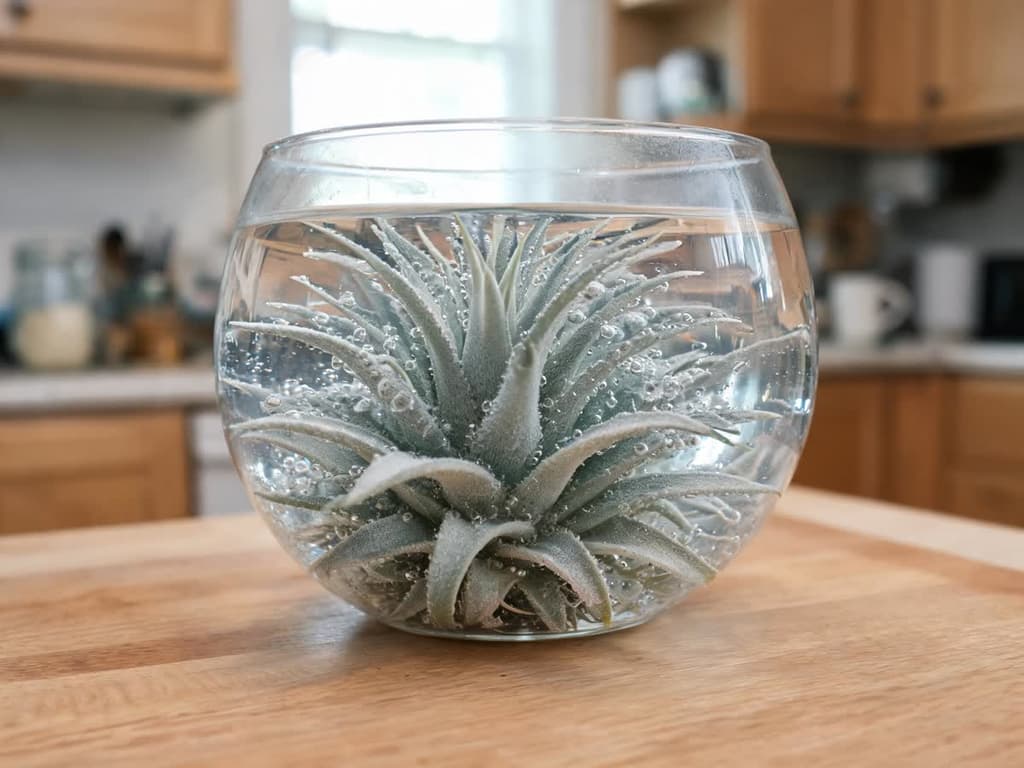
Water your air plant (tillandsia) once a week by submerging the entire plant in water for 20 to 30 minutes. If heat and dry air occur together, or with air conditioning or artificial light, increase to 2 to 3 times a week. Smooth, green-leaved tillandsias drink more than silvery, fuzzy-leaved varieties. After every watering, let the plant dry upside down within 4 hours.
This frequency synthesizes 10 horticultural sources: American university extensions, the New York Botanical Garden, and the British RHS. The NC State Extension calls for at least one watering a week. The Royal Horticultural Society (RHS) recommends up to 2 to 3 soaks a week from spring to fall. The air in your home determines which frequency to use. We follow 1 soak a week as a baseline, like NC State and Iowa State. With heat and dry air together, we increase to 2 to 3, like the RHS.
Quick summary:
Routine: 1 soak per week, lasting 20 to 30 minutes, in room-temperature water.
Heat with dry air, air conditioning, or artificial light: 2 to 3 soaks per week.
Cold and low light: 1 soak every 2 weeks. Below 12 °C (54 °F), do not wet.
Misting only counts as watering if the entire plant gets wet until water runs off.
After soaking, shake it off, turn it upside down, and let it dry within 4 hours.
Flowering plants: submerge only the leaves and keep the bloom out of the water.
How often to water tillandsia
Tillandsia (Tillandsia), also called air plant, is a genus with more than 600 species in the pineapple family. It has no soil to hold water. The leaves are covered in trichomes, small scales that absorb water and nutrients through the surface, according to NC State Extension. Because of this, watering wets the entire plant, and the frequency depends on how quickly the air in the house dries it.
Indoor condition | Frequency | Source |
|---|---|---|
Routine: warm, bright home, without dry air | 1 soak per week | NC State (at least), Iowa State, UVM, Clemson |
Heat with dry air, from spring to fall | 2 to 3 soaks per week | RHS |
Dry air, for those who prefer misting over soaking | Misting until dripping, every other day | Penn State, Cornell |
Cold and low light | 1 soak every 2 weeks | Iowa State |
Below 12 °C (54 °F) | Do not wet | RHS |
The tillandsia as an air plant profile covers light, temperature, and species within the genus.
Green-leaved or silver-leaved tillandsia: which drinks more
The smooth, glossy green-leaved tillandsia is mesic, native to humid forests. The silvery, gray, or fuzzy-leaved variety is xeric, native to dry places. The New York Botanical Garden (NYBG) explains the difference: xeric plants have large, dense trichomes that capture the little water present in dry air. For this reason, water xeric varieties less frequently. When rinsing, the NYBG recommends 2 to 4 times a week for green varieties and every 7 to 10 days for silvery ones.
The NYBG guide gives the difference in minutes. Soak the green tillandsia for 10 to 20 minutes. The silvery one can just take a quick dip, because it needs less water. NDSU Extension sums it up the same way: gray plants prefer spaced-out watering, and green ones, frequent watering.
Some tillandsias fall between both types, with light green, slightly fuzzy leaves. If yours looks like this, start with 1 soak per week and move up to 2 to 3 if the leaves curl inward. Knowing the species clears up any doubt. Bloom (available for iOS) identifies the plant from a photo and displays the species.
Dry air, heat, air conditioning, and artificial light
Heat and dry air pull water from tillandsia faster, requiring more frequent watering. The RHS advises watering more often in high temperatures and low humidity, and less often in cold, humid air. The Penn State Extension recommends keeping the plant away from air conditioners and heater vents, which dry it out quickly.
Plants kept under grow lights also drink more. The NYBG guide notes that tillandsias grown under artificial light need more water than those in natural light. If your home has dry air, such as during your region's dry season, increase to 2 to 3 soakings a week.
Cold: below 12 °C, keep the plant dry
In the cold, tillandsia dries slowly. Iowa State reduces watering to once every 2 weeks in a cold, low-light location. The RHS goes further: with temperatures below 12 °C (54 °F), do not water, because the plant stays wet for too long. Return to your routine when the temperature rises above 12 °C.
Soaking, rinsing, or misting: which method wets the whole plant
Soaking is the safest method because it wets all the leaves at once. You submerge the whole plant in a bowl of water and wait. Rinsing means rotating the plant under a running faucet for a few seconds and letting it drain upside down. Penn State and Cornell recommend doing this twice a week. Misting means wetting the plant with a spray bottle.
A potted plant drinks through its roots, and water goes directly into the soil. This is true for watering amaryllis, camellias, and chrysanthemums. A tillandsia's roots only serve to anchor it to a support, which is why water must reach the leaves.
Soaking duration varies from source to source, and none of them measured the difference between one timeframe and another:
Soaking time | Source |
|---|---|
10 to 20 minutes (green leaves); quick dip (silver leaves) | NYBG |
20 to 30 minutes | Clemson |
30 to 60 minutes | Iowa State, UVM |
20 minutes to 1 hour, once a week | Penn State, Cornell |
We stick to 20 to 30 minutes in our routine: it is the duration Clemson uses and falls within the Penn State and Cornell range. Up to 1 hour remains within what Iowa State and the University of Vermont (UVM) recommend. Within these timeframes, rot comes from standing water between the leaves after watering, according to UVM and the RHS.
Misting divides the sources. Iowa State, the RHS, and the NYBG say misting does not wet the plant enough and only complements soaking. UF/IFAS, Clemson, and NDSU accept misting as watering, as long as the plant gets wet until water runs off. No one has compared the two methods. We follow soaking as the primary method, the safest option, and accept misting only until runoff. A light misting every few days does not hydrate a tillandsia, and it wilts anyway.
How to water tillandsia by soaking, step by step
Fill a bowl with room-temperature water, as recommended by Iowa State and UVM.
Submerge the entire plant, keeping all the leaves under water.
If the plant is blooming, keep the flower above the water.
Let it soak for 20 to 30 minutes. For silver-leaved tillandsias, the NYBG suggests just a quick dip without specifying the duration; when in doubt, leave it for 20 minutes.
Remove the plant from the water and gently shake it to dislodge trapped water from the center.
Place the plant upside down on a towel or drying rack in a bright, airy spot.
Return the plant to its spot only when the base is completely dry, which takes up to 4 hours.
A well-watered plant displays firmer, more open leaves. Dull, curling leaves before watering signal thirst.
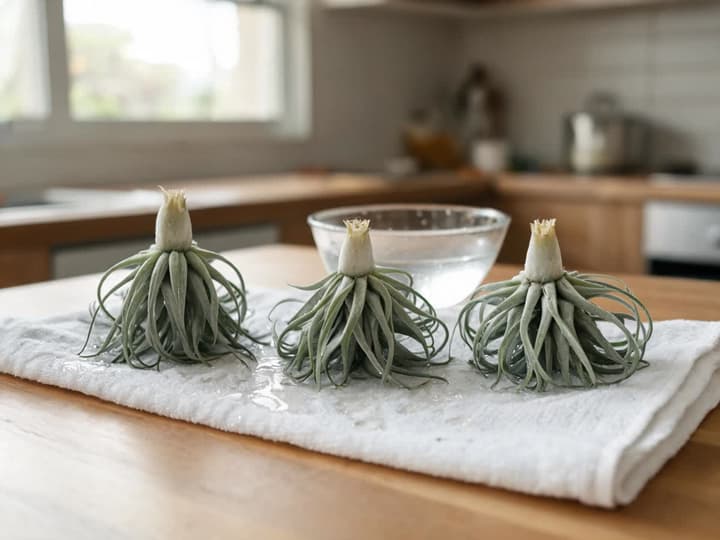
Drying upside down within 4 hours
Drying determines whether watering keeps your tillandsia healthy or causes it to rot. According to the RHS, rot almost always begins from water trapped in the plant's center combined with poor airflow. That is why tillandsias dry upside down: water drains out of the center rather than pooling at the base of the leaves.
The NYBG recommends letting the plant dry within 4 hours in a spot with good air circulation. UVM suggests draining the plant on its side or upside down for 1 to 2 hours. Iowa State suggests 30 minutes to 3 hours. If the base remains wet after 4 hours, airflow in that spot is insufficient: move it to a different drying location.
Tillandsias in glass globes
A glass globe traps moisture and hinders drying. The NYBG guide advises against keeping tillandsias in containers without openings. If water collects at the bottom of the glass, take the plant out so it does not rot.
Penn State and the Cornell Cooperative Extension instruct waiting at least 4 hours after watering. Only return the plant to the glass with a dry base. Never water the tillandsia inside the globe. Remove the plant, soak it in a bowl, let it dry outside the globe, and only then return it. The NYBG also advises against placing the globe in direct sun, because the glass can burn the plant.
What water to use for tillandsia
Use rainwater or tap water that has sat overnight in an open container. The RHS prefers rainwater. In hard water (water rich in dissolved minerals), salts deposit onto the trichomes and block water absorption. In hard-water areas, use only rainwater: resting overnight removes chlorine, but not the mineral content. Iowa State and UVM let tap water rest overnight to allow chlorine to evaporate.
When it comes to distilled water, sources disagree. The NYBG favors distilled water because tap water deposits mineral salts on the plant, but instructs adding a small amount of fertilizer to the water. UVM avoids distilled and filtered water because they lack nutrients. We follow UVM, a university extension: choose rainwater or rested tap water. If you only have distilled water, follow the NYBG and add bromeliad fertilizer (the tillandsia's plant family) at one-quarter of the package rate.
Softened water, which runs through a system that replaces minerals with salt, harms tillandsias according to UVM. Choose rainwater or rested tap water instead.
Flowering tillandsia: wet only the leaves
When a tillandsia blooms, keep the flower out of the water. The NYBG notes that wet petals do not last as long. According to UVM, a wet flower can turn mushy and rot. Hold the plant by its base and dip only the leaves, or give it a brief rinse while steering clear of the flower.
Signs of underwatering and overwatering
Curled leaves call for more water. A dark, soft base calls for less. The table breaks down the warning signs:
Sign | What it indicates | What to do |
|---|---|---|
Leaves curling or rolling tighter than usual | Underwatering | Water thoroughly by soaking and increase frequency |
Dull color and dry brown tips | Lack of water or chlorine sensitivity | Switch to rainwater or rested tap water and water more often if air is dry |
Lower leaves shedding, firm base | Stress or relocation | Maintain the current routine and monitor |
Brown or black center or base, center leaves pulling free | Rot from standing water | Stop watering and dry the plant thoroughly |
Clemson views curled leaves, dull color, and brown tips as signs of insufficient water. UF/IFAS points to curled leaves as an indicator of a dehydrated plant.
Brown tips: thirst or chlorine
Brown tips on tillandsia have two common causes. Cornell treats brown tips as a lack of water. Iowa State points to chlorine in tap water as another cause of brown tips. No one has measured which cause carries more weight. If the plant already gets a weekly soak and the tips stay brown, switch to rainwater or rested tap water. If the air in the house is dry, also increase to 2 to 3 soaks a week.
Dark base and leaves detaching from the center
A dark base with leaves pulling loose from the center is a sign of rot in tillandsia. According to the RHS, rot turns the plant's center or some leaves brown or black. The culprit is typically water pooling in the center paired with poor airflow. A 1-hour soak fits within Iowa State's guidelines, and the plant rots when it fails to dry out afterward.
Rot at the center is also known as crown rot.
If the center feels mushy and the middle leaves pull out when tugged, stop watering. Leave the tillandsia upside down in an airy spot until it dries out completely, and only then resume weekly soaking.
Wilted, dull plant: long recovery soak
Light misting without regular soaking leaves tillandsias wilted, pale, and curled because it fails to hydrate them sufficiently, according to Iowa State. The NYBG revives thirsty plants with a 1- to 2-hour soak once a week instead of a short dip. Repeat this until the leaves firm up again. The RHS goes further: a dehydrated plant can sometimes recover after an overnight soak.
No study has compared the two durations. Choose 1 to 2 hours as the safer option, and dry the plant upside down within 4 hours, just as with regular watering. The RHS cautions that a long bath alone will not fix the issue: the plant will only thrive if your watering routine changes permanently.
Frequently asked questions
How long can tillandsia stay in water?
For standard watering, soak your tillandsia for 20 to 30 minutes. Up to 1 hour remains well within the recommendations of Iowa State and UVM. Silver-leaved tillandsias can simply receive a quick dip. To revive a wilted plant, the NYBG recommends 1 to 2 hours. After any soak, the plant must dry out within 4 hours.
What happens if tillandsia goes without water?
Without water, a tillandsia curls its leaves, loses its luster, and develops dry brown tips. The roots serve only as an anchor: water enters entirely through the leaves. According to the RHS, a severely dehydrated plant can sometimes recover with an extended soak, but it will only remain healthy if the regular watering schedule improves.
How do you know if a tillandsia needs water?
A thirsty tillandsia displays curled leaves, curves inward more tightly than usual, and takes on a dull color. Immediately after watering, the leaves feel firm and open up. If the leaves curl again before your next weekly watering, increase your schedule to 2 to 3 soakings per week.
Can you water tillandsia by misting only?
Yes, provided the misting drenches the whole plant until water runs off, which UF/IFAS, Clemson, and NDSU accept. A light spritz is not enough: Iowa State, the RHS, and the NYBG treat misting solely as a supplement to soaking. In dry indoor air, Penn State suggests misting until dripping every other day.
Related articles

How to Care for Hibiscus: Sun, Watering, Fertilizer, and Pruning for Flowers
How to care for hibiscus: 6 hours of direct sun, evenly moist soil without waterlogging, half-strength fertilizer in spring and summer, and pruning in early spring. Find out why the flower lasts one day and why buds drop before opening.

Do Ferns Like Sun or Shade? It Depends on the Type
Ferns prefer bright shade: plenty of light, but no direct sun on their fronds. Tuberous sword fern is the exception that handles sun. Here is the ideal light for each type, where to place pots, and how fronds show too much or too little light.

African Violet Yellow Leaves: Causes and What to Do
Yellow leaves on an African violet usually stem from overwatering, and the first place to check is the center of the plant. Losing one lower leaf at a time is normal. Identify whether age, watering, cold water, sunlight, cold drafts, or fertilizer is the culprit based on the yellowing pattern, and see what to do today.