How to Care for a Jaboticaba: Sun, Water, Pots, and Why It Won't Fruit
How to care for a jaboticaba in a pot or backyard: how much sun and water it needs, which pot to use, why it won't fruit, propagation wait times, and treating mealybugs and rust.
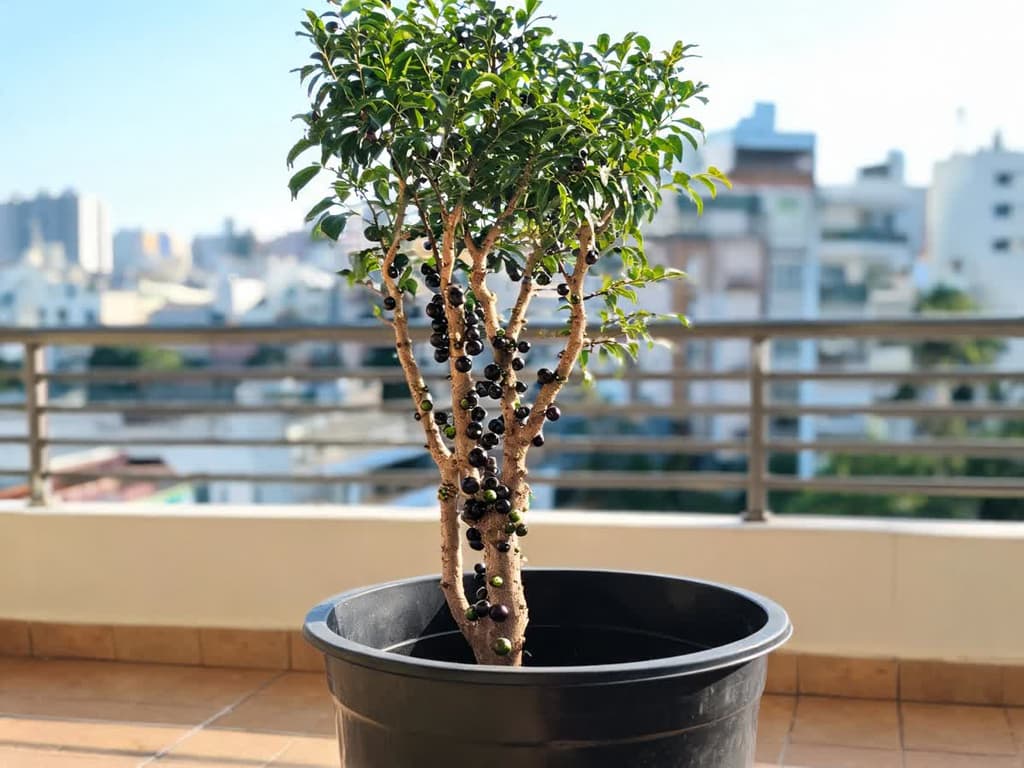
To care for a jaboticaba, keep the soil consistently moist without letting water pool. Give the plant the sunniest spot in your home. Jaboticaba trees tolerate drought poorly, and full sun yields heavier crops, according to the University of Florida (UF/IFAS). In a container, it lives well for many years as long as you step up the pot size gradually and fertilize. The wait for fruit depends on how the sapling was started. A seed-grown tree takes 8 to 15 years. A grafted tree or air layer, made from a branch of an already fruiting tree, bears fruit within a few years.
The most common question growers ask is why their jaboticaba tree is not bearing fruit. The first factor to check is the age and source of the sapling, even before adjusting fertilizer. Three problems appear further down: dropping fruit and leaves, a white flour-like coating on the fruit, and safety concerns around dogs.
The numbers come from Brazilian research and university extension services, which advise plant growers. The primary sources are Embrapa, the Federal University of Technology – Paraná (UTFPR), Revista Brasileira de Fruticultura, and UF/IFAS. The jaboticaba plant profile highlights the plant and its most common issues.
Quick summary:
Sun: as much as possible. The plant tolerates partial shade, but full sun produces heavier crops.
Watering: consistently moist soil with good drainage. The water-absorbing roots sit in the top few inches of soil, and containers dry out quickly.
Pot: the jaboticaba tolerates cramped roots. Move it up to an only slightly larger pot with drainage holes at each repotting.
Soil: slightly acidic, with a pH of 5 to 6 (pH measures soil acidity; 7 is neutral), according to UF/IFAS.
Fertilizer: low nitrogen. Excess nitrogen burns the plant and attracts pests.
Pruning: young plants do not need it. On mature trees, remove only crossing branches and those casting shade onto the trunk.
Time to fruit: 8 to 15 years for a seed-grown plant. A few years for a grafted or air-layered sapling.
Pets: the ASPCA toxic plant list does not include the jaboticaba, either as toxic or as non-toxic.
How to identify the jaboticaba
The jaboticaba (Plinia cauliflora, formerly Myrciaria cauliflora) is a tree in the myrtle family, the same family as the guava. It is native to Brazil and grows slowly. An Embrapa study mapping its climate adaptation identifies the Atlantic Forest, primarily in the Southeast and South of Brazil, as its most favorable climate.
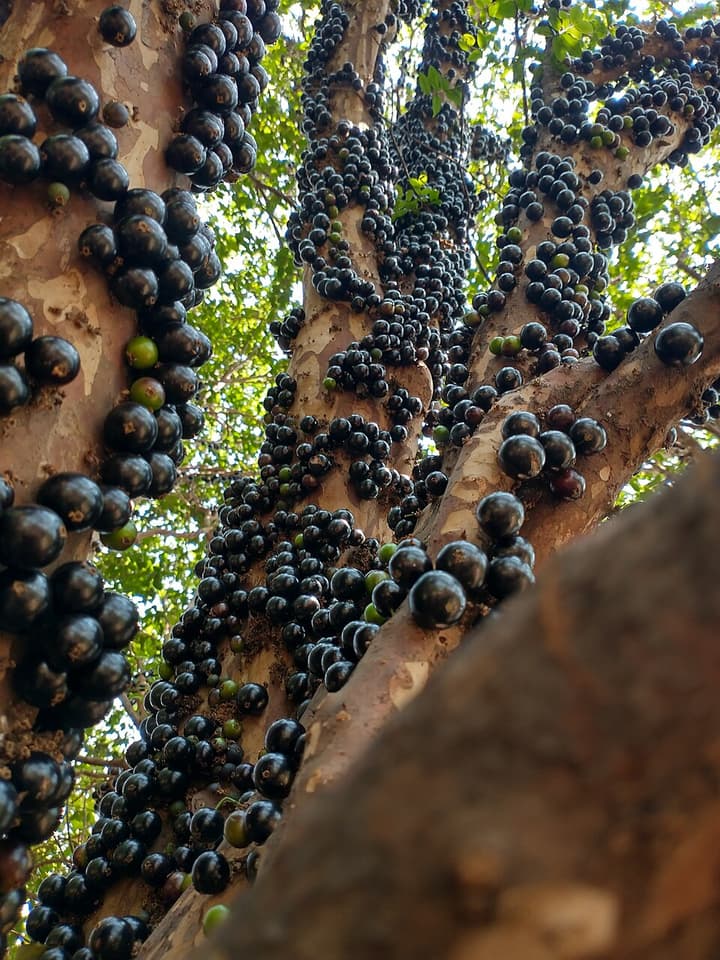
Its defining feature is cauliflory: flowers and fruit emerge directly on the trunk and thick branches, rather than at the tips of the shoots. If the tree in your yard has purple, nearly black globes pressed against the bark without visible stems, it is almost certainly a jaboticaba. Other jaboticaba species exist, such as the sabará (Plinia jaboticaba), which fruit in the exact same way.
Do not pull up your tree out of concern for your dog. The jaboticaba does not appear in the ASPCA toxic plant database, the standard toxicity reference for dogs and cats. Its absence does not prove the plant is completely safe, because the database does not cover every species. If your dog eats fruit or seeds and vomits or becomes lethargic, bring the dog to a veterinarian along with a fruit from the tree.
Why the jaboticaba is not bearing fruit
The first cause to verify is the age of the plant. A seed-grown jaboticaba takes 8 to 15 years after planting to produce fruit. This data comes from a UTFPR study published in Ciência Rural in 2012. Before that point, it will not fruit no matter how well you care for it. The table outlines the likely causes of missing fruit and what to do for each. Only the age of the sapling has direct experimental measurements. The other causes have partial backing in the sources.
Condition | How to recognize | What to do |
|---|---|---|
Young seed-grown plant | You planted a seed or do not know the source, and the tree is under 8 years old | Wait. To get fruit sooner, purchase a grafted or air-layered sapling |
Plant genetically distinct from parent | Seed-grown sapling that grows vigorously but will not bloom, or sets little fruit | Seeds usually produce a plant genetically distinct from the parent tree (UF/IFAS). Only grafted or air-layered saplings duplicate the parent plant |
Insufficient sun reaching the trunk | Dense canopy, crossing branches shading the trunk | Provide more sun and perform light pruning on branches blocking light from the trunk |
Lack of water during flowering and fruiting | Soil drying out for days at a time, brown leaf tips | Keep the soil moist continuously |
Excess nitrogen fertilizer | Flush of new leaves, pests appearing, burned leaf margins | Stop nitrogen fertilizer and switch to organic fertilizer |
Severe cold or frost | Fruit taking longer to ripen, frost-burned leaves | On frosty nights, move containers under cover or protect the plant with fabric. In Paraná, during a colder and wetter year, the fruit took 8 extra days to ripen |
In measured trials, watering did not trigger flowering in the jaboticaba. In a study on a related species, daily watering increased crop yield. In a UTFPR container trial with Plinia cauliflora, daily watering failed to induce blooming. UFRGS studied another jaboticaba species, Plinia peruviana. There, watering schedules did not shift the flowering season, but daily watering increased fruit yield. UF/IFAS notes that cold, non-freezing, and dry periods enhance flowering. That data comes from publications from 1994 and 2006, not from irrigation trials. Letting the plant dry out to force flowering is not supported by irrigation measurements. This guide therefore instructs you to keep the soil moist.
A tight pot does not prevent fruiting. The jaboticaba tolerates root confinement in a container, and this can even hasten blooming in some varieties, according to UF/IFAS. The requirement is repotting the plant into a larger container over time and applying fertilizer.
Home tricks to force blooming lack verified results. UFFS tested girdling (cutting a ring around the bark of a branch) on sabará jaboticaba trees aged 4 to 12 years that had not yet fruited. The cut did not accelerate fruiting. The only method that worked in research trials was a chemical growth regulator, paclobutrazol, tested in containers by UTFPR. It is not a home garden product.
How much sun a jaboticaba tree needs
The jaboticaba produces heavier crops in full sun than in partial shade, according to UF/IFAS. UF/IFAS notes that while it prefers partial shade, it tolerates full sun, where it yields larger crops. Sources diverge on shading: the same UF/IFAS source cites good performance under 30% to 60% shade cloth in Florida greenhouses. At UTFPR, young hybrid jaboticabas grew at the same rate from full sun up to 80% shade, though that study measured vegetative growth, not fruit yield. This guide follows the recommendation of higher yields in full sun, as it is the only one measuring fruiting. For fruit production, provide the most sunlight your location offers.
On a balcony, choose the spot that receives direct sun for the longest hours. Young plants handle partial shade well as they grow. On mature trees, sunlight must also reach the trunk, where the blooms emerge.
How to water a jaboticaba tree
Water whenever the surface of the soil begins to dry, pouring until water runs out the container's drainage hole. The jaboticaba performs best in consistently moist soil and suffers during dry spells, according to UF/IFAS. In containers, regular watering is critical because the fine, water-absorbing roots occupy the top few inches of the soil.
You can water a jaboticaba every day, provided the pot has drainage holes and water never sits in the saucer. In hot weather, a container on a balcony may require daily watering. In cold weather and on rainy days, the soil dries more slowly: feel the surface with your finger and water only once it feels dry. Young plants demand more frequent watering than mature trees.
Older trees tolerate more water: UF/IFAS records mature trees surviving up to a month of flooded conditions, provided the ground dried out afterward. Drought works differently: lack of water causes leaves to turn brown from the tips inward and eventually drop.
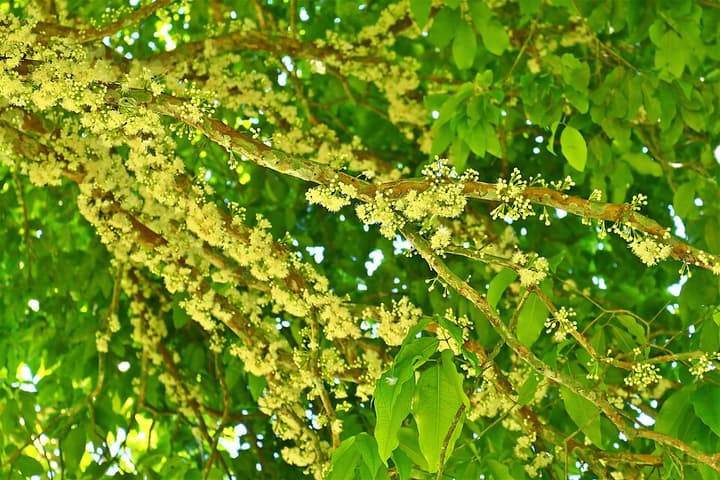
No study has measured the exact stage when water stress harms the jaboticaba most. The safest course is to monitor watering most closely during flowering and while the fruit is still green. In an orchard in southwestern Paraná, Brazil, blooming lasted 7 to 10 days. From full bloom to ripe fruit took 35 to 50 days. Keep the soil moist throughout this entire window.
Potted jaboticaba: container and soil care
The jaboticaba lives for many years in a container thanks to its slow growth rate, according to UF/IFAS. No institutional source specifies the ideal pot size for a mature tree. UF/IFAS advises moving the plant into larger containers over the years, without naming exact dimensions for each step. Since no trial has measured this, the safest method is stepping up one pot size at a time, always using containers with bottom drainage holes.
Use a fertile potting mix that retains moisture while allowing excess water to drain freely. UF/IFAS recommends slightly acidic soil, with a pH of 5 to 6. Two Brazilian gardening guides call for a pH of 6.5 to 7.0, without citing research. A UTFPR study on 3-year-old açu jaboticabas tested pH levels of 5.5, 6.5, and 7.5. The pH differences did not change plant growth. For this reason, do not apply agricultural lime (the powder used to raise soil pH) without a formal soil test from an agricultural laboratory.
The fig tree also tolerates root restriction in a container, and the fig tree care guide shows how to repot it step by step.
Fertilizer for jaboticaba trees
Fertilize lightly, preferably with organic fertilizer, and avoid high-nitrogen fertilizers (the first number in the NPK ratio on the package). Excess nitrogen burns jaboticaba leaves, which tolerate phosphorus and potassium better, according to UF/IFAS. The same source prefers organic fertilizer, which prevents salt buildup in the soil. In Brazil, the Revista Brasileira de Fruticultura itself acknowledges that there is no tested fertilization recommendation for establishing jaboticaba trees.
The lack of official recommendations explains why recipes vary anywhere from monthly to twice a year.
Jaboticaba saplings: how long until they fruit
The origin of the sapling determines the waiting time. A seed-grown tree takes 8 to 15 years to fruit (UF/IFAS mentions 8 to 10 years in Florida). A grafted or air-layered sapling can fruit in just a few years, according to UF/IFAS. When shopping, ask whether the sapling is grafted or produced by air layering.
A literature review published in Revista Brasileira de Fruticultura in 2019 compares propagation methods. Air layering (inducing roots on a branch still attached to the tree) roots successfully over 80% of the time. Grafting succeeds in over 70% of cases. Softwood stem cuttings (a section of new green growth placed into soil to root) root only around 10% of the time.
You can plant the seed, but sow it the same day you take it out of the fruit. Outside vacuum packaging, the seed loses its ability to germinate in about 5 days, according to UTFPR. The plant that grows from it is usually different from the mother tree.
Avocado trees grown from seed share this same long wait, and the avocado care guide compares seed-grown saplings with grafted ones.
Pruning a jaboticaba tree
Young jaboticaba trees do not require pruning and naturally develop a dense, branched canopy on their own, according to UF/IFAS. On mature trees, prune out crossing branches and those casting shade onto the trunk and interior canopy: this improves flowering and fruit set. Avoid cutting thick, old limbs, because that is where the fruit forms.
No Brazilian research institution specifies an ideal month for pruning. Gardening guides disagree, recommending either winter, before blooming, or immediately after harvest. The safest practice is light pruning performed outside the blooming period when no fruit is present on the trunk.
Why jaboticaba leaves and fruit drop
If the bark of an established tree remains healthy, its chances of recovery are high. UF/IFAS notes this pattern in trees recovering from drought. Before treating the plant, examine what is dropping and its current condition.
Leaves browning from the tips and dropping: lack of water. UF/IFAS describes this symptom following short dry spells. Return to keeping the soil evenly moist.
Foliage scorched after feeding: excess nitrogen. Stop fertilizing and flush the pot slowly until water drains out the bottom to leach excess fertilizer salts from the root zone.
Leaves, buds, and young fruit dropping with yellow spots: rust disease, covered in the diseases section.
Leaves dropping alongside white cottony masses on branches: mealybugs. One species, the citrus mealybug, carries a toxin in its saliva that causes the plant to shed leaves and buds, according to NC State.
Green fruit dropping on a young tree: young trees cannot sustain many fruits, which improves as the tree matures. No treatment is needed. At UFFS, older jaboticaba trees carried a higher percentage of fruit all the way through ripening.
The jaboticaba dropping leaves page details the specific symptoms associated with foliage loss.
Pests and diseases of the jaboticaba
Jaboticaba trees encounter few pests. UF/IFAS states that aphids, scales, mealybugs, and whiteflies are uncommon unless the tree is stressed or over-fertilized with nitrogen. Among diseases, Embrapa lists the jaboticaba as susceptible to rust.
Mealybugs: the white "flour" on fruits
Mealybugs are soft-bodied, oval insects measuring up to 3 mm, coated in a white powdery wax resembling cotton, according to NC State. To confirm their presence, rub the white residue with a cotton swab: if a soft insect appears underneath, it is a mealybug. The insect extracts sap and secretes a sugary, sticky honeydew where a black fungus, sooty mold, develops.
Fruit that has already dried up cannot recover, but treating the tree now protects the next bloom. For light infestations, NC State recommends removing the insects with a cotton swab dipped in rubbing alcohol. The waxy coating shields their eggs, so any contact insecticide must be applied at least twice. Check the tree weekly over the following weeks to capture any surviving insects.
Do not use household dish soap. Colorado State University Extension explains that insecticidal soaps manufactured for plants differ from liquid dish detergents. Dish detergent can burn foliage and damage the soil. Home remedies, including tobacco sprays, lack proven experimental testing. Before spraying the entire tree, test your insecticidal soap on a single branch and observe it for 1 to 2 days.
If the white residue is a dry powder that wipes off onto your finger without any insect underneath, mealybugs are not the culprit. None of the sources referenced in this guide describe powdery mildew or white powder fungi on jaboticaba. Rust also sheds spores as powder, but that dust is yellow and appears on new shoots and young leaves.
Jaboticaba rust
Rust is caused by the fungus Austropuccinia psidii, which infects jaboticaba, guava, and other members of the myrtle family, according to Embrapa Amazônia Ocidental. In the literature, the fungus attacks tender new growth: shoots, young leaves, flower buds, and immature fruit. On araza (araçá-boi), another myrtle species, Embrapa describes bud, leaf, and young fruit drop alongside branch tip dieback. For jaboticaba, the source simply lists it as susceptible.
On eucalyptus, Embrapa Florestas describes the earliest symptoms as small light-green or yellowish-red flecks that develop into yellow powdery pustules. In that same description, infection spikes between 18 °C and 25 °C when foliage stays wet for prolonged periods. On jaboticaba, UF/IFAS notes lesions following heavy rain or extended damp periods; spotted fruit remains safe to eat.
To protect future crops, Embrapa Florestas notes copper fungicides and Bordeaux mixture for jaboticaba. Bordeaux mixture consists of copper sulfate and lime. Verify local product registration and follow label rates prior to application. Water the soil rather than the foliage, and thin inner branches so wet leaves dry quickly.
When a spot does not match any description, a clear photo helps separate mealybugs, rust, and burn damage. Bloom (available for iOS) identifies plants from photos, and its Premium tier provides diagnostic troubleshooting.
Frequently asked questions
How many years does a jaboticaba tree take to bear fruit?
A seed-grown plant requires 8 to 15 years to produce, according to a UTFPR study in Ciência Rural. A grafted or air-layered sapling can fruit within a few years, according to UF/IFAS. If you do not know the background of your sapling and it is under 8 years old, the lack of fruit may simply be its age.
Do potted jaboticaba trees grow very large?
It grows slowly. UF/IFAS says it lives in a container for many years for this reason. Growing wild in Brazil and without pruning, it can reach about 15 meters. In Florida, trees planted in the ground generally stay between 3 and 4.5 meters. In a container, the size depends on the pot and pruning.
What kills a jaboticaba tree?
Extended drought and freezing temperatures are the two primary threats UF/IFAS identifies for this tree. UF/IFAS notes that jaboticaba trees tolerate drought poorly and sustain damage from prolonged temperatures below −2 °C. Cold tolerance varies among species and cultivars.
What time of year does the jaboticaba bear fruit in Brazil?
It depends on the region and on that year's weather. One orchard in southwestern Paraná, Brazil, had two harvests in a row: one in September and October, and another in March and April. In the Planalto Médio region of Rio Grande do Sul, the main crop and the late crop together gave about 75 days of harvest.
How to care for a jaboticaba: the essentials
The jaboticaba tree requires consistently moist, well-draining soil, maximum sun, and low nitrogen. It lives well in a container if you step up the pot size gradually. If it fails to fruit, first check the age and origin of the sapling. A seed-grown tree takes 8 to 15 years, and a grafted or air-layered tree produces within a few years. During flowering and when bearing green fruit, do not let the soil dry out. Against mealybugs, use a cotton swab with alcohol and repeat. Against rust, use a registered copper-based product.
The next step is confirming how your sapling was propagated and shifting its position so direct sun hits the trunk.
Sources
Jaboticaba: A Unique Fruit Tree for Florida Home Gardeners (HS1519), UF/IFAS Extension (2026)
Anelamento de ramos e conservação pós-colheita de frutos em jabuticabeira, Tedesco, UFFS
Ferrugem do araçá-boi, Comunicado Técnico 180, Embrapa Amazônia Ocidental (2025)
A ferrugem do eucalipto na região Sul do Brasil, Comunicado Técnico 252, Embrapa Florestas (2010)
Insect Control: Soaps and Detergents, Colorado State University Extension
Related articles
How to Care for Hibiscus: Sun, Watering, Fertilizer, and Pruning for Flowers
How to care for hibiscus: 6 hours of direct sun, evenly moist soil without waterlogging, half-strength fertilizer in spring and summer, and pruning in early spring. Find out why the flower lasts one day and why buds drop before opening.
Do Ferns Like Sun or Shade? It Depends on the Type
Ferns prefer bright shade: plenty of light, but no direct sun on their fronds. Tuberous sword fern is the exception that handles sun. Here is the ideal light for each type, where to place pots, and how fronds show too much or too little light.
African Violet Yellow Leaves: Causes and What to Do
Yellow leaves on an African violet usually stem from overwatering, and the first place to check is the center of the plant. Losing one lower leaf at a time is normal. Identify whether age, watering, cold water, sunlight, cold drafts, or fertilizer is the culprit based on the yellowing pattern, and see what to do today.